
NEWS
The M5 Ultra Nears an RTX 5080 Without the 360-Watt Card
M5 Ultra OpenCL scores sit behind an RTX 5080, from a Mac Studio that maxes at 385 W and can hold 512GB.

Geekbench 7 OpenCL listings put Apple’s new M5 Ultra around 210,000 to 226,000, short of Nvidia’s RTX 5080 at 250,711. Metal scores on the same Mac Studio sit around 350,000 to 366,744, a test Nvidia cards do not run.
Apple opened preorders on August 25 and set availability for September 22. Those OpenCL figures describe a complete Mac Studio, not a 360 W add-in card sitting in someone else’s tower.
Metal Scores Are Landing Near 360,000
The identifier in the database is Mac17,15, the 2026 Mac Studio with M5 Ultra. Public Mac17,15 Geekbench GPU listings cluster in the mid-350,000s on Metal, with a high of 366,744.
An 80-core M3 Ultra result in the same Metal test is 249,564. Apple never shipped an M4 Ultra in this chassis, so that 80-core M3 chip is the last Studio peak on the same API. Metal is Apple’s graphics and compute stack, which is why the jump looks huge inside the Mac family and why it cannot be dropped onto an RTX 5080 row.
GEEKBENCH 7 GPU LISTINGS
| Chip | OpenCL | Metal |
|---|---|---|
| M5 Ultra (public listings) | 210,000 to 226,000 | 350,000 to 366,744 |
| M3 Ultra, 80 GPU cores | 140,821 | 249,564 |
| Nvidia RTX 5080 | 250,711 | not listed |
Geekbench 7 GPU scores are calibrated against a baseline of 100,000, set as an RTX 4060. Double the score is meant to mean double the performance inside that suite, not across games or CUDA apps.
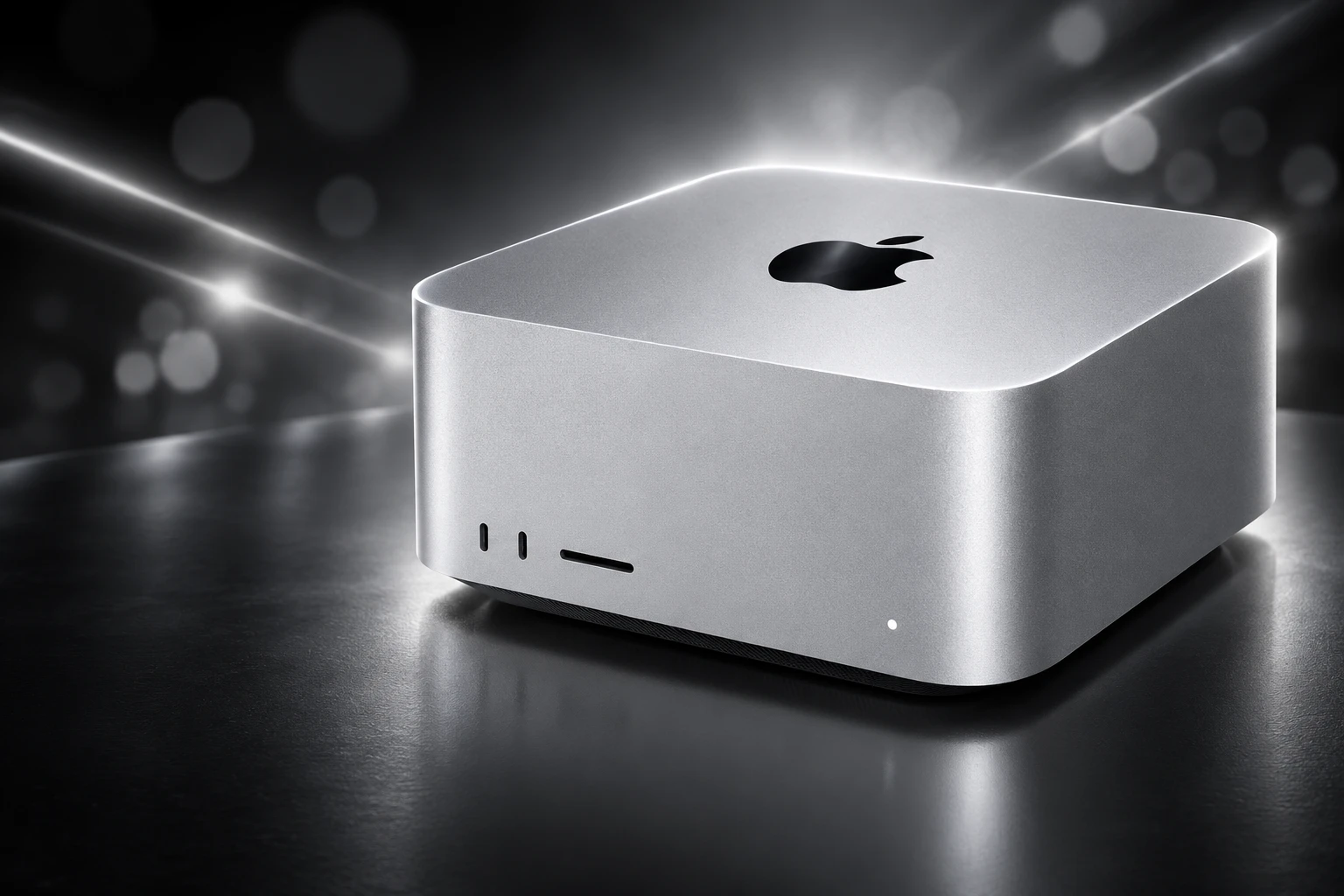
How Far OpenCL Sits Behind the 5080
OpenCL is the Geekbench 7 GPU test both products share, and the M5 Ultra’s listings sit around 210,000 to 226,000 against 250,711 for the RTX 5080. An 80-core M3 Ultra result on that test is 140,821. The Ultra has closed a lot of ground on its predecessor and still trails the Nvidia card.
The same OpenCL band also sits next to RTX 4080-class results around 219,000. That is why some writeups reach for a 5080 and others for a 4080. The foil changes the headline more than the Mac’s number does.
Geekbench 7 added CUDA as a GPU API alongside OpenCL, Vulkan, and Metal. Nvidia cards score higher on CUDA than on OpenCL in that suite, so an OpenCL-only cross-check is the legal comparison and the one that flatters Apple. It is also the one that leaves the 5080’s own stack off the page.
The Whole Box Draws 385 Watts at the Wall
Apple’s power sheet for a 36-core, 80-core M5 Ultra with 512GB of memory and a 16TB SSD lists a max of 385 W from the wall, measured at the outlet, including supply losses. Idle with Finder open is 9 W. The last 80-core Studio, the M3 Ultra in the same class of config, maxed at 270 W, so the new peak is 115 W higher.
POWER AT THE OUTLET
- M5 Ultra max: 385 W from the wall on Apple’s 36-core, 80-core, 512GB, 16TB test unit.
- M3 Ultra max: 270 W in the matching 80-core class on the same Apple sheet.
- M5 Ultra idle: 9 W with Finder open and default power settings.
- RTX 5080 TGP: 360 W for the card alone, not a whole PC.
The RTX 5080’s rated board power is 360 W, with 16 GB of GDDR7, 960 GB/s of memory bandwidth, and 10,752 CUDA cores. Launch price was $999. Spec sheets do not give you the rest of the tower: CPU, memory, storage, and PSU overhead sit on top of that 360 W.
The Mac Studio’s own electrical limit is 480 W of maximum continuous power, in a 7.7 by 7.7 by 3.7 inch chassis that weighs 8.0 pounds in the Ultra config. Lining that box up with a 5080 is a whole-computer number against a board number. The OpenCL gap is still there. The wattage story is not the one a 600 W scare figure would imply.
Apple’s support page that carries the 385 W from the wall figure was dated September 21, the same day the first review benches landed.
A Review Unit Came In Lower on Metal
Public listings and a plugged-in review unit are not the same measurement. One lab ran Geekbench 7 on a 36-core, 80-core machine with 256GB of unified memory and 4TB of storage, a config priced at $12,299, and posted Metal at 246,680 and OpenCL at 159,918. Its M3 Ultra control in the same lab sat at 208,163 Metal and 121,553 OpenCL.
WHAT WE KNOW
- Public Metal cluster: Mac17,15 listings sit around 350,000 to 366,744 on Geekbench 7 Metal.
- Public OpenCL cluster: the same machines sit around 210,000 to 226,000, behind 250,711 for the RTX 5080.
- Sale date: Apple set availability for September 22 after the August 25 announce.
WHAT IS UNCONFIRMED
- The lab gap: why that $12,299 review unit scored 246,680 Metal against the public mid-350,000s has not been explained.
- A settled average: Geekbench 7 still has a thin sample, and later uploads can move the cluster.
The same review unit was kinder to Apple in Cinebench 2026’s GPU test, at 133,119 against 81,731 for the M3 Ultra, a 63 percent lift. That is closer to Apple’s own “up to 1.8x faster graphics” line than the lab’s Geekbench 7 Metal run, and still not a 5080 substitute. Early hands-on notes also flag that finding the Ultra’s limit takes longer than a launch-week bench pass.
512GB Is What a 16GB Card Cannot Hold
The base M5 Ultra in the Mac Studio starts at $5,499 with a 30-core CPU, a 64-core GPU, 96GB of unified memory, and 1TB of storage. The 36-core, 80-core chip, 256GB or 512GB of memory, and the bigger SSDs sit above that. M5 Max starts at $2,499 and tops out at 128GB.
Apple’s claim set is not a Geekbench sheet. It is a memory and matrix-math pitch. Neural Accelerators now sit in each GPU core on an Ultra for the first time, next to a 32-core Neural Engine. Bandwidth is 1.2 TB/s, which Apple calls 50 percent higher than the last Ultra.
APPLE’S M5 ULTRA CLAIMS
- Peak AI compute: up to 4.3x peak AI compute versus M3 Ultra, and 9.8x versus M1 Ultra.
- Graphics and CPU: up to 1.8x faster graphics and 1.3x higher multithreaded CPU speed versus M3 Ultra.
- Local models: up to 512GB of unified memory, so large open-weight models can sit on one machine.
- Media and I/O: up to 33 streams of 8K ProRes 422 at 30 fps, Thunderbolt 5 at 120 Gb/s, and a four-system cluster Apple rates at up to 3x faster AI inference than one box.
Johny Srouji, Apple’s chief hardware officer, put the bet on that memory and those GPU-side accelerators, not on beating a 5080 at rasterization.
By integrating Neural Accelerators directly into the GPU and offering massive amounts of high-bandwidth unified memory, the new Mac Studio is our most powerful Mac ever.
Johny Srouji, chief hardware officer, Apple newsroom
A 16GB card cannot load a 156GB-class local model in one gulp. That is the job people are actually buying the 256GB and 512GB Studios to do, including agent loops that stay on the desk instead of on an API bill. The 5080 still has the higher OpenCL listing. It does not have 512GB of unified memory at 1.2 TB/s.
The Work That Still Needs CUDA
Training and the fat multi-GPU jobs still live where NVLink and CUDA live. Thunderbolt 5 can cluster Mac Studios and share memory, and Apple quotes a 3x inference lift for four machines, but that fabric is not a 900 GB/s GPU-to-GPU link. Repliers who run local models keep pointing at that gap, and they are right to. A stack of quiet cubes is a different machine from an eight-card server.
Dense models on lesser M5 silicon already show the other edge: token rates that look fine in a slide can fall into the unusable teens once the model is not sparse and the context window grows. The Ultra’s 80-core GPU and 1.2 TB/s bus are meant to push that ceiling up. They do not make every MLX or llama.cpp build as fast as a tuned CUDA graph on a 5080.
So the OpenCL neighborhood around 210,000 to 226,000 is real, and so is the 250,711 still sitting in front of it. The Mac that posts those numbers is a 7.7-inch box whose max wall draw is 385 W and whose memory can be specified to 512GB. The RTX 5080 remains the faster card on the only test both run, at 360 W TGP, with 16 GB on the board and CUDA behind it.

Edinburgh Opens a 2027 Tour Built for Time Trials

Korda Maps Auður From Meðalland to Irvine Bay

Apple Music Films Its New Logo in Mineral Oil

Oppo Prices the Pad Mini Above India’s iPad Mini

Austen Soaks Scotland Before Boelo Brings Weekend Gales

Volkswagen Sells the Osnabruck Plant to Clear a Board Fight

Apple’s Foldable iPhone Hinges on Samsung Display Supply

Saksham Gaur Finds He Is His Own Company’s Client

Tata Motors’ Iveco Tender Opens as Holders Still Decide

Onimusha Way of the Sword Preload Hits a Windows 11 Wall
-
 AUTO2 months ago
Volkswagen Sells the Osnabruck Plant to Clear a Board Fight
-
 NEWS2 months ago
Apple’s Foldable iPhone Hinges on Samsung Display Supply
-
 AUTO2 months ago
Tata Motors’ Iveco Tender Opens as Holders Still Decide
-
 BUSINESS2 months ago
Saksham Gaur Finds He Is His Own Company’s Client
-
 GAMING2 months ago
Onimusha Way of the Sword Preload Hits a Windows 11 Wall
-

 ENTERTAINMENT3 years ago
What is SD on Amazon Prime? – All You Need to Know
-

 BUSINESS2 months ago
Hyderabad 22-Carat Gold Jumps After a False Bargain
-

 NEWS2 months ago
iQOO 16 Locks 8,400 mAh While 100W Charging Holds