
NEWS
A Janus Catalyst Turns Seawater Into Peroxide and Chlorine
A Janus seawater catalyst makes peroxide and chlorine together, turning the chloride that usually poisons cells into a second product for coastal plants.

A two-faced catalyst made from copper and cobalt frameworks turned Bohai seawater into hydrogen peroxide and active chlorine in one laboratory cell. Tong Bao and colleagues at East China Normal University, working with the University of Queensland, Fuzhou University, and Shanghai University, report the run in eScience, in the issue dated 1 September 2026.
Coastal power stations already pump seawater through electrolytic cells to make hypochlorite for cooling pipes, and they throw away the hydrogen that forms on the other electrode. This cell keeps the chlorine product and tries to collect peroxide there instead.
The Unused Side of a Seawater Cell
Seawater holds about 97 percent of the planet’s water, yet most chemical plants still drink freshwater. Peroxide is bleached into paper and used as a disinfectant. Active chlorine, mostly hypochlorous acid in this work, is the workhorse of water treatment. Both are usually made far from the shore and then shipped.
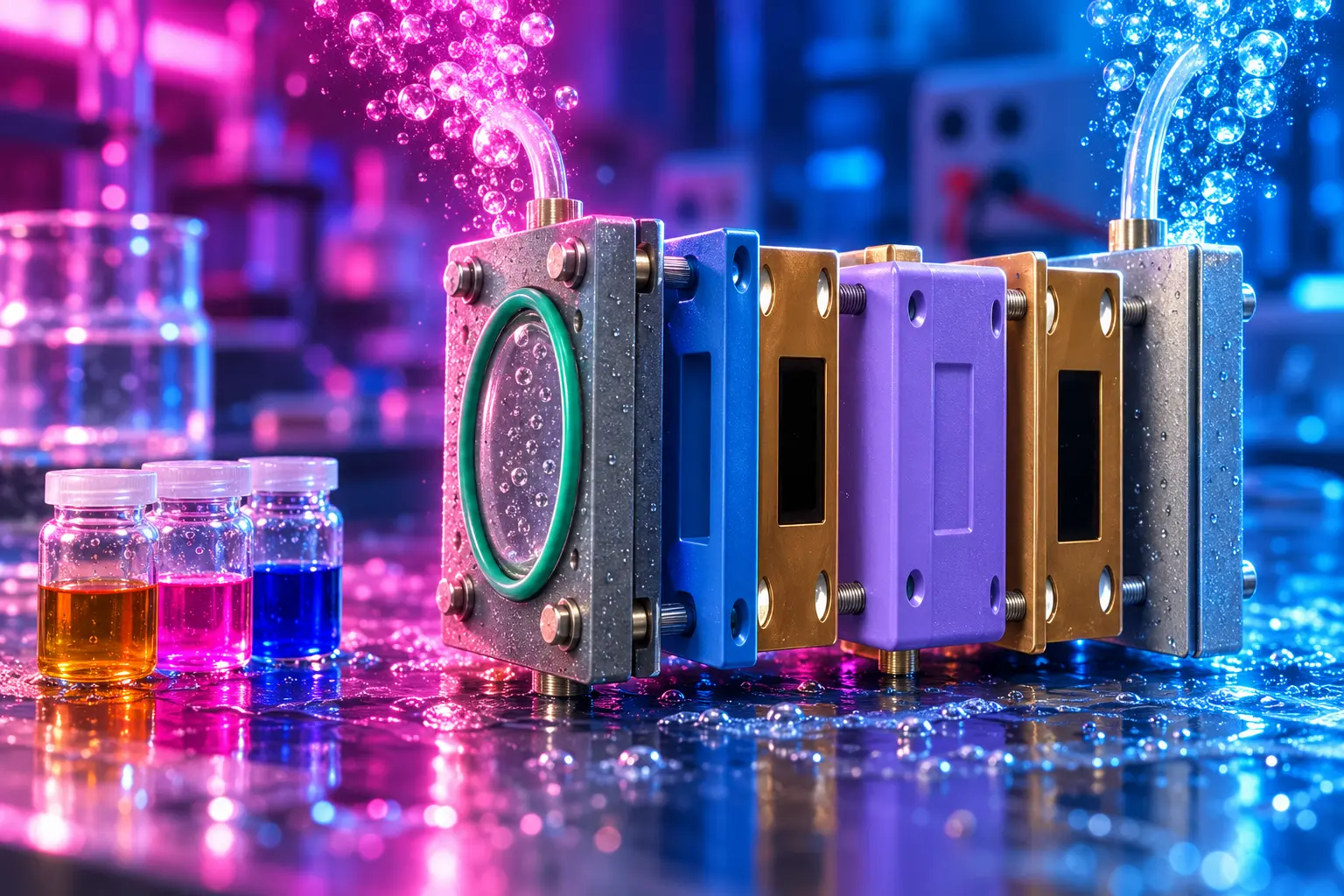
Bao’s group built a Janus conductive framework seawater electrolyzer that uses air oxygen and the chloride already dissolved in seawater. The cathode does the two-electron oxygen reduction that yields hydrogen peroxide. The anode does the chlorine evolution reaction. Most oxygen-reduction cells pair that cathode with oxygen evolution, which dumps low-value O2. Pairing it with chlorine evolution is the move that gives two saleable liquids from one feed.
Chengzhong Yu, at the University of Queensland’s Australian Institute for Bioengineering and Nanotechnology, and Chao Liu, at East China Normal University, are among the corresponding authors, with Pei Yuan at Fuzhou University and Xiao He at East China Normal University. The paper was received on 9 January 2026, accepted on 6 April 2026, and posted online on 11 April 2026.
Public recaps of seawater electrolysis still reach for hydrogen as the headline product. The liquids in this cell are peroxide and active chlorine. That is a different factory, even if the electrolyte looks the same.
Why Most Seawater Electrolyzers Treat Chloride as a Poison
Direct seawater electrolysis has a well-known fight on the anode. Chloride can oxidize to chlorine or hypochlorite at voltages close to those for oxygen. The same ions corrode metal electrodes. Reviews of hydrogen-from-seawater work spend their pages on coatings, alkaline buffers, and membranes meant to keep chloride off the catalyst.
The cathode has the opposite problem when the target is peroxide. Chloride sticks to active sites, blocks oxygen, and cuts the two-electron path. The paper puts the bind in one sentence: the cathode needs chloride pushed away, and the anode needs chloride pulled in.
Janus structures, named for the two-faced Roman god, put those two surface chemistries on one particle. The group had already used MOF-on-MOF stacks, with a built-in electric field at the join, for nitrate reduction to ammonia. Here the same architecture is aimed at seawater’s chloride split personality.
A Copper Core Pulls Chloride and a Cobalt Shell Pushes It Away
The particle is a core-satellite stack. Positively charged Cu-HITP nanorods form the core. Negatively charged Co-HHTP nanoparticles grow on the outside. HITP is 2,3,6,7,10,11-hexaiminotriphenylene. HHTP is 2,3,6,7,10,11-hexahydroxytriphenylene. Both are conductive metal-organic frameworks with related planar nets, so they can share an interface without a dead insulating gap.
At that interface the team finds Cu-O-Co bonds. Cobalt sites bind oxygen for the peroxide reaction. Copper sites bind chloride for chlorine evolution. Different Fermi levels push electrons from Cu-HITP toward Co-HHTP, which the authors read as a built-in field that helps charge move across the join.
HOW THE TWO FACES SPLIT THE WORK
- Cobalt shell: The Co-HHTP surface is negatively charged, so it repels chloride at the cathode and leaves oxygen-reduction sites open.
- Copper core: The Cu-HITP surface is positively charged, so it concentrates chloride at the anode and feeds chlorine evolution.
- The join: Cu-O-Co bonds and the Fermi-level offset create separate cobalt and copper sites instead of a blended average surface.
Cu-HITP nanorods were grown first, then Co-HHTP was formed on them in 1-propanol with cobalt acetate. The same recipe without the copper rods gave plain Co-HHTP, which the team ran as a control beside plain Cu-HITP.
38 mV Versus a Commercial Chlorine Anode
In simulated seawater the Janus powder was selective for peroxide and needed less extra voltage for chlorine than a commercial dimensionally stable anode, the RuO2-TiO2 coating that has defined chlor-alkali cells since the 1960s. Parent materials without the second framework lagged on both tests.
HALF-CELL COMPARISON
| Material | Extra voltage at 10 mA per sq cm | Peroxide rate at 100 mA per sq cm |
|---|---|---|
| Cu-HITP@Co-HHTP | 38 mV | 7.52 mol per g catalyst per hour |
| Commercial DSA | 115 mV | Not reported in this test |
| Cu-HITP only | 164 mV | 1.63 mol per g catalyst per hour |
| Co-HHTP only | 206 mV | 3.35 mol per g catalyst per hour |
Peroxide selectivity on the Janus material in that simulated electrolyte was 99.1%. The Tafel slope for oxygen reduction was 71.0 mV per decade, against 80.2 for Co-HHTP and 109.2 for Cu-HITP. On the chlorine half-cell, the same Janus powder made 0.98 mol of Cl2 per gram per hour at 10 mA per sq cm, with 99.8 percent of the current going to that product. Over 100 hours the chlorine-side current fell by less than 5.35 percent.
Those figures are half-cells. The integrated device used real seawater from the Bohai Sea and made both liquids at once.
BOHAI CELL OUTPUT
| Product | Rate | Share of current |
|---|---|---|
| Hydrogen peroxide | 9.34 mol per g catalyst per hour | 95.1 percent |
| Active chlorine | 9.26 mol per g catalyst per hour | 94.3 percent |
The matched rates are the point of the pairing: almost a mole of peroxide for a mole of active chlorine, from the same seawater pass. The integrated cell held for over 100 hours with little fade. That is a laboratory clock, not a plant outage schedule, and it is a different measurement from the 5.35 percent drop on the chlorine half-cell.
Coastal Plants Already Make Hypochlorite From the Sea
The chlorine half of this idea is not a laboratory orphan. Power stations, desalination intakes, and offshore platforms already generate sodium hypochlorite by putting seawater through electrolytic cells, then dose the product back into cooling circuits to kill slime and shellfish. De Nora’s SEACLOR and SANILEC lines describe on-site sodium hypochlorite from seawater as a way to skip chlorine-gas tankers and the hardness problems that come with trucked commercial hypo.
WHAT A WORKING SEAWATER CHLORINATOR ALREADY DOES
- Product strength: Typical output sits at 500 to 2500 ppm sodium hypochlorite, much thinner than drum hypo.
- Dose: Continuous feed is often 1 to 2 ppm, with shock doses of 4 to 6 ppm for 15 to 20 minutes, two to four times a day.
- Hydrogen: The other electrode makes hydrogen, which is diluted with air, often to under 1 percent by volume, then vented.
That hydrogen stream is the unused side. A cell that kept chlorine-class oxidant and made peroxide on the cathode would turn a waste gas into a second water-treatment chemical. It would also cut a second supply chain.
Brine-based on-site generators do not solve the freshwater problem. Xylem’s OSEC B-Pak makes 0.8 percent sodium hypochlorite from salt, and the spec still calls for brine hypochlorite units that need potable water, with hardness under 1 grain per gallon (17 mg/L) and about 15 gallons of water per pound of equivalent chlorine. A true seawater cathode that makes peroxide would skip that softened-water bill as well as the salt bill.
Where the World’s Peroxide Is Still Made
Hydrogen peroxide is still a bulk chemical from a handful of large plants. A 2024 study of carbon-neutral routes to the same molecule puts megatonne anthraquinone peroxide production at about 4.3 million tonnes a year. The anthraquinone autoxidation path, also called Riedl-Pfleiderer, still supplies more than 95% of that volume. Hydrogen for those plants is still largely made from methane.
PEROXIDE SUPPLY IN BRIEF
- Annual output: About 4.3 million tonnes a year of hydrogen peroxide.
- Dominant route: Anthraquinone autoxidation still accounts for more than 95 percent of supply.
- Hydrogen source: Steam-methane reforming still feeds that working solution in the conventional plants.
Electrochemical two-electron oxygen reduction has been the cleaner alternative on paper for years, because it can run on air, water, and current. In freshwater it already works in lab cells. In seawater the chloride poisoning is why those cells stay inland. A cathode that sheds chloride, paired with an anode that eats it, is how that chemistry could sit on a coast without a distilled-water plant behind it.
The products would not replace a 220,000-tonne anthraquinone works. They do not need to. Island water systems, coastal mills, and cooling intakes buy peroxide and chlorine in drums because that is what the logistics network sells. A box that makes both from the water next to the fence changes the purchase order, not the world total.
Five-Minute Dye Tests and a 100-Hour Run
The group took the liquids from the cell and poured them on dyes and on bacteria. Methyl orange, methyl red, and methylene blue lost their colour within five minutes in both the peroxide stream and the active-chlorine stream, which the paper identifies as mostly HClO. Against Escherichia coli, inhibition zones grew from 20.0 mm after five minutes of electrolysis to 44.9 mm after 60 minutes.
Those tests are beaker proofs, not plant trials. They do show that the two streams are strong oxidants as made, without a separate concentrator. For a coastal works that already doses hypochlorite into a pipe, that is the relevant form.
WHAT WE KNOW
- Dual products: The Bohai cell made peroxide and active chlorine together at 9.34 and 9.26 mol per gram of catalyst per hour.
- Current use: 95.1 percent of the current went to peroxide and 94.3 percent to active chlorine in that integrated run.
- Anode voltage: Chlorine evolution needed 38 mV of extra voltage at 10 mA per sq cm, against 115 mV on a commercial DSA in the half-cell comparison.
- Lab life: Both the integrated cell and the chlorine half-cell were run past 100 hours, with a measured current drop under 5.35 percent on the half-cell.
WHAT IS UNCONFIRMED
- Scale: Conductive MOF powders are not yet a drop-in for titanium anodes that last years in chlor-alkali halls.
- Ampere-level current: The published figures sit at 10 and 100 mA per sq cm, not the 1 A per sq cm band industrial seawater hydrogen papers now advertise.
- Product strength: The paper does not claim a drum-strength peroxide or a 12 percent hypo, only the oxidant liquids as generated.
- Fouling: Calcium and magnesium in real seawater still scale electrodes in other systems; this run does not map that risk over months.
The 100-hour Bohai cell is still a lab device sitting on a published catalyst. The chlorination skids on seawater intakes are already in the water, and they still vent hydrogen. The open engineering job is whether a copper-cobalt Janus powder, or something built on the same charge split, can take that unused electrode and pay it in peroxide.

Edinburgh Opens a 2027 Tour Built for Time Trials

Korda Maps Auður From Meðalland to Irvine Bay

Apple Music Films Its New Logo in Mineral Oil

Oppo Prices the Pad Mini Above India’s iPad Mini

Austen Soaks Scotland Before Boelo Brings Weekend Gales

Volkswagen Sells the Osnabruck Plant to Clear a Board Fight

Apple’s Foldable iPhone Hinges on Samsung Display Supply

Saksham Gaur Finds He Is His Own Company’s Client

Tata Motors’ Iveco Tender Opens as Holders Still Decide

Onimusha Way of the Sword Preload Hits a Windows 11 Wall
-
 AUTO2 months ago
Volkswagen Sells the Osnabruck Plant to Clear a Board Fight
-
 NEWS2 months ago
Apple’s Foldable iPhone Hinges on Samsung Display Supply
-
 AUTO2 months ago
Tata Motors’ Iveco Tender Opens as Holders Still Decide
-
 BUSINESS2 months ago
Saksham Gaur Finds He Is His Own Company’s Client
-
 GAMING2 months ago
Onimusha Way of the Sword Preload Hits a Windows 11 Wall
-

 ENTERTAINMENT3 years ago
What is SD on Amazon Prime? – All You Need to Know
-

 BUSINESS2 months ago
Hyderabad 22-Carat Gold Jumps After a False Bargain
-

 NEWS2 months ago
iQOO 16 Locks 8,400 mAh While 100W Charging Holds