
NEWS
iPhone Duo’s Six Million Forecast Rewrites a Foldable Market in Decline
Counterpoint’s 6 million iPhone Duo call would reverse a foldable slump as global phone shipments fall 16.7%, if Apple can actually build that many.

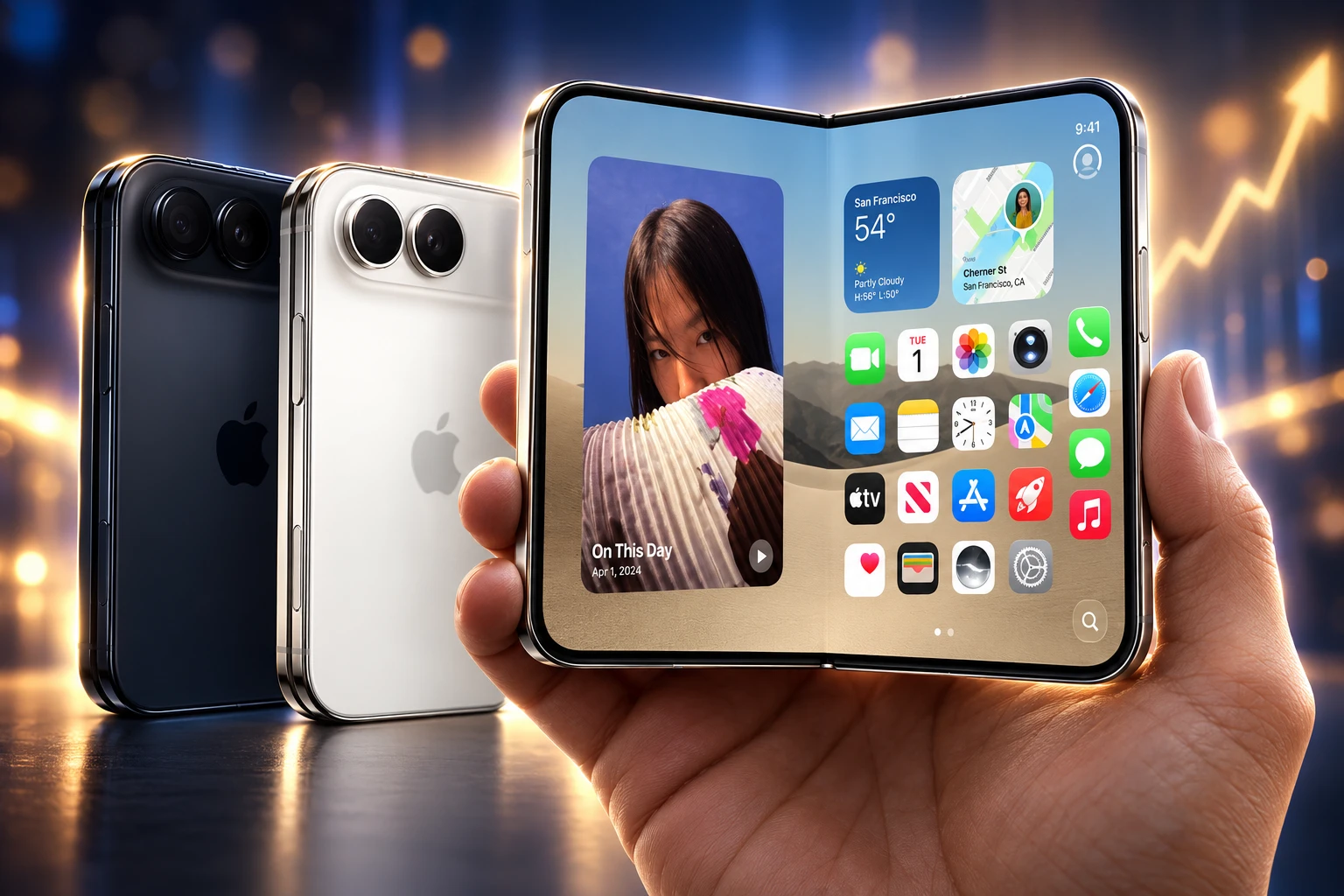
Counterpoint Research puts 2026 sales of the iPhone Duo at about 6 million units, the upper end if Apple can raise production of its first foldable phone. The $1,999 handset, unveiled on September 9, still has not gone on sale, with pre-orders due on October 16.
That volume is modest by iPhone standards. It is large enough, in IDC’s tracking, to stop a foldable decline in a year when worldwide smartphone shipments are headed for their steepest fall on record.
Six Million Is the Production Ceiling
Ivan Lam, a senior analyst at Counterpoint, said the number looks like a foldable run, not a standard iPhone run, and depends on how fast Apple can make the new hardware. Tarun Pathak, Counterpoint’s research director, described six million as the estimate at the upper end and tied it to the same factory question.
Apple priced the Duo at $1,999 in the United States for 256GB, about $100 above Samsung’s Galaxy Z Fold8. Pathak called that one of the most impressive parts of the launch.
Keeping the iPhone Duo just under the $2,000 mark looks like a pretty bold move, especially for a first-generation foldable. At this price, we think demand potential could be quite strong, particularly among existing iPhone Pro series users and early adopters who have been waiting for an Apple foldable.
Tarun Pathak, research director, Counterpoint Research
THE 2026 DUO FORECAST
- Sales call: About 6 million units in 2026, the upper end if production ramps.
- Category share: Counterpoint puts the Duo at roughly 25% of global foldable shipments.
- US price: $1,999 for 256GB, or $83.29 a month for 24 months.
About 6 million would still be a sliver of Apple’s phone business. Inside foldables, it would put a first-year product in second place, which is the part of the forecast that changes the category rather than Apple’s mix.
The Rest of the Phone Market Is Contracting
IDC’s Worldwide Quarterly Mobile Phone Tracker, updated on August 26, said worldwide smartphone shipments will fall 16.7% in 2026 to just over 1 billion units, the steepest annual contraction the industry has recorded. A quarter earlier the firm had forecast a 13.9% drop.
The cause is a memory shortage that began in late 2025. NAND and DRAM costs are up over 300% year on year, and IDC expects the average selling price to reach $581, up 27.6% in a single year, while total market value still grows 6.3% to $613 billion because higher prices are doing the work volume once did.
HOW 2026 SPLITS BETWEEN PHONES AND FOLDABLES
| Measure | Whole smartphone market | Foldables |
|---|---|---|
| 2026 change | Down 16.7% | Up 12.6% |
| 2026 volume | Just over 1 billion units | 22.9 million units |
| 2027 outlook | Memory costs stay high into 2028 | Up 18%, about 27 million units |
| Without Apple | Steepest drop on record, IDC said | Double-digit decline, IDC said |
Android takes almost the whole unit hit, with shipments down 24.3% as vendors retreat from the cheap end of the shelf. iOS shipments fall only 1.3%, and iOS share rises almost four points to a record 23.6%. HarmonyOS nearly triples to 51 million units as Huawei holds price in China. The 173 million phones sold below $100 a year earlier are the ones vendors are cutting, and that low tier already dropped almost 60% year on year in the second quarter.
Foldables Were About to Shrink Without Apple
Almost nothing in that forecast grows except foldables. IDC sees the category rising 12.6% in 2026 to 22.9 million units, then 18% in 2027 to about 27 million, and it said Apple is converting a segment that was about to decline into the fastest-growing part of the industry. Without Apple, foldable shipments would have fallen at a double-digit rate.
The same note said Apple will ship more than 17 million foldable iPhones by 2027, capturing roughly 40% of the global foldables market, with an average selling price exceeding $2,550 and more than $45.7 billion in value, over half of the category’s total. That is the second-order reading of Counterpoint’s 2026 call: about 6 million units this year is the on-ramp to a much larger claim on a small, expensive niche.
The bigger message is that foldables are moving beyond being just a technology showcase and becoming a more established premium smartphone category.
Tarun Pathak, research director, Counterpoint Research
They are still a thin slice of phones in use. Ookla’s Speedtest file through early September found foldables at roughly 1.4% of global samples, with adoption under 1% in Germany, about 3% in the United States, and about 9% in South Korea. Recon Analytics put US foldables at 1.13% and found that only 2% of people it surveyed would pay more than $1,800 for a folding iPhone.
Samsung Still Leads a Category Apple Just Entered
Samsung still owns the phones already in pockets. Ookla’s samples through September 11 put Samsung at 76.2% of foldable tests, with the Galaxy Z Fold7 alone at 24.2%. The new Galaxy Z Fold8 sat at 3.3%, a function of how recently it went on sale rather than a verdict on the model.
Samsung put the Fold8 on sale in the United States on August 7, 77 days before the Duo is due in stores, and listed it at $1,899.99. Nabila Popal, a senior director at IDC, said a $100 gap is negligible for someone already willing to spend $1,800.
IPHONE DUO AND GALAXY Z FOLD8 AT LAUNCH
| Spec | iPhone Duo | Galaxy Z Fold8 |
|---|---|---|
| US starting price | $1,999 | $1,899.99 |
| On sale | October 23, 2026 | August 7, 2026 |
| Inner display | 7.6 inches | 7.6 inches |
| Weight | 254 g | 201 g |
| Folded thickness | 11.3 mm | 9.7 mm |
The gap is much wider in South Korea, where the Duo starts at 3.29 million won and the Fold8 at 2.28 million won. Local trade figures put Fold8 sales about 10% higher in the week after Apple’s September 9 event, a reminder that Samsung can still sell the phone that is already on shelves while Apple is still taking names.
What $1,999 Buys Against the Galaxy Z Fold8
John Ternus, Apple’s chief executive, called the Duo the most transformational change to iPhone since the original. He also said the other products out there “just look like two phones glued together side by side.” Opened, the phone uses a 7.6-inch inner Super Retina XDR display, 50% larger than iPhone 18 Pro Max, with a 5.4-inch outer screen that Apple said carries 90% of the screen area of iPhone 18 Pro.
Both screens share the same aspect ratio so content scales when the device opens. The inner panel gets a nano-texture finish that Apple said reduces glare and minimizes crease visibility, and the hinge is built from more than 100 components. The phone is rated IP68, uses grade 5 titanium, and comes in star white and night sky. Apple quoted up to 31 hours of video playback on the inner display and 44 hours on the outer display.
It is also heavier and thicker than the Fold8, at 254 grams and 11.3 mm folded against 201 grams and 9.7 mm. Pathak said the old foldable problems have not gone away.
The key challenges remain pretty much the same, durability, crease visibility, hinge reliability, thickness, weight and battery life. Apple will not solve all of these overnight, but its scale and strict quality requirements should push suppliers to invest more in engineering, capacity and yield improvement.
Tarun Pathak, research director, Counterpoint Research
US STORAGE PRICES FOR IPHONE DUO
- 256GB: $1,999, the configuration Counterpoint is treating as the demand test.
- 512GB: $2,199, a $200 step up from the base model.
- 1TB: $2,599, now well clear of the Fold8’s US starting price.
- 2TB: $3,199, the top storage tier Apple listed at launch.
The $800 jump from the $1,199 iPhone 18 Pro is the objection that will follow the Duo into every store demo. About 6 million units does not require mass conversion. It requires a slice of Pro owners and the people who have waited years for an Apple foldable, which is a small share of phone buyers and a large enough pool if even a fraction of that base shows up.
The Upgrade Path Runs Through iPhone 18 Pro
Apple introduced the Duo on the same morning as iPhone 18 Pro and iPhone 18 Pro Max, and for the first time did not ship a matching base model. Counterpoint said that steered people who wanted an upgrade toward the pricier phones. Initial iPhone 18 Pro sales in China rose 12% against iPhone 17 Pro, in a market that fell 17% year on year in summer 2026, and Apple’s share there reached 33%.
Lam said price hikes of over $200 on many Chinese flagship models may have raised the price anchor and strengthened the iPhone’s relative value. Memory costs are doing some of that work worldwide. A $1,999 foldable looks less isolated when the average phone is already heading toward $581 and the cheap tier is leaving the shelf.
That is also why the Duo’s first customers are likely to be people already inside Apple’s premium funnel, not Android foldable owners switching for a hinge. Pathak pointed at iPhone Pro users and early adopters. The missing base iPhone 18 makes that funnel even narrower, and even more expensive.
October 16 Opens a Short Sales Window
The about 6 million figure is a sales estimate for the remaining months of 2026, not a full-year iPhone cycle. Fake pre-order pages are already circulating, more than two weeks before Apple takes real orders.
THE DUO’S PATH TO STORE SHELVES
- September 9, 2026: Apple unveils iPhone Duo at Apple Park, with Ternus taking the foldable himself.
- October 16, 2026: Pre-orders open at 5 a.m. PT in more than 70 countries and regions.
- October 23, 2026: The phone goes on sale in those first markets.
- October 30, 2026: Another 28 countries and regions get the device.
Lam’s caution sits over that calendar. Demand can be strong among Pro owners and still miss about 6 million if the hinge, display, and dual-battery pack do not come out of the line fast enough. Pathak’s upper-end wording is the same warning in different clothes.
Pre-orders start at 5 a.m. PT on October 16. The forecast will be tested by what Apple can actually build before the year runs out.

Edinburgh Opens a 2027 Tour Built for Time Trials

Korda Maps Auður From Meðalland to Irvine Bay

Apple Music Films Its New Logo in Mineral Oil

Oppo Prices the Pad Mini Above India’s iPad Mini

Austen Soaks Scotland Before Boelo Brings Weekend Gales

Volkswagen Sells the Osnabruck Plant to Clear a Board Fight

Apple’s Foldable iPhone Hinges on Samsung Display Supply

Saksham Gaur Finds He Is His Own Company’s Client

Tata Motors’ Iveco Tender Opens as Holders Still Decide

Onimusha Way of the Sword Preload Hits a Windows 11 Wall
-
 AUTO2 months ago
Volkswagen Sells the Osnabruck Plant to Clear a Board Fight
-
 NEWS2 months ago
Apple’s Foldable iPhone Hinges on Samsung Display Supply
-
 BUSINESS2 months ago
Saksham Gaur Finds He Is His Own Company’s Client
-
 AUTO2 months ago
Tata Motors’ Iveco Tender Opens as Holders Still Decide
-
 GAMING2 months ago
Onimusha Way of the Sword Preload Hits a Windows 11 Wall
-

 ENTERTAINMENT3 years ago
What is SD on Amazon Prime? – All You Need to Know
-

 BUSINESS2 months ago
Hyderabad 22-Carat Gold Jumps After a False Bargain
-

 NEWS2 months ago
iQOO 16 Locks 8,400 mAh While 100W Charging Holds