
AUTO
Scenicruiser No. 001 Goes to Auction After Years Unsold
Greyhound’s first Scenicruiser is Mecum Lot V200 after $980,000 and $650,000 asks, a bet that serial 001 can sell a 40-foot bus.

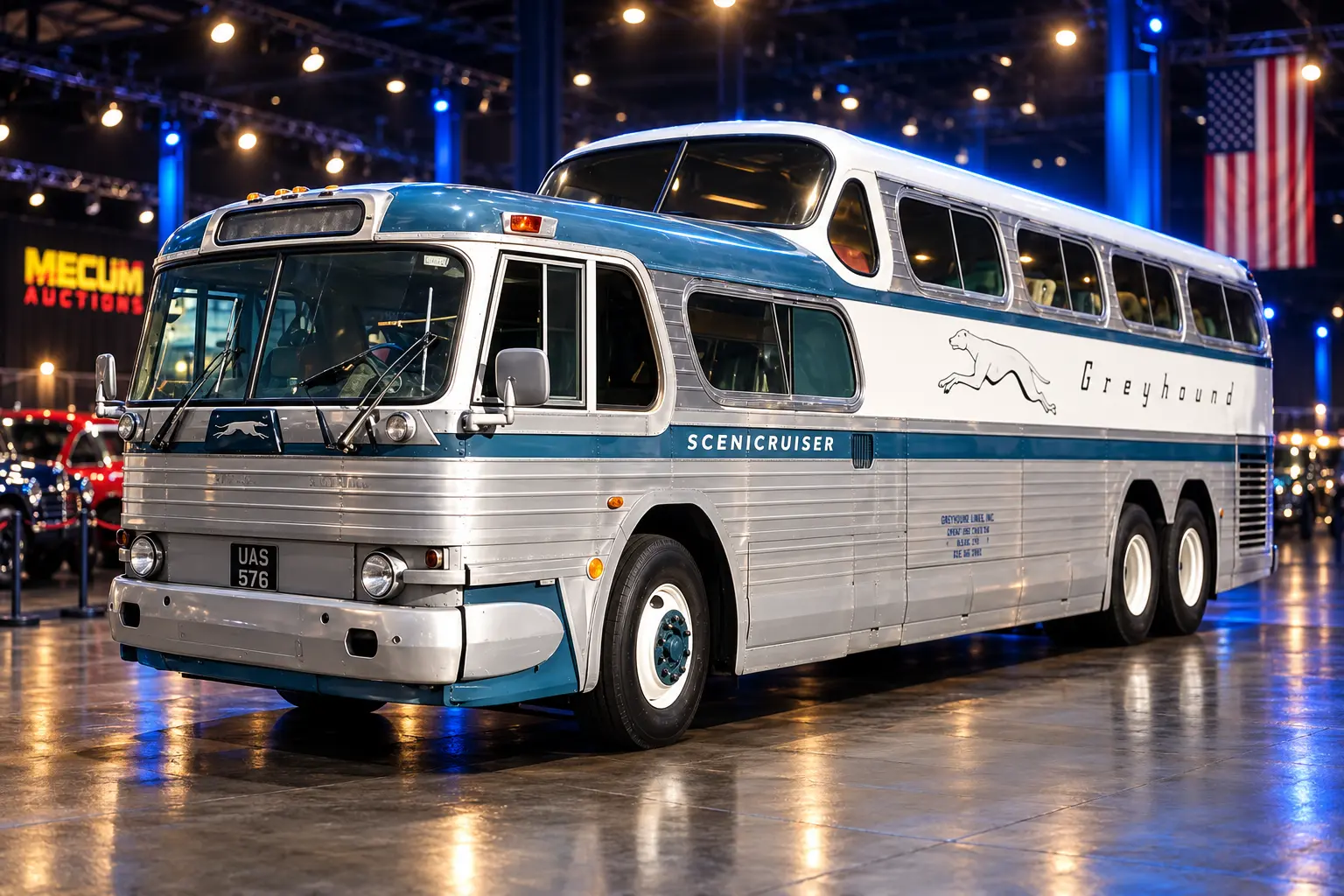
The first production Greyhound Scenicruiser is scheduled as Lot V200 at Mecum Las Vegas on Saturday, November 14. Serial No. 001 is a 40-foot split-level coach with its passenger seats still in place, cataloged as the first 1954 GM PD-4501 Scenicruiser, and Mecum has not posted an estimate.
The same bus already had a public price on Facebook Marketplace in October 2024, when a Los Angeles listing asked $650,000. That figure was itself a cut from a January 2023 historic-fleet ask of $980,000. Las Vegas is the attempt to turn those private numbers into a hammer.
Greyhound Shopped Serial 001 for Years
Bus PD-4501-001 is not a barn find that just surfaced. Specialist history of the type records that it stayed in Greyhound hands until 2022, numbered P-5446 in Pennsylvania Greyhound service and later carrying the side number 1954, the year it was built. It was the coach that started the company’s historic fleet after a restoration in Miami, and it rolled on the Greyhound Centennial Tour in 2014.
When the historic fleet was offered, the asking price on this Scenicruiser was $980,000, a figure preserved in a January 2023 equipment listing. The Facebook Marketplace ad that followed in October 2024 asked $650,000 and attached a seller appraisal of $1,000,000, plus paperwork identifying it as the first Scenicruiser built. The listing said the coach had been kept under cover, ran, and drove on a rebuilt Detroit Diesel 8V-71 and a 4-speed manual.
THE PUBLIC ASKS ON SERIAL 001
| Date | Venue | Figure |
|---|---|---|
| January 2023 | Historic-fleet listing | $980,000 ask |
| October 2024 | Facebook Marketplace, Los Angeles | $650,000 ask |
| Listed with the 2024 ad | Seller appraisal | $1,000,000 |
| September 2026 | Mecum Las Vegas, Lot V200 | No published estimate |
Jim Michaud, a Massachusetts bus operator long associated with Greyhound heritage coaches, put the restoration math in blunt terms while the coach was still being shopped as a company relic.
Obviously, the PD4501 has extreme significance as it has serial number PD4501-001. It is the very first one off the production line and has remained in Greyhound’s fleet its entire life.
Jim Michaud, bus operator, January 2023
Michaud added that restorations on par with 001 had run well over one million dollars, a build-cost claim that sits beside the seller’s $1,000,000 appraisal rather than replacing it. None of those figures is a sold result. Until November 14, the public record on this coach is a stack of asks.
Lot V200 Is a 40-Foot Coach With 43 Seats
Mecum’s lot notes, which the house says come from the consignor and are not independently verified, describe a two-level parlor coach with 10 seats on the lower deck and 33 on the raised rear deck, 43 in all, plus panoramic windows, air-ride suspension, a gold-and-black interior, and Greyhound’s white-and-blue paint. The gallery runs to 129 photographs. Goodyear white-letter tires are on it. The washroom on the lower deck is still there, which is the detail that separates this bus from most survivors.
The body is a 40-foot monocoque with fluted aluminum siding. Period figures put luggage volume under the upper deck at 344 cubic feet and the fuel tank at 180 gallons, with a loaded weight of 20 tons. Of the tandem rear axles, only the forward one is driven. General Motors built the type at the Truck and Coach plant in Pontiac, Michigan, exclusively for Greyhound, 1,000 production coaches from 1954 to 1956, then rebuilt the 1953 EXP-331 prototype to production spec as serial 1,001.
Mecum credits Raymond Loewy for the split-level shape. Greyhound’s own 1954 language said the coach was designed by Greyhound with General Motors, with Loewy Associates on the interior colors. The paper trail starts earlier: Greyhound’s Orville S. Caesar filed, with Loewy, a 1944 double-deck coach patent, and Cooper Hewitt records that the wartime project called for styling by Raymond Loewy Associates. The production PD-4501 that Greyhound put on the road was a company-and-GM job that grew out of that work, not a one-man sketch that rolled off the line unchanged.
Pennsylvania Greyhound P-5446 Never Left the Family
The first production Scenicruisers were handed over in Pontiac on July 14, 1954. Serial 001 went to Pennsylvania Greyhound Lines as P-5446. When the rest of the fleet was sold off in the 1970s, this one was kept, restored, and used as the star of the historic collection, including the 2014 centennial tour. Specialist notes say it remained in that fleet until 2022.
The Pacific Bus Museum listed Frank Gonzalez as the current owner at its Open House on August 17, 2025, and said he acquired the coach from the Greyhound Historic Fleet. Mecum’s lot page does not name a consignor. The chain that matters for bidders is simpler than the paperwork: the only Scenicruiser that Greyhound kept as a relic is now a Saturday car-auction lot in Las Vegas.
HOW SERIAL 001 GOT TO LAS VEGAS
- July 14, 1954: First production coaches are delivered at Pontiac; serial 001 is assigned to Pennsylvania Greyhound as P-5446.
- About 1975: Greyhound withdraws the type; 001 is held for the historic fleet and later numbered 1954 on the side.
- 2014: The coach takes part in Greyhound’s Centennial Tour.
- 2022: It leaves the Greyhound historic fleet for private ownership in Southern California.
- January 2023: A historic-fleet listing asks $980,000.
- October 2024: A Los Angeles Facebook Marketplace ad asks $650,000.
- August 17, 2025: The Pacific Bus Museum shows the coach as Frank Gonzalez’s PD-4501-001.
- November 14, 2026: It is scheduled as Lot V200 at Mecum Las Vegas.
That sequence is why “first production” is doing so much work in the catalog. Plenty of Scenicruisers became church buses, school coaches, or motorhomes. This one spent its second life as a company artifact, which is the whole case for six-figure money on a vehicle most collectors cannot garage.
Twin 4-71s Forced a Fleet-Wide Rebuild
The 8V-71 in Lot V200 is easy to misread as a restorer’s upgrade. It is not. No single GM diesel then in production could haul a loaded Scenicruiser up a grade at highway speed, so chief engineer Milo Dean paired two 4-71 two-stroke fours, each 284 cubic inches (4.7 liters) and 150 horsepower, set side by side. Each engine drove through its own fluid coupling into a transfer case, then a 2-speed clutch and a Spicer 3-speed gearbox, six forward ratios in all. The right-hand engine also ran the air-conditioning compressor. Spare power plants were cached along the routes, and the whole assembly was meant to roll out on a dolly for a quick swap.
Greyhound’s own figures later put almost 88% of mechanical failures on that power-plant system. The solenoid clutch slammed fully in or fully out, so the coach lurched on every start; GM switched to a mechanical linkage in early 1956 and retrofitted about 900 coaches already in service. From coach 571 in mid-1955, the transfer case was redesigned and the one-engine limp-home feature was dropped. New buses were driven from Pontiac to Greyhound’s Toledo shop for corrections before they entered service.
On July 25, 1956, 13 days after the last Scenicruiser shipped, Greyhound president Arthur Genet said the company would seek damages from GM for “repeated and extraordinary mechanical failures.” The dispute was settled on October 11 without a suit, alongside a $17 million Greyhound order for conventional GM coaches. The 1930 coach-supply relationship did not recover.
Once the Detroit Diesel 8V-71 existed, Greyhound hired Marmon-Herrington of Indianapolis to rebuild the 979 coaches still on the roster; 22 had already been lost to fires and wrecks. The work ran from October 1961 through September 1962 and cost about $10 million. Each bus received a single 568-cubic-inch (9.3-liter) V8, the same displacement as the two fours combined, a conventional clutch, and a Spicer 4-speed. Greyhound spent about $3 million more on interiors and relettered the fleet Super Scenicruiser. The Pacific Bus Museum’s type history is the clean version of that change: the whole class was repowered with Detroit Diesel 8V-71 engines. Lot V200’s “refitted” V8 is that program, not a custom job.
The updated coaches went to 17 regional Greyhound companies. Around 1970 some 500 were renovated again, and about 130 became combo coaches with a walled-off rear bay for package freight. Withdrawal came about 1975, the last of them in commuter work around San Francisco.
How Many Greyhound Scenicruisers Still Survive
About 213 Scenicruisers are known to survive, roughly 20% of the 1,001 built, and only 39 are thought to still have seats. The rest were gutted for living quarters, party floors, or freight. That is the scarcity claim underneath Lot V200: first serial, original 43-seat layout, washroom intact, Greyhound paint.
THE SCENICRUISER COUNT
- Built: 1,001 coaches for Greyhound only, 1954 to 1956, including the rebuilt prototype as serial 1,001.
- Rebuilt: 979 received the 8V-71 and 4-speed in 1961-62; 22 were already gone.
- Still around: About 213 known survivors; 39 still fitted with seats.
- This one: Serial PD-4501-001, 10 lower seats and 33 upper, washroom on the lower deck.
The conversion market, where most surviving coaches actually trade, sits in a different band. A 1956 PD-4501 rebuilt as a motorhome in 2015 sold through a bus-conversion classified board at $125,000, with a rebuilt 8V-71, an Eaton 9-speed, and a full galley and stateroom. Another Scenicruiser, fleet No. 983, converted in the early 1980s as an entertainer coach, carried a $35,000 sold tag on Marketplace. Those are not comps for a seated No. 001, and that is the point. They are the prices a 40-foot Greyhound fetches when it is treated as a used coach with a bed in it.
If Lot V200 sells near the old $650,000 ask, the gap between a seated first-production relic and a converted sister coach becomes a public number. Owners of the other 38 seated buses will use it. So will people sitting on gutted motorhomes who have been told, for years, that a Scenicruiser is a million-dollar object because one seller appraised this one that way.
A 20-Ton Lot Still Needs a Place to Live
Mecum’s car crowd can write a six-figure check. Housing a 40-foot, 20-ton split-level coach is a different skill. The bus needs a commercial bay or a rural pad, a driver who can manage a 4-speed and air brakes, and a fuel budget built around a Detroit two-stroke V8. Insurance, tires, and a place to turn around are the running costs that sit behind every romantic photo of the upper deck.
That is the objection that keeps attaching itself to this listing. Wanting to live in a Greyhound is easy; paying for parking, diesel, and upkeep on a 20-ton parlor coach is the part that sorts real bidders from people who liked the postcard. Anyone shopping Lot V200 as a house on wheels is also shopping against those $35,000 and $125,000 conversions, which already have bunks and a galley. Serial 001 is being sold as the opposite of a conversion: seats, washroom, company livery, first-off-the-line paperwork.
The sale itself is the Las Vegas Convention Center sale in November, November 12-14 at the South Hall, 3150 Paradise Road, a three-day car auction of about 1,000 vehicles. Lot V200 is on Saturday. Check-in for sellers is November 10 and 11. Bidding is in person, online, or by telephone after registration, and Mecum offers in-house financing. The lot information on the website is advance copy from the seller; the house says the description on the block controls.
WHAT WE KNOW
- The identity: VIN PD-4501-001, first production Scenicruiser, formerly Pennsylvania Greyhound P-5446 and historic-fleet side number 1954.
- The sale date: Lot V200, Saturday, November 14, 2026, Mecum Las Vegas.
- The last named owner: Frank Gonzalez, listed by the Pacific Bus Museum on August 17, 2025, after purchase from the Greyhound Historic Fleet.
WHAT IS UNCONFIRMED
- The estimate: Mecum has not published a pre-sale figure, and the house does not guarantee the consignor’s notes.
- The consignor: The lot page does not name the seller, so Gonzalez’s 2025 ownership is the last documented private hand, not a confirmed auction entry.
The winning bidder takes home a 40-foot piece of Greyhound’s mainline years, and a storage problem that starts the minute the hammer falls. Mecum has not said what that hammer should be. After $980,000 and $650,000 asks that never became a public result, November 14 is the first time the market will have to answer out loud.
WHAT THE WINNING BIDDER TAKES ON
- The length: A 40-foot split-level coach, not a car that fits a standard collector garage.
- The weight: About 20 tons loaded, on air-ride and a driven forward rear axle.
- The drivetrain: A fleet-rebuilt Detroit Diesel 8V-71 and a 4-speed manual, the 1961-62 Greyhound spec.
- The interior: 43 original-style seats and a lower-deck washroom, which is the rare layout among the 213 known survivors.
For a Saturday lot in a hall full of cars, that is an unusual bill of goods. Serial 001 already survived the twin-engine years, the 1970s sell-off, and two asking prices that did not close in public. The bet in Las Vegas is that “first one built” can finish the job a Facebook ad could not.

Edinburgh Opens a 2027 Tour Built for Time Trials

Korda Maps Auður From Meðalland to Irvine Bay

Apple Music Films Its New Logo in Mineral Oil

Oppo Prices the Pad Mini Above India’s iPad Mini

Austen Soaks Scotland Before Boelo Brings Weekend Gales

Volkswagen Sells the Osnabruck Plant to Clear a Board Fight

Apple’s Foldable iPhone Hinges on Samsung Display Supply

Saksham Gaur Finds He Is His Own Company’s Client

Tata Motors’ Iveco Tender Opens as Holders Still Decide

Onimusha Way of the Sword Preload Hits a Windows 11 Wall
-
 AUTO2 months ago
Volkswagen Sells the Osnabruck Plant to Clear a Board Fight
-
 NEWS2 months ago
Apple’s Foldable iPhone Hinges on Samsung Display Supply
-
 AUTO2 months ago
Tata Motors’ Iveco Tender Opens as Holders Still Decide
-
 BUSINESS2 months ago
Saksham Gaur Finds He Is His Own Company’s Client
-
 GAMING2 months ago
Onimusha Way of the Sword Preload Hits a Windows 11 Wall
-

 ENTERTAINMENT3 years ago
What is SD on Amazon Prime? – All You Need to Know
-

 BUSINESS2 months ago
Hyderabad 22-Carat Gold Jumps After a False Bargain
-

 NEWS2 months ago
iQOO 16 Locks 8,400 mAh While 100W Charging Holds