
NEWS
FAA SMART AI Shrinks to a 90-Day Washington Test
Airlines forced the FAA to open its SMART air-traffic AI as a 90-day advice tool at three Washington airports, after weeks of panic over cancellations.

The FAA’s SMART air-traffic AI will open as a 90-day advice tool for the three airports that serve Washington. Airline chiefs spent weeks demanding that narrower start.
Strategic Management of Airspace, Routes, and Trajectories is the software layer in a $875 million, 12-year award to Boston firm Air Space Intelligence. It is meant to flag congestion from schedules, weather, and airport capacity before flights leave the gate. After closed-door talks, the first slice will not write new controller rules or bind airline schedules. It will send extra route options through pipes the FAA already uses.
The Tool Starts as Advice at Three Airports
Industry officials briefed on the plan say SMART is due to debut in coming days for Reagan National, Dulles, and Baltimore/Washington International. Government and industry officials have described a possible start as soon as Monday, Sept. 21. FAA Administrator Bryan Bedford has said the first phase lasts roughly 90 days and is mainly for testing the model and building airline confidence in its calls.
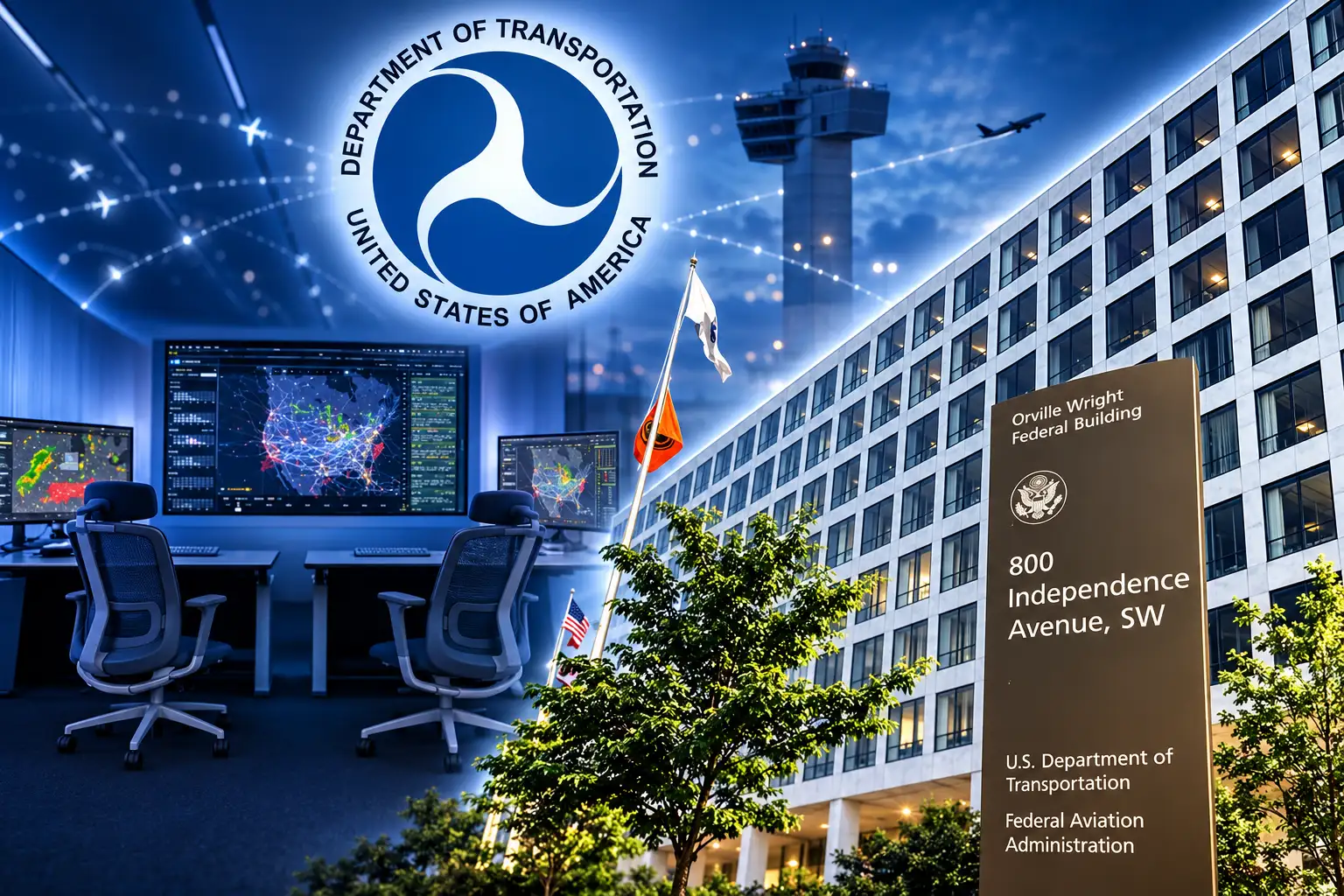
The advice will be generated at a SMART center housed at the Transportation Department, then passed to the FAA’s established command center and on to controllers through systems they already use for routing. One airline official said that design creates no new procedures for controllers or carriers. Another called the fact that the tool will not be wired into day-to-day air traffic management “a big relief.”
THE 90-DAY FENCE
- The scope: Advice only for the three airports that serve Washington, with no new controller or airline procedures.
- The clock: A roughly 90-day first phase to test predictions and whether carriers will trust them.
- The pipe: Alternate routes move from a DOT SMART center through the existing command center, then into tools controllers already have.
STILL UNCONFIRMED
- The Monday start: Officials have described a possible debut as soon as Sept. 21; the FAA has not posted a public go-live time.
- The opt-out: Carriers spent three months asking whether they can decline the tool and still have not received a granular answer.
- The keyboard: It is still unclear whether controllers will type into SMART themselves or only see its output in current displays.
Nobody in those talks alleged the software would undercut safety. The fear was cost. Officials said a more aggressive tool could spur extra cancellations and reschedules in the name of dodging weather and bottlenecks, a headache for airlines and passengers alike.
Duffy Promised Fixes Before Bags Were Packed
That fence sits next to language the FAA published on June 22, 2026, the day it named ASI. Transportation Secretary Sean Duffy said the two new platforms would fundamentally reshape how the airspace is managed, slashing thousands of delays and cancellations. On the same day he posted a video that told travelers SMART and its sister system would correct scheduling conflicts before they packed their bags, anticipate storms earlier, and dynamically adjust flight paths in advance.
🚨BREAKING NEWS FOR THE FUTURE OF FLIGHT🚨@AirSpaceIntel is working with the FAA to deploy two state-of-the-art technologies that will revolutionize air traffic management
Here’s how SMART and FMDS will work for YOU:
✅ Corrects scheduling conflicts before you pack your bags… pic.twitter.com/h6pBrstZRd— Secretary Sean Duffy (@SecDuffy) June 22, 2026
FAA spokesperson Hannah Walden is still using that register. She said the agency is “moving at record speed to modernize America’s National Airspace System, and SMART will fundamentally change the way we manage our skies.” She also said SMART helps the FAA see problems coming instead of waiting for congestion or weather to cause delays, and that airlines have been “at the table” from the beginning, which is why the agency is taking “a slow, methodical approach to the rollout.”
The methodical line is the one carriers say they had to extract. The June copy still reads like a national rewrite. The product that is about to switch on is an extra set of suggested routes for one metro area.
Four Airline Chiefs Forced a Narrower Test
Airline officials said they spent about three months in almost weekly group meetings with the FAA and still left with more questions than answers. One of the biggest was how far the AI would reach into daily traffic management. “I think that’s what people were freaking out about,” one industry official said.
They asked the agency to shrink the first step. “We’ve been requesting and talking to [FAA] and saying, ‘Let’s narrow the scope of this. Start, crawl, walk, run.’ And I think ultimately that’s what they decided to do,” one official said. Bedford then sat down on Sept. 10 with major-airline chief executives, including the heads of United Airlines, American Airlines, Delta Air Lines, and Southwest Airlines. A fourth official said the CEOs’ reception, after Bedford walked through the vision, was “exceptionally favorable and supportive of the effort.”
HOW THE FENCE GOT BUILT
- May 2025: Duffy announces the Brand New Air Traffic Control System push after years of stalled upgrades and a deadly midair collision near Reagan National in January 2025.
- June 22, 2026: The FAA awards ASI the SMART and FMDS work and publishes the “reshape the airspace” pledge.
- Summer 2026: Airlines hold almost weekly implementation meetings and still cannot get clear answers on controller use, data feeds, training, or an opt-out.
- Sept. 9, 2026: United CEO Scott Kirby issues a public statement backing the tool if it performs as hoped.
- Sept. 10, 2026: Bedford meets the big-four airline CEOs; officials later describe a limited, 90-day Washington start.
- Sept. 16, 2026: Duffy, at a National Artificial Intelligence Association talk in Washington, says, “We have to do a slow roll into the airspace.”
Kirby’s note was the bullish end of the public range. “If it works as we think it can, it will do more to reduce delays and cancellations than anything that’s happened in decades,” he said. American CEO Robert Isom said the airline is working closely with the FAA on SMART, “which when done thoughtfully and methodically will offer enhanced benefit to the traveling public.” Airlines for America, whose CEO Chris Sununu praised the award on the FAA’s June 22 page, called SMART “one of the most exciting and bold initiatives taken on by the FAA in decades.” Delta said it “fully supports” the modernization effort and is “actively engaged in the development process.”
Those statements landed after the crawl-walk-run fight, not before it. Philip Mann, a principal consultant at Vector Strategic Consulting who advises on aviation safety and AI governance, called the limited launch the right call. The remaining gap is simpler than the slogans: there is still no operational scorecard, because SMART has not yet run against live FAA traffic.
What the $875 Million Contract Buys
ASI’s award covers two systems. Flow Management Data and Services is supposed to become the new data backbone of the Air Traffic Control System Command Center, replacing the current traffic-flow management system. SMART sits on top of that data as a cloud layer that, in Bedford’s Sept. 15 budget testimony, uses AI to predict congestion and conflicts earlier and to adjust departure times, routes, and timing at designated points en route.
The FAA’s June 22 notice said controllers now hunt weather, capacity, and other feeds across numerous screens and spreadsheets, and that the new stack would house the critical data in one platform, spotting delays and unused airspace days, weeks, and even months ahead. Bedford told Congress SMART “reduces delays, predicts schedules, and safely creates more efficient flight paths.” The 90-day Washington slice is a thinner job: extra routing options, especially in weather, sent through current command-center practice.
THREE LAYERS, ONE MODEST SWITCH-ON
| Layer | Job on paper | What the first 90 days do |
|---|---|---|
| FMDS | Command Center data backbone; balances demand and capacity | Still the longer build; not the passenger-facing debut |
| SMART | AI layer that predicts congestion and proposes routes and times | Advice for three Washington-serving airports only |
| Existing ATC tools | Human separation and current routing messages | Unchanged; SMART recommendations ride those pipes |
Bedford has said the 90-day window is also a lab. The FAA will sit with airlines, pick specific flights, compare paths, and score how accurate SMART’s predictions are. He has argued the real shift is forecasting where weather is headed rather than only mapping where it is. “That is a big difference between whether we keep airspace closed too long,” he said. “So how can we make more space available safely, based on better data and better decision-making tools.”
Boston’s Vendor Already Runs Airline Software
ASI is not a paper contractor walking into the NAS cold. In its June 22 release, the company said its Flyways AI platform already supports routing, traffic management, and safety across a substantial share of U.S. domestic flying, and that the same stack is in use with the U.S. Air Force and Indo-Pacific Command. Named civil customers include Alaska Airlines, Delta Air Lines, United Airlines, and National Grid. The firm is headquartered in Boston and backed by Andreessen Horowitz.
We have invested nearly $100 million of our own resources to develop a platform that is operational today, and we are honored to bring that same proven capability to the FAA and to the American people at national scale.
Bernard Asare, president of civil aviation, Air Space Intelligence
CEO Phillip Buckendorf said modernizing ATC “has been a promise” and, under Duffy and Bedford, “it is now a reality.” ASI said it is entering SMART and FMDS with nearly $100 million of its own resources already sunk, and with technology already operating at scale, rather than a years-long custom build. It expects both systems to roll out over 12 to 24 months. ASI did not answer a later request for comment on the narrowed launch and has pointed questions to DOT and the FAA.
That customer list colors the public cheerleading. Kirby’s United is already an ASI user, and so is Delta, which said it is in the development process. The loudest airline praise is coming from carriers that already bought the product, which is not a conflict on its face and is also not an independent field test. American and Southwest sat in the Sept. 10 room too; they have been more careful in public.
No Cost Estimate, 11,389 Separate Schedules
SMART is one software bet inside a much larger rebuild Duffy branded the Brand New Air Traffic Control System in May 2025, after the January 2025 collision near Reagan National and a fatal March runway crash at LaGuardia. Congress appropriated $12.5 billion for that push. Bedford told appropriators on Sept. 15 that as of Sept. 1 the FAA had replaced over 64 percent of its copper-based time-division multiplexing network, moved 21 towers from paper strips to electronic displays, installed 101 surface-awareness systems, converted over 403 radio sites, and put 6 surface-movement radars into 5 airports.
The Government Accountability Office, in a report publicly released Sept. 14, said speed is outrunning the books. FAA officials could not show the analysis behind high-level phase 1 cost figures, and the estimate they did share omitted government costs, most phase 1 operating costs, and all of phase 2. The agency told GAO it will need about $10.2 billion for phase 2, not counting facilities, and it has no start or finish date for that phase. Phase 1 is supposed to be done by December 2028.
WHAT GAO COUNTED IN SEPTEMBER
- $12.5 billion: The sum Congress appropriated for the new ATC push, mostly aimed at phase 1.
- $10.2 billion: FAA’s stated need for phase 2, facilities not included, with no dates attached.
- 2,560 of 5,170: Copper wires GAO recorded as replaced as of May 2026, a different tally from Bedford’s later 64 percent TDM figure.
- Over 75 percent: Share of the FAA’s 138 ATC systems that GAO, in September 2024, found unsustainable or potentially unsustainable.
Instead of one integrated master schedule for phase 1, GAO found 11,389 project schedules that are not integrated, so jobs land at the same sites without a plan to cut the hit on controller operations. The watchdog said those gaps raise the odds of repeating decades of overruns, delays, and missed targets, which would leave the agency on systems prone to failure. Transportation partially concurred with both recommendations. GAO said both should be fully addressed. Controllers already handle up to 45,000 flights a day on that aging stack.
Controllers Keep Separation and Remain Short
The union that speaks for the people who still separate those flights has drawn a hard line. A National Air Traffic Controllers Association spokesman said the union “believes any new technology should complement and not replace the experience, training and professional judgment of air traffic controllers who are responsible for the safety of the National Airspace System.” Duffy has said the same in blunter words: “Am I gonna replace a controller and have AI manage the airspace? The answer to that is hell no, that’s not gonna happen.”
Staffing is the other half of that sentence. Bedford’s Sept. 15 testimony set a staffing target of 12,563 controllers under a new model. As of August 2026, about 11,000 certified professional controllers were on the floor at 313 federal facilities, with 4,000 people in the training pipeline, including about 900 already-certified controllers finishing facility training after a move. The agency hit a 2,000-trainee goal in fiscal 2025, says it will exceed 2,200 in fiscal 2026, and has asked for $95.4 million to hire and train 2,300 more in fiscal 2027, inside a $22.4 billion FAA budget request.
A NATCA-aligned worry sits under those hiring charts. The FAA has argued that better scheduling tools can hold the line with fewer bodies than older plans assumed, and the union has been fighting that math. SMART is being sold as workload relief, which is catnip in a short tower and poison if it becomes an excuse to stop hiring. The 90-day design, with humans still making every separation call, is how Bedford and Duffy keep both claims alive at once.
QUESTIONS THE CARRIERS STILL ASK
- Who clicks: Whether controllers will work inside SMART or only read its output in current displays.
- Who feeds: Whether ASI, the FAA, or both will push routing information to airlines and to the field.
- Who trains: Whether airline operations desks must learn a new tool or can keep their present workflows.
- Who can leave: Whether a carrier can opt out of SMART and still get a normal slot in constrained airspace.
Three airline officials said those items were still not answered in granular detail even after the CEO session. That is the unglamorous half of “at the table.” A related gap has no owner yet either: if a SMART suggestion is wrong, and a carrier takes it, who wears the delay, the fuel burn, and the passenger hit. The 90-day test can measure forecast accuracy. It cannot, by itself, write that liability rule.
Bedford’s 90-Day Bet on Weather Calls
Bedford has been plain about what he wants the first 90 days to prove. He wants to know whether the system performs as billed, and whether airlines will trust the recommendations enough to act on them. The specimen he keeps returning to is weather: hold a piece of airspace closed because a storm is there now, or open it sooner because the model says the cell is moving. That is a concrete test, and it is also a modest one next to Duffy’s June promise to fix conflicts before anyone packed a bag.
Sununu’s June line still hangs over that bet. “A program of this kind has been talked about for decades, and this administration is finally taking action,” he said. Action, for the next 90 days, is an advice feed at three Washington airports, riding the old pipes, scored against real flights. If the predictions hold, Bedford has said he wants a wider rollout. If they do not, the FAA will have spent the opening of an $875 million contract learning that in public, on the same airspace that failed in January 2025.

Edinburgh Opens a 2027 Tour Built for Time Trials

Korda Maps Auður From Meðalland to Irvine Bay

Apple Music Films Its New Logo in Mineral Oil

Oppo Prices the Pad Mini Above India’s iPad Mini

Austen Soaks Scotland Before Boelo Brings Weekend Gales

Volkswagen Sells the Osnabruck Plant to Clear a Board Fight

Apple’s Foldable iPhone Hinges on Samsung Display Supply

Saksham Gaur Finds He Is His Own Company’s Client

Tata Motors’ Iveco Tender Opens as Holders Still Decide

Onimusha Way of the Sword Preload Hits a Windows 11 Wall
-
 AUTO2 months ago
Volkswagen Sells the Osnabruck Plant to Clear a Board Fight
-
 NEWS2 months ago
Apple’s Foldable iPhone Hinges on Samsung Display Supply
-
 AUTO2 months ago
Tata Motors’ Iveco Tender Opens as Holders Still Decide
-
 BUSINESS2 months ago
Saksham Gaur Finds He Is His Own Company’s Client
-
 GAMING2 months ago
Onimusha Way of the Sword Preload Hits a Windows 11 Wall
-

 ENTERTAINMENT3 years ago
What is SD on Amazon Prime? – All You Need to Know
-

 BUSINESS2 months ago
Hyderabad 22-Carat Gold Jumps After a False Bargain
-

 NEWS2 months ago
iQOO 16 Locks 8,400 mAh While 100W Charging Holds