
NEWS
CIOC Energy Raises €3 Million From Its Biggest Customer
CleverNett, already routing 2,000 home batteries through CIOC Energy, takes a minority €3 million stake so the optimiser can trade power itself in four countries.

€3 million has landed in CIOC Energy from CleverNett, the Belgian hybrid-solar developer that already routes 2,000 home batteries through the Brussels platform. CleverNett takes a minority stake and CIOC Energy will remain independent.
The cash is meant to grow the commercial and technical team and to buy the company its own access to power markets in Belgium, the Netherlands, Germany and Romania.
CleverNett Already Steers 2,000 Home Batteries Through CIOC
Most energy-tech raises arrive from funds that never touched a battery. This one arrives from the developer whose household pack is already on the software, which is why the independence clause does so much work in a short announcement.
CIOC Energy, founded in September 2023 and based on Koning Albert II-laan in Brussels, sells monitoring, control and trading for solar, batteries and chargers as one stack. LinkedIn lists the firm in the 11-50 staff band. CleverNett, based in Kortrijk and formerly Nett Energie, builds hybrid parks and household systems and then needs someone to run them every quarter-hour.
Arthur Despiegelaere, chief executive of Nett Energie, has called CleverNett the largest hybrid solar producer in Belgium, counting 84 megawatt-peak of solar and 37.5 megawatt-hours of storage across its parks and almost 2,000 household installations, with about 58 megawatt-peak and about 68 megawatt-hours still in development. CIOC Energy’s own managed book is larger, because the 2,000 homes sit beside more than 100 business sites.
THE TWO BOOKS THAT NOW SHARE A CAP TABLE
| Book | Solar | Storage | What it includes |
|---|---|---|---|
| CIOC Energy managed | 200 MWp | more than 100 MWh | more than 100 business sites plus 2,000 homes |
| CleverNett hybrid, operating | 84 MWp | 37.5 MWh | parks plus almost 2,000 household systems |
| CleverNett, in development | about 58 MWp | about 68 MWh | not yet built |
| CleverNett 2030 target | not stated in megawatts | 500 MWh | €500 million installation volume and 1 million panels |
The overlap is not theoretical. At Frunpark in Châtelineau, CleverNett took 2.4 megawatt-peak of rooftop solar into management with four fast chargers on site, and named CIOC Energy as the control layer. Emile Steyaert, co-founder and chief operating officer of CleverNett, has said the EMS gives “full asset visibility to boost efficiency and capture flexibility value.”
CleverNett itself was launched on 2 April 2025 as a joint venture of Gridlink and Nett Energie, with €65 million of start capital and support from SFPIM, Belgium’s sovereign wealth fund. The offer is third-party finance: panels and batteries on a business roof, a fixed long-term price, and surplus sold on. The firm’s own site still asks when a hybrid solar park pays off, and it puts solar on only 8 percent of Flemish roof area. SFPIM already holds a 31.18 percent stake in Gridlink, a holding the fund valued at €66.09 million in its 2024 report. That is one layer above CIOC Energy, not a direct state cheque into the optimiser.
The Installer, the Software and the Trader Still Point Fingers
Alexander De Bièvre, chief executive of CIOC Energy, sold batteries for years before he built the control layer. The pitch is that a split market leaves faults unwatched and blame circulating between three desks that do not share a log.
We sold batteries ourselves for years, so we know exactly how fast things can go wrong when nobody’s keeping watch. Without constant follow-up, faults simply go unnoticed. And when something breaks down, everyone points at someone else: the installer doesn’t know the software and the control system only carries out what the energy trader decides.
Alexander De Bièvre, CEO, CIOC Energy
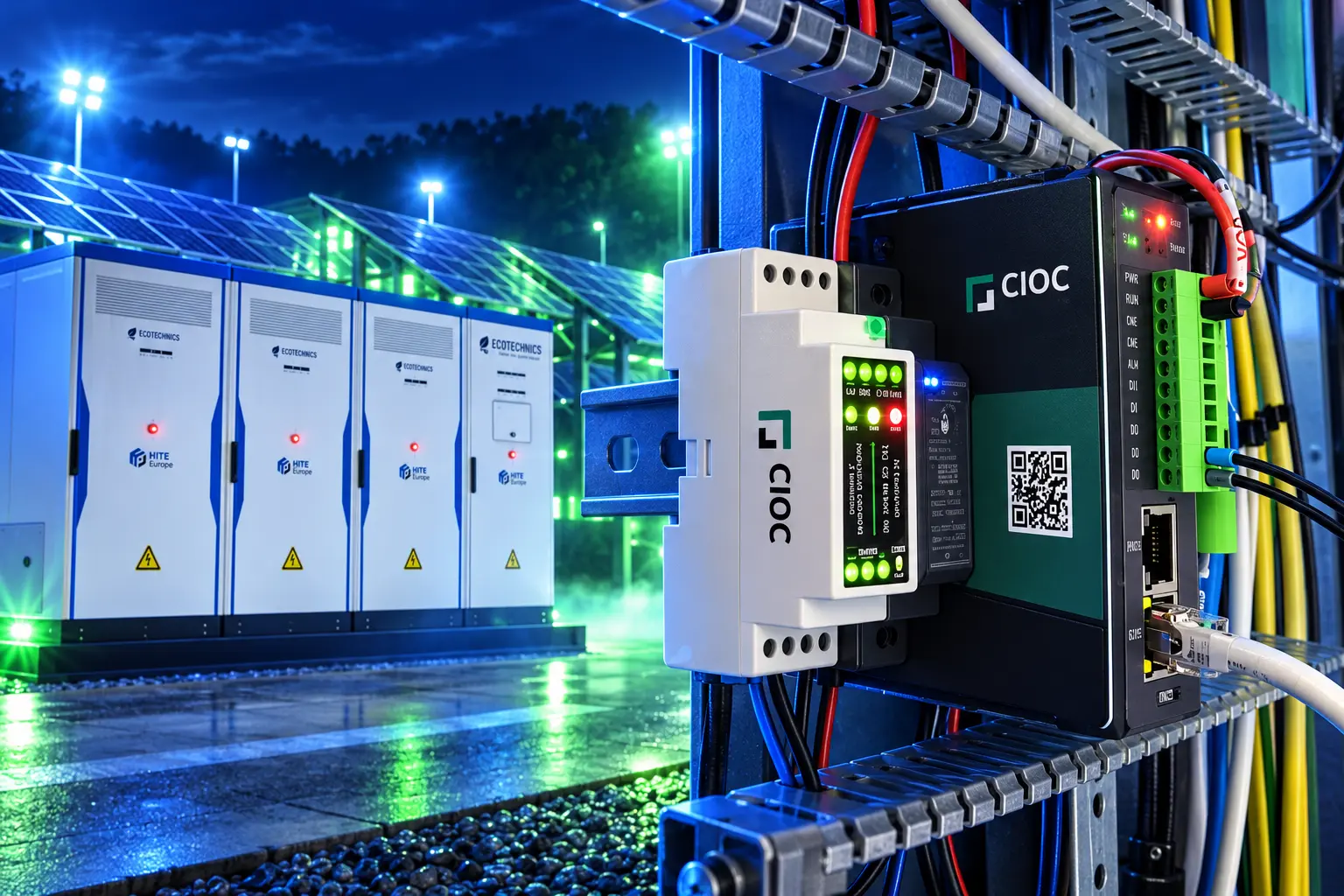
The company’s answer is a control module that sits in the electricity cabinet and runs panels, batteries and charge points as one system. Solar can be pushed into storage. Peaks can be flattened when machines and chargers draw at once. Stored power can be sold when the price is worth the cycle. CIOC Energy describes that stack as a vertically integrated energy optimiser, with asset control on one side and market optimisation on the other, holding state of charge, lifetime and price in the same loop.
That is the product the 2,000 homes already feel. It is also the product that still, until this raise, had to live with someone else’s trading desk on the far side of the cabinet.
How CIOC Energy Charges for Extra Returns
Customers can take an energy contract with direct exposure to the imbalance market and still keep control of the assets away from the supplier. CIOC Energy then compares the return the site would have earned with no optimisation against the return its platform actually posts, after distribution and supply costs, and bills an agreed share of the gap.
If the extra return is zero, the fee is zero. That rule is simple to print and hard to honour if a third party still decides when the battery moves. A trader who does not share the fee has no reason to chase the last imbalance quarter. An installer who does not see the software has no reason to notice a silent inverter. The no-win, no-fee model only scales if the same firm that watches the cabinet also sends the bid.
On its public channel the company puts the imbalance choice in plain language: charge now or wait for a deeper negative price, discharge now or hold state of charge for a later spike. Value, it says, depends on when you charge and discharge. The new money is how that sentence stops being a slide and becomes a licence.
Own Market Access Starts With Elia’s Paperwork
In Belgium, the party that offers balancing energy to the transmission system is a Balancing Service Provider. Elia, the system operator, publishes a five-step path for new balancing providers and warns that doing it yourself takes real implementation work. Many asset owners still ride in on an existing BSP instead.
ELIA’S PATH ONTO THE BALANCING MARKET
- The contract: A sworn statement and application go to Elia, then product terms for FCR, aFRR or mFRR once the firm is qualified.
- The IT link: Secure interfaces must exchange bids, activations, metering and settlement, and Elia tests the setup before it goes live.
- The DSO paper: Distribution-connected batteries need an FSP-DSO contract with each local grid company, plus a flexibility study where required.
- The delivery points: Every asset is registered against an approved meter, with transfer-of-energy papers if the BSP is not also the site’s BRP and supplier.
- The prequalification: Volumes for capacity auctions must be tested; FCR requires this step, while aFRR and mFRR can still run as non-contracted energy.
A BSP also nominates a Balance Responsible Party for imbalance settlement. Holding that BRP role yourself removes a counterparty, and it is the step that costs real money. European BESS Index notes that BRP licences typically need hundreds of thousands of euros in collateral, sometimes millions, plus risk systems that a 50-person shop does not keep on a shelf. EU market-design rules protect independent aggregation, so CIOC Energy can in principle sit beside a customer’s existing supplier. The paperwork still has to be filed in each country, not once for the bloc.
CIOC Energy already told the labour market what it is missing. On 30 August 2026 it advertised for a product manager for EMS, VPP and electricity trading, asking for hands-on time at a BRP, BSP, DSO, TSO or VPP operator and for fluency in Elia, Fluvius, EPEX Spot, intraday, FCR, aFRR and FFR. The raise on 23 September 2026 is the budget behind that job, not a sudden change of mind.
The Four Markets on CIOC Energy’s List
Belgium is the home grid and the one whose onboarding pack is already on the table. The other three names in the announcement are not a random tour. Each is a place where a small optimiser either just got a door, still needs a BRP, or can still find a fat imbalance spread.
WHERE THE €3 MILLION IS SUPPOSED TO BUY A SEAT
| Market | What a small optimiser walks into |
|---|---|
| Belgium | Elia BSP onboarding, DSO flexibility contracts, and a fee model that needs the trader and the cabinet under one roof |
| Netherlands | Independent aggregators are recognised, yet Dutch aggregators still need a BRP agreement for aFRR and mFRR and still cannot enter wholesale markets, per smartEn’s 2025 monitor |
| Germany | From 1 October 2026, small batteries can enter the same energy markets as large plants, Flexa co-CEO Fabian Fürst said, pointing to about 23 GWh of small-scale storage |
| Romania | Transelectrica’s balancing market still prices deviations after day-ahead and intraday close; Enspired put installed BESS at 137 MW early in 2025, heading toward about 493 MW by year end, with access rules still being written |
Germany’s date is the one that does not wait. Fürst’s point is that a huge stock of home and small commercial batteries, long trapped by subsidy rules that kept them from charging off the grid, gets a path into the same books as utility storage. A Brussels optimiser that already runs 2,000 homes in Belgium has an obvious reason to want a German seat before that volume is spoken for.
Romania is the other way around: less storage, a single national price zone, and a balancing market that still pays people who can move when the schedule is wrong. The Netherlands sits in the middle, with mature TSO products and a legal knot that still forces a BRP handshake. None of those doors open because a press note lists the country. They open when the IT tests pass and the collateral is posted.
The €3 Million Has to Hire a Trading Desk
Set beside CleverNett’s €65 million hardware vehicle, the software cheque is small. It is sized for people, interfaces and guarantees, which is exactly what De Bièvre said he would buy. CIOC Energy will remain independent, so the 2,000-home book does not become a captive of the developer on paper. In practice the largest customer now sits on the cap table, and the optimiser’s next hires will spend their days proving that the extra return, and therefore the fee, can be booked without a third trader in the middle.
FROM BATTERY SALES TO A MINORITY STAKE
- September 2023: CIOC Energy is founded in Brussels to monitor, control and trade solar and batteries as one stack.
- 2 April 2025: Gridlink and Nett Energie launch CleverNett with €65 million of start capital and SFPIM support, putting hybrid parks and household batteries on third-party finance.
- 30 August 2026: CIOC Energy advertises for a product manager who already knows BRP, BSP and Elia rules.
- 23 September 2026: CleverNett takes a minority €3 million stake; CIOC Energy will remain independent and says it will trade directly in Belgium, the Netherlands, Germany and Romania.
The independence clause is written into the deal. The licences, the Elia interfaces and the four-country trading setup are not. Those still have to be built with the €3 million and the people CIOC Energy said it will hire.
Frequently Asked Questions
Did Belgium’s Sovereign Wealth Fund Invest in CIOC Energy?
No. SFPIM holds 31.18 percent of Gridlink, the holding that co-founded CleverNett with Nett Energie, and it valued that Gridlink line at €66.09 million in its 2024 report. The €3 million into CIOC Energy comes from CleverNett as a minority stake, one corporate layer below the state fund.
How Long Does Elia Take to Accept a New Balancing Provider?
After a completed application form and sworn statement, Elia has two weeks to accept or refuse a candidate, and it can ask for a financial screening from an independent agency covering balances, liquidity and solvency. Signing the product terms and passing the IT tests come after that first gate.
What Does CleverNett Mean by a Hybrid Solar Park?
Hybrid, in its usage, means solar and a battery behind the same grid connection, designed, sized and steered together, rather than a battery on its own meter. The point of that layout is to charge from rooftop surplus that would otherwise hit the grid at a low or negative price, in quarter-hour steps.
Can a CIOC Energy Customer Keep a Separate Energy Supplier?
Yes. The platform is built so a site can take imbalance-market exposure while the optimiser, not the supplier, keeps control of the panels, batteries and chargers. Transfer-of-energy paperwork is then required with Elia if the balancing provider is not also the site’s BRP and supplier.
CleverNett now owns a slice of the firm that already steers its homes and at least one 2.4 megawatt-peak rooftop. CIOC Energy keeps the legal room to sign other developers, and it has a three-year-old platform, a performance fee that disappears when it adds nothing, and a shopping list of four grids that still want paperwork, tests and cash on deposit.

Edinburgh Opens a 2027 Tour Built for Time Trials

Korda Maps Auður From Meðalland to Irvine Bay

Apple Music Films Its New Logo in Mineral Oil

Oppo Prices the Pad Mini Above India’s iPad Mini

Austen Soaks Scotland Before Boelo Brings Weekend Gales

Volkswagen Sells the Osnabruck Plant to Clear a Board Fight

Apple’s Foldable iPhone Hinges on Samsung Display Supply

Saksham Gaur Finds He Is His Own Company’s Client

Tata Motors’ Iveco Tender Opens as Holders Still Decide

Onimusha Way of the Sword Preload Hits a Windows 11 Wall
-
 AUTO2 months ago
Volkswagen Sells the Osnabruck Plant to Clear a Board Fight
-
 NEWS2 months ago
Apple’s Foldable iPhone Hinges on Samsung Display Supply
-
 AUTO2 months ago
Tata Motors’ Iveco Tender Opens as Holders Still Decide
-
 BUSINESS2 months ago
Saksham Gaur Finds He Is His Own Company’s Client
-
 GAMING2 months ago
Onimusha Way of the Sword Preload Hits a Windows 11 Wall
-

 ENTERTAINMENT3 years ago
What is SD on Amazon Prime? – All You Need to Know
-

 BUSINESS2 months ago
Hyderabad 22-Carat Gold Jumps After a False Bargain
-

 NEWS2 months ago
iQOO 16 Locks 8,400 mAh While 100W Charging Holds