
NEWS
Apple Vision Pro 512GB Still Sells the Same 23 Million Pixels
The Vision Pro 512GB lists at $3,899 after Apple’s June storage hike, with the same 23 million pixel displays and a cabled 353-gram battery.

The Apple Vision Pro 512GB still puts 23 million pixels in front of your eyes, and Apple’s U.S. store lists that middle storage model at $3,899. The display spec has not moved since the first headset. The price has.
On June 25, 2026, Apple raised the 512GB SKU by $200 after AI data-center demand pushed memory and storage costs. The M5 headset that wears those pixels is heavier on the spec sheet, still tied to a 353 grams battery on a cable, and still rated at up to 3 hours of video.
Apple Now Charges $3,899 for 512GB
When Apple announced Vision Pro with the M5 chip on October 15, 2025, the line started at $3,499. The 512GB model sat at $3,699, and 1TB sat at $3,899. Those were the same three rungs the original 2024 headset used, only with a new chip and a new band in the box.
The June 25, 2026 store update moved every rung. Apple said the consumer electronics industry was facing a component shock it had not seen at this speed, driven by AI data centers buying memory and storage. A company statement put it this way: “We have never seen a component price increase this much, this quickly.”
The 256GB headset went to $3,699. The 512GB headset went to $3,899, which is what 1TB cost at the M5 launch. The 1TB model jumped $300, to $4,199. For $200 more than the 256GB unit, you still get the same screens, the same M5 and R1 chips, and the same external battery. You get more NAND.
THE JUNE 2026 STORAGE LADDER
| Storage | M5 launch price | June 25, 2026 price | Change |
|---|---|---|---|
| 256GB | $3,499 | $3,699 | +$200 |
| 512GB | $3,699 | $3,899 | +$200 |
| 1TB | $3,899 | $4,199 | +$300 |
Apple did not publish a separate display, chip, or battery SKU at those prices. Storage is the only hardware fork on the buy page. The 512GB model is the middle of that fork, and it now costs what the top of the ladder cost in October 2025.
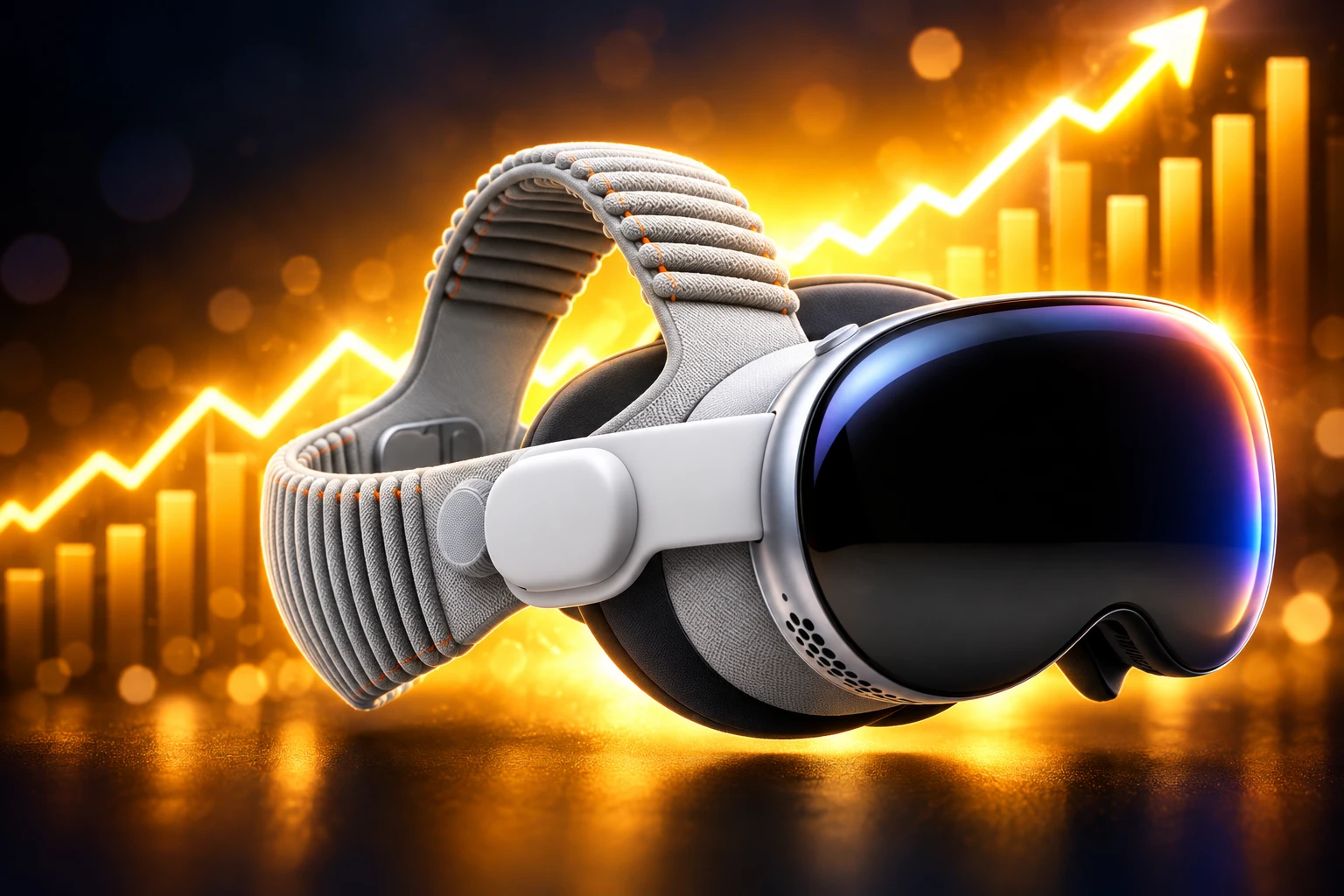
The Same 23 Million Pixels
Every Vision Pro Apple sells, including the 512GB unit, uses a dual micro-OLED system. Apple’s spec sheet lists 23 million pixels and a 7.5-micron pitch, with 92% DCI-P3 coverage. Refresh options are 90Hz, 96Hz, 100Hz, and 120Hz, plus playback at multiples of 24 fps and 30 fps so film cadence stays clean.
That pixel count is the number in every product pitch. It was also the number on the original headset. The 256GB, 512GB, and 1TB builds share this panel pair. Paying $3,899 does not buy a denser screen than the $3,699 build sitting next to it.
DISPLAY SPECS THAT DID NOT MOVE
- Pixel count: 23 million across a dual micro-OLED 3D display system.
- Pixel pitch: 7.5 microns, with 92% DCI-P3 color coverage.
- Refresh: 90Hz, 96Hz, 100Hz, and 120Hz, including 24 fps and 30 fps multiples.
- Cameras: 6.5 stereo megapixels, 18 mm, ƒ/2.00, for spatial photos and video.
The cameras are part of the same freeze. Apple still lists a stereoscopic 3D main camera system at 6.5 stereo megapixels. Two high-resolution main cameras, six world-facing tracking cameras, four eye-tracking cameras, a TrueDepth camera, and a LiDAR Scanner remain the sensor stack. The 512GB badge does not change any of that glass.
M5 Renders More of the Same Panels
What did change in 2025 is the silicon behind those panels. The current headset uses an Apple M5 chip with a 10-core CPU (4 super cores and 6 efficiency cores), a 10-core GPU, a 16-core Neural Engine, 153GB/s of memory bandwidth, and hardware-accelerated ray tracing. The R1 chip still claims 12-millisecond photon-to-photon latency and 256GB/s of memory bandwidth.
Apple says the M5 headset renders 10 percent more pixels on the custom micro-OLED displays than the previous generation. That is a rendering claim, not a new panel claim. The headset still advertises 23 million pixels. The extra 10 percent is more of that array drawn sharply where you are looking, which is how foveated rendering spends GPU time. Call it a sharper gaze zone on the same physical screens, not a new display in the bill of materials.
With the breakthrough performance of M5, the latest Apple Vision Pro delivers faster performance, sharper details throughout the system, and even more battery life, setting a new standard for what’s possible in spatial computing.
Bob Borchers, Vice President of Worldwide Product Marketing, Apple, October 15, 2025
The 120Hz mode is the same kind of upgrade. Apple says M5 can raise the refresh rate to 120Hz to cut motion blur in surroundings and to smooth Mac Virtual Display. The original model topped out lower on the spec sheet. The cameras listed beside that claim did not get a new megapixel number, so the pass-through view still depends on the same 6.5 stereo-megapixel system. The Neural Engine is rated up to 50 percent faster on system jobs such as capturing a Persona, and up to 2x faster on third-party apps.
How the Dual Knit Band Added 150 Grams
Apple lists the M5 headset at 26.4 to 28.2 ounces (750 to 800 grams). That figure includes the Light Seal and the counterbalanced Dual Knit Band, and it can vary with configuration. The first model was listed at 21.2 to 22.9 ounces (600 to 650 grams). Both ends of the range moved by 150 grams.
The extra mass is the comfort story, written onto the spec sheet. The Dual Knit Band uses upper and lower straps 3D-knitted as one piece. Apple put flexible fabric ribs in the lower strap and embedded tungsten inserts there as a counterweight, with a dual-function Fit Dial to tighten each strap on its own. The band is sold separately for $99 in small, medium, and large, and Apple says it fits the M5 and the original M2 headset.
People who try the new band after the Solo Knit Band tend to keep it, because the rear weight pulls the front off the face. The trade is honest on a scale: you wear more grams so the visor presses less on the nose. Apple still prints 750 to 800 grams next to a product whose first listing was 600 to 650 grams. The 512GB model does not get a lighter build than 256GB. Storage never did.
Three Hours on a 353-Gram Brick
The battery is still a separate aluminum pack on a cable. Apple rates it at 353 grams, the same figure the first headset carried, and says you can slip it in a pocket. Official runtimes are up to 2.5 hours of general use and up to 3 hours of video playback. You can keep using the headset while the pack charges. Apple does not claim you can swap a fresh pack in without a pause.
Those video and general-use numbers are 30 minutes longer than the original listed ratings of 2 hours and 2.5 hours. The cable did not go away. For a product sold as a spatial computer, the session length is still a movie, not a workday, unless you sit near a charger. The 512GB SKU does not buy a bigger cell. It buys a bigger disk on the same brick.
THE VISION PRO HARDWARE CALENDAR
- 2024: Apple introduces the original Vision Pro, model A2117, with 256GB, 512GB, and 1TB storage steps.
- October 15, 2025: Apple announces Vision Pro with M5, model A3416, and the Dual Knit Band, starting at $3,499.
- October 22, 2025: M5 units go on sale in Apple Stores.
- June 25, 2026: U.S. prices rise to $3,699, $3,899, and $4,199 after the memory and storage cost spike.
In the box with the current headset you get a Light Seal, a Light Seal Cushion, the Dual Knit Band, a cover, an extra Light Seal Cushion, the battery, a polishing cloth, a 40W Dynamic Power Adapter with 60W maximum output, and a 1.5m USB-C charge cable. Glasses stay outside that list. Apple designed the visor to be used without them, and ZEISS Optical Inserts attach to the lenses magnetically if you need a prescription.
Skip 256GB When the Files Stay On-Device
The 512GB model exists because visionOS wants large files close to the headset. Spatial photos and spatial videos from the stereo cameras land in Photos. 3D apps, environments, and offline movies sit on internal storage that cannot be upgraded later. If you plan to keep that library on the device instead of streaming it, the $200 step from 256GB is the product, not a nicer screen.
There is a hard cap that cuts against the idea of the headset as a capture deck. Apple’s high-quality recording mode can save your view in 4K, unfoveated, for up to three minutes, with 4K mirroring at the same time. That is a clip, not a shoot. Long spatial video still belongs on an iPhone or a camera, then on this disk if you want it local.
WHAT 512GB IS FOR
- Spatial media: Photos and videos captured with the 6.5 stereo-megapixel cameras, kept on the headset.
- 3D apps: visionOS titles and scenes you do not want to re-download over Wi-Fi 6.
- Short 4K dumps: Unfoveated recordings of your view, each limited to three minutes.
- Offline playback: Movies and files you intend to watch without a network, inside the 3-hour video window.
Hands, eyes, and voice remain the built-in inputs, with keyboards, trackpads, mice, game controllers, Logitech Muse, and the PlayStation VR2 Sense controller on the accessory list. None of those inputs change with storage. The 512GB buyer is paying to keep more of that work local while the battery clock runs.
Model A3416 Still Uses the 2024 Display Spec
Apple’s identify page splits the line cleanly. The current headset is Apple Vision Pro (M5), model A3416, introduced in 2025, in 256GB, 512GB, and 1TB. The original is Apple Vision Pro (M2), model A2117, introduced in 2024, with the same three capacities. Check Settings, General, About if a used unit shows up without a box label.
The M5 frame uses 100% recycled aluminum in the enclosure and the battery case, and Apple says the product is made with 20% recycled content. IPD coverage is 51 to 75 mm. Wireless is still Wi-Fi 6 and Bluetooth 5.3. Those are the current machine. They are not a new pair of 23 million pixel displays, and they are not a wireless battery.
So the 512GB listing at $3,899 is a storage price on a headset whose famous screen spec predates M5, whose extra grams are in a tungsten-weighted band, and whose power still rides in a 353 grams pack on a cable. The pixels were never the part that moved.
Frequently Asked Questions
Does the 512GB Vision Pro Use a Different Display?
No. The 256GB, 512GB, and 1TB models share the same dual micro-OLED system, and they also share the same 16GB of unified memory and the same M5 and R1 chip pair, so storage is the only hardware choice on the buy page.
How Do I Tell an M5 Headset From the Original M2?
Open Settings, then General, then About. The M5 unit is model A3416 from 2025, and the original is model A2117 from 2024; Apple’s identify page is the official split if the box is gone.
Can You Use Vision Pro While the Battery Charges?
Yes. Apple’s specs say the headset can run while the pack is charging, and the company’s own tests in August and September 2025 used video playback, web browsing, spatial video capture, and FaceTime, with results that still vary by settings and network.
Does the Dual Knit Band Fit the Original Vision Pro?
Yes. Apple sells the band for $99 and lists compatibility with both the M5 and M2 headsets, in small, medium, and large sizes that you can match in the Apple Store app on iPhone.
Do I Need ZEISS Optical Inserts for Vision Pro?
You cannot wear glasses with the headset. Apple’s checkout asks vision questions, later inserts may require a new Light Seal, and a valid unexpired U.S. prescription has to be uploaded to ZEISS within 30 days of the order.

Edinburgh Opens a 2027 Tour Built for Time Trials

Korda Maps Auður From Meðalland to Irvine Bay

Apple Music Films Its New Logo in Mineral Oil

Oppo Prices the Pad Mini Above India’s iPad Mini

Austen Soaks Scotland Before Boelo Brings Weekend Gales

Volkswagen Sells the Osnabruck Plant to Clear a Board Fight

Apple’s Foldable iPhone Hinges on Samsung Display Supply

Saksham Gaur Finds He Is His Own Company’s Client

Tata Motors’ Iveco Tender Opens as Holders Still Decide

Onimusha Way of the Sword Preload Hits a Windows 11 Wall
-
 AUTO2 months ago
Volkswagen Sells the Osnabruck Plant to Clear a Board Fight
-
 NEWS2 months ago
Apple’s Foldable iPhone Hinges on Samsung Display Supply
-
 AUTO2 months ago
Tata Motors’ Iveco Tender Opens as Holders Still Decide
-
 BUSINESS2 months ago
Saksham Gaur Finds He Is His Own Company’s Client
-
 GAMING2 months ago
Onimusha Way of the Sword Preload Hits a Windows 11 Wall
-

 ENTERTAINMENT3 years ago
What is SD on Amazon Prime? – All You Need to Know
-

 BUSINESS2 months ago
Hyderabad 22-Carat Gold Jumps After a False Bargain
-

 NEWS2 months ago
iQOO 16 Locks 8,400 mAh While 100W Charging Holds