
NEWS
Wikipedia Rolls Out Reading Lists After Failed Mobile Tests
Wikipedia Reading Lists reach seven editions this month while a mobile bar test measures whether logged-out readers come back.

Wikipedia Reading Lists went live Tuesday on the Arabic, French and Indonesian editions, the second of four waves this month. Logged-in readers on those wikis can bookmark an article and open it later from a private list that syncs with the Wikipedia apps.
The same month, Wikipedia is testing a thinner mobile bar on logged-out readers. The test asks whether they come back within 21 days, after two earlier mobile tests cut return visits.
Arabic, French and Indonesian Wikipedia Get Reading Lists Today
The Reader Experience team is turning on the web bookmark in phases so it can watch for bugs before English Wikipedia, then the rest of the language editions, get the same button. Bengali, Chinese, Czech and Vietnamese Wikipedia have had it since 25 August. English Wikipedia is due on 14 September. Every remaining Wikipedia is due on 28 September.
THE SEPTEMBER ROLLOUT
| Wave | Date | Wikipedias |
|---|---|---|
| 1 | 25 August 2026 | Bengali, Chinese, Czech, Vietnamese |
| 2 | 1 September 2026 | Arabic, French, Indonesian |
| 3 | 14 September 2026 | English |
| 4 | 28 September 2026 | All remaining Wikipedias |
The apps have offered reading lists for years. Bringing them to desktop and mobile web answers a 2021 Community Wishlist request to make those app lists usable in a browser. Users who turn on syncing in the Android or iOS app will see pages they saved on a phone show up on the web list, and the other way around.
The first web build is a single list. Folders, named collections and extra lists, which the apps already have, are not on web yet. The team told project-page readers that collections were the most common ask in beta, and that it is working on designs for desktop and mobile web. A note to Czech Wikipedia editors said that web collections work is planned for October.
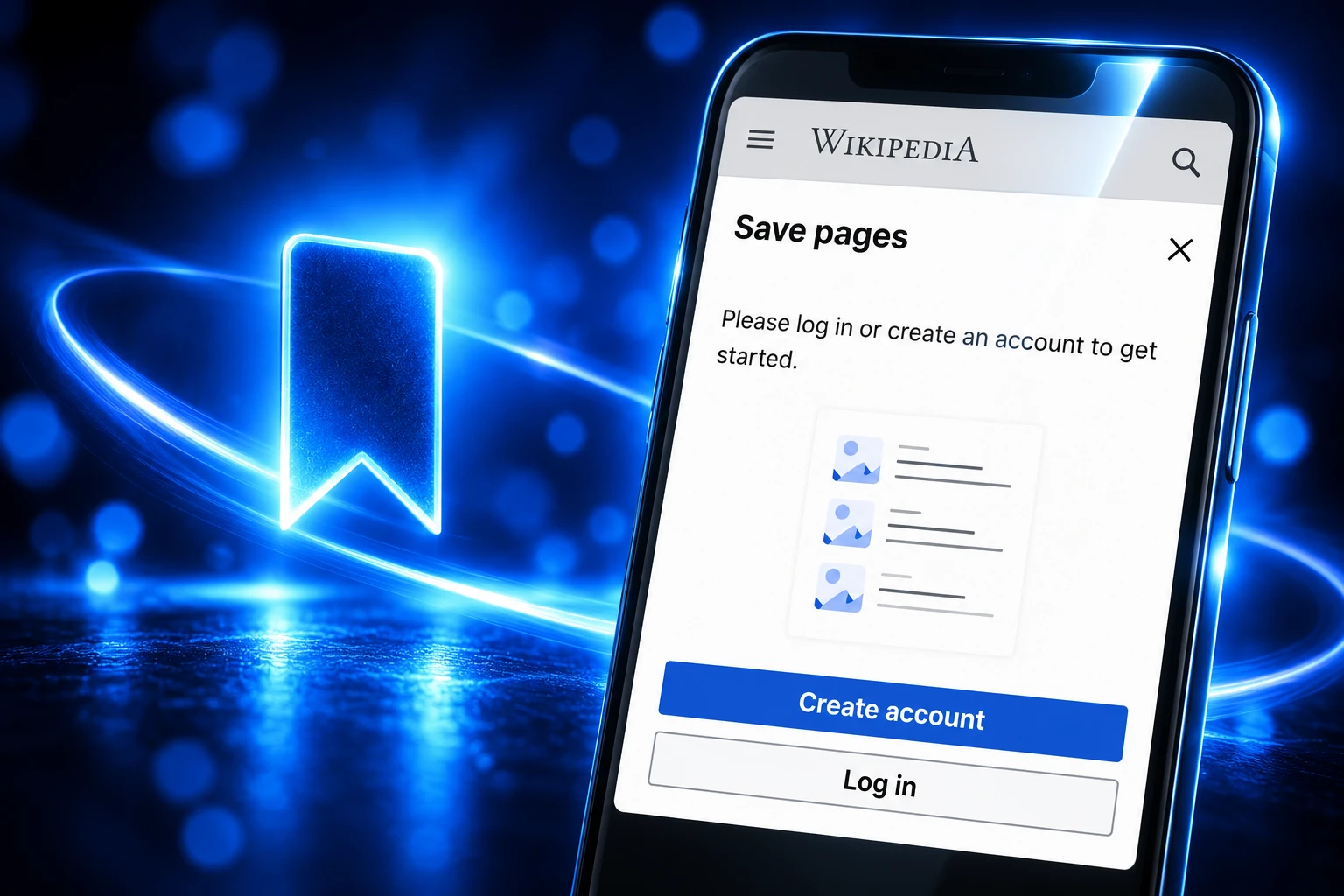
The Web List Is Private and Capped at 5,000
Logged-in users can now save articles to a private reading list from a bookmark icon near the top of the page. Saved titles live on the Reading Lists special page. The list stores a link, not a frozen copy of the article, so the page you reopen is the live version.
WHAT THE FIRST WEB VERSION ALLOWS
- The cap: A user can save 5,000 articles.
- The skins: The feature runs on Vector 2022 and Minerva, and not on Vector 2010, Monobook, Timeless, Modern or CologneBlue.
- The pages: Only main-namespace articles can be saved in this version; project pages and other namespaces are a later ask.
- The account: Saving needs a login, so the list can follow the user across devices; logged-out readers still have browser bookmarks.
- The privacy: Lists are personal. They are not public pages and they do not ask wiki communities to moderate user-made collections.
The team is not offering an opt-out, and it has no plan to let users hide the bookmark. Watchlist is a separate tool. Saving an article does not watch it for edits, and watching a page does not drop it onto the reading list. Editors can do both on the same article.
That split caused a fight in beta. On some screens the bookmark pushed the watchstar out of the toolbar, and editors said they lost a tool they use every day. The desktop design now shows both icons, and the watchstar has a “watch” label. On mobile, and in the sticky header, the bookmark stays in view and the watchstar moves into the overflow menu.
Public lists had a prior life. Gather, a 2015 Wikimedia project, let people publish named collections on the wiki. It was pulled after 2016 over moderation and community control. The new lists do not bring that model back. Any public-list idea, the team wrote, would need a fresh look at that history and a live community talk.
Two Mobile Tests Cut Sessions and Return Visits
Reading Lists are the logged-in half of a wider return-visit push. The Reader Growth team has spent the past year testing mobile-web changes whose score is whether a reader comes back, and the first two big tests went the wrong way.
In December 2025 it ran a four-week A/B test that opened every mobile section by default and pinned the current section header. The bet was that people would find facts faster and stay longer. Auto-expanded sections shortened mobile sessions from 52.2 seconds in the control group to 44.1 seconds in the treatment group, a 15% drop. Early 21-day retention, measured on the first 7-day cohort, fell from 42.3% to 41.6%, about 1.5% relative. The team killed the feature and wrote that a wall of text left people overwhelmed.
A February 2026 table-of-contents test on mobile also showed a negative impact on retention, the same team wrote on its project page, and it was not shipped. Sessions got longer, which the team read as people hunting for a heading and then leaving. Open rates for the new contents control were low.
THE READER GROWTH MOBILE TESTS
| Test | When | Change | Result |
|---|---|---|---|
| Expanded sections | December 2025 | All sections open, pinned header | Session 44.1s vs 52.2s; retention 41.6% vs 42.3%; not shipped |
| Mobile table of contents | February 2026 | Added a contents control on long articles | Longer sessions, lower retention, low open rate; not shipped |
| Minimal Minerva | 31 August to 28 September 2026 | Thinner logged-out mobile bar, lead text about 40 pixels higher | Running; primary metric is a return within 21 days |
Minimal Minerva, nicknamed minmin on English Wikipedia’s technical village pump, is the third try. It runs only for logged-out readers on the Minerva mobile skin, on English, Persian, Czech, Bengali and Polish Wikipedia. English Wikipedia puts 1% of those readers in the test; the other four wikis put 10%. The bar is a bit lighter, and the lead paragraph sits about 40 pixels closer to the top of the screen. Logged-in readers and editors are left alone. A URL parameter lets anyone preview the treatment without joining the sample.
The primary metric is whether a reader comes back within 21 days. The team is also watching constructive edits, so a retention bump does not come at the cost of slower or fewer successful edits. The test is due to switch off on 28 September, the same day Reading Lists reach every remaining Wikipedia.
A Bookmark Replaces the Watchstar for Anonymous Phones
Wanting a Wikipedia account only to bookmark pages is already a common ask. The May test put a number on it. From 18 May to 18 June the team showed logged-out mobile readers on German, Spanish, Italian, Portuguese, Polish, Dutch, Turkish and Urdu Wikipedia a bookmark icon in place of the watchstar.
We saw that about twice as many users tapped on the bookmark compared to the star, indicating desire from anonymous users to save articles.
Reader Experience team, Reading Lists project page, mediawiki.org
People who tapped the bookmark entered the account-creation flow at four times the rate of anonymous users who see the usual invitation to create an account in order to watch a page. On the back of that, the team is showing the bookmark to logged-out users on mobile web through September, and it said it will look at a desktop bookmark for anonymous users shortly after. Saving still needs an account. The icon is the prompt.
Beta users who already had accounts liked the list itself. Of 1,620 surveys collected while the feature was in beta from April to June, 1,509 were positive (93.1%) and 111 were negative (6.9%). More than 800 comments, 28% of the total, included open-ended notes. About 26% of those were plain praise. One respondent wrote, “It’s useful for me to go to something that I will be looking at more without having to search it up again.” Most of the negative notes were about the watchstar being displaced, which is the change the team later walked back on desktop.
An earlier project page set a target of a 5% rise in internal referral traffic among people who use the feature, plus a measurable rise in return visits over two weeks. Those figures are goals, not results. The live metric to watch in September is still the logged-out 21-day return on Minimal Minerva, because that group is the bulk of Wikipedia’s audience.
The Saved Tab Becomes Collections on Android
The Wikipedia Android app is being rebuilt so its Saved tab matches iOS and the new web list. The latest app release adds an All articles view, drops the default Saved reading list, and renames reading lists to Collections. The Android team wrote in its July update that it had started that migration, including backend work on how list data is stored, with a release aimed at early September under task T420788.
The All articles view is there because web and iOS already treat “everything I saved” as a view, not as one more list. On Android, saving an article used to drop it into a default Saved list; adding it to a custom list moved it, so it vanished from Saved. The first time an Android user opened the web list, they would have seen a pile of titles with no matching screen in the app. All articles is the shared picture of every saved page, whichever collection it sits in.
The apps remain ahead of web in one respect. They already let people make named lists, search inside saved pages, and keep copies for offline reading. Web cannot yet sort, export, share, or attach notes. Those asks are on the project page as possible later work, not as a committed roadmap. Suggested articles based on what you saved are on that same list of ideas.
The Math API Shuts by the End of September
While readers get a bookmark, anyone calling Wikimedia’s Math API is on a clock. The August 2026 API changelog announced the deprecation and said the endpoints will be fully sunset by the end of September 2026. Per-wiki Math paths were already marked deprecated in January, when the preferred route moved to wikimedia.org, with a removal date no sooner than this month.
THE MATH SHUTOFF
- January 2026: Per-wiki Math endpoints are marked deprecated; the preferred path is the wikimedia.org Math API.
- August 2026: The changelog announces a full sunset by the end of September 2026.
- End of September 2026: The endpoints close. Callers are told to move to other rendering. Third-party MediaWiki sites that use the Math extension must run version 1.43 or later.
The changelog tells developers to move to native MathML rendering in browsers or to MathJax as a client-side renderer. MediaWiki’s Math extension documentation warns that Mathoid, the old server-side converter that sits behind RESTBase, is no longer actively developed. On English Wikipedia’s mathematics project talk page, editor jacobolus wrote in August that the preference-gated MathJax option shipping there was “unacceptably bad,” and argued the old pipeline is being dropped before the new one is ready. That dispute is separate from the API close date, which is now this month.
Thumbnails Move to thumb.wikimedia.org This Month
Thumbnail URLs are changing host, from upload.wikimedia.org to thumb.wikimedia.org. Old thumbnail URLs will keep working for the foreseeable future, Wikimedia tech notes said, but MediaWiki will advertise the new domain. Videos, transcodes and original files stay on upload.wikimedia.org for original media.
On the Commons technical village pump, Wikimedia staffer JTweed-WMF said thumbnail serving is moving off the upload cluster for better caching and resilience against scraper traffic, and that the change was already rolling wiki by wiki, with test wikis, mediawiki.org, Czech and Persian Wikipedia, and German Wikipedia among the first. Tool author Kevin Payravi wrote that he hoped the new host would ease rate limits that had broken thumbnail display in tools. JTweed-WMF said the other reason is to put thumbnails on the same CDN cache as text, which is larger, so thumbs are not pushed out by automated grabs of huge original files. Separate rate limits for thumbnails and originals are planned once the split is in place.
Sites that hotlink Wikimedia thumbs at odd pixel widths have already been squeezed this year. Direct requests that do not use the standard steps (20, 40, 60, 120, 250, 330, 500, 960, 1280, 1920 and 3840 pixels) are rejected at the CDN. On-wiki thumbs still round up to the next step and let the browser scale.
English Wikipedia gets the bookmark on 14 September. The Minimal Minerva test and the last Reading Lists wave both land on 28 September, which is also the month the Math API is due to go dark.

The BMW iX4 Undercuts Mercedes and Trails Its Twin

Scotland’s Ten Big Supermarkets Already Hold the Weekly Shop

Scotland EMS Faces a State Probe After a Wagram Death

Meritz Signs Ripple to Race Korea’s 2027 Token Rules

Pocognoli’s First Camp Leaves Scotland Third and Exposed

Volkswagen Sells the Osnabruck Plant to Clear a Board Fight

Tata Motors’ Iveco Tender Opens as Holders Still Decide

Saksham Gaur Finds He Is His Own Company’s Client

Onimusha Way of the Sword Preload Hits a Windows 11 Wall

Apple’s Foldable iPhone Hinges on Samsung Display Supply
-
 AUTO1 month ago
Volkswagen Sells the Osnabruck Plant to Clear a Board Fight
-
 AUTO2 months ago
Tata Motors’ Iveco Tender Opens as Holders Still Decide
-
 BUSINESS2 months ago
Saksham Gaur Finds He Is His Own Company’s Client
-
 GAMING2 months ago
Onimusha Way of the Sword Preload Hits a Windows 11 Wall
-
 NEWS2 months ago
Apple’s Foldable iPhone Hinges on Samsung Display Supply
-

 NEWS1 month ago
iQOO 16 Locks 8,400 mAh While 100W Charging Holds
-

 NEWS1 month ago
The Frame Pro’s $1,200 Labor Day Cut Needs a Soundbar
-

 AUTO2 months ago
Simple Wave Chases Range as Ather Konarc Cuts Price