
ENTERTAINMENT
Six Flags Magic Mountain Retires X2 After Tests Passed
Six Flags retired X2 at Magic Mountain citing lost guest confidence, even after the 4D coaster passed repeated G-force tests.

Six Flags Magic Mountain permanently retired X2 on Tuesday, Sept. 29, citing lost guest confidence in the fourth-dimension coaster.
Park president Brian Oerding said the ride had passed a multitude of safety tests. It had sat idle since July 12, after two riders needed emergency brain surgery days apart.
Six Flags Retired X2 After Guest Confidence Collapsed
In a park blog post, Oerding said the company had decided to permanently retire X2 after almost 20 years as the relaunched ride. He dated that run from 2008, when new trains and a new name replaced the original X, which opened to the public on Jan. 12, 2002.
While X2 consistently passed a multitude of safety tests, we have decided to close the ride because we believe it’s the right thing to do. Ride safety is a cornerstone of our business, and when we see guest confidence affected, we take it seriously.
Brian Oerding, president, Six Flags Magic Mountain, park blog post
The park’s own account posted the same news that morning.
After almost 20 years, we have decided to permanently retire X2. Read Six Flags Magic Mountain Park President Brian Oerding’s blog post for more details: https://t.co/gtLWzbYnZm pic.twitter.com/L8HupTsFBQ
— Six Flags Magic Mountain (@SFMagicMountain) September 29, 2026
Six Flags said X2 had welcomed more than 16 million guests since 2008 and had a passionate following among ride fans. That following is real. Enthusiasts have long ranked the spinning-seat layout with skydiving, and the shutdown reads to them as the loss of a one-of-a-kind machine, not a failed inspection.
Oerding pointed readers to the company’s comprehensive safety program at Six Flags, which puts daily park checks beside outside inspectors, state inspectors where they apply, insurers, and corporate engineers. The same program tells guests that many rides are a poor match for heart, neck, or back trouble, recent surgery, or other conditions, and that only the rider knows those limits. That split, tests on one side and a medical warning on the other, is the ground the park stood on when it pulled X2 without saying a test had failed.
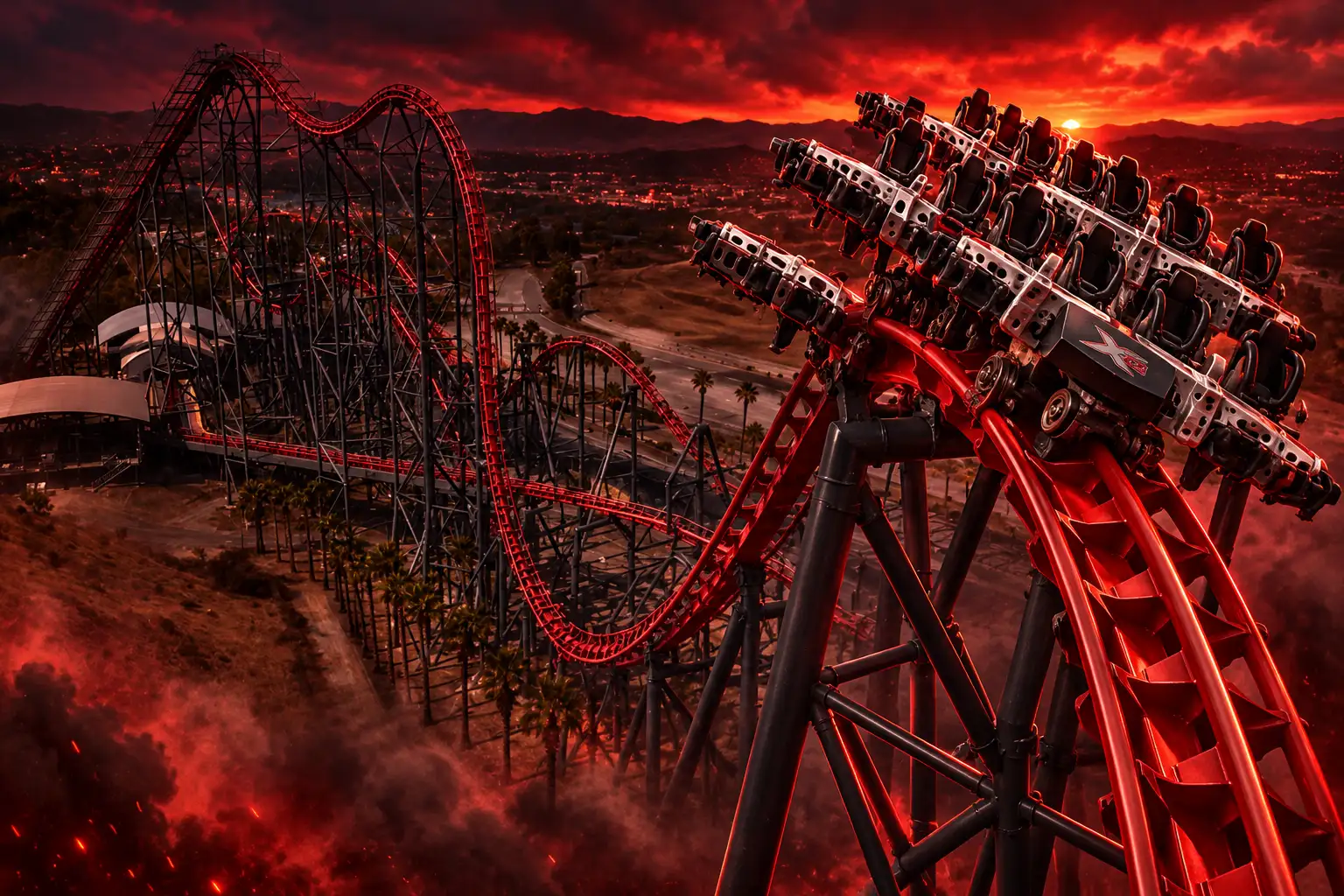
What a Fourth-Dimension Coaster Does to a Rider
X2 was the prototype of the type. Seats hang on both sides of the rail and rotate on a second axis, so a rider can face the ground, the sky, or a full 360-degree spin while the train is already twisting. The layout used a chain lift, an inside raven turn, an outside raven turn, and fly-to-lie moves that put riders on their backs, then prone.
Industry listings give the ride a 175-foot lift and 215-foot drop, a top speed of 76 mph, 3,610 feet of track, two inversions, an 88.5-degree first plunge, and a peak of 4 Gs. Arrow Dynamics built it. S&S Worldwide supplied the lighter trains fitted in 2008.
Erik Seedhouse, an associate professor at Embry-Riddle Aeronautical University and author of a book on human responses to high and low gravity, said four Gs is more than the about three Gs astronauts felt during a space shuttle launch, and that four Gs would usually not be harmful. Roller coasters, he said, are G-limited to five G, which is not a problem for a single ride, though a person with a medical condition who rides multiple times may face a problem.
That is the industry’s comfort zone. It is also why a coaster can clear acceleration tests and still end up in a coroner’s file. The forces sit inside the published envelope. The envelope was written for a rider whose brain and blood vessels behave as the model expects.
Two Deaths, Then a July Pair of Brain Surgeries
The park did not retire a ride with a clean medical history. Two riders died after getting off X2, and two more went to the same Valencia hospital in July 2026.
THE X2 INJURY FILE
- October 2010: Hilda Farias, 28, dies after riding X2. The Los Angeles County medical examiner’s office records an acute cerebellar hemorrhage. Doctors at the time suggested an underlying brain abnormality. Her family later received a settlement.
- June 23, 2022: Christopher Hawley, 22, a San Diego State University graduate, rides X2 with his younger brother and cousin. He holds a rail on the exit ramp, walks unsteadily, and says his head hurts.
- June 24, 2022: Hawley dies. A CT scan had shown a catastrophic right subdural hematoma. The medical examiner rules the death accidental, from blunt head trauma in a park ride accident.
- July 5, 2026: Pamela Guillen, celebrating her daughter’s 16th birthday, repeatedly strikes her head on the headrest, vomits, and loses consciousness. Surgeons remove part of her skull for a severe subdural hematoma. She does not wake for two weeks.
- July 11, 2026: Naomi Greer-Wilkinson, 25, loses consciousness after the same coaster and undergoes emergency brain surgery at the same hospital.
- July 12, 2026: Six Flags shuts X2. California’s Division of Occupational Safety and Health opens an inquiry.
- August 27, 2026: Six Flags and S&S Worldwide settle the Hawley family’s wrongful-death case for an undisclosed amount, with no finding of defect. A trial had been set for early September.
- September 21, 2026: Three riders sue Six Flags and S&S Worldwide, alleging catastrophic brain injuries and a failure to warn.
- September 29, 2026: Oerding announces the permanent retirement, eight days after those filings.
Anne Hawley, Christopher’s mother, said she was relieved the ride was shut for good.
This ride should have been closed long before our son Christopher was injured, and it certainly should have been closed after he died. Instead, it took more than four years and dozens of other injured riders for Six Flags to do the right thing.
Anne Hawley, mother of Christopher Hawley, statement through Wisner Baum
Doctors who treated the two July riders described a rapid acceleration-deceleration event. In the Hawley case, Six Flags and S&S argued that an arachnoid cyst already in his brain had ruptured, and that a biomechanical engineer found the ride did not generate enough force to cause the bleed. That defense, that the machine is fine and the hidden condition is not, is the same argument some fans still make about the shutdown. It is also why a settlement with no finding of defect left the design itself unindicted.
Industry Tests Cleared Four Gs Three Times
Court papers in the Hawley case said X2 passed industry-standard acceleration tests in 2008, 2018, and 2023, including a round after his death. A state employee testified that Cal/OSHA had looked at the seat restraints and head padding, that Six Flags later supplied data showing the forces were still inside the standards, and that the division allowed the coaster to reopen.
WHAT THE FILE SHOWS
- Test years: Acceleration checks in 2008, 2018, and 2023, the last of them after Hawley’s death.
- Peak force: Listings put the ride at 4 Gs, under the five G limit Seedhouse described for coasters.
- State role: Cal/OSHA inspected and allowed a restart after 2022; the 2026 inquiry followed the July surgeries.
- Park line: Daily inspections, and a claim in filings that a rider using the coaster as instructed would not suffer a traumatic brain injury.
U.S. ride design leans on ASTM F2291, the practice that sets acceleration limits for amusement rides. California does not run a federal amusement-ride agency over permanent park coasters. It runs a state program. The tests the park cites live in that stack of industry practice plus state inspection, which is why a ride can keep a clean test card while families keep a coroner’s report.
Japan and China Still Spin the Same Seat Design
X2 was the first full-size controlled fourth-dimension coaster. It is no longer the only one, and the retirement does not retire the class.
THE THREE FULL-SIZE 4D COASTERS
| Ride | Park | Opened | Status |
|---|---|---|---|
| X2 (opened as X) | Six Flags Magic Mountain, Valencia | 2002, relaunched 2008 | Retired Sept. 29, 2026 |
| Eejanaika | Fuji-Q Highland, Japan | 2006 | Operating |
| Dinoconda | China Dinosaurs Park, Jiangsu | 2012 | Operating |
S&S kept selling a simpler cousin, the 4D Free Spin, whose rows rotate without the full Arrow-style rail. Those trains still run at other U.S. parks, including Tumbili at Kings Dominion. Nothing in Oerding’s post speaks to those rides. Nothing in the Valencia retirement orders Fuji-Q or China Dinosaurs Park to change a bolt.
The prototype is the one that spent two decades in American courts. The later copies are the ones still selling tickets. If the harm came from 4 Gs plus a spinning seat, those parks now own the question. If the harm came from an aging Arrow layout, a rough raven turn, or a headrest that did not hold a skull, then X2 can die alone. The park did not say which story it believes. It said guest confidence was affected.
Cal/OSHA Still Has an Open File on the Ride
Gary A. Dordick, the Beverly Hills lawyer who filed the September suits, said the shutdown came too late for his clients and that it will not stop the cases. His firm has been retained by more than 100 additional people who allege brain injuries of varying severity after riding X2. S&S Worldwide, which settled with the Hawleys and built the 2008 trains, issued no public comment on the retirement.
WHAT WE KNOW
- The ride: Permanently retired on Sept. 29, 2026, after last running on July 12.
- The deaths: Farias in 2010 and Hawley in 2022, both after riding X2, both later tied to settlements.
- The July cases: Guillen and Greer-Wilkinson, six days apart, both in emergency brain surgery.
- The park’s stated reason: Guest confidence, with a claim that safety tests kept passing.
WHAT IS UNCONFIRMED
- A state shutdown order: California’s permanent amusement ride safety rules let the division inspect, certify, take accident reports, and issue an order prohibiting operation. The park closed X2 itself. No public scrap order has been posted.
- A replacement: Six Flags has not named a new ride for the plot.
- The remaining suits: Terms of the Hawley deal stay confidential. Other injury cases, including one set for trial in 2027, are still live. Dordick said more filings are coming.
The steel is still in Valencia. The sister coasters in Japan and China still dispatch spinning seats. The file Cal/OSHA opened in July is the one piece of the story the park cannot retire by blog post.
Frequently Asked Questions
Who Designed X2, and Who Built the Trains?
Alan Schilke designed the layout for Arrow Dynamics, which installed X as its last roller coaster before the firm failed and S&S Worldwide took over the steel-coaster line. Arrow built the original trains. S&S supplied the lighter trains fitted when the ride came back as X2 in 2008, which is why both companies sat in the Hawley case.
What Was the Height Limit and How Many People Could It Carry?
Riders had to be at least 48 inches tall. The coaster was listed at 1,600 riders an hour, with three trains of seven cars, four seats across, 28 people per train, using over-the-shoulder harnesses on the wing seats.
When Did the Original X First Run?
Season passholders rode on Dec. 24, 2001. The public opening was Jan. 12, 2002. The park closed the original trains for a rebuild and reopened the coaster as X2 in 2008 with onboard audio, fog, and fire effects.
Can California Order a Park Ride Shut?
Yes. The state’s Permanent Amusement Ride Program, under Cal/OSHA, includes inspections, certificates of compliance, accident notification, and an order prohibiting operation. In the Hawley aftermath the division allowed X2 to reopen after reviewing force data. In July 2026 it opened a new inquiry; the park then retired the ride on its own.
Do Other Fourth-Dimension Coasters Still Operate?
Eejanaika at Fuji-Q Highland in Japan (2006) and Dinoconda at China Dinosaurs Park (2012) still run the controlled-spin S&S/Arrow design. Separate 4D Free Spin models, a simpler S&S product, still operate at several U.S. parks. Those rides were not named in the Magic Mountain retirement post.
Disclaimer: This article is news reporting on a ride retirement, public statements, and court filings. It is for information only and is not medical, legal, or personal-injury advice. It does not say whether any rider should have boarded X2, whether any company is liable, or how any pending claim should be decided. Anyone with symptoms after an amusement ride, or a question about a claim, should speak with a licensed physician and a qualified attorney in the relevant state. Figures, case statuses, and the Cal/OSHA inquiry reflect the public record as dated in the sources above and may change as filings and inspections move.

Edinburgh Opens a 2027 Tour Built for Time Trials

Korda Maps Auður From Meðalland to Irvine Bay

Apple Music Films Its New Logo in Mineral Oil

Oppo Prices the Pad Mini Above India’s iPad Mini

Austen Soaks Scotland Before Boelo Brings Weekend Gales

Volkswagen Sells the Osnabruck Plant to Clear a Board Fight

Apple’s Foldable iPhone Hinges on Samsung Display Supply

Saksham Gaur Finds He Is His Own Company’s Client

Tata Motors’ Iveco Tender Opens as Holders Still Decide

Onimusha Way of the Sword Preload Hits a Windows 11 Wall
-
 AUTO2 months ago
Volkswagen Sells the Osnabruck Plant to Clear a Board Fight
-
 NEWS2 months ago
Apple’s Foldable iPhone Hinges on Samsung Display Supply
-
 AUTO2 months ago
Tata Motors’ Iveco Tender Opens as Holders Still Decide
-
 BUSINESS2 months ago
Saksham Gaur Finds He Is His Own Company’s Client
-
 GAMING2 months ago
Onimusha Way of the Sword Preload Hits a Windows 11 Wall
-

 ENTERTAINMENT3 years ago
What is SD on Amazon Prime? – All You Need to Know
-

 BUSINESS2 months ago
Hyderabad 22-Carat Gold Jumps After a False Bargain
-

 NEWS2 months ago
iQOO 16 Locks 8,400 mAh While 100W Charging Holds