
NEWS
Scotland’s Rights Watchdog Tests the Plan After 1,133 Deaths
Scotland’s human rights commission has asked John Swinney to show how the 2026 drugs plan is designed and judged after 1,133 drug deaths.

Scotland’s human rights watchdog has asked First Minister John Swinney how ministers are embedding rights in drugs policy, after 1,133 people died in 2025.
Professor Angela O’Hagan, chair of the Scottish Human Rights Commission, sent that request on 12 October and copied three Holyrood committees. She treats the toll as a question of the right to health and, in some cases, the right to life.
The Watchdog Asked How the New Plan Will Be Judged
The letter followed National Records of Scotland’s release on 23 September, which showed an 11% rise, 116 more deaths than in 2024. Commission members, O’Hagan wrote, had noted with alarm that Scotland still has Europe’s highest drug death rate despite years of pledges to reverse it.
She said drug deaths are unacceptable and avoidable, and that they are not an inevitability for Scotland. The ask is specific. She wants an urgent update on rights-based design and on how any policy is judged, not another inventory of services.
Drug deaths are a human rights issue. Updated statistics show an 11% rise in deaths related to illicit drugs. This is devastating for the people affected, their families and communities. Death rates are persistently high in Scotland, despite policy commitments to reverse this situation.
Professor Angela O’Hagan, Chair, Scottish Human Rights Commission
The letter names the duties she says are engaged and points ministers to a UN-backed standard for applying them to drugs policy, the International Guidelines on Human Rights and Drug Policy.
RIGHTS THE COMMISSION SAYS ARE ENGAGED
- The health duty: Article 12 of the International Covenant on Economic, Social and Cultural Rights, the right to the highest attainable standard of health.
- The life duty: Article 2 of the European Convention on Human Rights, an absolute right given effect in the Human Rights Act 1998, engaged in some circumstances.
- The poverty link: the commission’s own poverty work, which treats deprivation as both a cause and a consequence of rights denials.
That package moves the argument off a count of rehab placements. It asks whether the next decisions can be scored against those duties, including the deprivation pattern in the death register.
Scotland’s 2026 Plan Already Claims a Rights Approach
Ministers are not starting from a blank page. On 10 March 2026 the Scottish Government and COSLA published Preventing Harm, Promoting Recovery, the Alcohol and Drugs Strategic Plan for 2026 to 2035. The announcement said the plan is underpinned by a human-rights based approach, with people who have first-hand experience helping to shape services.
The plan took over from the National Mission on Drug Deaths, announced in January 2021 with an extra £250 million over five years. That mission ended in April 2026. The new plan is backed by more than £160 million in 2026-27 and is built around prevention and early intervention, harm reduction, treatment and care, and a wider circle of support. It also says medication-assisted treatment standards will be expanded to cover alcohol and all drugs.
Alcohol and Drugs Minister Maree Todd, speaking when the 2025 figures came out, said the plan would strengthen surveillance, deepen links between treatment, housing and other services, and target communities most at risk. She also said Scotland’s first local drug-checking service would open in Glasgow in October 2026, building on the UK’s first safer drug consumption facility.
O’Hagan’s letter arrives after that text was already public. The live question is whether the rights sentence in the March plan is changing design and evaluation, or sitting in the foreword while the death register moves.
Cocaine Was Implicated in Over Half of Deaths
NRS counted 1,133 drug use deaths in 2025, the sixth highest annual total, still below the 2020 peak of 1,339. The age-adjusted rate was 21.4 per 100,000 people, four times the rate when the series began in 2000. The average age at death was 46, up from 32 in 2000. The highest rates remain in the 35 to 44 and 45 to 54 groups.
DRUG USE DEATHS, 2024 AND 2025
| Measure | 2024 | 2025 | Change |
|---|---|---|---|
| All drug use deaths | 1,017 | 1,133 | +116 (11%) |
| Male deaths | 699 | 830 | +131 (19%) |
| Female deaths | 318 | 303 | -15 (5%) |
| Cocaine implicated | 479 | 589 | +110 (23%) |
| Nitazenes implicated | 76 | 247 | More than three times |
Cocaine was named in 589 deaths, 52% of the total, the highest since NRS began publishing that split in 2008. In 101 deaths cocaine was the only drug named. Nitazenes were named in 247 deaths, 22% of the register, more than three times the 76 recorded in 2024. Etonitazene accounted for 215 of those nitazene deaths.
Public Health Scotland has told services that nitazenes pose a high risk of overdose, that some types are hundreds of times more potent than heroin, and that they often appear as unexpected contaminants in heroin, benzodiazepines and oxycodone. The alert says the response is still naloxone, though the overdose may be more sudden and severe.
Opiates and opioids were still implicated in 881 deaths, 78% of the total. Heroin or morphine appeared in 468 deaths (41%) and methadone in 338 (30%). Benzodiazepines were implicated in 433 deaths (38%), down from a peak of 879 in 2020. More than one drug was implicated in 78% of deaths, a separate count from the opioid share.
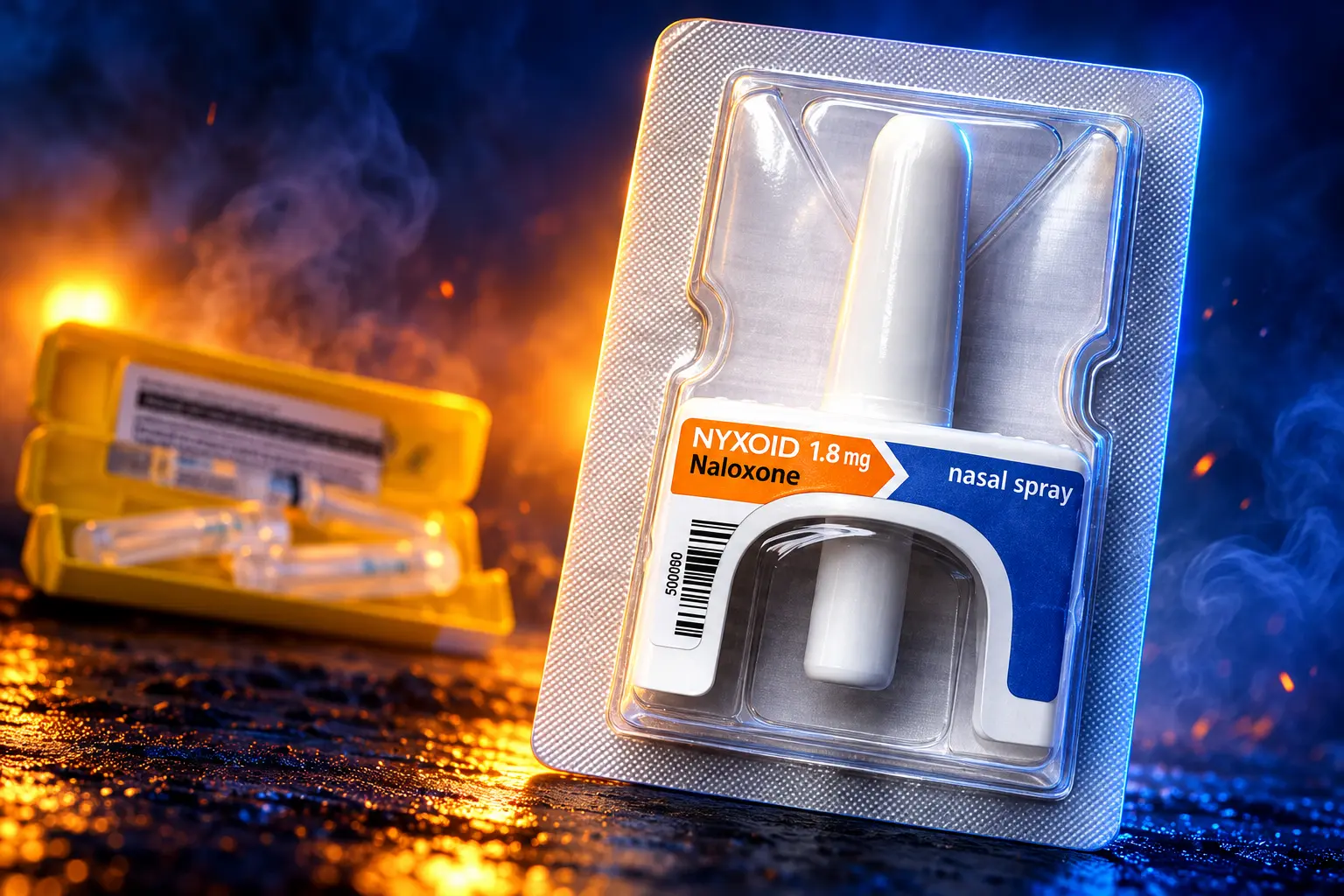
Naloxone reverses opioid overdoses. It does not reverse cocaine. Todd warned of an increasingly toxic and unpredictable supply and said the cocaine rise, and the continued threat from nitazenes, must drive more coordinated action. Police Scotland officers have administered naloxone more than 1,300 times in five years, and she told parliament that almost 89% of people at risk of an opioid overdose have been supplied with a take-home kit.
Against an increasingly toxic and unpredictable drugs supply, this rise is deeply concerning and unacceptable. The increase in deaths involving cocaine, and the continued threat from dangerous synthetic opioids like nitazenes, must drive more coordinated action across the country.
Maree Todd, Alcohol and Drugs Minister, Scottish Government statement, 23 September 2026
Those kits are a thin answer to a register in which cocaine now appears in more than half of cases. Nitazenes still respond to naloxone, though they may need repeated doses. Cocaine does not.
What the National Mission Counted
The five-year mission was built to cut deaths with treatment access, rehab capacity, naloxone and, late in the period, a consumption room. The 2025 register is the first full calendar year after several of those tools were in place, and it still rose.
FROM THE MISSION TO THE LETTER
- January 2021: the Scottish Government announces a National Mission on drug deaths with an extra £250 million through 2026.
- January 2025: The Thistle, the UK’s first safer drug consumption facility, opens in Glasgow.
- 10 March 2026: ministers and COSLA publish the 2026 to 2035 alcohol and drugs plan, saying it is underpinned by a human-rights based approach.
- April 2026: the National Mission ends.
- 23 September 2026: NRS publishes 1,133 drug use deaths for 2025, an 11% rise.
- 12 October 2026: O’Hagan writes to Swinney asking how rights are being designed into the work and how impact will be judged.
Todd said the government funded more than 1,100 residential rehabilitation placements last year, above the pledge of 1,000 a year, and that publicly funded access had more than doubled since 2019-20. Bed capacity reached 574 in 2025, against a target of 650 by 2026 from 425 in 2021, with £100 million set aside for residential rehab over the mission. At First Minister’s Questions on 24 September, Swinney said Thistle staff had responded to 195 medical emergencies and that the death toll would have been worse without that service.
Annemarie Ward, chief executive of Faces and Voices of Recovery UK, said the government was listing kits, placements and visits. “Those are measures of activity. They are not measures of success.”
Male deaths rose 19% to 830. Female deaths fell 5% to 303, the lowest since 2017. The 2025 increase was a men’s crisis inside a national one, concentrated in middle age, and it arrived after a mission that reported progress in the tools it could count.
Deaths Run 15 Times Higher in the Poorest Areas
NRS found the rate in the most deprived areas was 15 times the rate in the least deprived. For all causes of death the gap is about two times. Deaths rose in 20 local authority areas and fell in 10.
Swinney told parliament the drivers are intergenerational poverty and trauma, plus an upsurge in grossly harmful synthetics. He said he was briefed on 26 February 2026 about an expected rise in suspected deaths and asked for a review of drug and alcohol interventions, considered at a summit on 19 June with the health secretary, Todd and COSLA. He called the situation a public health emergency and said the deaths were unacceptable and intolerable. He also said the government supports decriminalising drugs for personal use.
O’Hagan’s letter uses that deprivation ratio as a rights fact, not a social footnote. A plan that claims a rights approach has to show what it changes in the poorest streets, where the death rate is 15 times the rate in the richest, rather than only how many national placements were funded.
Wholesale routes and county lines that move cocaine and heroin into Scotland are real, and adulterants follow when supply tightens. They do not explain why Scotland’s drug poisoning death rate was 2.4 times England’s on the latest comparable 2024 figures, 1.6 times Northern Ireland’s and 1.5 times the rate in Wales. Health, housing and most treatment have been devolved for more than 25 years. The mortality gap is a Scottish outcome.
Three Committees Now Have the Letter
O’Hagan copied the conveners of the committees that scrutinise rights, health and public services, and she copied Todd. The file is now a parliamentary object as well as a letter to the First Minister.
WHO RECEIVED THE FILE
- Equalities, Human Rights and Civil Justice Committee: the rights scrutiny body named in the letter, with convener Katie Hagmann copied.
- Health and Social Care Committee: the health scrutiny body named in the letter, with convener Helen McDade copied.
- Public Service Reform Committee: the third committee named in the letter, which scrutinises how public services are designed and run.
Todd said the reserved Misuse of Drugs Act 1971 still limits further public health measures, which is why ministers keep asking the UK government to transfer greater powers over drugs policy. Swinney’s support for decriminalising personal use sits inside that dispute. O’Hagan does not wait for Westminster. She asks what Holyrood is already doing with poverty, healthcare inequalities, and the design of the plan that is now in force.
Kirsten Horsburgh, chief executive of the Scottish Drugs Forum, said the nitazene share of deaths showed how fast the risks are changing and called for quicker expansion of safer consumption facilities, drug checking and harm reduction equipment. Todd’s Glasgow checking service is one reply to that. It is intelligence about a contaminated market, not a treatment pathway.
WHERE EXPERTS DISAGREE
- The commission: O’Hagan says deaths are avoidable and that any further action must address root causes, with rights built into design and evaluation, not only into policy language.
- The minister: Todd says the supply has become more toxic, that existing interventions have not cut deaths enough, and that reserved UK law blocks some of the next public health steps.
- Recovery campaigners: Ward says listing naloxone kits, rehab placements and consumption-room visits measures busyness, and that 830 dead men in one year demand a different system, not a busier one.
The 2025 register is closed at 1,133. The National Mission has ended. The 2026 to 2035 plan is published and already claims a rights approach. The commission has asked Swinney how those rights are being designed into the work that remains, and how anyone will know if they are.
Disclaimer: This article is news reporting and analysis of official statistics and a public letter from the Scottish Human Rights Commission. It is informational only and does not constitute medical advice on addiction, overdose or treatment, and it does not constitute legal advice on human rights claims or duties under the Human Rights Act 1998. Anyone seeking treatment, harm-reduction supplies or advice about drug use should contact local health services, an alcohol and drug partnership, or a qualified clinician, and anyone considering a legal challenge should consult a solicitor. Figures, committee names and policy statuses are those given in the cited official publications and statements and may be revised.

Edinburgh Opens a 2027 Tour Built for Time Trials

Korda Maps Auður From Meðalland to Irvine Bay

Apple Music Films Its New Logo in Mineral Oil

Oppo Prices the Pad Mini Above India’s iPad Mini

Austen Soaks Scotland Before Boelo Brings Weekend Gales

Volkswagen Sells the Osnabruck Plant to Clear a Board Fight

Apple’s Foldable iPhone Hinges on Samsung Display Supply

Saksham Gaur Finds He Is His Own Company’s Client

Tata Motors’ Iveco Tender Opens as Holders Still Decide

Onimusha Way of the Sword Preload Hits a Windows 11 Wall
-
 AUTO2 months ago
Volkswagen Sells the Osnabruck Plant to Clear a Board Fight
-
 NEWS2 months ago
Apple’s Foldable iPhone Hinges on Samsung Display Supply
-
 BUSINESS2 months ago
Saksham Gaur Finds He Is His Own Company’s Client
-
 AUTO2 months ago
Tata Motors’ Iveco Tender Opens as Holders Still Decide
-
 GAMING2 months ago
Onimusha Way of the Sword Preload Hits a Windows 11 Wall
-

 ENTERTAINMENT3 years ago
What is SD on Amazon Prime? – All You Need to Know
-

 BUSINESS2 months ago
Hyderabad 22-Carat Gold Jumps After a False Bargain
-

 NEWS2 months ago
iQOO 16 Locks 8,400 mAh While 100W Charging Holds