
BUSINESS
Sensex Gains 299 Points on a Still Costly Oil Slide
Sensex and Nifty bounced as Brent fell a sixth day to $98.2, but India’s oil bill, frozen pumps and a 95-handle rupee still carry the war premium.

The Sensex rose 299.17 points to 74,828.25 on Wednesday, 23 September, as Brent crude fell for a sixth session to $98.2 a barrel. The Nifty 50 added 117.80 points, or 0.50 percent, to 23,446.80 and still closed under the 23,500 cap technicians keep naming as the next test.
Cheaper oil, a firmer rupee tick and a drop in India VIX to 10.36 did the work on the tape. They did not change the bill India is still paying for a war that began in late February, or the fact that foreign funds sold into Tuesday’s oil dip.
The Bounce Was Only 299 Points
Tuesday’s close had left the Sensex at 74,529.08, down 329.91 points, and the Nifty at 23,329, down 85.30. Wednesday took back most of that loss and stopped. Bank Nifty rose 333 points, or 0.59 percent, to 56,549. The Nifty Midcap 100 gained 0.70 percent and the Nifty Smallcap 100 gained 0.89 percent, so the bounce was broader than the headline.
Nifty Metal led with a 2.40 percent jump, helped by SAIL’s 6 percent rise and by roughly 3 percent gains in Tata Steel, JSW Steel and Hindalco. FMCG added 1.32 percent, PSU banks 1.14 percent, realty 1.10 percent and pharma 0.90 percent. Nifty IT fell 0.87 percent and media fell 0.63 percent, the only major groups to finish lower.
WEDNESDAY’S CLOSING LEVELS
| Index | Close | Change | Percent |
|---|---|---|---|
| Sensex | 74,828.25 | +299.17 | +0.40% |
| Nifty 50 | 23,446.80 | +117.80 | +0.50% |
| Bank Nifty | 56,549 | +333 | +0.59% |
| Nifty Metal | – | – | +2.40% |
| Nifty IT | – | – | -0.87% |
| Nifty Midcap 100 | – | – | +0.70% |
| Nifty Smallcap 100 | – | – | +0.89% |
Among Sensex members, Tata Steel, Bajaj Finance, ITC, UltraTech Cement, Power Grid, Larsen & Toubro, Bajaj Finserv, Sun Pharma and Adani Ports led the winners. HCL Technologies fell 1.10 percent, Infosys 1.03 percent and Tata Consultancy Services 0.95 percent, with Titan, Mahindra & Mahindra and ICICI Bank also lower. Vikram Kasat, chief business officer for advisory and dealing at PL Capital, called it a measured recovery after Tuesday’s cut, with foreign selling still the overhang.
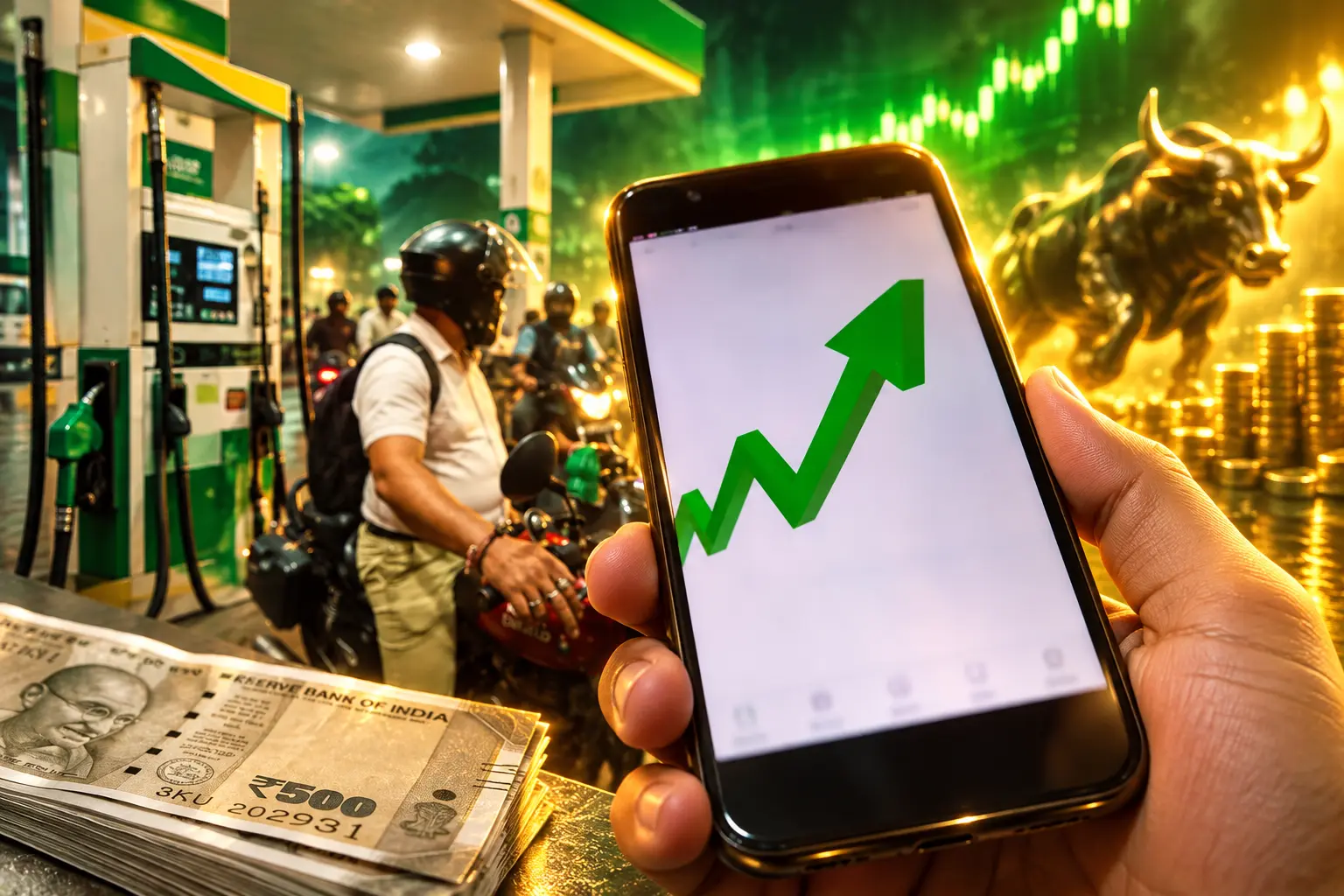
Cheaper Oil Is Still $98 Oil
Brent settled 1.1 percent lower at $98.2, the sixth straight drop, after Saudi Arabia signalled it would restore flows on the East-West pipeline to the Red Sea port of Yanbu and after traders priced hopes of talks around the US-Iran war at the United Nations in New York. Oil had traded as high as $109 a barrel after that 1,200 km line was shut following drone strikes on pumping stations about two weeks earlier. A $98 handle is cheaper than that spike. It is not cheap.
Before the war began in late February, Brent had been around $70 to $75. It crossed $100 on 9 September. India’s crude basket, which had been near $69 before Hormuz was restricted in early March, ran above $114 in April and was still near $109 in early September, according to the Indian crude basket price series tracked by the Petroleum Planning and Analysis Cell. Ponmudi R, chief executive of Enrich Money, said the pullback offers some relief for a country that lives on imported fuel. Hariselvan Radhakrishnan, founder of HST Wealth, put the limit in one line.
The retreat in crude prices has eased some pressure on India’s inflation and external balances, but that relief remains vulnerable to renewed geopolitical escalation.
Hariselvan Radhakrishnan, Founder and CEO, HST Wealth
THE OIL SHOCK ON THE CALENDAR
- Late February 2026: The US-Iran war begins. Brent had been around $70 to $75 a barrel.
- Early March 2026: Passage through the Strait of Hormuz is restricted. India is forced off a route that had carried about 45 percent of its crude.
- April 2026: The Indian crude basket averages $114.5 a barrel.
- 9 September 2026: Brent crosses $100 again as the shock re-escalates.
- Mid-September 2026: Drone strikes shut Saudi Arabia’s East-West pipeline. Oil prints as high as $109.
- 23 September 2026: Brent settles at $98.2 after a sixth down session. The Sensex rises 299.17 points.
After the cash market closed, remarks attributed to Mohsen Rezaei, secretary of Iran’s Supreme National Security Council, circulated on trading desks saying Hormuz would stay shut until Tehran’s conditions were met. Gift Nifty slipped as crude ticked up on those comments. The six-day slide can reverse on a sentence.
The Import Bill Barely Noticed the Rally
India is the world’s third-largest importer of oil, and an EY study put crude import dependence slightly above 90 percent in FY26. Paul Stahle, a former US State Department energy adviser writing for the Atlantic Council, noted that before the Hormuz squeeze, 45 percent of India’s crude, half its LNG and 90 percent of its LPG moved through that strait. The International Energy Agency still casts India as the largest source of global oil demand growth through 2030. That is a hard bill to shrink in a week.
PPAC figures show the crude import bill at $63.4 billion (about Rs 5.94 lakh crore) in April-July, up 56.5 percent from $40.5 billion a year earlier, while volumes were almost unchanged at 81.9 million tonnes against 81.5 million. July alone cost $13.7 billion, up 41 percent, on 21.4 million tonnes against 18.9 million. Motilal Oswal estimates the current account deficit could widen to 1.7 percent of GDP, about $71 billion, if crude stays above $90 for much of the second half.
The government’s own April to August crude import volumes tell the same story in tonnes: 18,468 thousand tonnes in April, 22,190 in May, 19,592 in June, 21,405 in July and 19,014 in August. A sixth down-day in Brent changes the next cargo. It does not rewrite those five months.
Frozen Pumps and a Rs 23 Diesel Gap
Public-sector petrol and diesel have risen only about Rs 3 a litre since the war began. ICRA estimates that at September’s average prices, oil marketing companies are under-recovering about Rs 23 a litre on diesel, Rs 5 on petrol and Rs 200 on every domestic LPG cylinder. India burns roughly 280 million litres of diesel a day, which puts the diesel gap near Rs 650 crore a day, or over Rs 9,000 crore a fortnight. Refining profits offset part of that. They have not closed it.
WHERE THE FUEL GAP SITS
- Diesel: About Rs 23 a litre under recovery, the economy’s truck, tractor and generator fuel.
- Petrol: About Rs 5 a litre, a smaller hole and a calmer global market than diesel.
- Domestic LPG: About Rs 200 a cylinder, stacked on earlier unpaid LPG costs at the three state retailers.
- First-quarter hits: HPCL lost Rs 11,526 crore, BPCL Rs 3,962 crore and IOC Rs 2,661 crore after holding pump prices.
Private pumps already tested a pass-through. Nayara Energy raised petrol by Rs 5 and diesel by Rs 3 a litre in March, then watched petrol sales fall 30 percent and diesel 46 percent. Shell lifted diesel in Bengaluru by over Rs 25 a litre and saw diesel volumes drop 77 percent. Sales at public-sector pumps rose nearly 9 percent. The freeze concentrates the loss on IOC, BPCL and HPCL, and it leaves the price signal off at the retail pump.
The leak shows up anyway. Consumer inflation rose to 4.82 percent in August from 4.45 percent, with goods transport services inflation above 14 percent even though pump prices had not moved since May. Wholesale inflation hit 9.92 percent, with fuel and power at 22.93 percent. The RBI held the repo rate at 5.25 percent in early August, trimmed its FY27 inflation forecast to 5 percent and raised growth to 6.7 percent, while still projecting inflation to peak at 5.9 percent in October-December. The next policy meeting is on 7 October. First-quarter GDP grew 7.8 percent, so the committee is not waiting on a weak economy.
Any evidence of these risks materialising may need policy tightening.
Sanjay Malhotra, Governor, Reserve Bank of India, MPC minutes
Why Nifty IT Fell on a Nasdaq Record Day
US equities finished mixed on Tuesday, but the Nasdaq Composite gained 0.45 percent to 27,244.28, a second straight record close, as Micron and other AI names held the bid. MSCI’s Asia-Pacific index excluding Japan rose 0.7 percent, its sixth up session. South Korea gained 1.2 percent and Taiwan 0.9 percent. India took 0.50 percent on the Nifty and still left its software complex in the red. HCL, Infosys and TCS did not inherit Nasdaq’s AI premium. They inherited a rupee that only ticked 5 paise better, to 95.57, after opening at 95.58, and a global buyer who is paying for chips, not for Indian IT services this week.
The AI bid that did land in Mumbai showed up in power, not in software. Clean Max Enviro Energy Solutions rose 4 percent after Macquarie started coverage at Outperform with a Rs 1,700 target, an implied 26.3 percent upside, on a path to about 8 GW of installed capacity by FY29 and about 5 GW of additions, with data and AI customers already about 42 percent of contracted capacity. The stock is up 13 percent in three sessions. Bajaj Finance gained 2.2 percent after UBS raised it to Neutral from Sell and lifted its target from Rs 910 to Rs 1,100, a 21 percent higher price target, on a stronger unsecured credit cycle. Metals followed Chinese demand and a firmer complex, which is the older oil-and-China channel, not the Nasdaq one.
That split is the session in miniature. A country that imports its crude and exports its code got paid for steel and for a renewables platform that sells power to data centres. It did not get paid for the IT index that usually tags along when US tech rips.
Foreign Funds Sold Into the Oil Dip
Kasat said foreign institutional investors sold about Rs 3,810 crore on 22 September, while domestic institutions bought about Rs 4,120 crore. Softer crude, a slightly firmer rupee and a 4 basis-point move in bonds should have been an easy handoff for equities. Foreign cash still left. Domestic money covered the print again, which is how the Nifty can rise 0.50 percent and still feel like a market that has not turned.
THE RELIEF THAT DID NOT BRING FOREIGN CASH
- Brent: $98.2 a barrel, down 1.1 percent, sixth straight session.
- Rupee: Opened at 95.58, touched 95.57, a 5 paise gain in interbank trade, still a 95 handle.
- India VIX: 10.36, down nearly 6 percent, the calmest tape reading of the week.
- Flows on 22 September: FIIs sold about Rs 3,810 crore; DIIs bought about Rs 4,120 crore.
Gold held around Rs 1.53 lakh per 10 grams and silver around Rs 2.4 lakh a kilogram, Kasat noted, which is not the posture of a market that believes the war premium is gone. Asia can string together six AI-led sessions. India still needs the oil number and the foreign-flow number to move together, and on this bounce only oil did.
Nifty Stopped Short of 23,500
Ponmudi said the Nifty opened just above its previous close near 23,352 and stayed inside the prior day’s range, with 23,500 the hurdle that would open a run toward 23,600. Immediate support is 23,300, then 23,200 to 23,100. Momentum improved, he said, with the RSI near 38, still a weak reading that needs more buying to confirm. The index closed at 23,446.80. That is a recovery. It is not a breakout.
The 23,500 level remains an important hurdle; a sustained and decisive breakout above this zone could improve the near-term technical structure and support a recovery toward the 23,600 region.
Ponmudi R, CEO, Enrich Money
Wall Street futures were firmer into the Indian close, which kept the door open for Thursday. The evening argument was cruder than that. Brent is at $98.2 because a pipeline may restart and because diplomats are in New York, not because Hormuz is a normal strait again. The Sensex can take 299.17 points off that headline. It cannot take the import bill, the diesel gap, or the next statement from Tehran off the screen.
Disclaimer: This article is news reporting and market analysis for information only. It is not investment advice, a recommendation to buy or sell any security, commodity or currency, or a forecast of returns. Readers should consult a SEBI-registered investment adviser or a qualified financial planner before acting on any market move, brokerage rating or technical level named here. Index closes, oil prices, currency prints, flows and company-specific targets reflect the sources as of 23 September 2026 and can change in the next session.

Edinburgh Opens a 2027 Tour Built for Time Trials

Korda Maps Auður From Meðalland to Irvine Bay

Apple Music Films Its New Logo in Mineral Oil

Oppo Prices the Pad Mini Above India’s iPad Mini

Austen Soaks Scotland Before Boelo Brings Weekend Gales

Volkswagen Sells the Osnabruck Plant to Clear a Board Fight

Apple’s Foldable iPhone Hinges on Samsung Display Supply

Saksham Gaur Finds He Is His Own Company’s Client

Tata Motors’ Iveco Tender Opens as Holders Still Decide

Onimusha Way of the Sword Preload Hits a Windows 11 Wall
-
 AUTO2 months ago
Volkswagen Sells the Osnabruck Plant to Clear a Board Fight
-
 NEWS2 months ago
Apple’s Foldable iPhone Hinges on Samsung Display Supply
-
 AUTO2 months ago
Tata Motors’ Iveco Tender Opens as Holders Still Decide
-
 BUSINESS2 months ago
Saksham Gaur Finds He Is His Own Company’s Client
-
 GAMING2 months ago
Onimusha Way of the Sword Preload Hits a Windows 11 Wall
-

 ENTERTAINMENT3 years ago
What is SD on Amazon Prime? – All You Need to Know
-

 BUSINESS2 months ago
Hyderabad 22-Carat Gold Jumps After a False Bargain
-

 NEWS2 months ago
iQOO 16 Locks 8,400 mAh While 100W Charging Holds