
NEWS
Scotland’s Remote Fibre Deal Leaves Highland Villages Waiting
Seventeen months after Openreach’s £157 million Scotland deal, rural gigabit access is 54% and Highland build had not begun by June.

Seventeen months after ministers sold a £157 million Openreach deal as the end of digital exclusion in remote Scotland, rural gigabit coverage still sits at 54%. Consumer Scotland put urban access at 89% in its 26 September 2026 report. That 35-point gap is the largest urban-rural split in the UK.
The May 2025 release named Durness, Applecross, Skye, Islay, Tiree and the Outer Hebrides. Build has since started in easier mainland towns first.
The Rest of Scotland Call-Off Is Larger Than the Launch Pitch
On 1 May 2025 the Department for Science, Innovation and Technology, Building Digital UK and the Scottish Government announced a £157 million contract with Openreach for around 65,000 homes and businesses. They called it the largest award then made under Project Gigabit, the UK scheme that pays for full fibre where commercial build will not go.
Fast, reliable broadband is coming to some of the most remote parts of Scotland 💻🤳
We’ve awarded the largest single investment under Project Gigabit to @WeAreOpenreach to benefit around 65,000 homes & businesses, breaking down barriers and boosting economic growth under our… pic.twitter.com/mkhWKa8ePy
— Department for Science, Innovation and Technology (@SciTechgovuk) May 1, 2025
Chris Bryant, then Telecoms Minister, tied the money to work, banking, study and remote NHS appointments in places still on old copper. Openreach deputy chief executive Katie Milligan said more than half of Scotland’s homes could already order full fibre, and that the new network would reach communities that would otherwise be left behind. She cited expert forecasts of a £4.4 billion boost to the Scottish economy and a path to 30 million UK premises by 2030 if trading conditions hold.
The formal call-off was signed on 15 April 2025. By 29 July 2026, BDUK’s published table showed the Rest of Scotland call-off now lists 77,640 premises at £175.6 million. Those later figures are the live contract, not a second deal. Premises counts on these awards can move when another supplier has already built, or when the engineering proves harder than the bid.
HOW THE SCOTLAND FIBRE BET CHANGED ON PAPER
| Snapshot | Public money named | Premises | As of |
|---|---|---|---|
| Launch announcement | £157 million | around 65,000 | 1 May 2025 |
| Rest of Scotland call-off | £175.6 million | 77,640 | 29 July 2026 |
| R100 contracts | £600 million | 112,939 planned | 28 August 2026 |
The May release also pointed to an £800 million Openreach framework from August 2024, with work already under way to more than 227,000 premises in hard-to-reach parts of Wales and England. A separate Project Gigabit award in February 2025, run with the Scottish Government, was for up to 11,000 premises in the Borders and Midlothian, later described as covering the Borders and East Lothian and held by GoFibre. Ministers said further awards for Orkney, Shetland and the east of Scotland would follow later in 2025.
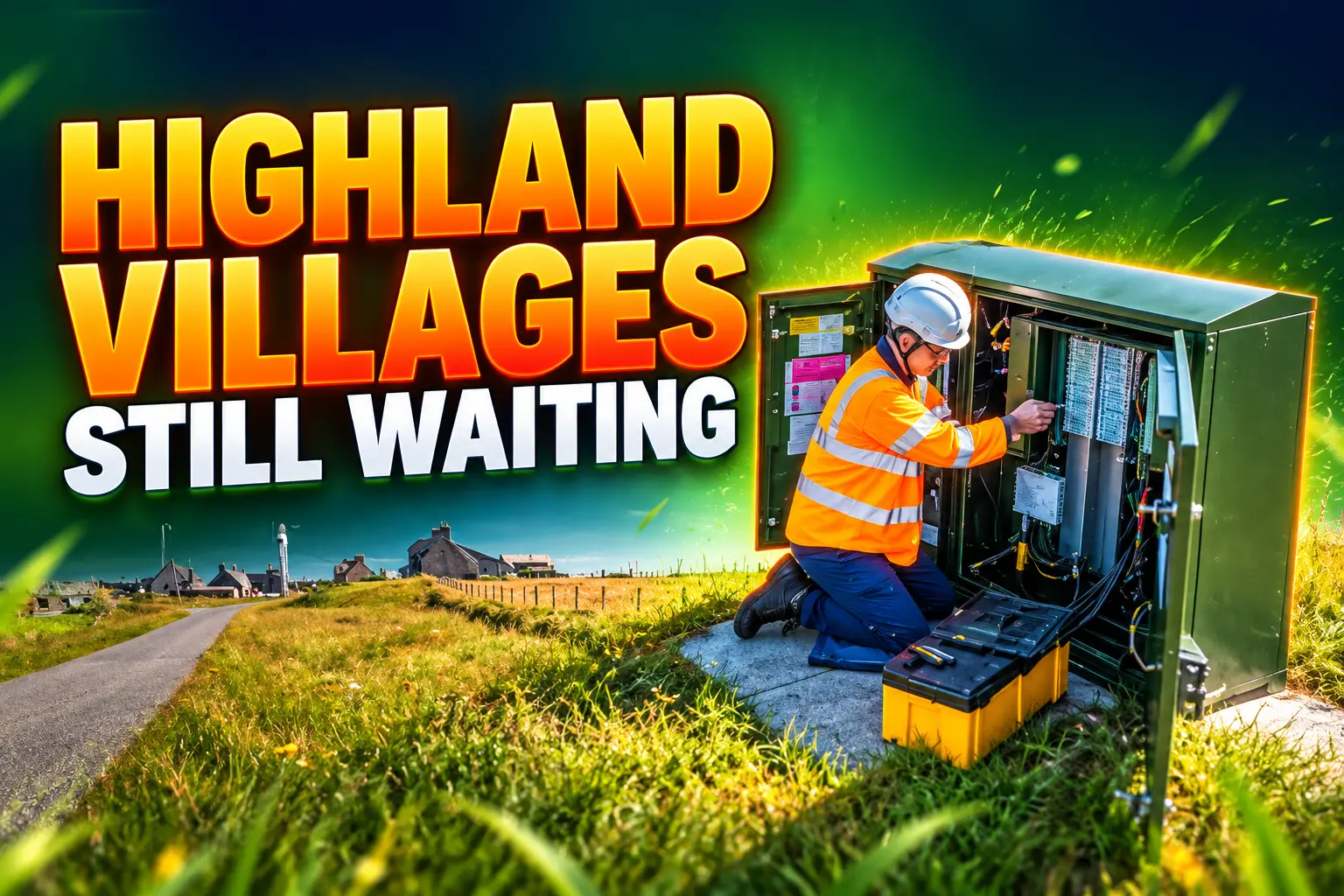
By June, Highland Had Zero Premises From the New Contract
Fibre in the far north is a civil job before it is a broadband product. Duct has to be laid, poles set and cable blown in weather windows that close for weeks. BDUK’s September 2026 progress update said Project Gigabit contracts with GoFibre and Openreach had reached more than 5,600 premises across Scotland, including the Borders, East Lothian, central, northern and western areas, Dumfries and Galloway and the north-east. That total covers both suppliers. It is still a small share of a Rest of Scotland call-off that now runs to 77,640 premises.
On 1 June 2026, Tom Arthur, answering for the Scottish Government, recorded no Project Gigabit builds yet in Highland against 15,398 premises still on the plan. Moray was also at zero, with 9,338 planned. Argyll and Bute had 219 built and 11,518 planned. Na h-Eileanan an Iar had 183 built and 8,124 planned. He said a live procurement for Orkney and Shetland could not be broken down until a contract was awarded, which means the island awards trailed in the May 2025 release had not landed by early summer 2026.
FROM THE VOW TO THE FIRST DIGS
- 3 May 2018: Scottish Government accounts say every home and business will have superfast broadband by the end of 2021.
- 15 April 2025: Openreach signs the Rest of Scotland Project Gigabit call-off.
- 1 May 2025: Ministers unveil the £157 million, around 65,000-premises pitch and say just 7% of Outer Hebrides premises can get gigabit broadband.
- 1 June 2026: Holyrood figures show zero Project Gigabit premises built in Highland and Moray.
- July 2026: Openreach says full-fibre work has started in Patna, Kilcreggan, Cove, Muirkirk, Kippen, Fintry, Strathblane and Blanefield.
- 22 September 2026: BDUK says more than 5,600 Project Gigabit premises have been reached in Scotland by Openreach and GoFibre.
- 26 September 2026: Consumer Scotland publishes the 54% rural gigabit figure.
Those July start points matter because they are not the places in the launch copy. Patna is in East Ayrshire. Kippen, Fintry, Strathblane and Blanefield sit in the Stirling hill country. Kilcreggan and Cove are on the Clyde. Muirkirk is inland Ayrshire. The contract still lists Highland, the Western Isles and Argyll and Bute. The first visible build ran through towns a contractor can reach without a two-ferry day.
WHERE OPENREACH SAID BUILD HAD STARTED IN JULY 2026
- Patna: East Ayrshire village on the mainland road network.
- Kilcreggan and Cove: Clyde coast settlements in Argyll and Bute, not the far north-west.
- Muirkirk: Inland Ayrshire, well south of the named Highland peninsula villages.
- Kippen, Fintry, Strathblane and Blanefield: Stirling-area villages grouped in the same Openreach notices.
Durness, billed as the most north-westerly village on the UK mainland, and Applecross, the remote west-coast peninsula, were still in the plan rather than in the July start list. That is how a “largest ever” rural contract actually moves: the easy clusters first, the long single-track last.
Rural Scotland Still Has the UK’s Widest Gigabit Gap
Consumer Scotland, the statutory consumer body, found that 54% of rural consumers have gigabit access against 89% in urban Scotland. Overall, 82% of premises, or 2,409,146 properties, can get gigabit speeds. More than 500,000 still cannot. The watchdog said that is the largest urban-rural divide anywhere in the UK.
Our new report: only 54% of rural consumers in Scotland have gigabit-capable broadband, compared with 89% in urban areas. It's the largest urban-rural digital divide in the UK.
5G availability lags behind other nations too.
Read more: https://t.co/yykCVcbjQO pic.twitter.com/IA9LVRUJDb
— Consumer Scotland (@Consumer_Scot) September 28, 2026
In Aberdeenshire, Argyll and Bute, the Western Isles, Orkney and Shetland, less than half of premises have gigabit-capable broadband. Highland, Moray, Angus, Perth and Kinross and Dumfries and Galloway all sit below 70%. In May 2025 ministers had put Outer Hebrides gigabit access at 7%. By late September 2026 the Western Isles were still in the group of councils below 50%.
GIGABIT ACCESS IN THE CONSUMER SCOTLAND SNAPSHOT
| Area | Gigabit-capable access |
|---|---|
| Scotland overall | 82% (2,409,146 premises) |
| Urban Scotland | 89% |
| Rural Scotland | 54% |
| Aberdeenshire, Argyll and Bute, Western Isles, Orkney, Shetland | below 50% |
| Highland, Moray, Angus, Perth and Kinross, Dumfries and Galloway | below 70% |
Around 10,000 premises in Scotland still cannot get even a “decent” service, meaning the 10 Mbps download and 1 Mbps upload floor, from a fixed line or fixed wireless. Project Gigabit is aimed at 99% gigabit-capable coverage by 2032. BDUK’s September update put Scotland on 82%, in line with the consumer report, and said remaining rural gaps are now mixed with leftover pockets in towns.
Guy Hinks, Scotland chair of the Federation of Small Businesses, put the same split in trade terms: “For many rural businesses, the digital divide is becoming an economic divide.” A farm software login, a guest-house card machine and a boat-yard invoice all fail in the same way when the line drops. Coverage maps do not show that.
Tens of Thousands On, R100 Still Owes the North
Project Gigabit was never the only public fibre programme in these postcodes. The Scottish Government’s Reaching 100% scheme, R100, is a £600 million Openreach build that was sold as superfast for every premises, a 30 Mbps floor, and has in practice been built mostly as full fibre. Scottish Government data updated on 28 August 2026 show 99,434 connections delivered under the R100 contracts, including extra build beyond the original maps, plus 6,299 through the R100 Scottish Broadband Voucher Scheme, against 112,939 premises in the planned contract total.
The North contract is the hole. Against 60,764 planned deliveries there, 36,932 had been built and 3,728 had come through vouchers. Highland shows 6,190 Highland premises on the R100 build of 12,770 planned, with 981 voucher lines. The Western Isles show 573 of 2,206 planned, with 114 vouchers. Central and South have already gone past their original planned totals because of that extra build. The leftover work is concentrated where the new UK contract also has to go.
Richard Lochhead, then Scottish Government business minister, said in the May 2025 release that DSSB, the older Digital Scotland Superfast Broadband programme, and R100 had together delivered over one million faster connections through public investment. Openreach, in a February 2025 Highlands update, said demand for full fibre in the Highlands had topped 50%, against a Scottish average of 38%. People in the North will take the product. The ducts are what ran late.
That late-running is the memory every new announcement walks into. In 2018 official Scottish Government accounts promised superfast for every home and business by the end of 2021. Replies under later island-fibre posts still reach for that date. A fresh Project Gigabit map does not reset it.
Starlink Already Occupies Roofs the Ducts Have Not Reached
While Openreach plans routes, low-earth-orbit dishes have been going on the same roofs. Consumer Scotland, citing Ofcom, said Starlink had 15,000 subscribers in Scotland in 2025, up from 11,000 in 2024, out of 110,000 active UK connections. About 2,000 of the Scottish subscribers had no decent broadband by any other means. That is a small slice of the 15,000, which means most dishes sit where a slow copper line already exists and the dish is the usable service.
WHO IS ONLINE BEFORE THE NEW FIBRE ARRIVES
- Starlink in Scotland: 15,000 subscribers in 2025, up from 11,000 the year before.
- No other decent path: about 2,000 of those Scottish dishes are in premises that cannot get a decent fixed or wireless line.
- Still off a decent line: around 10,000 Scottish premises cannot get the 10 Mbps floor from fixed or fixed wireless.
- Off gigabit: more than 500,000 Scottish premises still cannot order a gigabit-capable service.
Highland trains to Inverness, Thurso and Wick have already been running with satellite Wi-Fi, and councils have used dishes on schools and emergency sites where a landline was missing or had failed. The May 2025 fibre pitch treated those places as waiting for Openreach. Plenty of them have been buying a sky path instead, at a monthly price that Highlands and Islands Enterprise has flagged as around £75, above typical full-fibre and mobile home-broadband tariffs.
Bryant’s own launch statement left a second door open. He pointed to a Digital Inclusion Action Plan and a pledge “to take everyone along with us in the digital revolution so that we don’t entrench existing inequalities as technological progress races ahead.” That is an admission that a live fibre joint does not, on its own, get an older resident onto an NHS app, or a low-income household onto a full-price gigabit tariff. Consumer Scotland made the same point on social tariffs: more products exist, awareness is still low, and for the poorest households the bill is still too high.
Scotland also has the highest number of landmass areas lacking mobile coverage of the four UK nations. A gigabit socket in the front room does not fix a 4G hole on the single-track road to the next village. The remote-work and telemedicine pitch in the press release needs both.
What a Working Line Changes in a Place Like Durness
Digital exclusion for people living and working in hard-to-reach areas across Scotland can be a huge obstacle to living a better and healthier life. Elderly and vulnerable people could miss out on the best treatment options in North Ayrshire, while budding entrepreneurs could be held back from their dream of running a successful business in Moray.
Chris Bryant, then Telecoms Minister, 1 May 2025
When a line does go live, the change is boring and specific. Yvonne Boles, senior site manager of Tayside Reserves at RSPB Scotland, said gigabit fibre to the Loch Leven visitor centre had stopped the old connection “constantly going down or being very slow,” which had hit office work and card payments in the shop and café. That example in the remote-Scotland release was a Tayside reserve already on the network, not a north-west croft. It is still the clearest picture of what the product does: payments, bookings, a staff laptop that stays up.
Those are the same jobs that keep a peninsula village viable, and they now run beside Highland villages already testing off-grid living, where power, heat and water are being redesigned at the same time as the incoming fibre. A household that generates its own electricity still needs a stable uplink for metering, invoicing and the GP slot Bryant put at the centre of the pitch. The off-grid experiments make the wait for the duct sharper, not softer, because the rest of the house is being rebuilt around a connection that is not there yet.
Openreach’s own Highlands take-up figure of 50% says the order will be placed when the engineer finishes. The second-order question is who is left to place it. Depopulation, second homes and winter closures do not reverse because a planning map turned green. They reverse if a nurse can do admin from the village, a boat-builder can send drawings, and a teenager can sit an online exam without driving to Ullapool.
Durness and Applecross remain on the Rest of Scotland list. The 77,640-premise call-off is larger than the launch pitch, and R100 is still filling its North gap. Until those two builds actually pass the last crofts, rural Scotland’s 54% gigabit figure is the live result, and the dish on the gable is the service people use in the meantime.

The BMW iX4 Undercuts Mercedes and Trails Its Twin

Scotland’s Ten Big Supermarkets Already Hold the Weekly Shop

Scotland EMS Faces a State Probe After a Wagram Death

Meritz Signs Ripple to Race Korea’s 2027 Token Rules

Pocognoli’s First Camp Leaves Scotland Third and Exposed

Volkswagen Sells the Osnabruck Plant to Clear a Board Fight

Tata Motors’ Iveco Tender Opens as Holders Still Decide

Saksham Gaur Finds He Is His Own Company’s Client

Onimusha Way of the Sword Preload Hits a Windows 11 Wall

Simple Wave Chases Range as Ather Konarc Cuts Price
-
 AUTO1 month ago
Volkswagen Sells the Osnabruck Plant to Clear a Board Fight
-
 AUTO1 month ago
Tata Motors’ Iveco Tender Opens as Holders Still Decide
-
 BUSINESS1 month ago
Saksham Gaur Finds He Is His Own Company’s Client
-
 GAMING1 month ago
Onimusha Way of the Sword Preload Hits a Windows 11 Wall
-
 AUTO1 month ago
Simple Wave Chases Range as Ather Konarc Cuts Price
-

 BUSINESS1 month ago
Hyderabad 22-Carat Gold Jumps After a False Bargain
-

 BUSINESS1 month ago
The Rs 4.66 Lakh Crore IPO Queue Is Mostly Paper
-

 BUSINESS1 month ago
UltraTech Ultravolt Launch Splits Friday Stocks to Watch