
BUSINESS
The Higher Maths Paper That Tested the New Exam Board
Qualifications Scotland’s first Higher Maths paper drew more than 14,000 petition signatures over wording, then the A rate still fell to 37.6% after a 3-mark cut.

Qualifications Scotland cut the Higher Maths A line by 3 marks after a May petition, and the A rate still fell to 37.6%. The new board had promised clearer papers and a louder learner voice. Its first Higher Maths diet produced the opposite mood in the hall.
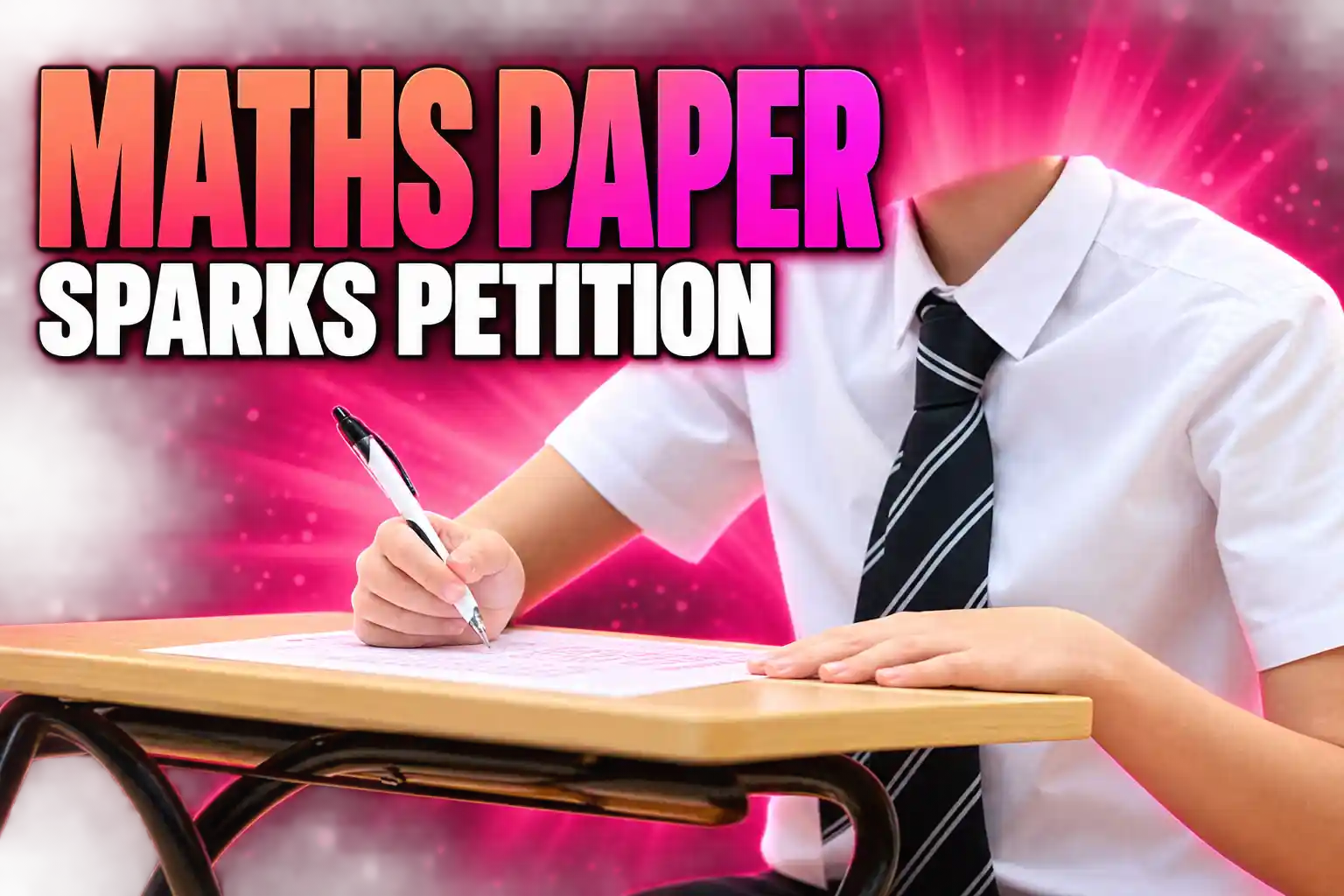
On 7 May 2026, 19,792 candidates sat the course. By 12 May more than 14,000 people had signed a petition calling for a full review of Paper 1, calling it poorly worded and out of step with every previous paper.
14,000 Signatures After a Thursday Morning Paper
Paper 1, the non-calculator script, ran from 9:00am to 10:15am for 55 marks. Paper 2 followed at 10:45am for 65 marks. The petition targeted Paper 1 only, though candidates said both felt heavy.
An S5 pupil in Aberdeen who wants to study medicine said she had worked through four years of past papers and still froze. “I thought I was really prepared, and had the impression that I was over-prepared but it was so different to what I’d done before.”
Darcy Ford, 16, from Renfrewshire, had been predicted an A and had completed ten years of past papers in the week before the exam. “When I was working through them, I found that the question wording and formatting is actually very consistent,” she said. “But compared to the questions in our exam this year, they were unrecognisable.”
A candidate in South Lanarkshire put the scene in the corridor in one line: “There were people in tears coming out that paper.” Arran Bauer, 16, from Stirling, called the last question on Paper 1 a “total curveball” and said he had to stare at items “to figure out what was going on.”
The petition’s own text drew a hard line. It said students expected a challenge, and that the problem was language that made it unclear what was being asked. It asked for an independent review of the wording, an explanation of why the paper left the old style, and grade lines that took the confusion into account.
THE MAY SPIRAL
- 7 May 2026: Candidates sit Higher Maths Paper 1 and Paper 2, the first diet under Qualifications Scotland.
- 11 May 2026: The petition passes 11,000 signatures; pupils describe command words they say they had not been trained to expect.
- 12 May 2026: Signatures pass 14,000; maths teachers go on the record to call the paper fair.
- 13 May 2026: The Scottish Mathematical Council publishes a review of both papers.
- 4 August 2026: Results day. The A boundary sits at 83 out of 120, three marks below 2025.
- September 2026: The course report tells teachers the papers performed largely as intended.
The first public demand from candidates was the same one that follows every hard Scottish maths paper: drop the cut-off. That is already how awarding works. What they also wanted, and did not get, was a separate inquiry into the wording.
Qualifications Scotland Promised a Reset
The board is new in law and young in the exam hall. The Education (Scotland) Act 2025 received Royal Assent on 6 August 2025, dissolved the Scottish Qualifications Authority, and created Qualifications Scotland, Teisteanasan Alba in Gaelic. The name went up on 2 December 2025. Full statutory functions moved on 2 February 2026, three months before this paper.
SQA had run national awards since 1997. It left office under the shadow of pandemic grading and of the 2024 Higher History marking row. Research the old body published in 2024 found that only one in five learners, parents and educators thought it had earned trust back.
Chief executive Nick Page used the launch to sell a break with that record.
The arrival of Qualifications Scotland represents a reset: a reset for our qualifications system, a reset for Scotland and, most importantly, a reset for learners, teachers, head teachers, lecturers, principals, training providers and businesses.
Nick Page, Chief Executive, Qualifications Scotland launch statement, 2 February 2026
The same statement pledged a reset for learners, teachers and lecturers, learner and teacher interest committees, four classroom teachers on a new School Partnership Team, and less reliance on high-stakes exams in several subjects. Education Secretary Jenny Gilruth said the point was “building something we can all trust.” Andy Harvey, national officer for education at the EIS union, called it a chance to rebuild trust with the profession.
The 2026 National Qualifications were not rewritten for the new badge. Centres were told courses, papers and support packs would run as planned. The first test of the reset, for this cohort, was the same two-hour maths morning Scotland has sat for years, under a letterhead that had been alive for 94 days.
Official Command Words on an Unfamiliar Paper
The complaint that travelled fastest was about command words, the short verbs that tell a candidate how to answer. Pupils said the 2026 phrasing did not match the past papers they had drilled. Andrew Moulden, who runs Maths.scot, compared the script with papers back to 2000 and rejected that claim.
“There was no phraseology at all that was out of the ordinary,” he said. “I have a good idea of what’s come up back to the year 2000. This was nothing special.” He later published a question-by-question audit of Paper 1. Every command word he listed sits on the board’s official list of mathematics command words.
WORDS ON THE PAGE
- Express: Rewrite in a specified form, used on the completing-the-square opener, a type that also appeared in 2022 and 2025.
- Find: Obtain an answer and show working, the default verb on integration, circles and definite integrals.
- Show / give a reason: Prove a statement without full formal proof; Paper 1 question 11 asked candidates to explain why a quadratic factor could not be split into linear factors.
- Sketch and determine: Used on the inverse-function graph that closed Paper 1, the item candidates later called a curveball.
Moulden’s verdict on each of the 12 Paper 1 questions was “fair.” He wrote that the wording was clear and similar to previous years, and that the petition’s claims were “unsupported by the evidence.” The gap, as he framed it, was between that paper and the way candidates had learned to see a Higher Maths question.
The Scottish Mathematical Council posted its review of both papers on 13 May and pushed teachers toward items that do not copy last year’s shape.
Read SMC's response to the difficulty of the Higher Mathematics Paper 2026 https://t.co/NJCfaUpk1f
— SMC (@scottishmaths) May 13, 2026
In the published note the council said teachers should “embrace clever examination questions which do not mirror routine types but encourage deeper thinking, preparing students with such questions in class whenever possible.” That is a polite way of saying the past-paper pack is not the course.
Why Did Well-Prepared Candidates Freeze?
The hall and the mark scheme told different stories. David Clelland, whose Clelland Maths channel has about 20,000 subscribers, called it “quite a high pressure paper and hard in places,” with some items “quite abstract” and “different to what pupils were expecting.” He also said the command words were not unusual, and that a last-minute livestream the night before had gone through question types that then appeared.
Chris Smith, a maths teacher, told interviewers the paper needed both routine items and stretch. “There should be questions that are routine. But there should also be questions which test and stretch the best candidates. This was a good paper that had both.” The EIS maths network gave the same initial reading: fair.
Qualifications Scotland said experienced subject teachers, including principal assessors, write and check every paper “to make sure they are clear, fair and suitable for learners.” It added that papers vary in difficulty, and that marking and grading take that into account so final grades “fairly reflect their achievements and maintain standards.”
Ford’s week of past papers is the other half of the story. She had trained on a house style and then met items that asked for the same skills in a different order. Bauer said some wording felt closer to papers from the 2000s than to “the modern day higher,” and that recognising the question type still helped him answer. The live complaint on the night of 7 May was the same: Paper 1 did not look like the last 20 years of scripts, and the last question on inverse-function graphs had not shown up in the revision piles candidates trusted.
Moulden admitted the human fact. “The experience of the students is, of course, undeniable, it’s clear that a lot of them were thrown sideways. But we don’t know why.” The September report later named the same weak spots the hall had felt, without accepting the charge that the paper was unclear.
The A Rate Still Fell After a 3-Mark Cut
Results day was Tuesday 4 August 2026. The awarding meeting did what the board had promised in May. It moved the lines a little, then held the pass rate almost still.
The 2026 Higher Mathematics course report records 19,792 resulted entries, 25 more than the 19,767 in 2025. A grade needed 83 marks out of 120, against 86 the year before. A C needed 58, against 60. The A share fell from 41.2% to 37.6%, a drop of 3.6 percentage points, or 711 fewer A grades. The A to C rate slipped from 73.9% to 73.5%.
HOW THE LINES MOVED
| Grade | 2025 minimum | 2025 share | 2026 minimum | 2026 share |
|---|---|---|---|---|
| A | 86 | 41.2% (8,144) | 83 | 37.6% (7,433) |
| B | 73 | 18.2% (3,597) | 70 | 20.3% (4,025) |
| C | 60 | 14.5% (2,862) | 58 | 15.6% (3,097) |
| D | 47 | 10.4% (2,059) | 45 | 11.5% (2,271) |
| No award | – | 15.7% (3,105) | – | 15.0% (2,966) |
The report says both papers “performed largely as intended and were accessible to most candidates.” It then lists the items that ran hot. In Paper 1, questions 5(b), 12(b)(i) and 12(b)(ii) were “slightly more demanding than intended at upper A.” In Paper 2, questions 5(b), 5(c), 9 and 13(b) were slightly more demanding than intended. Those judgements, it says, were taken into account when the boundaries were set.
The same report is blunt about where marks went. Many candidates “did not perform as well in questions that required deeper reasoning or precise mathematical communication.” On Paper 1 question 11, the uniqueness item that angered petitioners, only a few candidates saw that the discriminant showed a quadratic factor was impossible to factorise, rather than merely difficult. Most candidates attempted most questions. Numerical slips, not vanished topics, cost a lot of Paper 1 marks.
So the board did ease the paper, by 3 marks at A and 2 at C, and still awarded a thinner share of top grades. The independent review the petition wanted does not appear in the report. The ordinary grade-boundary meeting does.
Higher History Already Taught This Lesson
Two years earlier the old board faced a similar storm in a different subject. Higher History’s A to C rate fell 13 percentage points to 65.7% in 2024. On the compulsory Scottish paper the national average dropped from 20.6 marks to 15.3. Teachers, including markers, said the standard had been tightened after the exam, with more detail required for the same mark.
SQA’s own review, ordered by the chief examiner, concluded that the marking standard had not changed and that processes had worked as intended. It reported that 81% of markers said performance on the Scottish paper was lower or much lower than in 2023. Teachers called the finding a whitewash. Nick Page later accepted, in interviews after he took the job, that the episode should be looked at again.
The History fight was about marking rules candidates said they had never been shown. The Maths fight is about question language candidates said they had not been trained to read. In both cases the awarding body answered with process: the paper was checked, the standard was the standard, any extra demand would be handled in the boundary meeting. In both cases a large group of well-drilled pupils felt the ground move under a course they thought they knew.
Qualifications Scotland was built so that argument would sound like the old regime. Its first high-uptake STEM paper shows how much of that regime it still runs. The interest committees and the classroom teachers on the partnership team were not in the room on 7 May. The principal assessors were. The September advice to centres is to teach the reasoning the report says many candidates missed, not to reopen Paper 1.
Ford wanted engineering and feared a maths grade would block her. Bauer wanted the last question to look like the ones in his pack. They sat a paper the official word list already described, then received grades from a meeting that shaved a few marks off the A line and left the pass rate almost where it was. The reset held the standard. The pupils who had treated past papers as the syllabus found that standard in a script they did not recognise.
Frequently Asked Questions
When Did Candidates Sit Higher Maths in 2026?
Both papers were on Thursday 7 May 2026, the same day as the Scottish Parliament election, with exams running as scheduled. Paper 1 was non-calculator, 55 marks in 1 hour 15 minutes; Paper 2 was calculator, 65 marks in 1 hour 30 minutes. The course specification in force was version 3.0, dated May 2023, which had already cut the total from 150 marks to 120 from session 2023-24.
What Were the 2026 Higher Maths Grade Boundaries?
On a 120-mark course, A was 83, B 70, C 58 and D 45. Those lines were published with results on 4 August 2026. A C at 58 is 48% of the paper; the notional C the board aims at is 50%, which is why a 2-mark cut is treated as a small demand adjustment rather than a rescue.
What Is a Command Word in a Scottish Maths Paper?
It is the verb that tells the candidate what kind of answer will score. “Hence” means use the previous result; “show that” means write every step including the given conclusion, without a formal proof; “state” means no working is required. The mathematics list is shared across National Qualifications, so a word that looks new in Higher has often already appeared at National 5.
Did Qualifications Scotland Open an Independent Review of Paper 1?
No separate inquiry was published. The board pointed to its normal marking and grading process, and the September course report says the statistics were compiled before appeals were finished. Grade-boundary meetings can move lines when a paper runs harder than intended, which is the adjustment that landed in August, not a rewrite of the script.

TCS Opens Q2 as Mid-Cap IT Keeps the Growth

Bitcoin’s Jobs Rally Fails While December Hike Odds Hold

The Heat Turn a Bucks Rematch Into Vice City Night

The G7 Opens Diesel Tanks While Carriers Head East

Kia Bets Fortuner Money on a Made-in-India Sorento

Volkswagen Sells the Osnabruck Plant to Clear a Board Fight

Tata Motors’ Iveco Tender Opens as Holders Still Decide

Saksham Gaur Finds He Is His Own Company’s Client

Onimusha Way of the Sword Preload Hits a Windows 11 Wall

The Frame Pro’s $1,200 Labor Day Cut Needs a Soundbar
-
 AUTO4 weeks ago
Volkswagen Sells the Osnabruck Plant to Clear a Board Fight
-
 AUTO1 month ago
Tata Motors’ Iveco Tender Opens as Holders Still Decide
-
 BUSINESS1 month ago
Saksham Gaur Finds He Is His Own Company’s Client
-
 GAMING1 month ago
Onimusha Way of the Sword Preload Hits a Windows 11 Wall
-
 NEWS4 weeks ago
The Frame Pro’s $1,200 Labor Day Cut Needs a Soundbar
-

 NEWS1 month ago
Apple’s Foldable iPhone Hinges on Samsung Display Supply
-

 BUSINESS1 month ago
SEBI Reopens How F&O Settles After the Closing Auction
-

 BUSINESS1 month ago
The Rs 4.66 Lakh Crore IPO Queue Is Mostly Paper