
BUSINESS
Saylor Says the CLARITY Stall Will Feed Bitcoin
Michael Saylor says the Senate’s CLARITY Act stall will push bank custody and Bitcoin-backed loans, leaving token markets without a statute.

Michael Saylor said a stalled U.S. crypto bill will send more money into Bitcoin, because banks can already hold the asset and lend against it. The Senate failed the CLARITY Act on a 49-50 cloture vote on September 15, 2026, 11 votes short of the 60 it needed.
The irony is built into the docket. The bill was written to sort tokens, exchanges, and DeFi. Bitcoin already lives under older law, and Saylor’s company is sitting on a stack that does not need a new statute to be held at a bank.
The Senate Stopped CLARITY 11 Votes Short
The measure on the floor was H.R. 3633, the Digital Asset Market Clarity Act, sponsored by Rep. J. French Hill. It never reached a debate on the substance. Cloture on the motion to proceed is the 60-vote test that opens that debate, and the Senate failed to invoke cloture 49-50 on Record Vote 234.
Voting began at 2:18 p.m. Eastern. The chamber announced the result at 3 p.m. Senator Chris Coons did not vote. The four Republican no votes were Susan Collins, Josh Hawley, Jerry Moran, and Thom Tillis. Tillis voted no so he could enter a motion to reconsider one minute later. No Democrat voted to take the bill up.
HOW THE BILL REACHED A 49-50 WALL
- May 29, 2025: Hill introduces H.R. 3633 in the House.
- July 17, 2025: The House passes it 294-134.
- May 14, 2026: Senate Banking orders the bill reported with a substitute.
- June 1, 2026: It is placed on the Senate calendar as Calendar No. 423.
- August 8, 2026: Leadership files cloture on the motion to proceed.
- September 15, 2026: Cloture fails 49-50; Tillis enters a motion to reconsider at 3:01 p.m.
The ethics fight did the damage. Democrats wanted a harder bar on officials who profit from crypto while they write the rules, a demand sharpened by financial disclosures cited in the debate that showed more than $1.4 billion in crypto-related income for President Donald Trump in 2025. Republicans put forward last-minute language on divestment, blind trusts, and state attorneys general. It did not move a Democratic vote.
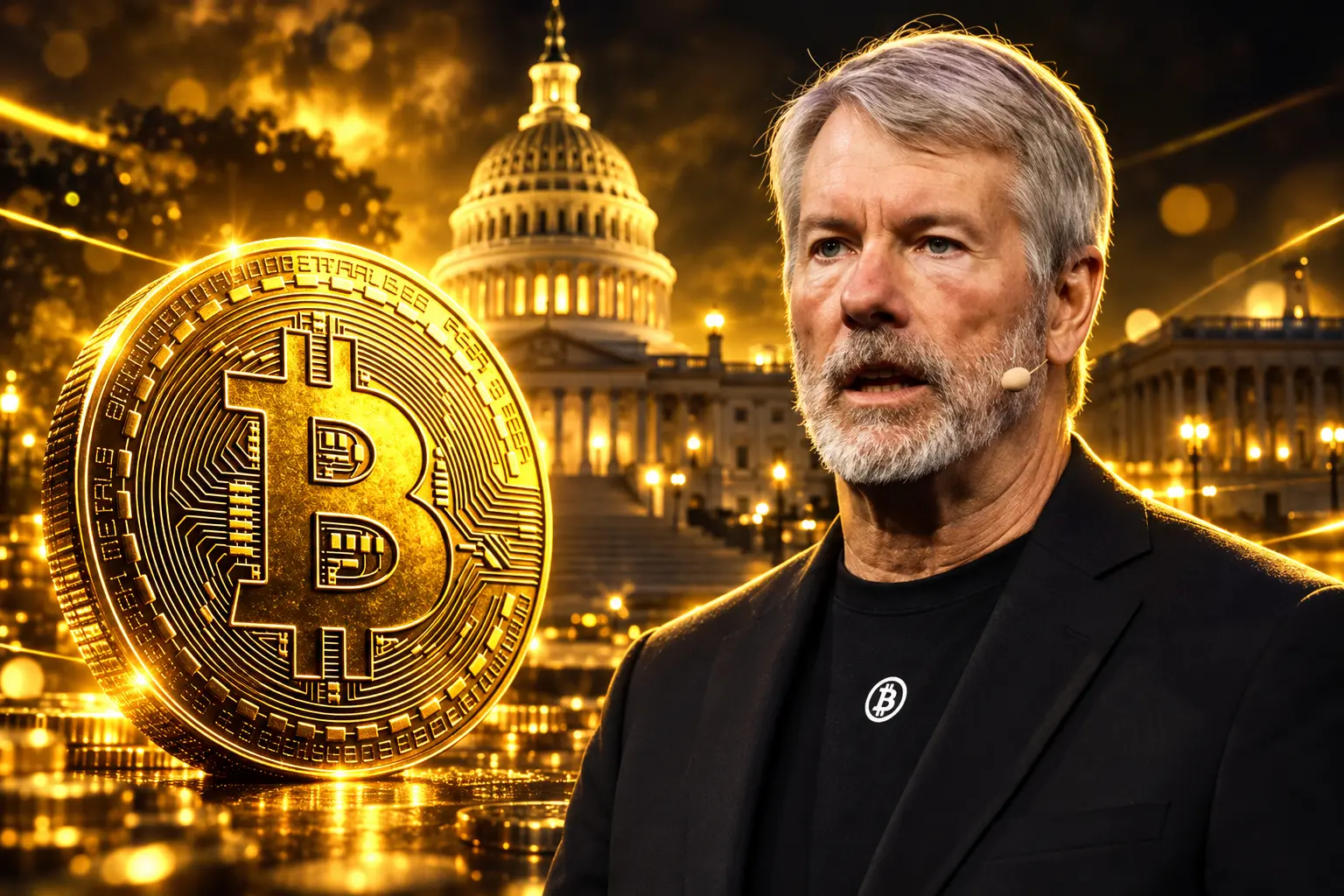
Saylor Expects Banks to Lend Against Bitcoin
Saylor, executive chairman of Strategy, posted the next morning. He did not ask the Senate to try again. He said the agencies can keep moving, and that banks will widen Bitcoin custody and loans against BTC, which he argues will pull more capital into Bitcoin and digital credit.
His post, in full, ran as one thought.
“With CLARITY stalled, I expect the SEC, CFTC, and Treasury to advance rules under existing law, banks to expand Bitcoin custody and loans against it, and more capital to favor Bitcoin and digital credit. GENIUS supports stablecoin adoption. Progress need not wait for Congress.”
With CLARITY stalled, I expect the SEC, CFTC, and Treasury to advance rules under existing law, banks to expand Bitcoin custody and loans against it, and more capital to favor Bitcoin and digital credit. GENIUS supports stablecoin adoption. Progress need not wait for Congress.
— Michael Saylor (@saylor) September 16, 2026
That is not a trader’s bounce call. Strategy already holds 845,050 bitcoin on Strategy’s ledger, bought for $63.73 billion at an average of $75,412 a coin. The last add in that ledger was 4,603 bitcoin on August 31, 2026, at $80,318, about $370 million. The pile is about 4 percent of the 21 million coin cap. A man sitting on that much BTC is describing a pipe that already exists.
Cory Klippsten, who runs Swan, put the same split in blunter words under Saylor’s post. Crypto firms went to Congress for a permission slip. Bitcoin did not.
Crypto companies need Washington to write the rules for them. Bitcoin never did.
Cory Klippsten, CEO of Swan, on X
Ripple chief executive Brad Garlinghouse, whose business needs token rules that Bitcoin does not, called the result a sting and said a post-mortem had to be done. Coinbase chief executive Brian Armstrong said he was disappointed, then pointed at the same off-ramp Saylor used: the SEC and the CFTC already have tools, and another Senate vote is still possible.
The CLARITY Act didn't advance in the Senate today, which was a disappointment. While it's possible bi-partisan conversations continue and it lives to fight another day, we can't wait on Congress anymore.
The SEC and CFTC have the tools they need to create clear rules under…
— Brian Armstrong (@brian_armstrong) September 15, 2026
GENIUS Already Wrote Rules for Dollar Tokens
Saylor’s nod to GENIUS is the other half of the funnel. Congress already built a federal lane for payment stablecoins. It did not build one for the rest of the token market.
The GENIUS Act as Public Law 119-27 was signed on July 18, 2025. It limits U.S. payment-stablecoin issuance to permitted banks, federal nonbank issuers, and smaller state issuers. Issuers must hold one dollar of approved reserves for each dollar of coins, in cash, short-term Treasuries, and a short list of like assets. Payment stablecoins sit outside the definitions of security and commodity. State-only issuance stops at $10 billion.
CLARITY was the companion half. It was meant to split the SEC and the CFTC, register trading venues, and sort which tokens are securities and which are commodities. House passage in July 2025 looked like the hard part. The Senate never opened the bill.
TWO LAWS, TWO OUTCOMES
| Item | GENIUS Act | CLARITY Act |
|---|---|---|
| Status | Public Law 119-27, signed July 18, 2025 | House passed 294-134; Senate cloture failed 49-50 on September 15, 2026 |
| What it covers | Payment stablecoins and their issuers | Market structure, token sorting, exchanges, DeFi, self-custody |
| Who holds the pen now | OCC, Treasury, bank regulators writing the rules | SEC, CFTC, and Treasury under older statutes, unless the Senate votes again |
Dollar tokens have a statute. Bitcoin has years of commodity treatment and bank letters. The middle of the market, the part CLARITY was drafted to name, still does not.
What Token Markets Still Need From Congress
The gap is specific. Native tokens used to raise capital still need a durable line between a security and a commodity. DeFi developers still need a rule that does not treat writing software as running an exchange. Self-custody still needs a federal answer that is not an enforcement case. Tokenized stocks still need an exemption path that a later commission cannot shrug off.
Bernstein analysts led by Gautam Chhugani told clients on September 16 that the SEC and CFTC will now try to cover that ground themselves, and that they will move in a way the note called aggressive and swift to make up for months spent on the bill. The firm also said another Senate vote this year looks unlikely, given the calendar and the ethics fight.
RULES BERNSTEIN SAYS THE AGENCIES WILL WRITE
- Token sorting: How native crypto tokens are treated when a team raises capital.
- DeFi and self-custody: Guardrails for developers and for wallets that do not hold customer keys.
- Tokenized stocks: An innovation exemption for equity on a chain.
- Perpetual futures: Faster approvals for real-world-asset perps, plus joint work on single-stock perps.
- Event contracts: Tweaks to how federal sports contracts are classed as swaps.
Those files can be opened without CLARITY. They cannot do what the bill was sold as doing. Bernstein’s own note said a statute would have locked the industry against a later political swing. Agency rules do not. A future chair can pull them.
National Banks Can Already Broker Crypto Trades
Saylor’s bank point is the part of the stall that is already in force. On December 9, 2025, the Office of the Comptroller of the Currency said banks may act as crypto intermediaries in riskless principal trades, standing between two customers without keeping the coins on the bank’s own book. Earlier OCC letters had already treated crypto custody as part of the business of banking and dropped a pre-clearance hurdle for those books.
That paper trail is why a failed market-structure vote does not freeze Bitcoin the way it freezes a new token. A national bank can hold BTC, move it for a customer, and, if credit policy allows, take it as collateral. CLARITY would have put staking, digital-asset lending, and related services into statute. Banks do not need that statute to start with Bitcoin.
The charter queue shows the same tilt. Morgan Stanley received preliminary OCC approval in June 2026 for a digital-asset trust bank. Circle received a national trust bank charter in July 2026. Block applied in September 2026 for an uninsured trust bank aimed at Bitcoin and stablecoin custody. None of those filings waited on Record Vote 234.
For Strategy, cheaper bank loans against BTC would turn a treasury pile into a credit line. That is a corporate finance change, not a slogan. It is also a change other large holders can copy without asking the Senate to sort Solana, XRP, or a DeFi pool.
Atkins and Selig Inherit a Reversible Mandate
Patrick Witt, executive director of the President’s Council of Advisors for Digital Assets, did not sell the vote as a hidden win. He called it a failure of American leadership and said the cost may be that Brussels or Beijing, not Washington, sets the next market standard. Then he handed the file to the agencies.
There’s no sense in sugarcoating it: today’s vote was a major disappointment.
Patrick Witt, Executive Director, President’s Council of Advisors for Digital Assets, on X
His close was a direct tag to SEC Chair Paul Atkins and CFTC Chair Michael Selig: they are up. That is the path Saylor likes, because it does not require 60 senators. It is also the path that can be walked back. A rule the Atkins commission writes in 2026 can be withdrawn in 2029. A statute cannot.
Armstrong left a second door open, the political one. Bipartisan talks can continue, and Tillis’s motion means H.R. 3633 is not struck from the books. Majority Leader John Thune can file cloture again if he finds 11 more votes. Bernstein’s note treated that as a long shot before the November 2026 midterms, with Congress due to leave Washington ahead of those elections.
The Bill Remains on the Senate Calendar
Calendar No. 423 is still there. Tillis’s motion to reconsider is still there. The House text that passed 294-134 is still there. None of that puts token classification, DeFi, or self-custody into law on September 17’s side of the calendar.
What is in law is a stablecoin statute and a stack of OCC letters that already let banks handle Bitcoin. Saylor’s bet is that money will follow that pipe, into custody accounts and BTC-backed loans, while the firms that needed CLARITY to tell them what they are wait on a chair, a comment file, or another 60-vote test.
The next move that matters is not a floor speech. It is whether Atkins and Selig actually publish those rules, and whether a bank that already has an OCC letter starts taking Bitcoin as collateral at scale. Until one of those happens, the stall is just a 49-50 line in the record and a very large corporate bitcoin book that did not need the bill.
Disclaimer: This article is news reporting and analysis of a Senate vote, company statements, and regulator letters. It is for information only and is not investment, trading, legal, or tax advice. It does not recommend buying, selling, or holding bitcoin, Strategy shares, stablecoins, or any other digital asset, and it does not tell any person how to vote, lobby, or structure a custody or lending product. Readers should speak with a licensed financial adviser, attorney, or tax professional who knows their facts before making any money or legal decision. Vote tallies, holdings, prices, and bill status are those published by the sources named above and can change with later filings, later votes, or later agency action.

Edinburgh Opens a 2027 Tour Built for Time Trials

Korda Maps Auður From Meðalland to Irvine Bay

Apple Music Films Its New Logo in Mineral Oil

Oppo Prices the Pad Mini Above India’s iPad Mini

Austen Soaks Scotland Before Boelo Brings Weekend Gales

Volkswagen Sells the Osnabruck Plant to Clear a Board Fight

Apple’s Foldable iPhone Hinges on Samsung Display Supply

Saksham Gaur Finds He Is His Own Company’s Client

Tata Motors’ Iveco Tender Opens as Holders Still Decide

Onimusha Way of the Sword Preload Hits a Windows 11 Wall
-
 AUTO2 months ago
Volkswagen Sells the Osnabruck Plant to Clear a Board Fight
-
 NEWS2 months ago
Apple’s Foldable iPhone Hinges on Samsung Display Supply
-
 AUTO2 months ago
Tata Motors’ Iveco Tender Opens as Holders Still Decide
-
 BUSINESS2 months ago
Saksham Gaur Finds He Is His Own Company’s Client
-
 GAMING2 months ago
Onimusha Way of the Sword Preload Hits a Windows 11 Wall
-

 ENTERTAINMENT3 years ago
What is SD on Amazon Prime? – All You Need to Know
-

 BUSINESS2 months ago
Hyderabad 22-Carat Gold Jumps After a False Bargain
-

 NEWS2 months ago
iQOO 16 Locks 8,400 mAh While 100W Charging Holds