
BUSINESS
Nasdaq’s Tokenization Pitch Still Needs the Overnight Window
Adena Friedman says tokenization can free trapped collateral, yet Nasdaq still plans a nightly pause before 23-hour trading.

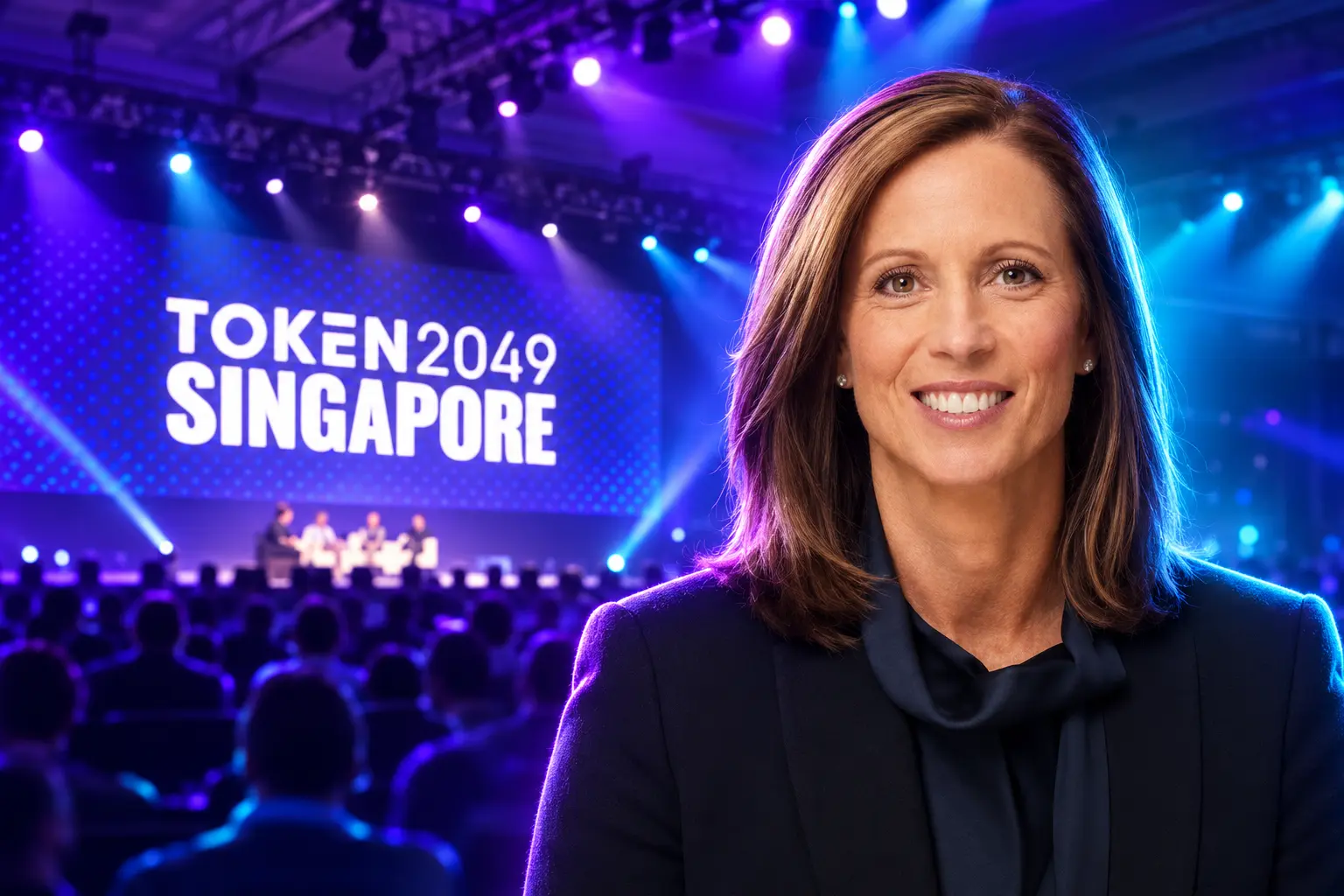
Nasdaq CEO Adena Friedman said tokenizing Treasurys, equities and money market funds could free tens of billions of dollars now sitting as collateral. She spoke on Oct. 8 at TOKEN2049 in Singapore, then spent much of the session on the overnight window banks still use to update systems and manage risk.
U.S. cash equities will not run around the clock in December. Nasdaq plans to add a night session on Dec. 6 and still halt the tape from 8 p.m. to 9 p.m. Eastern so processors can refresh and roll the trade date.
Friedman Tied the Billions to a Clock That Still Stops
Tokenization turns a Treasury, a share or a money market fund into a digital token that can move on a blockchain. Friedman’s version of the trade is narrower than a crypto keynote. She wants those instruments, and the cash that pays for them, to move as one stack so posted collateral can be reused instead of sitting idle in a triparty account until the next business morning.
“If you tokenize all those instruments along with the flow of money, then the collateral becomes very fluid,” she said at the conference. She added a second line that crypto desks already treat as obvious: “If we can tokenize money, then we can tokenize the flow of capital.”
Everything has to be real time all the time.
Adena Friedman, CEO of Nasdaq, at TOKEN2049 in Singapore
That sentence is the load-bearing one. Banks have long used the hours after the cash close to rebuild risk books, move margin and patch systems. A token that can transfer at 2 a.m. Singapore time is still trapped if the receiving bank’s collateral engine is in a batch job until 7 a.m. New York. Friedman said institutional interest has grown over the past year after Congress passed the GENIUS Act, the U.S. stablecoin statute, and that the retail side “has been about 10 years ahead” on all-hours trading.
She also named the limit that conference slogans skip. “Not every asset is liquid enough to support a 24/7 environment,” she said. The product Nasdaq is actually putting on a calendar is a 23-hour, five-day tape, plus software that can watch risk when the trading floor is empty.
The One Hour Nasdaq Still Has to Keep
Chuck Mack, Nasdaq’s senior vice president of North American markets, told an SEC roundtable in September that the firm will add an overnight session from 9 p.m. to 4 a.m. Eastern on the Nasdaq Stock Market. That slot sits on top of the sessions already in the rulebook: 4 a.m. to 9:30 a.m., 9:30 a.m. to 4 p.m., and 4 p.m. to 8 p.m. Trading is slated to start at 9 p.m. Sunday and stop at 8 p.m. Friday, with a one-hour industry pause from 8 p.m. to 9 p.m. Monday through Thursday.
Mack said Nasdaq is on track both as processor of the Tape C SIP, the consolidated feed for Nasdaq-listed names, and as an operating exchange. He said the firm sees Dec. 6 as the go-live, not a target. The SEC has already given conditional overnight approval to Nasdaq and to 24X, Cboe EDGX, MEMX and NYSE Arca. Those approvals were tied to the SIPs being ready to collect and print quotes through the night. On June 26, the SEC set Dec. 6 as the SIP launch date, with hours from 9 p.m. Sunday to 8 p.m. Friday and that same 8 p.m. refresh hour.
Four alternative trading systems, Blue Ocean, Bruce, IBKR Eos and MOON, already trade in the overnight hours. SEC staff put that activity at about 0.9 percent of NMS share volume, up 359 percent year over year. NSCC, the U.S. equity clearer, said its 24×5 clearing hours were live on June 29, 2026. The remaining bottleneck Friedman was describing is not the matching engine. “The easiest part is the exchange infrastructure,” she said.
THE RUN-UP TO A 23-HOUR TAPE
- July 18, 2025: President signs the GENIUS Act, creating a U.S. statute for payment stablecoins.
- December 11, 2025: SEC issues a three-year no-action letter allowing DTC to tokenize a defined set of liquid securities.
- June 26, 2026: SEC approves extended SIP hours and sets Dec. 6 as the 23×5 launch date.
- June 29, 2026: NSCC says 24×5 clearing is live.
- September 17, 2026: SEC hosts a roundtable on moving toward 24-hour U.S. equity trading.
- September 29, 2026: Nasdaq launches governed AI agents inside Calypso, its capital-markets platform.
- October 8, 2026: Friedman makes the collateral pitch at TOKEN2049 in Singapore.
- December 6, 2026: Nasdaq’s night session and the extended SIP are scheduled to go live.
The dark hour is not decorative. Listing venues will use it, and in some cases the whole overnight session, to process corporate actions that used to happen when the tape was fully off. Mandatory halts will cover symbol changes, CUSIP changes, large dividends, splits, de-SPAC deals, spin-offs, security-type changes, mergers and any other issuer event the listing market flags. Overnight limit-up and limit-down bands will sit 20 percent away from a pair of reference prices and stay static until morning. That is a 23-hour market with a planned blind spot, which is a different machine from a crypto order book that never closes.
DTCC Holds $114 Trillion, Almost All of It Offline
The Depository Trust & Clearing Corporation is the plumbing under Friedman’s number. Its depository subsidiary, DTC, provided custody and asset servicing for securities valued at $114 trillion in 2025. DTCC’s subsidiaries processed transactions valued at $4.7 quadrillion that year. Tokenized real-world assets tracked by RWA.xyz are about $38.8 billion. Tokenized U.S. Treasuries, the largest slice of that stack, are about $14.8 billion.
HOW THE PILES COMPARE
| Slice | Amount | What it is |
|---|---|---|
| DTC custody, 2025 | $114 trillion | Securities held at DTCC’s depository |
| Tokenized real-world assets | $38.8 billion | On-chain value tracked by RWA.xyz |
| Tokenized U.S. Treasuries | $14.8 billion | Largest tokenized asset class |
| Capital Friedman cited | Tens of billions | Collateral she said could be freed |
Those figures do not contradict each other. They describe different piles. Friedman is talking about margin and collateral that could be reused if it could move at night. DTCC is talking about the whole depository. In a May paper with Finadium, DTCC said digital forms of bonds, money market funds and cash could move faster across venues, and that intraday funding costs could be cut in half if dealers could fund on a ledger minute by minute instead of parking cash overnight or drawing daylight overdrafts.
Nadine Chakar, DTCC’s global head of digital assets, called digital assets “the next phase of capital and liquidity optimization in global markets.” The firm’s Collateral AppChain is built for around-the-clock collateral management and was expected to go live in the fourth quarter of 2026. DTC’s tokenization service, authorized by the December 2025 no-action letter, is limited at first to Russell 1000 stocks, ETFs that track major indices, and Treasuries. DTCC said in May that more than 50 firms, Nasdaq among them, were in the working group, with limited production trades planned for July and a service opening planned for October. A Stellar public-chain hook for those DTC tokens is slated for the first half of 2027, so the first wave is still a permissioned transfer between registered wallets, not a free-float on every chain.
The GENIUS Act Governs Coins, Not Stocks
Friedman pointed to the GENIUS Act as a reason institutions are finally showing up. The law, P.L. 119-27, was passed by the Senate 68-30 on June 17, 2025 and by the House 308-122 on July 17, then signed on July 18, 2025. Congressional Research Service analysis describes it as a federal framework for payment stablecoins, tokens designed for payment or settlement and redeemable for a fixed amount of money.
Issuers must be permitted payment stablecoin issuers, supervised at the federal level or by a certified state regime. Reserves have to match coins one-for-one in cash, deposits and short-term Treasuries. The statute takes effect on the earlier of Jan. 18, 2027 or 120 days after the main federal regulators finish their rules. The Federal Reserve issued two proposed rulemakings on Sept. 24, 2026, with comments due Nov. 30, 2026. Until those rules are final, the “tokenize money” half of Friedman’s formula is still a bill on the books, not a live rail every bank can post as collateral at 3 a.m.
That gap matters because she joined money and securities in one sentence. Tokenized stocks on Nasdaq’s own book still depend on the DTC pilot and on issuer choice, not on GENIUS. Payment stablecoins can become the cash leg. They do not, by themselves, turn a money market fund share into something a futures clearer will accept at the weekend. The interest she described is real. The statute she named does not finish the trade.
Calypso Agents Are Built for the Night Shift
Friedman said Nasdaq has already put digital agents inside its risk platform. They start by making recommendations. Banks, she said, could later let those agents take more direct action. “AI is critical for 24/7,” she said. Ten days before she spoke in Singapore, Nasdaq had already named the box those agents sit in.
On Sept. 29, Nasdaq launched an agentic AI operating environment inside Calypso, the front-to-back platform banks, brokers, asset managers and central banks use for trading, risk and collateral. Magnus Haglind, Nasdaq’s head of capital markets technology, said firms will not run agents at scale unless they can do it inside the systems they already trust, with those agents tied to real workflows, data and controls. The first tool is a natural-language assistant that queries Calypso’s own records. Nasdaq said it will add a suite of governed workers aimed at the manual breaks that still clog post-trade desks. Agents will be hosted in Calypso’s cloud on Amazon Bedrock, with on-premises clients able to connect to the same tools, and with no external data retention.
THE CALYPSO SURVEY
- Manual post-trade: Almost half of respondents in a Nasdaq and Acuiti survey flagged manual intervention in post-trade operations.
- Clearing gap: 56 percent said they risk losing ground to competitors if they do not put AI or machine learning into clearing.
- Existing agents: Nasdaq said more than 800 Verafin clients already use its agentic tools in a separate financial-crime product.
That survey is why the TOKEN2049 sound bite and the product calendar belong in the same story. If collateral tokens can move at 11 p.m., someone has to revalue the position, test the haircut and release or call margin before the Asia open. Human ops teams do not sit that shift seven days a week. Friedman is selling the tokens and the night crew as one package. The agents still recommend first. Direct action is the later step, and it is the step that actually replaces the batch window.
Thin Names Still Need a Closed Hour
Crypto venues already trade through U.S. holidays, so the Singapore audience heard a catch-up story. The harder constraint is still on the cash tape. Overnight share volume at 0.9 percent of the NMS book is growth from a tiny base, and Friedman’s own liquidity warning applies most to names that do not have a two-sided market at 1 a.m. Static 20 percent bands will stop some of the damage. They will not create a buyer.
WHAT STILL HAS TO CLOSE BEFORE COLLATERAL MOVES ALL NIGHT
- The pause: SIPs and exchanges still take 8 p.m. to 9 p.m. Eastern off the tape for refresh and trade-date rollover.
- Issuer events: Splits, large dividends, symbol changes and six other corporate actions can halt a name through the whole overnight session.
- The statute: GENIUS Act stablecoin rules are not in force until final regulations land or Jan. 18, 2027 arrives.
- The book: SEC staff still count overnight activity at about 0.9 percent of NMS share volume.
Arjun Sethi, co-CEO of Kraken, told the same Singapore audience that firms outside the United States want tokenized access to American listings. He cited one company with about $25 million in revenue that was looking for a path into public markets, and larger foreign issuers asking about tokenization and U.S. listings. That demand is why Nasdaq is bothering with a 9 p.m. open that lines up with Monday morning in Asia. It does not answer Friedman’s liquidity point. A tokenized Russell 1000 name can print on the same ticker as the ordinary share and still have no depth after dinner in New York.
DTCC can cut dealer funding costs if Treasuries and money funds move on its AppChain after the cash close. Nasdaq can staff a night session on Dec. 6. Neither fact frees the tens of billions Friedman cited until the 8 p.m. hour, the corporate-action halt list and the still-unfinished stablecoin rules stop being the places where collateral goes to wait.
Disclaimer: This article is news reporting and analysis of public remarks, exchange rule plans and official product announcements. It is informational only and is not investment advice, a solicitation to buy or sell any security, tokenized fund, stablecoin or exchange-traded product, or legal advice on the GENIUS Act, SEC no-action relief or overnight trading rules. Readers should consult a licensed financial adviser and, where the rules affect their firm, a securities lawyer before changing collateral, listing or extended-hours practices. Figures, dates and product statuses reflect the official statements and data trackers cited above and may change as regulations, platforms and market values move.

Edinburgh Opens a 2027 Tour Built for Time Trials

Korda Maps Auður From Meðalland to Irvine Bay

Apple Music Films Its New Logo in Mineral Oil

Oppo Prices the Pad Mini Above India’s iPad Mini

Austen Soaks Scotland Before Boelo Brings Weekend Gales

Volkswagen Sells the Osnabruck Plant to Clear a Board Fight

Apple’s Foldable iPhone Hinges on Samsung Display Supply

Tata Motors’ Iveco Tender Opens as Holders Still Decide

Saksham Gaur Finds He Is His Own Company’s Client

Onimusha Way of the Sword Preload Hits a Windows 11 Wall
-
 AUTO2 months ago
Volkswagen Sells the Osnabruck Plant to Clear a Board Fight
-
 NEWS2 months ago
Apple’s Foldable iPhone Hinges on Samsung Display Supply
-
 AUTO2 months ago
Tata Motors’ Iveco Tender Opens as Holders Still Decide
-
 BUSINESS2 months ago
Saksham Gaur Finds He Is His Own Company’s Client
-
 GAMING2 months ago
Onimusha Way of the Sword Preload Hits a Windows 11 Wall
-

 BUSINESS2 months ago
Hyderabad 22-Carat Gold Jumps After a False Bargain
-

 ENTERTAINMENT3 years ago
What is SD on Amazon Prime? – All You Need to Know
-

 NEWS2 months ago
iQOO 16 Locks 8,400 mAh While 100W Charging Holds