
BUSINESS
McDonald’s Hands Existing Stores the Growth Job and the Bill
McDonald’s NEXT puts about $8.5 billion behind existing restaurants, but franchisees still fund most remodels after U.S. guest counts fell.

McDonald’s told investors on September 23 it will put about $8.5 billion behind existing restaurants through 2036. The pledge is rent cuts and capital help, not a blank check, and franchisees still fund most of the work.
U.S. guest counts already fell in the second quarter. New rooftops still added more to system sales than those existing stores did. The growth job is moving onto operators who run the buildings the company already has.
An $8.5 Billion Partnering Check Through 2036
The plan has a name, McDonald’s > NEXT, and a destination date a decade out. Chairman and CEO Chris Kempczinski presented it at headquarters in Chicago as a way to be the first choice for more customers, more often, while making restaurants stronger and easier to run.
McDonald’s has the unmatched scale, customer insights, brand loyalty, and operational capabilities to not only adapt to the next wave of change in our industry, but to turn it into an advantage.
Chris Kempczinski, Chairman and CEO, McDonald’s Investor Day press release
Corporate support is the number Wall Street heard first. McDonald’s plans to provide approximately $8.5 billion in partnering support through 2036, including about $5 billion through 2030, as rent relief and capital. Ian Borden, executive vice president and global chief financial officer, said the bulk of the money through 2030 is meant to speed ArchIQ technology bundles plus kitchen and operations tools.
THE NEXT SUPPORT PACKAGE
- Efficiency target: About 250 basis points of gross restaurant-level gains once NEXT elements are in place across the U.S. and International Operated Markets.
- Cash-flow claim: That lift is equated to roughly $100,000 a year for the average U.S. restaurant, with most of it expected to reach the store’s bottom line over time.
- Payback clock: About four years for franchisees after partnering, and five or six years for the company, Borden said.
- Share aims: 1.5 percentage points more of the chicken market and 1.5 points more of beverages by 2030, while holding the lead in beef.
Operating margin is supposed to reach the low-to-mid 50% range by 2030. General and administrative costs are supposed to fall to about 1.9% of systemwide sales. Free cash flow conversion is aimed at the mid-to-high 80% range. From 2027 through 2030 the company plans about $3 billion a year of baseline capital spending, plus $1.5 billion to $2 billion of cumulative capital partnering to speed Restaurant > NEXT.
Those are headquarters numbers. They sit on a system that already serves more than 70 million customers a day, lists 17 billion-dollar menu brands, and counts nearly 220 million 90-day active loyalty members across 70 markets. About 95% of the restaurants are run by independent local owners. The next chapter depends on those owners spending, staffing, and serving through a consumer stretch Kempczinski is not calling a blip.
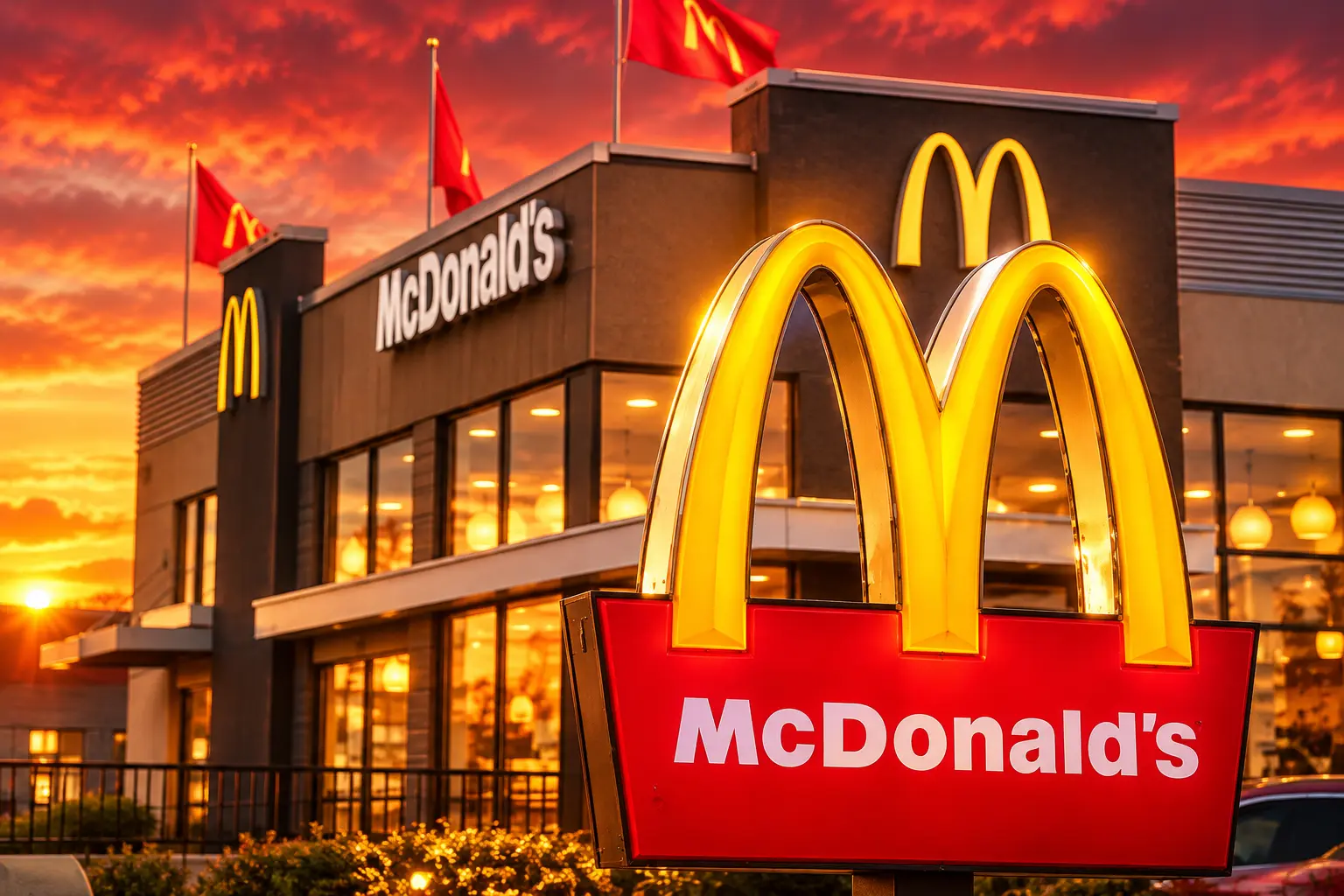
U.S. Guest Counts Already Went Negative
The second quarter ended June 30 with positive comps in every segment and a U.S. traffic problem underneath. McDonald’s said global comparable sales increased 1.3%. The U.S. rose 0.8%, International Operated Markets 1.5%, and International Developmental Licensed Markets 1.9%.
U.S. comps came from higher checks and mix, partly offset by negative comparable guest counts. A year earlier the same U.S. line was 2.5%. Global comps in that year-ago quarter were 3.8%.
COMPARABLE SALES, SECOND QUARTER
| Segment | Q2 2026 | Q2 2025 |
|---|---|---|
| United States | 0.8% | 2.5% |
| International Operated Markets | 1.5% | 4.0% |
| International Developmental Licensed Markets | 1.9% | 5.6% |
| Total company | 1.3% | 3.8% |
Systemwide sales, which count every restaurant, reached $37 billion and rose 5%, or 4% in constant currencies. That constant-currency 4% against 1.3% comps leaves about 2.7 points from restaurants that were not in the comparable base. Existing stores did not carry the quarter. New ones did.
Consolidated revenue was $7.1 billion, up 4%. Kempczinski said the playbook is working around the world and that the U.S. still needs a higher bar. Skye Anderson, a longtime company executive, was named president of McDonald’s USA the same morning to put more weight on that market.
Loyalty is the brighter internal meter. Trailing-twelve-month systemwide sales to loyalty members rose more than 20% to $40 billion, and 90-day active users rose 13% to nearly 220 million. Phone-started orders already account for about 40% of systemwide sales in the top five markets, Kempczinski told the Investor Day audience. Digital demand is not the same as more cars in the drive-thru.
Who Pays When Existing Restaurants Must Grow
McDonald’s collects rent and royalties. Franchisees buy the food, hire the crew, and write the remodel checks. When headquarters says existing restaurants must produce more of the growth, that sentence lands on owner-operators, not on a corporate kitchen.
A National Owners Association survey of more than 100 U.S. franchisees, a slice of a group of more than 2,000, was circulating weeks before Investor Day. Ninety-five percent said store-level profit fell in the first quarter of 2026 from a year earlier. Ninety-seven percent said the chain’s then-current plan was not raising cash flow. Nearly eight in ten said cash flow could not cover required reinvestment. Ninety-nine percent said food and paper costs had risen since late 2025.
WHAT THE NATIONAL OWNERS ASSOCIATION FOUND
- Profit trend: 95% of surveyed operators saw store-level profitability fall in the first quarter of 2026.
- Cash-flow verdict: 97% said the plan then in place was not improving cash flow.
- Reinvestment gap: Nearly eight in ten said cash flow was not enough for required reinvestment.
- Input costs: 99% reported higher food and paper costs since late 2025.
The association told the company that restaurant-level profitability continues to deteriorate, while rising operating costs, tight pricing room, and growing reinvestment duties are putting pressure on owner-operators. Software in the kitchen does not erase that constraint. If cash at the store is already short, an upgrade cycle still has to be financed, sequenced, and staffed without slowing the window.
Borden’s answer is that even pressured McDonald’s cash flow remains higher than the rest of the industry, and that partnering plus the $100,000 efficiency claim can carry the spend. Kempczinski said franchisees will have questions, as they do in every remodel cycle, and that the company will work through them. Shares still fell as much as 6.5% during the session, a read that the rent relief hits franchisor cash before the extra $100,000 shows up in the stores.
New Stores Still Add More Sales Than Comps
The easy story is that McDonald’s is done building. The figures say otherwise. In 2026, new restaurants are still expected to contribute about 2.5% to systemwide sales, which the company calls the fastest restaurant expansion in its history. In 2027 that contribution is nearly 2.5% again. It is only later, by 2030, that unit expansion is guided down to about 2%.
Under those sales figures sits a net unit-growth target of nearly 4.5% in 2027, then a band of 3.5% and 3% a year from 2028 through 2030. That path includes more than 550 combined U.S. and International Operated Market openings each year through 2030. All new openings are due to use the Restaurant > NEXT design from the first quarter of 2028, at a cost the company says should match today’s builds.
Since Accelerating the Arches launched in 2020, the system has added more than 6,000 restaurants. Core menu sales have grown more than 50%. Over that stretch the company has paid $24 billion in dividends and spent $14 billion on share buybacks. New boxes have been the cleaner growth line. Asking existing restaurants to do more is a second job on top of that, not a replacement for it.
Company returns on new restaurants, over a typical 20-year life, are described as high teens, above the long-term cost of capital. That is why openings are not stopping. It is also why a one-year slip in the 50,000-restaurant date is a returns decision, not a retreat from building.
A Four-Year Payback on an Extra $800,000
Borden put a price on the extra work inside a typical U.S. drive-thru. Incremental NEXT items, the kitchen, technology, and design pieces beyond a normal refresh, run about $800,000. A standard lobby remodel at a representative U.S. restaurant still costs $400,000 to $450,000, and the franchisee funds that line. The two bills are separate. Together they put a conventional store well over $1 million if both land in the same cycle.
U.S. average unit volume is north of $4 million, Borden said, with operating cash flow of about $500,000. The $100,000 efficiency claim is a 20% lift on that cash-flow figure, and 250 basis points on a $4 million store lines up with the same $100,000. A four-year payback after partnering implies the operator’s remaining net outlay is supposed to be recovered from that extra cash, not from hope.
THE REMODEL STACK FOR A U.S. DRIVE-THRU
| Line | Figure | Who funds it |
|---|---|---|
| Standard lobby remodel | $400,000 to $450,000 | Franchisee |
| Incremental NEXT work | About $800,000 | Shared through rent relief and capital |
| Target extra annual cash flow | About $100,000 | Mostly the restaurant over time |
| Franchisee payback after partnering | About four years | Operator, after company support |
| Company payback | Five or six years | McDonald’s |
Markets will set their own sequence, the company said, with a stated focus on franchisee capacity and returns. Design pieces are meant to ride the ordinary remodel cycle. Tech and kitchen tools come in as they mature. That phasing is how headquarters avoids asking every owner for $800,000 on the same Tuesday. It is also how the $8.5 billion can stretch to 2036 without covering a full extra kitchen in every store at once.
Restaurant > NEXT is one of four pillars, with Menu, Consumer, and People. Menu work is supposed to lift taste and quality, especially in chicken, beverages, and beef. Consumer work leans on loyalty and personal offers to create more visits. People work is a hospitality and training push branded Make It Golden, which the system is due to launch on Founder’s Day, October 5. ArchIQ, a generative-AI operating layer, is the tool Borden keeps tying to order accuracy, inventory, and scheduling. None of that runs if the owner cannot staff the shift or finance the equipment.
One Extra Year to Reach 50,000 Restaurants
The quarterly filing listed 46,028 restaurants at June 30, in more than 100 countries. McDonald’s still wants 50,000. That date is now the end of 2028, not the end of 2027. Borden tied the slip to a pressured consumer and to years of higher development costs, after a pipeline review. 2026 is still guided at about 2,600 gross openings and about 2,100 net additions, with about 750 of the gross total in the U.S. and International Operated Markets and more than 1,800 from developmental licensees and affiliates. 2026 capital spending is still $3.7 billion to $3.9 billion, most of it for new restaurants. In 2025 the system opened 2,275 restaurants, so this year’s gross pace is still rising.
THE PATH TO 50,000 RESTAURANTS
- 2020: Accelerating the Arches begins; more than 6,000 restaurants are added in the years that follow.
- 2025: 2,275 restaurants open worldwide.
- June 30, 2026: The count stands at 46,028 restaurants, about 95% franchised.
- August 4, 2026: Second-quarter results show 0.8% U.S. comps and negative U.S. guest counts.
- September 23, 2026: Investor Day sets NEXT, the $8.5 billion partnering pool, and a 2028 date for 50,000 restaurants.
- October 5, 2026: Make It Golden is due to start on Founder’s Day.
- 2026 full year: About 2,600 gross openings and about 2,100 net additions remain the target.
- First quarter 2028: All new openings are due to use the Restaurant > NEXT design.
- 2030: Unit expansion’s sales contribution is guided to about 2%; margin, G&A, and category-share targets come due.
- 2036: The $8.5 billion partnering pool is scheduled to be fully deployed.
Kempczinski told the room that industry traffic in wholly owned markets is expected to stay flat while inflation stays high, so growth has to come from share, not from a bigger category. That is why existing restaurants are being asked to run harder even as the company keeps building. Value stays “foundational,” in his wording, because check growth without visits is the pattern the U.S. already printed.
The test is not whether McDonald’s can announce another chapter. It is whether operators whose first-quarter profits fell will fund an $800,000 extra kit, keep service times short when promotions hit, and still see the $100,000. New restaurants will keep adding sales through 2027. After that, more of the story sits in the four walls that are already open.
Disclaimer: This article is news reporting and analysis of McDonald’s public filings, earnings materials, and Investor Day remarks. It is informational only and is not investment advice, franchise advice, or a recommendation to buy, sell, or hold McDonald’s shares or to acquire or remodel a restaurant. Readers weighing securities, franchise purchases, or store upgrades should consult a licensed financial adviser, franchise attorney, or accountant who can review their own figures. Sales results, unit targets, support amounts, and payback estimates are those published by the company and by franchisee groups as of the dates cited and can change with later results.

Edinburgh Opens a 2027 Tour Built for Time Trials

Korda Maps Auður From Meðalland to Irvine Bay

Apple Music Films Its New Logo in Mineral Oil

Oppo Prices the Pad Mini Above India’s iPad Mini

Austen Soaks Scotland Before Boelo Brings Weekend Gales

Volkswagen Sells the Osnabruck Plant to Clear a Board Fight

Apple’s Foldable iPhone Hinges on Samsung Display Supply

Saksham Gaur Finds He Is His Own Company’s Client

Tata Motors’ Iveco Tender Opens as Holders Still Decide

Onimusha Way of the Sword Preload Hits a Windows 11 Wall
-
 AUTO2 months ago
Volkswagen Sells the Osnabruck Plant to Clear a Board Fight
-
 NEWS2 months ago
Apple’s Foldable iPhone Hinges on Samsung Display Supply
-
 AUTO2 months ago
Tata Motors’ Iveco Tender Opens as Holders Still Decide
-
 BUSINESS2 months ago
Saksham Gaur Finds He Is His Own Company’s Client
-
 GAMING2 months ago
Onimusha Way of the Sword Preload Hits a Windows 11 Wall
-

 ENTERTAINMENT3 years ago
What is SD on Amazon Prime? – All You Need to Know
-

 BUSINESS2 months ago
Hyderabad 22-Carat Gold Jumps After a False Bargain
-

 NEWS2 months ago
iQOO 16 Locks 8,400 mAh While 100W Charging Holds