
BUSINESS
Jersey Keeps Queen Elizabeth Notes While the Stockpile Lasts
Jersey will spend its 2010 Queen Elizabeth notes first, as cash use falls and Guernsey’s polymer series sits unsigned for want of a signature.

Jersey will keep spending Queen Elizabeth II pound notes for years, Treasury has confirmed, because a paid-for stock of the 2010 D-class series is still sitting in reserve.
About £93 million of those notes were in circulation at the end of 2025. King Charles III banknotes entered circulation at the Bank of England on 5 June 2024, and they co-circulate with the late Queen’s polymer issues. Jersey has not set a date to follow.
Jersey Will Keep Spending the Queen’s Notes
Deputy Helen Miles of St Brelade asked the Minister for Treasury and Resources, Deputy Elaine Millar, in June 2025 what steps were being taken to put the King’s name and image on Jersey currency, and when new notes and coins might appear. Millar’s written answer on King Charles notes did not give a year.
The Government of Jersey currently holds a significant stock of banknotes featuring the portrait of Her Majesty Queen Elizabeth II. This is due to the need for large minimum print runs, which are required to achieve value for money in a smaller jurisdiction such as ours.
Deputy Elaine Millar, Minister for Treasury and Resources, WQ.254/2025
She added that a new series had been explored, but that stock levels mean “it shall be some time before any final decision is made on whether a new family of notes is required, and which design options may be preferred.” Treasury and Exchequer repeated that line in March 2026: the D-class reserve will be used first, and a public consultation is only one option for whatever comes after.
That is the policy. The identity argument, which portrait, which landmark, paper or plastic, sits behind a warehouse door.
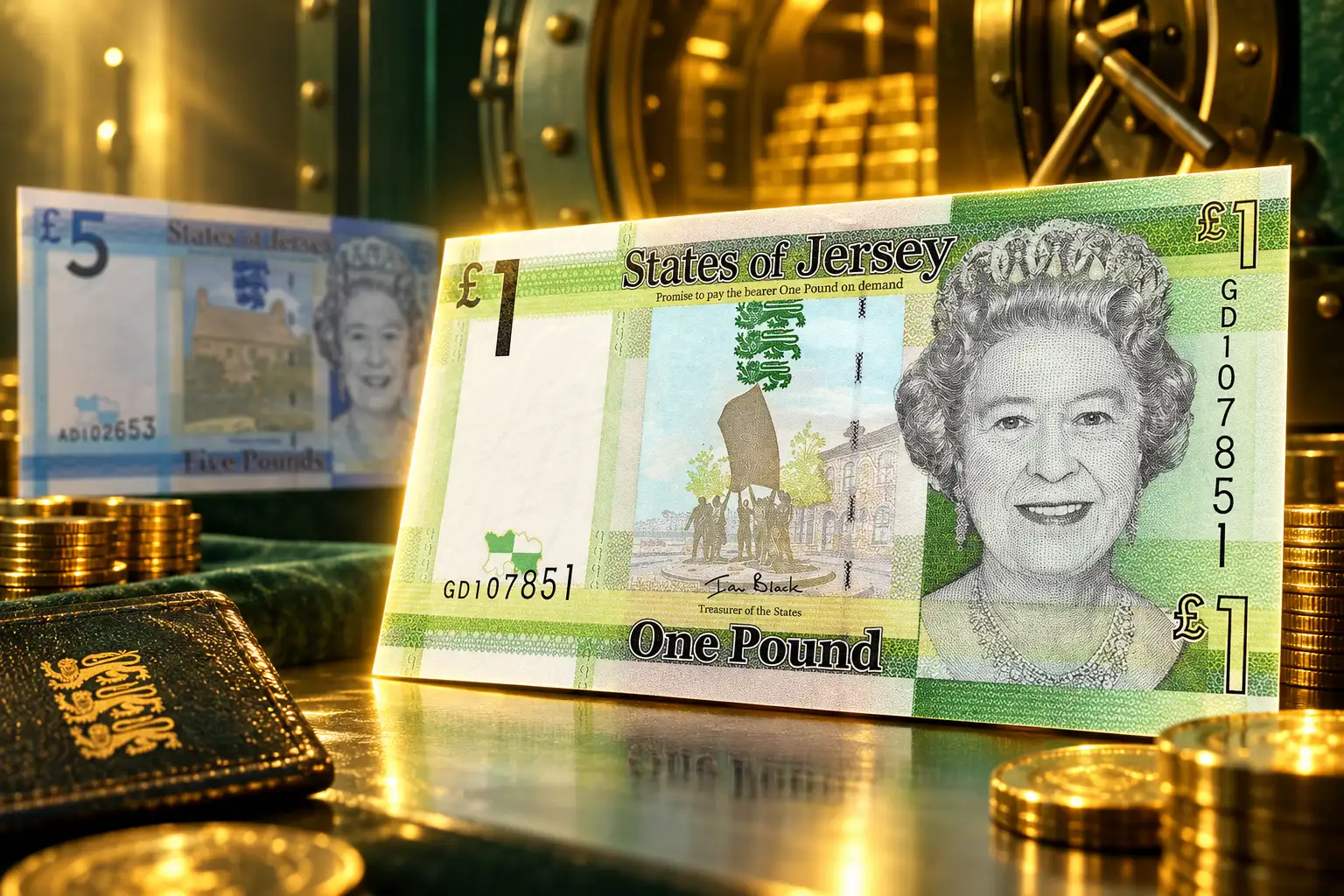
A Warehouse Full of D-Class Notes
Jersey issues its own sterling notes, which circulate at par with Bank of England money. Banks buy them from the States at face value. The cash is invested until a note comes back worn, damaged, or unwanted, which is how the island earns a return on every pound that stays out.
Ian Black, then States Treasurer, put a number on that model when the D-class notes launched. Banks paid the States for the cash they took, those payments were invested, and in 2008 the arrangement generated £3.7 million. Notes that leave in a tourist wallet and never return sit on the books as a liability that never has to be repaid in kind. For a small issuer, that is not a rounding error.
It is also why a fresh print run is a serious bill. Security printers set a minimum order. For Jersey that minimum is large relative to the till. Print too soon and the island pays to store notes it does not need, or to shred notes it already paid to make. Millar’s “value for money” line is inventory management, not a shrug at the King.
The Bank of England, with a far bigger cash cycle, still chose a slow switch. New Charles notes are printed only to replace worn ones and to meet extra demand, in line with Royal Household guidance on cost and waste. Queen Elizabeth II notes remain legal tender there. Jersey is applying the same logic with less room to spare: spend what is already paid for.
Bank Orders Have Fallen by Two-Thirds
The float that makes that model work is shrinking. Deputy Kirsten Morel, then Minister for Sustainable Economic Development, sent the Economic and International Affairs Panel the annual bank orders for Jersey notes in April 2024. Local banks called for £306,357,500 in 2014. In 2023 they called for £102,234,000.
JERSEY NOTE ORDERS AND RETURNS
| Year | Bank orders | Bank returns |
|---|---|---|
| 2014 | £306,357,500 | £301,527,619 |
| 2019 | £179,045,912 | £176,808,127 |
| 2020 | £124,884,500 | £122,529,775 |
| 2023 | £102,234,000 | £109,657,762 |
Morel said the large matching flows often reflect banks swapping old notes, which are then destroyed, for new. Even on that basis the call has fallen by about two-thirds in nine years, a drop of £204,123,500. In 2023, banks sent more notes back than they ordered. The pandemic years show the steepest step down, but the slide was already clear by 2019.
The same letter records how the States itself is paid. In 2014, 40 per cent of government income transactions still arrived by non-digital channels such as cash and cheque. By 2023 that share was 9 per cent. Most public-facing departments still take notes and cheques. The Public Finances Manual allows it, and also flags the cost and risk of handling cash.
Next Door, Polymer Notes Sit Unsigned
Guernsey did the thing Jersey is only talking around. In April 2025 the States Treasurer, Bethan Haines, said the next Bailiwick family would be polymer £1, £5, £10 and £20 notes, due in 2027, drawn from island art and with no portrait of the King.
It is only the last set of notes that Guernsey produced that included the monarch. We wanted to return to them being purely about Guernsey and more timeless.
Bethan Haines, States Treasurer, States of Guernsey
A panel picked three designs from 26 submissions. Guernsey-born artist Hayley Mallett and photographer Rachael de la Mare worked on the fronts. Urban architect Natasha K.HE, who moved to the island from China, worked on the backs. The finished art was to go to De La Rue, the printer founded in Guernsey, which already added new threads and an embedded stripe to Guernsey’s paper £5, £10 and £20 notes in 2023.
On 18 September 2026 those designs were still on hold. Chief executive Boley Smillie said it had become traditional, if not a legal duty, for a States treasurer to sign new notes, and the government would wait for a permanent chief financial officer. The States also refused another print run of the current Queen notes. Smillie said that would not have been a prudent use of taxpayer money. Bailiwick notes could thin out in the coming months, he said, with “ample access to Sterling notes” so no denomination actually runs short.
Jersey still has a vault of its own paper. Guernsey has art, a polymer brief, and no signature. The Channel Islands are not moving as a pair.
If Jersey ever does change substrate, the durability case is the one the Bank of England already made for itself. It says polymer notes last two-and-a-half times as long as paper, and that a polymer fiver has a carbon footprint 16 per cent lower than the cotton note it replaced. That saving only starts after the old stock is gone.
What the 2010 Series Still Carries
The notes in tills are 16 years old, and they were already a late refresh. Jersey began regular issues in 1963, then replaced the family in 1976, 1989 and 2010. The D-class designs were shown in February 2010 and went into general circulation on 29 April 2010, printed by De La Rue on cotton paper with a Jersey cow watermark, a map see-through, a windowed thread and Cornerstone patches in the corners.
The 1989 series had put birds on the money, Dartford warblers, oystercatchers, brent geese. The 2010 brief went to buildings, towers and parish heraldry, with values in English, French and Jèrriais.
The government’s own page on the current Jersey bank notes still walks a holder through how to check them, and lists the coastal towers on each reverse.
THE D-CLASS TOWERS
- £1, fresh green: Le Hocq Tower in St Clement, with the Monument to Freedom in Liberation Square on the face and La Hougue Bie on the back.
- £5, sky blue: Archirondel Tower at St Catherine’s Bay, with Le Rât Cottage and Les Augrès Manor, home of the Durrell Wildlife Conservation Trust.
- £10, burnt sienna: Seymour Tower offshore in Grouville Bay, with the Hermitage at Elizabeth Castle and the Lalique glass at St Matthew’s.
- £20, violet: La Rocco Tower at St Ouen’s Bay, with the States Building and the chamber inside.
- £50, red: Ouaisné Tower at Ouaisné Bay, with Mont Orgueil and Les Écréhous.
Holograms sit on the £10, £20 and £50, switching between the island outline and the crest, with La Corbière lighthouse in the background pattern. The twelve parish crests run on the reverse. Older 1963, 1976 and 1989-1993 notes can still be swapped at face value at a bank or the Customer Hub on Union Street.
Raised Ink and a Jersey Cow
A redesign pitched on accessibility would be arguing with work already done. The notes step up in size with value. Each denomination has its own colour and a large numeral on both sides. Intaglio ink on the title and the number is meant to feel raised. The holograms are smooth to the touch on the three higher notes, so a person who cannot see the colour can still tell them apart.
Damaged notes go back to the cashiers. If a full serial number is visible, they can be changed. If a serial is missing, the island holds a £1 note for a month and a higher note for three months, in case the other half turns up. That is the cash cycle as it stands, still running on 2010 paper.
Mint Packs Already Leave the Island
Jersey Post sells unused sets at face value plus a small administration charge. That is an official souvenir channel, not a side effect. Dealers still list crisp 2010 tens and fifties with the Queen on the face. Visitors keep photographing the smile. The live talk around these notes is collecting, not a campaign for Charles III.
CASH, NOTES AND THE SHRINKING TILL
- Jersey notes out: About £93 million of Jersey notes were in circulation at the end of 2025, separate from the unissued D-class reserve.
- UK payments: Cash was 9% of all UK payments in 2024, or 4.4 billion transactions, down from 12% in 2023, 23% in 2019 and 48% in 2014, according to UK Finance.
- Jersey receipts: Non-digital channels were 9% of government income transactions in 2023, down from 40% in 2014, a different 9% from the UK till figure.
- Polymer life: The Bank of England’s working figure remains at least two-and-a-half times the life of paper, which only helps after a reprint.
UK Finance also notes that 4.4 billion cash payments is still a lot of notes in the hand, and that cash fell behind Direct Debits, Faster Payments and credit cards as a share of all payments in 2024. Almost one in ten UK payments was still cash. In Jersey the people who need notes are older residents, visitors, and shops that do not want a card terminal on every stall. The Assembly has already spent time on a right to pay in cash in person. A prettier series does not reopen a closed till.
A new family would still have to clear ATMs, retailer scanners and seasonal staff training. It would still have to look like Jersey. That is not free, and none of it starts while the present notes are stacked, paid for, and legal.
The King Can Wait for the Next Print Run
Treasury has not published a consultation date, a substrate choice, or a portrait brief. Guernsey’s polymer notes, already drawn, were still waiting on 18 September 2026 for a finance chief to sign them. Jersey’s Queen Elizabeth notes are still the ones in the drawer, and mint packs are still on sale for anyone who wants to take the island home at face value plus a fee.

Edinburgh Opens a 2027 Tour Built for Time Trials

Korda Maps Auður From Meðalland to Irvine Bay

Apple Music Films Its New Logo in Mineral Oil

Oppo Prices the Pad Mini Above India’s iPad Mini

Austen Soaks Scotland Before Boelo Brings Weekend Gales

Volkswagen Sells the Osnabruck Plant to Clear a Board Fight

Apple’s Foldable iPhone Hinges on Samsung Display Supply

Saksham Gaur Finds He Is His Own Company’s Client

Tata Motors’ Iveco Tender Opens as Holders Still Decide

Onimusha Way of the Sword Preload Hits a Windows 11 Wall
-
 AUTO2 months ago
Volkswagen Sells the Osnabruck Plant to Clear a Board Fight
-
 NEWS2 months ago
Apple’s Foldable iPhone Hinges on Samsung Display Supply
-
 AUTO2 months ago
Tata Motors’ Iveco Tender Opens as Holders Still Decide
-
 BUSINESS2 months ago
Saksham Gaur Finds He Is His Own Company’s Client
-
 GAMING2 months ago
Onimusha Way of the Sword Preload Hits a Windows 11 Wall
-

 ENTERTAINMENT3 years ago
What is SD on Amazon Prime? – All You Need to Know
-

 BUSINESS2 months ago
Hyderabad 22-Carat Gold Jumps After a False Bargain
-

 NEWS2 months ago
iQOO 16 Locks 8,400 mAh While 100W Charging Holds