
NEWS
HPE Wagers Spaceborne Computer-4 on the Lunar South Pole
HPE will fly Spaceborne Computer-4 to the Moon in late 2026, betting unnamed chips and laptop SSDs can survive south pole heat and post the first HPC scores.

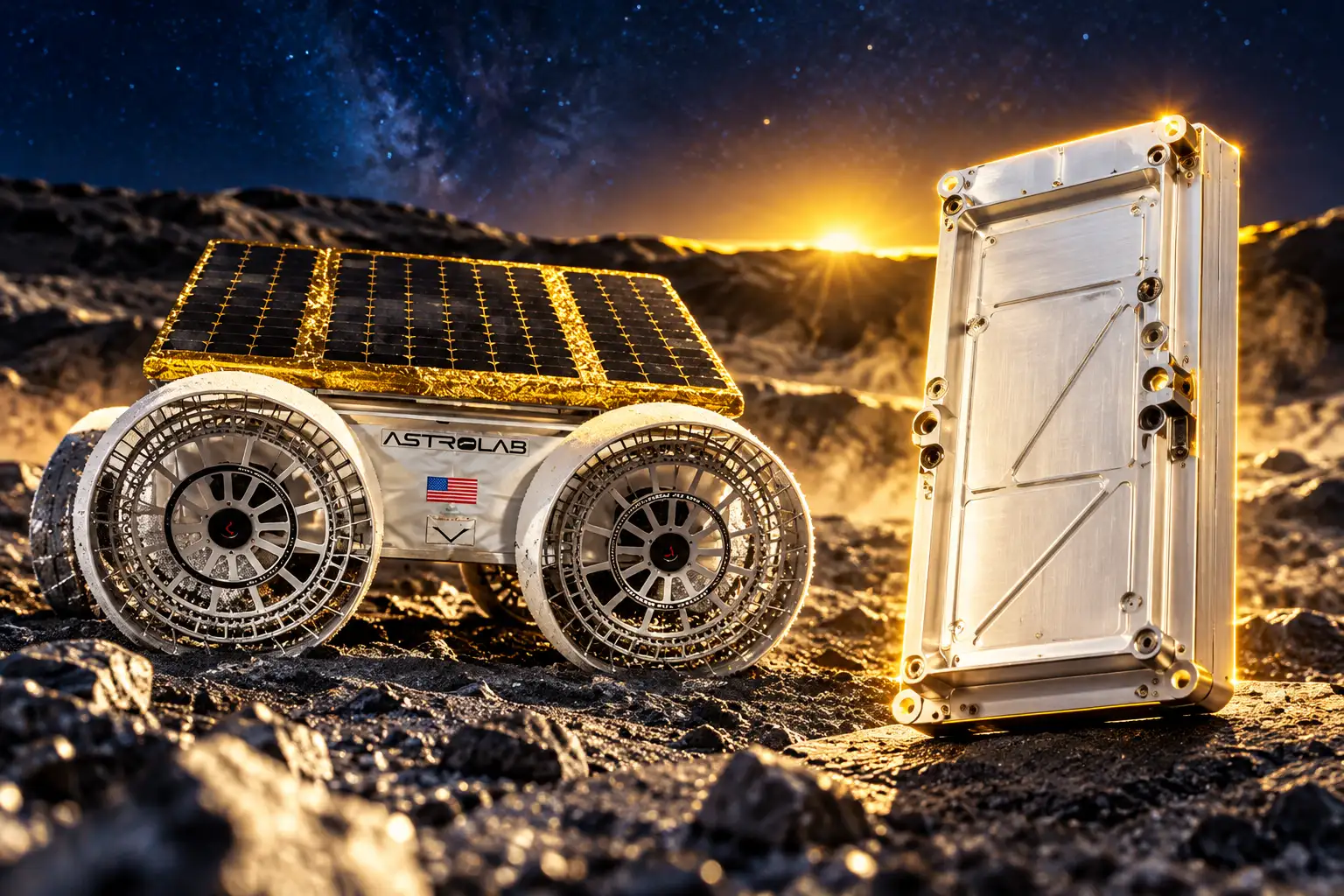
HPE said on Oct. 20 that Spaceborne Computer-4 will ride a lunar rover in late 2026 and attempt the first LINPACK and HPCG runs off Earth. The fanless module is booked on Astrolab’s FLIP rover, which Voyager Technologies’ Griffin-1 lander is due to set down near the lunar south pole.
The headline is a pair of supercomputer tests. The wager is whether commercial parts, watched by software and packed into a box you can lift with one hand, can keep working where there is no air, no magnetic field, and no one to swap a board.
A 2.6-Pound Box Has to Think for Itself
HPE’s release says Spaceborne Computer-4 will run the first high performance computing benchmarks on the Moon, along with onboard language models, camera inference, and LiDAR processing. Launch is planned for late 2026 under NASA’s Commercial Lunar Payload Services initiative. Scott Wiest, vice president, fellow, and global sales chief technologist at HPE, said lunar work will depend on turning data into answers at the point of discovery.
A round trip at light speed takes at least 2.6 seconds, and ground processing stretches that further. Mark Fernandez, HPE’s chief scientist and principal investigator on the Spaceborne line, said the wait to Mars can reach 20 minutes and that even the shorter lunar lag leaves operators looking at stale data. He told a press briefing the Soviets lost two rovers to operator errors caused by that delay. FLIP cannot wait on Hawthorne to decide whether the next patch of ground is safe.
That is why the module exists. LiDAR and cameras will make more raw data than the downlink can move, so the box has to send conclusions, not sensor dumps. The same pattern already rules factories and field gear with weak links. The south pole is just the harsh end of it.
THE MODULE IN HAND
- Mass: The chassis weighs 2.6 pounds.
- Size: The aluminum box measures 249 mm by 132 mm by 26 mm and has no fans.
- Power: FLIP feeds it on a 28 VDC rail with little wattage to spare.
- Storage cap: Each KIOXIA drive is limited to 5W, a throttle almost nobody uses on Earth.
HPE has not named the low-power 64-bit CPU or the GPU. Until an HPL figure posts from the surface, the speed class is a blank. The software stack runs in containers on Linux. Waste heat dumps into the rover’s radiators, and some of that warmth is meant to help FLIP through the night, when shade at the pole can sit at minus 200°C.
Nine Years on the Station Bought This Wager
Spaceborne Computer-4 is the first of the line built to run in vacuum. The earlier boxes lived inside the International Space Station, a cabin held near 20°C, under Earth’s magnetic field, with astronauts a hatch away. Fernandez’s team still treats that record as the asset. The method is software that watches the hardware, not custom chips designed for a decade of radiation tests.
Early ISS drives did fail. Later teardowns pointed to bad capacitors that also died in Earth units, which took cosmic rays off the suspect list for those losses. Fernandez has said he has had zero SSD failures since 2019. The current design keeps spare CPU cycles on a state table. If a reading trips a limit, the box slows down, sits idle, or powers off rather than cooking itself.
THE SPACEBORNE LINE TO THE MOON
- August 2017: Spaceborne-1, built around commercial servers, rides to the ISS to prove software hardening.
- 2019: The first system returns; SSD losses are traced to capacitors also seen on the ground.
- 2021: Spaceborne-2 arrives on station with KIOXIA flash and a GPU path for onboard analysis.
- March 15, 2024: NASA’s FLUID framework trains models on Earth and the ISS without moving raw data.
- 2024: Spaceborne-3 launches, still in low Earth orbit.
- 2025: A Llama 3.2 model runs on station under the Space Llama effort.
- February 12, 2026: HPE says Spaceborne Computer-4 is delivered and bolted into FLIP.
- October 20, 2026: HPE announces the lunar benchmark and AI plan for a late 2026 flight.
Francisco Cordova, chief operating officer of the ISS National Laboratory, said the station is extreme and still controlled next to what the Moon will do. China’s Chang’e-6 rover used basic onboard nets on the far side in 2024, and NASA’s Mars trucks still roll on space-hardened brains with 1990s-class punch. FLIP is carrying a 64-bit CPU and a GPU that can run many tasks at once, the way an edge box does on Earth, without that long hardening cycle.
Heat and Shadow at the South Pole
FLIP, short for FLEX Lunar Innovation Platform, is a 480-kilogram rover due to carry 20 payloads. Astrolab built it as a test mule for the later FLEX crew vehicle, with Venturi’s hyper-deformable wheels and a battery pack sized to live through lunar night. The rover is rated for at least 150 hours of that night. Wiest said HPE expects the computer to last the life of the mission, which he put at 10 days on the surface.
A full lunar night runs about 14 Earth days, longer than that 150-hour rating, so the survival claim is not a full polar winter. Polar summer keeps the Sun low on the horizon, which is why FLIP’s solar panel stands vertical. Shadowed crater floors, the places teams want to probe for water ice, are a different thermal world.
ISS VERSUS THE LUNAR SOUTH POLE
| Condition | ISS cabin | Lunar south pole |
|---|---|---|
| Air and cooling | Pressurized room, near 20°C | No atmosphere; the module is fanless and tied to rover radiators |
| Temperature | Held near 20°C | About 80°C in sunlight, about minus 200°C in shade |
| Radiation | Station shielding plus Earth’s magnetic field | Almost three times the ISS dose, no magnetic field |
| Repair | Crew on board | None; a bad board stays bad |
Fernandez put the design rule in plain terms. There is no spare parts locker on FLIP, so the computer spends cycles checking itself instead of running flat out.
In space, we don’t have the redundancy, we don’t have the repairman, we don’t have the spare parts, so we spent a lot of time, a lot of CPU cycles, checking everything out and making sure that everything is working out right.
Mark Fernandez, chief scientist, HPE Spaceborne program, press briefing
If the software stair-step works, a radiation spike costs speed or uptime, not the box. If it does not, a 10-day science outing ends in a quiet brick, and the LINPACK run never files.
What Rides Along With the Benchmarks
HPL, the High-Performance LINPACK test, measures sustained floating-point work on dense linear algebra. HPCG, High-Performance Conjugate Gradient, leans on memory access and communication, which is closer to how real codes behave. HPE wants both numbers from the surface. The rest of the manifest is why the rover is going at all.
WORKLOADS BOOKED ON THE MODULE
- LINPACK: HPL is scheduled as HPE’s claimed first supercomputer-style score from the Moon.
- HPCG: The companion test stresses memory and message patterns the LINPACK run can hide.
- Document RAG: A retrieval-augmented language model is meant to search mission files at the edge instead of paging Earth.
- Vision inference: Camera feeds are to be read on the rover so raw video can stay off the slow link.
- LiDAR mapping: Range data is booked for navigation, terrain models, and later building work.
- NASA FLUID: Three models, trained on Earth, station, and lunar data, are meant to share updates rather than datasets.
- Silent Shield: Deloitte’s intrusion detector is set to watch for odd behavior in near real time.
NASA already ran a two-ended version of that federated setup. A bioRxiv paper from the Ames group describes federated learning between Earth and the ISS on March 15, 2024, using Intel’s OpenFL stack on Spaceborne-2, with only model weights crossing the link. The lunar node is the new third seat. Roser Almenar, an AI and space law researcher at the University of Valencia, said language models still invent details, and a small error in space is not small. That warning sits on the same box as the navigation jobs.
On the ground, HPE will run Astrolab’s Hawthorne, California mission control on HPE Private Cloud, with CloudOps Software to schedule the automated work. That is the part of the announcement that looks like a product sale rather than a plaque. Jaret Matthews, founder and CEO of Astrolab, said the Moon is a hard place for advanced computing and that FLIP is built to host mixed payloads, not a single flagship instrument.
With HPE Spaceborne Computer-4, we are bringing AI and high performance computing to the lunar edge, helping the acceleration of scientific discovery and building the infrastructure for the next era of exploration.
Scott Wiest, vice president, fellow, and global sales chief technologist, HPE, Oct. 20 announcement
KIOXIA Drives Run as a Silent Mirror
Storage is two off-the-shelf KIOXIA BG6 Series client NVMe SSDs, the same family sold for thin PCs. The official brief lists capacities up to 2,048 GB, a PCIe 4.0 and NVMe 1.4c interface, and typical active power of 4.3 W to 4.7 W. The lunar pair are 1TB cards with a 5W cap turned on. They are not radiation-hardened parts.
Fernandez described the layout as a silent software RAID 1. The boot order tries one drive and falls to the other if that disk is hurt. Nine years of station use, he said, was enough to argue that the drives need no special space treatment. That claim is the storage half of the bet, and it is still an ISS claim until the south pole dose hits the same NAND.
KIOXIA has flown commercial flash on the earlier Spaceborne systems. This flight extends that log into vacuum, polar cold, and a radiation field almost three times the station’s. If both cards die, the benchmarks die with them. If the mirror holds, a client SSD that sells into laptops becomes a lunar design note.
HPE Will Not Name the CPU or GPU
The largest hole in the Oct. 20 notice is the silicon. HPE says only that the CPU is low-power and 64-bit and that a GPU is on the board. Without those names, nobody can price the result against a terrestrial edge server or guess the LINPACK band. An HPL number from the surface would close that gap in one posting, which is likely why HPE is willing to wait.
WHAT WE KNOW
- The ride: Spaceborne Computer-4 is integrated on FLIP for a late 2026 Griffin-1 delivery near the south pole.
- The tests: HPE has booked HPL, HPCG, language-model retrieval, vision, and LiDAR jobs on that module.
- The method: Protection is software monitoring, a two-drive mirror, and a fanless aluminum chassis tied into the rover’s thermal loop.
- The clock: Wiest put surface life at 10 days; FLIP is rated for at least 150 hours of lunar night.
WHAT IS UNCONFIRMED
- The chips: CPU and GPU vendors and models are still undisclosed.
- The score: No lunar HPL or HPCG figure exists; the run is a plan, not a result.
- Full night: There is no promise the module will run through a 14-day lunar night at minus 200°C.
- Landing: Griffin-1 still has to put FLIP on the soil before any of the software matters.
Useful work per watt will be the figure that travels. A location field that reads “the Moon” is a trophy. How much mapping, retrieval, and anomaly watch that 2.6-pound box can finish on FLIP’s tight rail is the number other landers can copy.
Earth Testing Is Over for the Rover
Astrolab said on Oct. 19 that a year of trials on FLIP and a test vehicle is complete. The rover has been through heat and cold loops meant to mimic the Moon, launch vibration, and the egress path off the top of Griffin-1. The remaining exam is the surface. Getting a rover from a lander deck onto loose regolith is a separate mechanical bet from whether Spaceborne Computer-4 boots after touchdown.
Over the past year, FLIP and our FLIP test vehicle have been put to the test.
They've survived trials of our egress system for getting to the lunar surface from the top of the Griffin-1 lander. FLIP has withstood intense heat and cold mimicking the conditions of the Moon. The… pic.twitter.com/YascYHoVos
— Astrolab (@Astrolab_Space) October 19, 2026
Astrolab’s own page still lists a summer 2026 landing for the FLIP rover to the lunar surface. HPE’s Oct. 20 notice, which names the computer as cargo, puts the flight in late 2026. The later date is the one tied to this payload. Matthews’s vehicle is a precursor for FLEX, the crewed rover Astrolab is building for Artemis, so a dead computer would still leave tire, battery, and dust data. A live computer would give those later buggies a template for thinking on the spot.
FLIP sat in the Hawthorne clean room in October with its solar panel stacked for a Sun that never climbs. Spaceborne Computer-4 is already on it. The LINPACK job, the three-world learning test, and the unnamed GPU all wait on the same landing.

Edinburgh Opens a 2027 Tour Built for Time Trials

Korda Maps Auður From Meðalland to Irvine Bay

Apple Music Films Its New Logo in Mineral Oil

Oppo Prices the Pad Mini Above India’s iPad Mini

Austen Soaks Scotland Before Boelo Brings Weekend Gales

Volkswagen Sells the Osnabruck Plant to Clear a Board Fight

Apple’s Foldable iPhone Hinges on Samsung Display Supply

Tata Motors’ Iveco Tender Opens as Holders Still Decide

Saksham Gaur Finds He Is His Own Company’s Client

Onimusha Way of the Sword Preload Hits a Windows 11 Wall
-
 AUTO2 months ago
Volkswagen Sells the Osnabruck Plant to Clear a Board Fight
-
 NEWS2 months ago
Apple’s Foldable iPhone Hinges on Samsung Display Supply
-
 AUTO2 months ago
Tata Motors’ Iveco Tender Opens as Holders Still Decide
-
 BUSINESS2 months ago
Saksham Gaur Finds He Is His Own Company’s Client
-
 GAMING2 months ago
Onimusha Way of the Sword Preload Hits a Windows 11 Wall
-

 BUSINESS2 months ago
Hyderabad 22-Carat Gold Jumps After a False Bargain
-

 ENTERTAINMENT3 years ago
What is SD on Amazon Prime? – All You Need to Know
-

 NEWS2 months ago
iQOO 16 Locks 8,400 mAh While 100W Charging Holds