
BUSINESS
Glasgow Clears a £25m Clyde Park Still Years From Use
Glasgow has approved a £25 million Custom House Quay and Carlton Place park, but sheet piles, a moved memorial and a June 2027 marine licence still sit in the way.

Glasgow City Council granted planning permission in September 2026 for a £25 million rebuild of Custom House Quay and Carlton Place. Construction is listed for 2027 to 2030.
A marine licence for the new north-bank wall does not begin until 1 June 2027, and the Spanish Civil War memorial on Clyde Street is due to be lifted, stored, and set down a few metres over.
The Vote Arrived 10 Months Late
Officers had first flagged a decision for 6 November 2025, after Hawkins\Brown lodged the masterplan in summer 2025. The stamp arrived on 14 September 2026, 10 months later, with Councillor Ruairi Kelly, the SNP deputy leader and housing convener, already talking about delivery rather than design.
Kelly said the scheme was “a major step forward in activating the riverfront and improving the surrounding environment.” After the vote he added: “Now that planning permission has been granted, we can get on with what is important to the people of Glasgow, and that is delivery.”
The council had already spent years on consultation, a Proposal of Application Notice, and a screening that found no Environmental Impact Assessment was needed. That paperwork trail is what the September vote closed.
FROM NOTICE TO PERMISSION
- 9 September 2024: A Proposal of Application Notice goes to planning, including public realm works, new pavilions, and relocation of the listed statue.
- 24 November 2024: Ryden screens the scheme for an Environmental Impact Assessment under reference 24/02819/SCR.
- 2 June 2025: The council confirms an EIA is not required.
- Summer 2025: The full planning application is submitted, with a decision first expected on 6 November 2025.
- 7 August 2026: Marine Scotland grants licence 00011592 for works in the Clyde.
- 14 September 2026: Planning permission is granted for both banks.
Hawkins\Brown has been on the job since 2021, when the council appointed the practice to lead a public-realm masterplan that was once hoped to be finished in 2024. Peter McLaughlin, a partner at the firm, said reinforcing the quay walls “has created the opportunity to regrade and renew the landscape on both banks, creating spaces to meet and spend time on the river frontage within the city centre.”
Sheet Piles Go In From June 2027
The north wall is the part that actually sits in the river, and it cannot be treated as a paving job. Custom House Quay’s existing structure is in poor condition. The design puts a new steel sheet-pile frontage in the water, in front of the present wall, and anchors it back into the ground.
Marine Scotland granted Glasgow City Council a construction licence on 7 August 2026, with Arch Henderson as agent and Haskoning UK named on the licence. That licence running to July 2029 does not commence until 1 June 2027, which is why the council’s own construction window is 2027 to 2030 rather than this autumn.
THE WALL THE PARK DEPENDS ON
- North wall: 459 metres of quay at Custom House Quay, to be rebuilt as a vertical sheet-pile edge from cope to seabed.
- South wall: 422 metres of stone revetment at Carlton Place, already slumped in places from scour, to be renewed as a graded bank.
- Licence window: 1 June 2027 to 1 July 2029 for the marine works.
- Build span: construction anticipated from 2027 to 2030, with technical design and a works contract still to finish.
Kelly had already sketched a split programme on 23 July 2026, before permission landed, putting Carlton Place first after bird nesting and Custom House Quay later in 2027.
Work at Carlton Place will begin in the autumn after nesting season and Custom House Quay is planned for later in 2027, it is still going through the technical design and planning phase.
— Cllr Ruairi Kelly (@RuairiKelly_) July 23, 2026
The Crown Estate holds the bed of the Clyde inside the red line, so the sheet piles are a marine job as well as a city one. Until that licence window opens, the north bank remains a closed engineering site on paper.
La Pasionaria Shifts a Few Metres
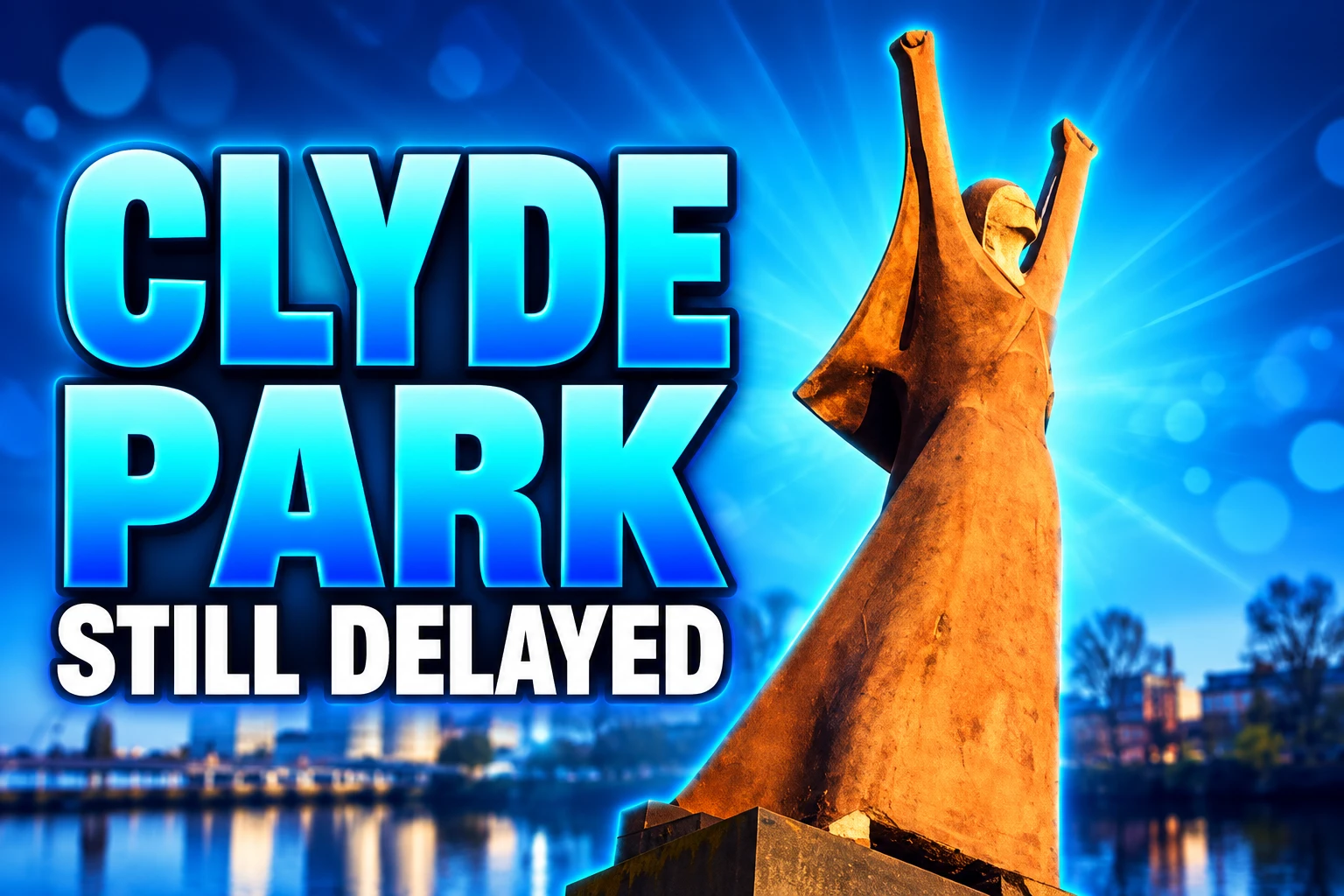
The most loaded object on the quay is not a bench. It is Arthur Dooley’s fibreglass figure of Dolores Ibárruri, known as La Pasionaria, on a corten steel plinth facing the river. The International Brigade Association of Scotland commissioned it; trade unionists raised a £3,000 fee; Dooley needed six attempts at the figure; bronze was dropped on cost.
It appeared on 5 December 1979 without a public unveiling after a fight on the council. Conservatives had tried to keep it off Clyde Street. It is Category B listed in 2004, restored in August 2010, and still carries the count of 2,100 British volunteers who went to Spain, 534 of whom were killed, 65 of them from Glasgow.
A separate listed-building consent sits beside the planning application because the statue has to move for the new wall and the new alignment of the park. The June 2025 planning statement, prepared by Ryden for Hawkins\Brown on behalf of the council, is blunt about the method.
The sculpture known as La Pasionaria will be carefully removed, stored, protected and re-instated a few metres away to align with the centre of Custom House.
Ryden planning statement for Glasgow City Council, June 2025
That is the whole relocation: re-instated a few metres away, not shipped off the river. A methodology has to be signed off before anyone touches it. Minor works are also proposed to the north masonry pier of the Category A South Portland Street Suspension Bridge once the 1970s podium that now abuts it comes off.
What Both Banks Are Due to Get
The red line covers 7.86 hectares (78,537 sqm) between Glasgow Bridge and Victoria Bridge, on both sides of the river and across the channel. Clyde Walkway Core Path C93 and National Cycle Route 75 already run the north bank, mostly by steps and ramps from Clyde Street. Carlton Place’s gardens are closed to the public.
NORTH BANK AND SOUTH BANK
| Bank | Quay wall | Present state | Planned work |
|---|---|---|---|
| Custom House Quay (north) | 459m | Poor structure, 1970s terraces, retaining walls hiding the river from Clyde Street | Sheet-pile wall, accessible urban park, event terrace, pavilions up to 1,101 sqm |
| Carlton Place (south) | 422m | Slumped stone revetment, gardens shut, trees not fully surveyed on safety grounds | Regraded bank, 5,000 sqm of open green space, play area, new paths |
Designs shown in consultation put a terraced performance space at the foot of Dixon Street, a quieter viewpoint opposite St Andrew’s Cathedral, and a patch for creative use. The vacant Ladies Waiting Room on Clyde Street is kept, with a possible shift into retail, food and drink, leisure or commercial use. Young people asked for more colour; corten steel is the answer in the drawings.
Trees take a hit so the walls and the ramps can be rebuilt. Forty-nine are to be kept, 79 trees are to come out, and 82 new ones are to go in, 53 of them on Custom House Quay and 29 on Carlton Place. The planning statement says retaining walls on the north bank block views from Clyde Street and cut surveillance, “leading to reports of anti-social behaviour at the site.”
At engagement sessions, 78.4% of people strongly agreed that Glasgow should improve its city river front, and 74.3% agreed the masterplan would improve the pedestrian experience and safety during the day. The Clyde in the city centre still has almost nowhere to sit down to a meal on the water. The pavilions and the Ladies Waiting Room change of use are the council’s answer to that, once the walls are in.
City Deal Cash Covers the Walls and the Park
The bill is meant to be met from the Glasgow City Region City Deal, through the Clyde Waterfront and West End Innovation Quarter programme. That programme is budgeted at £113.9 million for works along the river corridor from the city centre to Govan. The quay scheme is one slice of it, costed at £25 million.
WHERE THE MONEY SITS
- The Deal: a £1.13 billion City Deal signed in August 2014 by the UK Government, the Scottish Government and eight councils.
- This programme: £113.9 million for the Clyde Waterfront and West End Innovation Quarter, including Custom House Quay, Carlton Place and the Govan to Partick Bridge, which opened in September 2024.
- This site: £25 million for the walls, the park and the public realm, expected to support 333 full-time-equivalent construction jobs on the Association of Researchers in Construction Management method.
- The bed: the application site is council-owned on land; the river bed is Crown Estate interest, which is why the marine licence sits beside planning.
Kelly used the project in March 2026 when writer Gerry Hassan asked why Glasgow could not match Liverpool’s waterfront. “And the huge public realm project at Custom House Quay will reactivate the river front,” Kelly wrote. “I guess we actually are doing this.” The planning vote six months later is the first half of that claim. The second half still depends on a contractor, a cofferdam, and a 2027 start on the wall.
Glasgow Already Consented This Quay in 2005
This stretch of the Clyde has had paper victories before. In 2005 the council granted 04/01407/DC for a mixed-use scheme of homes, a nursery, bars, restaurants, a new quay wall, reclamation into the river and a pontoon. It was never built. A 2013 bid to stretch that consent, 10/02826/DC, was withdrawn.
The 1970s amphitheatre, steps and podium in front of the Category A Custom House are what now pass for a waterfront, and they are coming out. The heritage statement that accompanied the 2025 submission called the new masterplan “a once in a lifetime opportunity to reintegrate the City with the River Clyde.” Hawkins\Brown’s design and access statement used “once in a generation.” Both lines assume the walls are actually replaced this time.
The application the council is now building from is the one filed when plans first went in, with the memorial move already on the face of the notice. Listed Building Consent and Conservation Area Consent were submitted in parallel because the statue, the 1970s abutments on the Suspension Bridge, and the Glasgow Central Conservation Area all sit inside the red line.
Overgrowth Came Off Carlton Place in September
On 5 September 2026, crews were already cutting years of growth off the Carlton Place embankment, nine days before the planning vote. That matches Kelly’s July note that south-bank work would follow nesting season, and it is still a long way from a finished park. The gardens there have been shut. The stone bank has slumped. A tree survey of that side had to wait on health and safety.
Phasing after the vote still points to the heavier north-bank wall landing later, inside the marine window. Hawkins\Brown has said Custom House Quay is likely to go first among the main works; Kelly had the south bank earlier. Either way, nobody is promising a ribbon on the walkway in 2026.
The marine licence for the wall begins on 1 June 2027 and runs to 1 July 2029. Technical design and a works contract still have to close on the north bank. The park described as a once in a lifetime chance to meet the river is not scheduled to be finished before 2030.

TCS Opens Q2 as Mid-Cap IT Keeps the Growth

Bitcoin’s Jobs Rally Fails While December Hike Odds Hold

The Heat Turn a Bucks Rematch Into Vice City Night

The G7 Opens Diesel Tanks While Carriers Head East

Kia Bets Fortuner Money on a Made-in-India Sorento

Volkswagen Sells the Osnabruck Plant to Clear a Board Fight

Tata Motors’ Iveco Tender Opens as Holders Still Decide

Saksham Gaur Finds He Is His Own Company’s Client

Onimusha Way of the Sword Preload Hits a Windows 11 Wall

The Frame Pro’s $1,200 Labor Day Cut Needs a Soundbar
-
 AUTO4 weeks ago
Volkswagen Sells the Osnabruck Plant to Clear a Board Fight
-
 AUTO1 month ago
Tata Motors’ Iveco Tender Opens as Holders Still Decide
-
 BUSINESS1 month ago
Saksham Gaur Finds He Is His Own Company’s Client
-
 GAMING1 month ago
Onimusha Way of the Sword Preload Hits a Windows 11 Wall
-
 NEWS4 weeks ago
The Frame Pro’s $1,200 Labor Day Cut Needs a Soundbar
-

 BUSINESS1 month ago
SEBI Reopens How F&O Settles After the Closing Auction
-

 BUSINESS1 month ago
The Rs 4.66 Lakh Crore IPO Queue Is Mostly Paper
-
 NEWS1 month ago
Apple’s Foldable iPhone Hinges on Samsung Display Supply