
ENTERTAINMENT
George Lucas Traded Three Star Wars Films for a Museum
George Lucas still had three Star Wars sequels planned when he poured that decade into the Lucas Museum of Narrative Art, which opens September 22, 2026.

George Lucas still had three Star Wars sequels planned when he left filmmaking for a museum that opens September 22, 2026. He is 82. In the couple’s only interview of the opening, he told Norah O’Donnell that time had run short, and that the Lucas Museum of Narrative Art had won.
The films were Episodes VII, VIII, and IX, treatments Disney bought in 2012 and did not shoot. The museum is the decade those movies would have eaten, poured into a 300,000-square-foot building in Los Angeles Exposition Park.
Three More Star Wars Films Were Still on His Calendar
Lucas has said before that selling Lucasfilm was painful. This time he put a number on what he walked away from. He had three more Star Wars movies he still meant to make, and he retired anyway because he wanted the museum and could see the clock.
I decided to retire from making movies, which was a big deal because I had three more ‘Star Wars’ to make. But I realized that I was running out of time, and I did want to make this museum, and I’d spent a lot of time developing digital technology for the movie business.
George Lucas, filmmaker, speaking with Norah O’Donnell
Those three pictures are not a newly found trilogy. They are the sequels he had already started to staff before the sale, the ones he had discussed with Carrie Fisher, Harrison Ford, and Mark Hamill. Kathleen Kennedy, whom he picked to run Lucasfilm, has said those conversations happened before she took over.
He sat for the interview with his wife and co-founder, Mellody Hobson. The extended cut is the fullest version of how he now tells the trade.
What Lucas Mapped for Episodes VII Through IX
Lucas never locked a shooting script. The outlines kept moving, which is what unfinished films do. Across interviews collected in The Star Wars Archives: 1999-2005, he described a third trilogy about the daughter and the grandchildren, after a first trilogy about the father and a second about the son.
Episode VII would have begun a few years after Return of the Jedi, in the mess that follows a fallen empire, not 30 years later with a new substitute army. He said he was thinking about the years after the Iraq War: you win, you disband the other army, and then you find out what the leftover fighters do.
THE SEQUELS HE HAD IN MIND
| Figure | Role in Lucas’s plans |
|---|---|
| Leia Organa | Rebuilds the Republic, becomes Supreme Chancellor, and, in his words, “ended up being the Chosen One” |
| Luke Skywalker | Restarts the Jedi from a handful of survivors; dies in Episode VIII in the 2012 treatment Lucasfilm’s Pablo Hidalgo has described |
| Darth Maul | An aging crime boss who pulls gangs and leftover Imperials into one underworld, “the godfather of crime in the universe” |
| Darth Talon | Maul’s apprentice, “the new Darth Vader,” carrying most of the action |
| A young Jedi | In one version a girl named Taryn, later Thea or Winkie, looking for a withdrawn Luke |
Lucas told Paul Duncan that out of 100,000 Jedi, maybe 50 or 100 are left, so Luke would have trained two- and three-year-olds and waited 20 years for a new generation. Stormtroopers, in that telling, refuse to stand down, the way leftover fighters keep a war going after the flag comes down.
Hamill has said he also read a version in which Luke trains Leia and lives until Episode IX. Hidalgo’s note on the 2012 treatment puts Luke’s death in Episode VIII, the same chapter Disney later used. The clash is the point: these were living outlines, not a finished saga he handed over in a box.
He once talked about pushing the sequels into the “microbiotic world” of the Force and the Whills. Other pages in the Archives put Maul and Talon in a post-Empire vacuum while Leia rebuilds the state and Luke rebuilds the order. Both can be true of a man who kept rewriting until he stopped.
Disney Paid $4.05 Billion and Went Another Way
On October 30, 2012, Disney announced a $4.05 billion stock and cash deal for Lucasfilm, which Lucas wholly owned. Kennedy became president. Lucas was listed as a creative consultant. On December 21, 2012, Disney completed its purchase of Lucasfilm.
The company bought his outlines for three films. Bob Iger, then Disney’s chief executive, later wrote in The Ride of a Lifetime that he and studio head Alan Horn decided they needed to buy those stories, and that the purchase agreement made clear Disney was not bound to shoot them.
Lucas treated the buy as a quiet promise. When Kennedy, J.J. Abrams, and Michael Arndt walked him through a different plot, Iger wrote, “George immediately got upset” as it dawned on him they were not using what he had submitted. “George felt betrayed,” Iger wrote, and said he could have prepared him instead of surprising him.
After a private screening of The Force Awakens, Lucas did not hide his disappointment. “There’s nothing new,” he said. In the original trilogy he had wanted new worlds, new tools, new faces. In that film, he said, there were not enough visual or technical leaps. Iger wrote that Lucas was not wrong, and that Disney had been under pressure to deliver something that felt like Star Wars as fans already knew it.
So the decade Lucas would have spent on Maul, Talon, and a chancellor Leia went to other hands. The public got the films Disney made. The outlines stayed in the deal file.
Why This Is Not a Star Wars Museum
Hobson said the franchise accounts for about 7 percent of the art, “but it packs a punch.” Lucas kept repeating the same correction on the tour: it is a narrative art museum, and they put some Star Wars in it because that is what pulls a certain crowd through the door.
The opening cinema gallery is called Star Wars in Motion, built from the Lucas Archives (1971-2012), and it is about land vehicles from his first six films, from Luke’s landspeeder to the first physical build of General Grievous’s wheel bike. In the gardens, a bronze of Leia choking Jabba the Hutt sits near a 19th-century cast of David and Goliath. That is the lure. It is not the collection.
He has called the place a temple to the people’s art, meaning illustration, comics, murals, and other work that art schools often skip. Steven Spielberg, a friend of almost 60 years and a museum board member, said Lucas is giving a venue to artists the big institutions have not always accepted. Spielberg also collects Norman Rockwell. He said Lucas now has about three times as many Rockwells as he does.
The first piece Lucas ever bought was a comic strip he could afford in college, about $35. The opening hang puts Rockwell, N.C. Wyeth, Jessie Willcox Smith, Maxfield Parrish, Frank Frazetta, and Thomas Hart Benton in rooms of their own. Banksy, Diego Rivera, Judith F. Baca’s Great Wall of Los Angeles archive, Charles Schulz, and Frida Kahlo share the same argument: if an image tells a story, it belongs.
He told O’Donnell he does not think about legacies, awards, or reputation. Hobson said they put Lucas on the building to get people to come. He is, in her word, not sentimental about his own work. That sits oddly next to an opening night that looked like a premiere. Hamill and Ford walked those galleries on September 19, 2026, the same actors he had already sounded out about coming back, now guests at the building that replaced the pictures.
A Cloud Without a Straight Line, Over Exposition Park
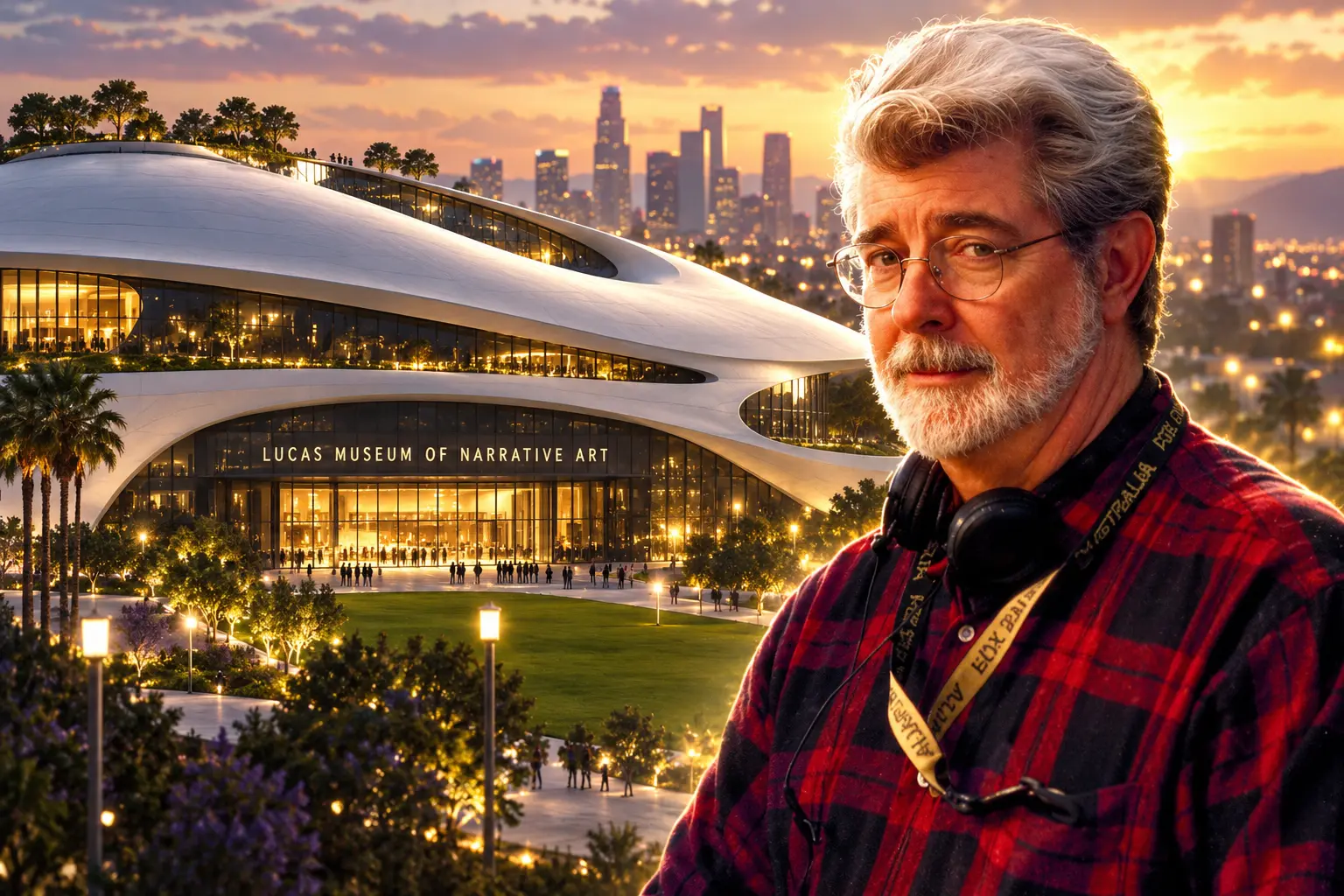
Lucas and Hobson founded the museum together. Ma Yansong of MAD, working with Stantec, designed a 300,000-square-foot form with no straight exterior line, clad in more than 1,200 uniquely shaped fiberglass-reinforced panels. A central arch spans 185 feet. An oculus hangs over a public plaza. Ma has said he wanted something as light as a cloud, or a dream, touching the park at only a few points.
The site is One Lucas Plaza, 3800 S Vermont Avenue, across from the University of Southern California, Lucas’s old school, on ground that used to be a parking lot. Mia Lehrer of Studio-MLA laid out the park and gardens. San Francisco and Chicago both dropped earlier versions of the project. Construction in Los Angeles ran about eight years. Lucas, speaking to reporters in one of the two theaters, called the whole span seventeen years of getting kicked out of cities and then getting it built. “I’m used to doing the impossible. This one almost broke my will.”
CBS put the bill at at least $1 billion of his own money. Other tallies float higher. The working figure from the interview is that floor.
WHAT VISITORS GET ON OPENING DAY
- The hang: more than 1,300 works in the opening shows across 30-plus galleries and more than 100,000 square feet of gallery space.
- The campus: a 13-acre park and gardens with more than 300 new trees, an amphitheater, a meadow, and a waterfall fountain, open from 8 a.m. to sunset.
- The theaters: the Robert Flaherty Theater and the Slavko Vorkapich Theater, drop-in rooms named for a documentarian and for the montage teacher who once chaired USC’s film department.
- The ticket: timed-entry tickets at $25 for adults, $21 for seniors 65 and over, free for children 17 and under, members, and active-duty military. Last entry is 45 minutes before closing.
Regular hours close the building on Tuesdays. Opening day is a Tuesday. The park, store, Skywalker Grill, and café do not need a gallery ticket. People who live in the 90037 zip code get a local pass. Timed tickets went on sale July 21, 2026, and the first public day sold out.
CEO Tracey Bates said every gallery was built with visitors in mind. Lucas’s own statement on opening is blunter about who the rooms are for. “The artists in this collection didn’t just create images, they connected our modern imaginations with our ancient emotions,” he said. “They deserve to be in a museum.”
Hobson Hit the Breaking Point; Lucas Did Not
Asked whether they ever thought about shelving the project after the delays, Lucas said she did, and he did not. Hobson had reached the end of her rope.
I said, ‘George, let’s just give the art to another museum and, like, call it a day.’ And he looked at me, and he said, ‘I am building this museum.’ And it was like the most intense version of him I had ever seen. We’re not ones to argue. And I was like, ‘Okay, we’re building a museum.’ I just went, I was like, ‘Got it. This is a non-negotiable.’
Mellody Hobson, co-founder, Lucas Museum of Narrative Art
The stubbornness goes back further than Star Wars. In high school he wanted to be an illustrator. His father shut it down: no artist in the family, and you cannot make a living that way. Lucas told O’Donnell he has always loved illustration art, and that illustrators are artists who do not get credit. He could not have made Star Wars without them. They turned his pages into images he could judge, cut, and rebuild.
On the press tour he said he had to take the curating back because the idea that illustration is art was too much for people trained otherwise. “You can’t say ‘This is art. This is not art.’ Art is in the eye of the beholder. If it is emotional to you, then it’s art.” He has been criticized for that, and he says he believes it anyway. He also calls himself a contrarian, the sort of person other people assume is wrong because the thing has not been done yet.
Hobson, who missed the years of the original films, said she watched him work on this instead, fanatical in the plain sense that he was a fan of the illustrators and wanted them on the wall. When the job got hard, he told her he could not finish it without her.
He Says Architecture Outlasts the Six-Week Run
Near the end of the conversation, Lucas drew a line between the job that made him famous and the one he has spent the last stretch of his working life finishing.
The advantage of architecture is it lasts. A movie comes out, six weeks, it’s gone.
George Lucas, filmmaker, speaking with Norah O’Donnell
Star Wars did not vanish in six weeks. He knows that. The bet is still the one he is making: a building will be standing when the run is over, and the people who draw stories will have a house that painting and sculpture have had for centuries. He refuses the legacy frame. The name on the door, Hobson said, is marketing.
FROM THE SALE TO THE DOORS
- October 30, 2012: Disney agrees to buy Lucasfilm for $4.05 billion; Lucas’s sequel treatments go with the company, without a promise they will be shot.
- December 21, 2012: The deal closes. Lucas steps back from the films he had started to staff.
- 2015: After a private screening of The Force Awakens, Lucas says there is nothing new in it.
- 2018: Construction in Exposition Park gets underway, the third city after San Francisco and Chicago fall away.
- September 19, 2026: Opening night. Hamill, Ford, Spielberg, and a large Hollywood guest list walk the galleries.
- September 22, 2026: The museum opens to the public.
Fourteen years after the sale, the sequels he described still exist as interviews, book pages, and a 2012 treatment Disney was free to ignore. The museum is the thing you can buy a ticket for. Hobson wants children to walk out thinking they can make something of their own. Lucas supplied the word she was reaching for: stubborn.
On September 22, 2026, the doors open in Exposition Park. The three films stay where he left them, on paper.

Edinburgh Opens a 2027 Tour Built for Time Trials

Korda Maps Auður From Meðalland to Irvine Bay

Apple Music Films Its New Logo in Mineral Oil

Oppo Prices the Pad Mini Above India’s iPad Mini

Austen Soaks Scotland Before Boelo Brings Weekend Gales

Volkswagen Sells the Osnabruck Plant to Clear a Board Fight

Apple’s Foldable iPhone Hinges on Samsung Display Supply

Saksham Gaur Finds He Is His Own Company’s Client

Tata Motors’ Iveco Tender Opens as Holders Still Decide

Onimusha Way of the Sword Preload Hits a Windows 11 Wall
-
 AUTO2 months ago
Volkswagen Sells the Osnabruck Plant to Clear a Board Fight
-
 NEWS2 months ago
Apple’s Foldable iPhone Hinges on Samsung Display Supply
-
 AUTO2 months ago
Tata Motors’ Iveco Tender Opens as Holders Still Decide
-
 BUSINESS2 months ago
Saksham Gaur Finds He Is His Own Company’s Client
-
 GAMING2 months ago
Onimusha Way of the Sword Preload Hits a Windows 11 Wall
-

 ENTERTAINMENT3 years ago
What is SD on Amazon Prime? – All You Need to Know
-

 BUSINESS2 months ago
Hyderabad 22-Carat Gold Jumps After a False Bargain
-

 NEWS2 months ago
iQOO 16 Locks 8,400 mAh While 100W Charging Holds