
LIFESTYLE
Homes in Foraging Hotspots List From £775,000
Five houses from £775,000 to £1.25 million are being sold as foraging bases, though the wild food sits on Trust land, beaches and public paths.

Five country houses, priced from £775,000 to £1.25 million, are on the market as foraging bases in England, Scotland and Wales. Aucoot, Inigo, The Modern House, Finest and Savills are selling slate, thatch, honey stone and a house that hovers over a river. The wild food in the particulars grows on National Trust ground, beaches and public walks.
Asking Prices From £775,000 to £1.25 Million
The pitch is the same in five different counties. Buy the kitchen, then walk out for wild garlic, mushrooms, sea herbs and gin botanicals. The buildings are not the same, and neither is what you actually take home with the keys.
THE FIVE ASKING PRICES
| House | Place | Asking price | Beds | Where the copy sends you |
|---|---|---|---|---|
| Waungron Uchaf | Whitland, Carmarthenshire | £775,000 | 4 | Oak woodland on the holding, then a 30-minute drive to the Tenby coast |
| Macey’s Cottage | Ansty, Wiltshire | £810,000 | 3 main, 2 extra | National Trust courses at Stourhead; a pick-your-own farm in the village |
| Detached house | Gullane, East Lothian | £850,000 | 4 | Beaches and golf-course country; chefs have picked mushrooms and sea herbs nearby |
| Ty Hedfan | Pontfaen, near Brecon | £895,000 | 5 | Local botanical gin walks; Bannau Brycheiniog five miles away |
| Rowden Lodge | Frome, Somerset | £1.25 million | 5 | A town of markets and cafes, then the county as a wild larder |
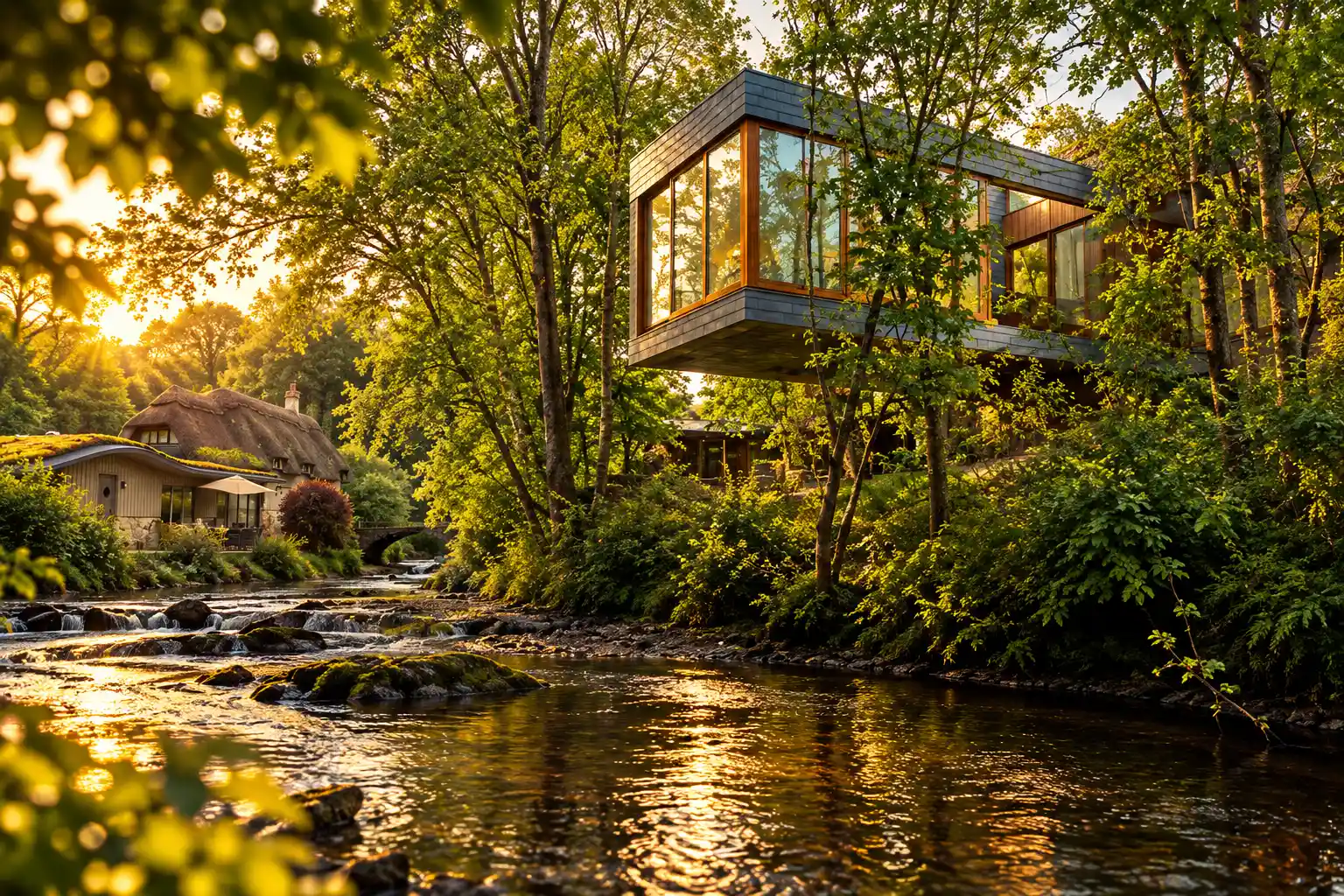
Ty Hedfan, Welsh for hovering house, is the one the architecture pages already know. Featherstone Young built it over the meeting of the Ysgir Fach and the Ysgir Fawr, shortlisted it for the Manser Medal in 2011, and described the river and bank as a Site of Special Scientific Interest. The listing copy now with Aucoot still sells five bedrooms, a green roof, mechanical extraction ventilation and planning permission for an office or studio in the grounds. The Modern House had the same house earlier; that page is gone.
Macey’s Cottage is the oldest shell. Inigo’s particulars date the Grade II thatch to about 1540, put Ansty in the Domesday Book in 1086, and say Roundhead soldiers camped nearby before walking on Old Wardour Castle. The house takes its name from a resident who left for Gallipoli in 1914, aged 18, and did not come back. A new wing repeats the curve of the thatch under a sedum roof, and a stream runs along the back boundary in Cranborne Chase national landscape.
Rowden Lodge is a 19th-century stable block in honey stone, ten minutes from Frome centre, recast as a five-bedroom house with an L-shaped glazed kitchen at the back. The Modern House is asking £1.25 million. Frome has the farmers’ market and the cafe streets; Somerset supplies the wild garlic and mushrooms in the brochure.
The Wild Food Is Missing From the Deeds
English parliamentary enclosure already took shared grazing and firewood off the open field. The new extra in a country listing is the hedge that is left, sold as a lifestyle perk you reach by car, path or beach, not by title plan.
Four of these sales work that way. Macey’s Cottage has a garden and a stream, then points you at National Trust land at Stourhead and a pick-your-own fruit farm in the village. Ty Hedfan has about 60 m of river frontage and a green roof, then points you at paid gin walks and a national park. Rowden Lodge is a town-edge lodge. The Gullane house has a south-west garden, a study, a sitting room, four bedrooms, three bathrooms and a double garage, then points you at the shore, 20 miles east of Edinburgh.
The fifth house is the break in the pattern. Waungron Uchaf is a 350-year-old farmhouse on Velfrey Road with an inglenook snug, a study with a wood-burning stove, and gardens of about 1.3 acres. Finest’s listing puts the wider holding at 34.89 acres of pasture and mature oak woodland, with a private footpath down to a stream. That buyer does get a wood. Everyone else is buying a kitchen next to someone else’s larder.
What Can You Legally Pick?
The brochure language is warmer than the statute. In England and Wales, picking wild mushrooms, flowers, fruit or foliage for yourself is carved out of theft. Selling the same haul, or taking it for a restaurant, is not.
A person who picks mushrooms growing wild on any land, or who picks flowers, fruit or foliage from a plant growing wild on any land, does not (although not in possession of the land) steal what he picks, unless he does it for reward or for sale or other commercial purpose.
Theft Act 1968, section 4(3)
That is the line that does not steal what he picks if the plant is wild and the bag is for the pot. It does not grant a right to walk off a path, and it does not let you pull a plant up by the roots. The Wildlife and Countryside Act 1981 makes it an offence to uproot a wild plant, fungi included, without the owner or occupier’s permission. Schedule 8 species stay off limits. Sites of Special Scientific Interest add another filter: operations that cut or remove plants and fungi often need consent. That matters at Ty Hedfan, where the river bank is notified land.
THE RULES THAT ACTUALLY BIND A PICK
- Personal bags: Flowers, fruit, foliage and mushrooms growing wild can be taken for your own use, and that is not theft in England and Wales.
- No roots: Uprooting without the occupier’s say-so is a separate offence, even when the pick itself is allowed.
- No sale: Commercial picking, including supply to a kitchen, needs the landowner’s permission.
- The 10% guide: NatureScot’s responsible-foraging advice is to take no more than 10% of the plants, fruits or mushrooms in an area, and to leave the rare ones.
Access is the other half of the problem, and it is not in the Theft Act at all. Mapped mountains, moors, heaths and downs in England are open access land for walking under the Countryside and Rights of Way Act 2000. That Act does not add a right to pick. Leave a footpath to take a mushroom in a private wood and you can still be in civil trespass, even if you have not stolen anything. Wales follows the same split. The pretty hedge in the brochure is often someone else’s hedge.
Scotland’s Access Law Changes the Gullane Pitch
Gullane is the one house on this list that sits under a different access statute. The Land Reform (Scotland) Act 2003 lets people cross most land and inland water for recreation if they behave. Hunting, shooting and fishing stay out. So does crossing land to take mushrooms or berries for profit. Personal picking is treated as custom, not as a new statutory right.
Scottish Outdoor Access Code guidance is blunt about that gap. The law neither writes foraging into the access right nor wipes out the old habit, which is why customary picking for personal use still stands. NatureScot’s 10% guide sits on top. Foreshore rights are older again and still cover some uncultivated shellfish. A Gullane buyer who walks to the bents is on stronger legal ground than an Ansty buyer who steps off a Wiltshire path into a private wood.
The food itself is not a marketing fiction. Tom Kitchin has foraged mushrooms and sea herbs in this stretch of East Lothian. Wee Folk of the Woods, a long-term supplier to his group, ran forage-and-feast days from The Bonnie Badger in the village, the inn Kitchin and Michaela Kitchin took on in 2018 and sold to Buzzworks in March 2026. Coeur Sauvage has also taught coastal foraging at Gullane Bents. The house on Savills’ books at £850,000 does not need to own the shore for that copy to be true. It only needs to be close.
Botanical Gin, a Trust Estate and the Tenby Shore
The overlooked trade here is not the estate agency. It is the people who already charge for a walk through the same larder. Official Scottish guidance even notes that a paid guided walk, collecting for personal or educational use, does not need the landowner’s permission, though protected sites are different and courtesy contact is still wise. That is the legal space in which a gin walk, a Trust course and a beach kitchen can exist, and then appear in a house brochure as local colour.
WHO SELLS THE WALK, NOT THE HOUSE
- Stourhead: Totally Wild UK runs a day on the wider estate covering identification, harvest and cooking, with wild-food tasters, for a £70 forage and cook course on 27 September, 3 October and 25 October 2026, 10:00 to 16:00, for ages 12 and up.
- Brecon country: Local botanical gin foraging walks start at £50 a person for about three hours, with a 300ml jar of your own blend to take home; half-day plant walks from The Angel Hotel in Abergavenny are £35, on the last Sunday of the month from March to October.
- Tenby and the Carmarthenshire coast: Craig’s Coastal Foraging runs shore walks for seaweed, shellfish and wild herbs, then cooks the catch on the rocks, a short drive from the Whitland farmhouse.
- East Lothian: Wee Folk of the Woods and other tutors have already productised the Gullane bents and woods for chefs and paying guests.
Ansty is the cleanest illustration of the split. Macey’s Cottage is £810,000 freehold. Two days after this gallery appeared, the Trust estate at Stourhead is still selling the same wider woods for £70, including the tasters. You do not need the thatch to walk Bonham Wood. You need a ticket, outdoor shoes, and a booking on 01747 841152.
Oak Woodland Comes With the Whitland Farmhouse
Finest added Waungron Uchaf on 2 January 2026 at £775,000, the lowest ask of the five and the only one that includes a working acreage. The house is about 2,788 sq ft, with four bedrooms and three bathrooms, on an elevated site south of the market town. The agent’s own pitch is valley views, stone walls, bluebells in spring, and nearly 35 acres split between open pasture and oak. If you want the forage inside the red line, this is the listing that actually does it.
It still sends you to the coast. Foraging firms operate around Tenby, a 30-minute drive, because the foreshore is a different larder from an oak wood: seaweed, samphire, shellfish, a kitchen on the rocks. The farmhouse buyer can do both. The Pontfaen buyer, five miles from Brecon, can step onto a green roof and a deck over a notified river and still have to book the gin walk.
None of this makes the houses worse. Ty Hedfan is a serious piece of Welsh modernism on a brownfield river plot that defeated a conventional cottage. Macey’s Cottage carries four centuries of thatch and a Civil War footnote. Rowden Lodge is a stable that became a town house for people who want Frome on foot. The Gullane house is a commuter coastal box with a lawn. The Whitland farmhouse is a holding. What the copy adds, in every case except Whitland’s wood, is a public larder priced as if it came with the freehold.
Totally Wild UK is at Stourhead on 27 September, then on 3 and 25 October. The ticket is £70.

Edinburgh Opens a 2027 Tour Built for Time Trials

Korda Maps Auður From Meðalland to Irvine Bay

Apple Music Films Its New Logo in Mineral Oil

Oppo Prices the Pad Mini Above India’s iPad Mini

Austen Soaks Scotland Before Boelo Brings Weekend Gales

Volkswagen Sells the Osnabruck Plant to Clear a Board Fight

Apple’s Foldable iPhone Hinges on Samsung Display Supply

Tata Motors’ Iveco Tender Opens as Holders Still Decide

Saksham Gaur Finds He Is His Own Company’s Client

Onimusha Way of the Sword Preload Hits a Windows 11 Wall
-
 AUTO2 months ago
Volkswagen Sells the Osnabruck Plant to Clear a Board Fight
-
 NEWS2 months ago
Apple’s Foldable iPhone Hinges on Samsung Display Supply
-
 AUTO2 months ago
Tata Motors’ Iveco Tender Opens as Holders Still Decide
-
 BUSINESS2 months ago
Saksham Gaur Finds He Is His Own Company’s Client
-
 GAMING2 months ago
Onimusha Way of the Sword Preload Hits a Windows 11 Wall
-

 BUSINESS2 months ago
Hyderabad 22-Carat Gold Jumps After a False Bargain
-

 ENTERTAINMENT3 years ago
What is SD on Amazon Prime? – All You Need to Know
-

 NEWS2 months ago
iQOO 16 Locks 8,400 mAh While 100W Charging Holds