
NEWS
The First Adult T. rex Trackway Records a 13-Foot Walk
The first adult T. rex trackway, found near Marmarth, North Dakota, records a 13-foot stride at 3.5 to 4.5 mph, a walk, not a sprint.

The first adult T. rex trackway, a 23-foot line of four prints in North Dakota, records a 13-foot stride at a brisk human walk. The animal was moving at 1.5 to 2 meters per second, about 3.5 to 4.5 mph, through soft ground that later turned to mudstone and sandstone.
Bones of Tyrannosaurus rex are famous. A living stride from a full-grown animal was not. The September 2026 trackway study in the Journal of Vertebrate Paleontology gives the first field number for that gait, and the number is a walk.
A Teacher Texted Four Exclamation Marks
Kent Hups, a science teacher at Northglenn High School in Colorado and a volunteer research associate at the Denver Museum of Nature & Science, was working a Denver museum dig in July 2025 when he stopped over three giant toes in the Hell Creek Formation near Marmarth, North Dakota. The land is U.S. Forest Service ground. He sat with the rock until he trusted it was a track at all.
Tyler Lyson, senior curator of vertebrate paleontology at the Denver museum, was digging a few miles away and did not buy it at first. Rocks in that country weather into all kinds of shapes, some of which look like feet. He marked an X in the dirt where a second print should sit if the first one was real. The crew dug and hit stone. Then a third print. Then a fourth.
The published path holds two left footprints and two right ones. Peter L. Falkingham, a palaeobiology professor at Liverpool John Moores University in England, is lead author even though he never stood on the slope. Evan Tamez-Galvan of the Denver museum scanned the site in the field with an Artec Leo imager. Falkingham read the meshes on a computer and in a headset.
Bones tell us an enormous amount about these animals, but footprints capture a moment of behavior. With a trackway, we can actually follow an animal as it moved across the landscape. That is incredibly rare for T. rex.
Tyler Lyson, senior curator of vertebrate paleontology, Denver Museum of Nature & Science
Hups is a co-author. He later said he tells students that science starts with curiosity, passion, and careful observation, and that he never imagined that lesson would lead him here.
Hell Creek Almost Never Keeps a Footprint
Hell Creek is one of the best-studied dinosaur rock units on Earth, a Late Cretaceous floodplain that now cuts across Montana, North Dakota, South Dakota, and Wyoming. Skeletons of T. rex and Triceratops turn up with some regularity. Trackways do not. Lyson has said that for this slice of time in North America, they are very rare.
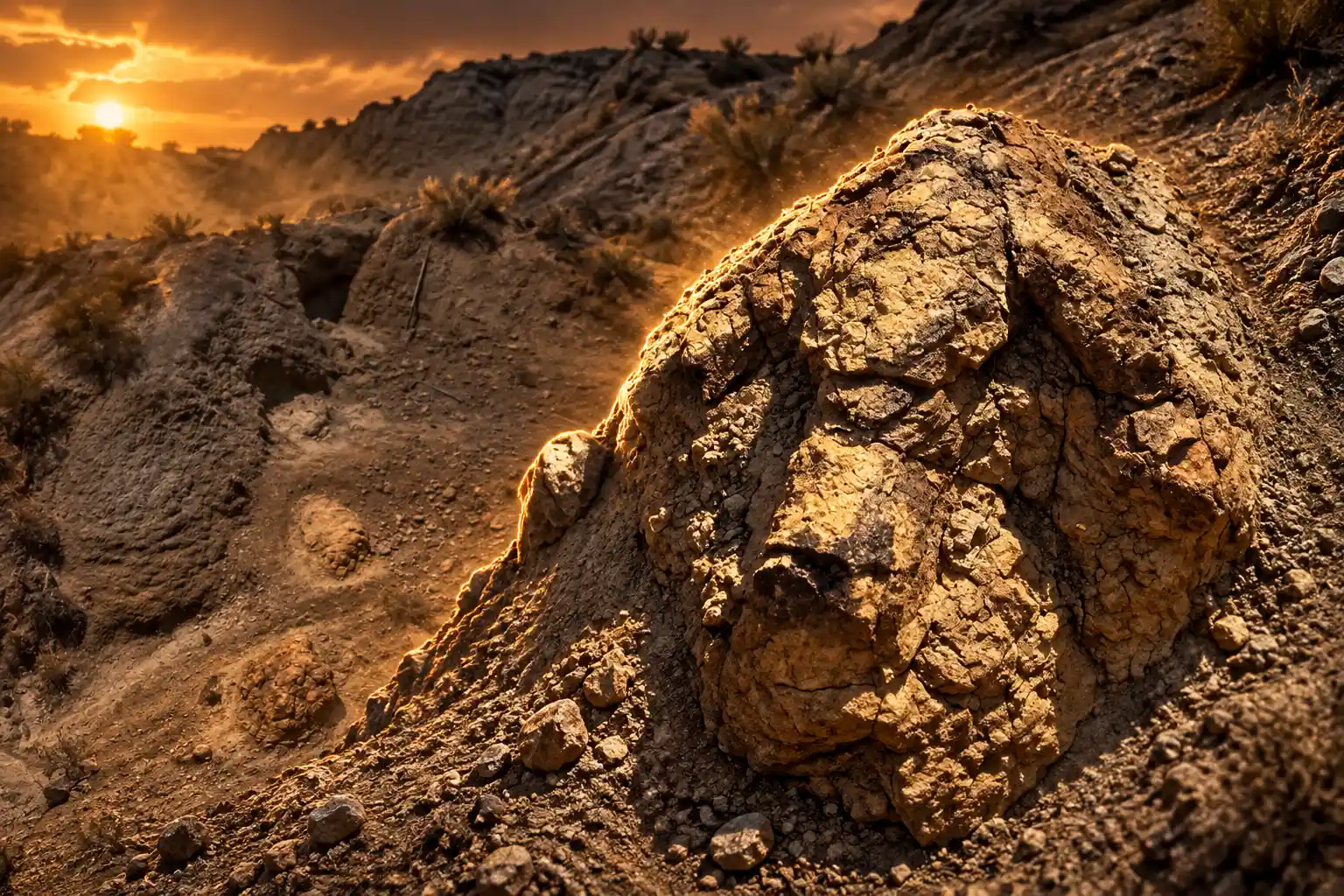
The Marmarth prints survived as natural casts, not as open holes in a slab. After the animal stepped in mud, sand filled the depressions. Calcium carbonate locked that sand into hard lumps. Those lumps are tougher than the rock around them, so they stood up as the hillside wore down.
WHY THE PATH IS STILL HERE
- The fill: Sand poured into the original muddy steps and then cemented, so the footprints became raised casts instead of empty molds.
- The cement: Calcium carbonate bound the sand into concretions that outlasted the softer beds around them.
- The timing: The trackway sits about 33 meters below the Hell Creek/Fort Union contact and is dated to about 66.5 million years ago, late in the last age of non-avian dinosaurs.
- The scan: Five high-resolution surface scans, including one of the whole path, now sit in a public dataset, so other labs can measure the same stone.
Falkingham’s group posted open 3D scans of the four prints with the paper, along with field photographs. The outlines are still blunt. Weathering chewed the pads. One print is a little longer than the others and gave the cleanest digital model, in part because a heavy animal sinking into soft sediment can spread the mark beyond the true sole.
What the 13-Foot Stride Measures
A single print can hint at foot shape. A trackway gives pace, stride, and a speed estimate. Each three-toed cast is about 3 feet (about 1 meter) long and about 80 centimeters wide. The animal covered about 13 feet (about 4 meters) per stride along a path about 23 feet (about 7 meters) long. Pace angles measured from track centers sit near 167 degrees and 164 degrees, a narrow line in keeping with other theropod paths.
Those figures produce a walking speed of 1.5 to 2 meters per second, about 3.5 to 4.5 mph, which the authors call consistent with other large theropod trackways. The museum’s release puts that in human terms: a brisk walk. The estimate is rough because the tracks are heavily weathered.
Thomas Holtz Jr., a vertebrate paleontologist at the University of Maryland who was not on the paper, has pointed out that the number sits well below any serious guess at top speed. The steps were made in wet soil, and animals go fastest on firmer ground. The path records one walk on one day, not a chase.
That still matters, because adult T. rex speed has been argued for decades with models and almost no adult stride data. Some anatomical readings once put a giant near 20 meters per second. Direct biomechanical work later clustered between 5 and 15 meters per second. In 2017, William I. Sellers of the University of Manchester and colleagues used models that limited T. rex to walking, arguing that a true run, with both feet off the ground, would load the skeleton beyond a safe bone stress of about 200 MPa.
THE WALK AGAINST THE MODELS
| Record | Speed | What it is based on |
|---|---|---|
| Hell Creek adult trackway | 1.5 to 2 m/s (3.5 to 4.5 mph) | Measured stride in soft sediment |
| Sellers and colleagues, 2017 | Walking gait only | Multibody dynamics plus bone stress |
| Biomechanical model range | 5 to 15 m/s | Muscle, mass, and limb models |
| Older anatomical claims | Up to 20 m/s | Long limbs, qualitative readings |
The new trackway does not test those upper bounds. It does something the models never had: it clocks an adult on the ground. The gait it records is a walk, which fits the slow-giant camp without closing the case against a faster step on better footing.
Two Earlier Prints Never Made a Path
Before Marmarth, researchers could point to two isolated adult prints and no confirmed adult sequence. The Hell Creek team treats T. rex as the most likely maker because of size, three slender toes with a long middle digit, a Late Cretaceous North Dakota setting, and T. rex bones in the same country. No other theropod that large lived there at that time.
Edmontosaurus, a duck-billed dinosaur, lived in the same place and also walked on three toes. Lyson says the feet are very different, and that Hell Creek is known well enough that those two giants are the only local animals big enough to stamp a meter-scale print. Falkingham still leaves a crack in the door: some unknown species could be missing from the bone record. As knowledge stands, he said, T. rex is about the only trackmaker that could have made these.
THE PRINTS BEFORE THIS PATH
- 1994: Martin Lockley and Adrian Hunt describe the first isolated New Mexico print from the Raton Formation, 86 centimeters long, later named Tyrannosauripus pillmorei after a U.S. Geological Survey geologist who found it in 1983.
- 2008: Philip Manning, C. Ott, and Peter Falkingham report a probable tyrannosaurid track from Hell Creek in Montana, another single stamp with no stride.
- July 2025: Hups finds the Marmarth casts on Forest Service land; the crew opens four prints in a line about 23 feet long.
- 8 September 2026: Falkingham, Hups, Tamez-Galvan, Lyson, and Antoine Bercovici publish the first adult T. rex trackway description.
- Summer 2026: The same team locates a fifth print, still in the hill, after the paper’s four-print account is already in press.
Smaller tyrannosaurid trackways exist elsewhere. The authors note those paths are about half as long in print length and likely belong to a juvenile Tyrannosaurus or a smaller relative. A meter-scale adult sequence had not been described.
Speed Models Had No Adult Trackway to Check
For a century, T. rex locomotion sat in a gap between movie sprints and physics. John Hutchinson and Mariano Garcia argued in 2002 that 11 meters per second would already be pushing the muscle math, and that 20 meters per second was not reasonable. Sellers’s later work went further and dropped a true run altogether for an adult of this bulk.
Trackways were supposed to be the tie-breaker. Until now the adult file held two lonely stamps, which cannot yield a stride. Juvenile or smaller tyrannosaur paths cannot be swapped in, because young and old animals walk differently, as Falkingham has said, the way a toddler and an adult do.
Anthony Romilio, a palaeontologist at the University of Queensland who was not on the study, has called even a poorly preserved Hell Creek example a meaningful find, a few seconds of life that bones cannot hold. Holtz has called the sequence perhaps the first definitive adult T. rex trackway. Both men are describing a walk. The leftover question is whether a running path will ever turn up in the same rocks.
A walking trackway still leaves a sprint untested in the field. Soft mud is a poor racetrack, and these outlines are too worn to show whether the foot struck flat or toe to heel, or how pads took the load. The useful product is narrower and still new: an adult stride length, a pace angle, and a speed band other labs can rerun from the same scans.
A Fifth Print Is Still in the Hill
The paper describes four tracks and calls an adult T. rex the most likely maker. After a fifth print showed up in summer 2026, Lyson said he had no doubt the path belongs to T. rex. Those are two different counts from two different seasons, and both can stand. The study froze the four-print geometry. The hillside kept going.
Denver museum’s account of the find says three of the footprints are slated for recovery by helicopter in fall 2026 and then a trip to Denver. The museum plans to share recovery updates with guests in winter 2026. Further cutting into the slope is another matter. The authors wrote that more of the path may still be buried, and that the overburden makes a bigger dig unlikely.
WHAT WE KNOW
- The published path: Four three-toed casts, two left and two right, about 23 feet long, from Hell Creek near Marmarth.
- The gait: About a 13-foot stride at 1.5 to 2 meters per second, a walk in soft sediment.
- The maker: An adult T. rex is the most likely trackmaker in the paper; Lyson tightened that after the fifth print.
WHAT IS UNCONFIRMED
- Top speed: Nothing in the path measures a run, and wet ground would hide one if it ever happened.
- Skin and pads: Weathering wiped most fine anatomy; lab work on the lifted casts may yet find traces.
- A longer line: A fifth print is in the hill; a full excavation through the overburden is not on the calendar.
Hups has said he cannot wait to get back out and keep looking, and that he hopes more people will stare harder at strange rocks. The casts that leave by air will be measured again under lights. The ones that stay will keep taking weather. Either way, the first adult T. rex path on record is a 13-foot walk through mud, taken about 66.5 million years ago, and it is finally a number instead of a guess.
Frequently Asked Questions
Where Was the First Adult T. rex Trackway Found?
The path is at Denver Museum locality DMNH Loc. 21732 in the Upper Cretaceous Hell Creek Formation of southwestern North Dakota, on federal land near Marmarth. Funding notes on the digital data include U.S. National Science Foundation grant NSF-FRES-2317666 and a UKRI Frontier Research grant called TRACKEVOL.
How Do You Tell a T. rex Print From a Duck-Bill Print?
Length greater than width is a carnivore clue, and these casts are about 3 feet long by about 80 centimeters wide, with slender toes and a long middle digit. Edmontosaurus, the big duck-bill in the same beds, also had three toes, but its feet are broader and built differently, which is why the team ruled it out as the maker of this line.
How Do Researchers Estimate Speed From Dinosaur Tracks?
They combine stride length with an estimate of body size, then apply a standard walking formula used on other large theropod paths. Falkingham’s group reports 1.5 to 2 meters per second for this animal and warns that poor preservation makes the figure approximate, which is why the paper gives a range rather than a single pace.
Why Scan the Tracks Instead of Making Plaster Jackets First?
The Artec Leo surface scanner can resolve down to 0.2 millimeters, though the team eased that over the roughly 14 square meters of hillside they covered. The five resulting meshes, about a million polygons each for the close-ups, let Falkingham study the site in VR from England and let anyone else download the same geometry.
What Does the Pace Angle Say About the Walk?
Pace angulation, measured from the center of each print, is about 167 degrees between the first left, first right, and second left, and about 164 degrees on the next trio. Those high, narrow angles match other theropod trackways and argue against a wide, waddling ornithopod gait.

Edinburgh Opens a 2027 Tour Built for Time Trials

Korda Maps Auður From Meðalland to Irvine Bay

Apple Music Films Its New Logo in Mineral Oil

Oppo Prices the Pad Mini Above India’s iPad Mini

Austen Soaks Scotland Before Boelo Brings Weekend Gales

Volkswagen Sells the Osnabruck Plant to Clear a Board Fight

Apple’s Foldable iPhone Hinges on Samsung Display Supply

Tata Motors’ Iveco Tender Opens as Holders Still Decide

Saksham Gaur Finds He Is His Own Company’s Client

Onimusha Way of the Sword Preload Hits a Windows 11 Wall
-
 AUTO2 months ago
Volkswagen Sells the Osnabruck Plant to Clear a Board Fight
-
 NEWS2 months ago
Apple’s Foldable iPhone Hinges on Samsung Display Supply
-
 AUTO2 months ago
Tata Motors’ Iveco Tender Opens as Holders Still Decide
-
 BUSINESS2 months ago
Saksham Gaur Finds He Is His Own Company’s Client
-
 GAMING2 months ago
Onimusha Way of the Sword Preload Hits a Windows 11 Wall
-

 BUSINESS2 months ago
Hyderabad 22-Carat Gold Jumps After a False Bargain
-

 ENTERTAINMENT3 years ago
What is SD on Amazon Prime? – All You Need to Know
-

 NEWS2 months ago
iQOO 16 Locks 8,400 mAh While 100W Charging Holds