
AUTO
The Last Borders Traffic Cops Now Clock On in Dalkeith
Duns closed on 31 August and four traffic officers now start from Dalkeith, the local cost of a national plan to sit road policing on arterial crash routes.

The last roads policing depot in the Scottish Borders closed on 31 August, and its four traffic officers now start from Dalkeith. For the first time in nearly 60 years, no dedicated patrols operate out of a region with about 2,000 miles (3,200 km) of public roads.
Police Scotland says the move will not change patrols. Brian Jones, vice-chair of the Police Federation, who ran the old Lothian and Borders traffic department, says it happened without consultation and that officers now face a long drive before they even begin a shift.
Four Officers Now Start Their Shifts in Dalkeith
The Duns depot was the last traffic base in the Borders after Galashiels and Hawick shut over the past decade. The four officers based there now work out of Dalkeith in Midlothian. Traffic officers from East Lothian have been moved to the same station.
Many roads policing officers now face drives of up to an hour to reach their base before they start the shift they are paid to spend behind the wheel. Jones put the welfare risk in plain terms.
They’re going to have to travel to and from Dalkeith before and after their shift, so there’s a huge welfare concern here, which I know senior officers are looking at.
Brian Jones, vice-chair, Police Federation
He said the federation had already seen the consequences of people driving home exhausted after a night shift. The federation has written to Borders politicians and to traffic police commanders about the latest changes.
THE SHIFT FROM DUNS
- The officers: Four traffic officers who were based at Duns now work out of Dalkeith.
- The commute: Many roads policing officers face drives of up to an hour before a patrol even starts.
- The network: About 2,000 miles of public roads in the Borders now have no traffic police base.
- The span: Dedicated patrols had operated out of the region for nearly 60 years.
Supt Andy Barclay, deputy head of road policing, said officers would still work in the Scottish Borders and keep a visible presence. The force called the restructuring a necessity under continued funding pressure.
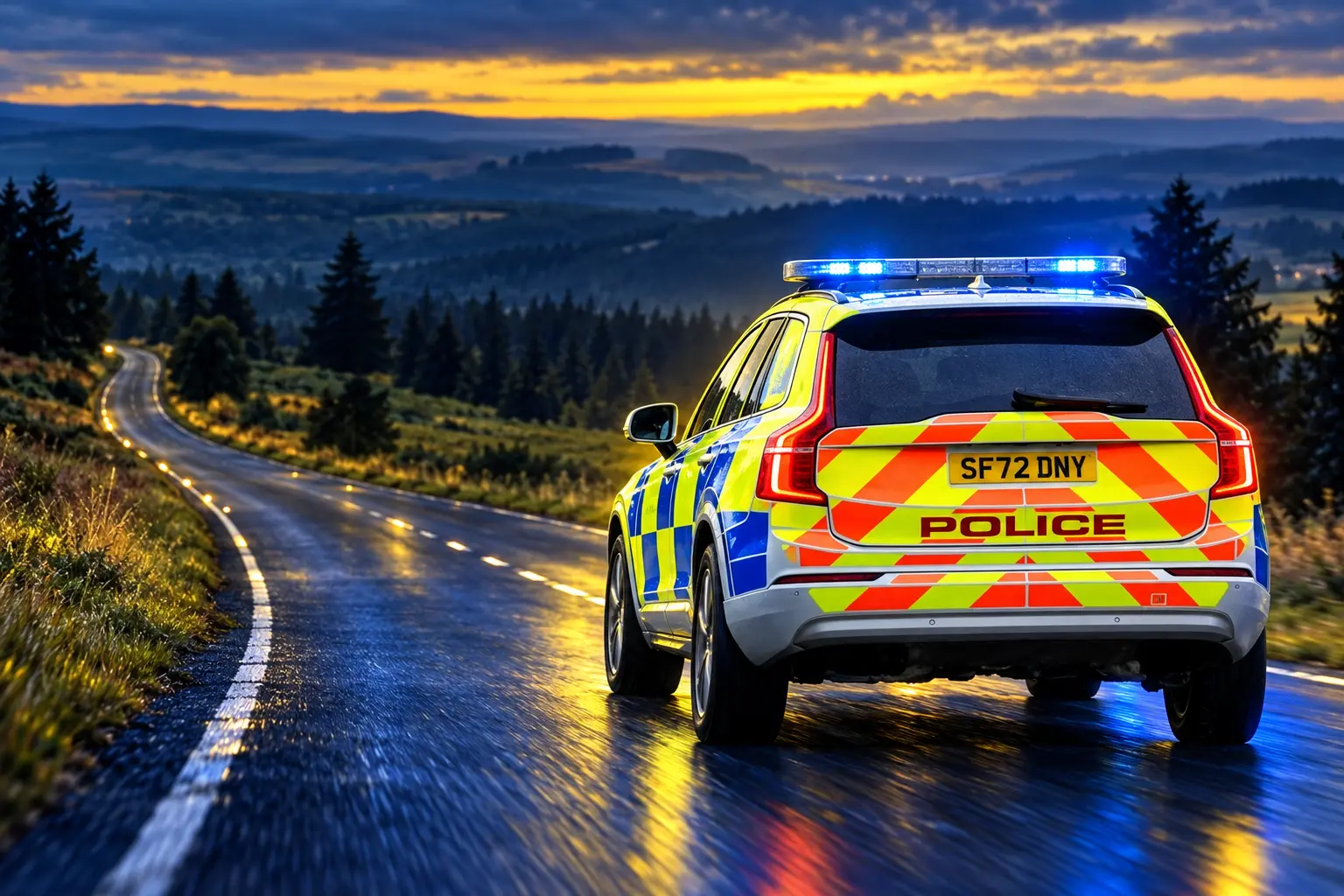
Police Scotland Had Only Just Restaffed Duns
The lock on the Duns depot is new. The decision to put traffic officers there is not. When Dunbar police station in East Lothian looked likely to close, Road Policing hunted for somewhere else to sit the unit.
Dunbar is about 12 miles, or 18 minutes, from Haddington, the main response hub. The building had been underused, with four road policing officers and one community officer posted there and the front counter open one day a week. A public consultation that closed on 20 September 2024 drew 26 responses; 18 percent agreed with disposal and 76 percent disagreed.
Road Policing then secured space at Duns, which had been a roads policing base several years earlier. One officer went to Dalkeith. As part of wider moves, four road policing officers relocated to Duns, and the unit fully left Dunbar. Inspector Ross Drummond, then the Lothians and Scottish Borders road policing inspector, said the wider model was under national review, but that in the interim a base at Duns was working well. Results of that consultation were updated on 24 February 2025. Eighteen months later the Duns depot itself shut.
HOW THE BORDERS LOST ITS TRAFFIC BASES
- 1 April 2013: Police Scotland is formed from eight regional forces, including Lothian and Borders Police.
- Over the past decade: Roads policing bases in Galashiels and Hawick shut.
- 2024: Four road policing officers move from Dunbar to Duns after the East Lothian station is lined up for disposal.
- 31 August 2026: The last remaining depot, at Duns, closes and the four officers transfer to Dalkeith.
The unit at Duns was still stopping cars in early 2026, and not only on Berwickshire roads. On 1 February, Duns roads policing officers removed two uninsured vehicles from the A1 and the Edinburgh City Bypass, a stretch that public replies treated as Dalkeith’s usual ground. The local base had already been pulled toward the capital’s traffic before the depot closed.
Our Duns Roads Policing Officers, stopped and removed two uninsured vehicles, from the road network, 01/02/2026, on both the A1 and Edinburgh City Bypass.
Both parties accepted conditional offers, 6 points and a £100 fine.#DunsRP #Seizedbypolice pic.twitter.com/vT9hlsKV6z
— Road Policing Scotland (@PSOSRoads) February 2, 2026
Why the Last Borders Traffic Base Closed
Barclay has described the Duns move as part of a countrywide shift, not a one-off estate tidy-up.
We have previously outlined the need to implement a sustainable model for road policing across the country. Road policing officers will continue to operate in the Scottish Borders and provide a visible presence to keep the roads safe.
Supt Andy Barclay, deputy head of road policing, Police Scotland
That model is set out in a Scottish Police Authority paper dated 17 March 2026. The force’s direction is to consolidate officers, aligning bases with key crash locations and arterial routes, and to dissolve divisional boundaries for road policing so crews can be sent to harm rather than to a historic county line.
Staff consulted after a November 2024 inspectorate report asked for three things: protection of the road policing specialism, a truly national function, and less time lost to court. The new operating model is the force’s answer. Local policing is supposed to keep a single inspector as a point of contact, with tasking through local delivery boards.
On a map that logic favours the A1, the A68 and the A7, the roads where people are killed and seriously injured. It does not favour a small depot in Duns whose officers were already being sent to the City Bypass. Jones put the loss in the opposite scale: the closing of Duns, he said, left 2,000 miles of roads without any traffic police base.
Road Policing Posts Have Fallen Since the Force Merger
Before 2013, Jones ran a Lothian and Borders traffic department of three sergeants and 20 constables. That team ran young-driver and motorcyclist work in the Borders and joint operations with police in Northumberland and Cumbria. The national force was sold as a way to keep that work while cutting duplicate back offices.
His Majesty’s Inspectorate of Constabulary in Scotland, in a thematic inspection published on 5 November 2024, found the specialist function had been hollowed out. A Police Scotland freedom of information reply, cited in that inspection, put 656 road policing posts at the force’s creation. The inspectorate later recorded a further cut of 43 posts in March 2023, from 544 to 501. Road policing is about 3.5 percent of officer numbers, and local officers told inspectors they could not spare time for road crime because they were tied up with other work, often around vulnerable people.
ROAD POLICING STRENGTH
| Point in time | What the figures show |
|---|---|
| Force created, 2013 | 656 road policing posts (Police Scotland FOI, cited by HMICS) |
| March 2023 | 501 posts, after a cut of 43 from 544 |
| Pre-2013 Lothian and Borders traffic | 3 sergeants and 20 constables for the whole region |
| Duns, until 31 August 2026 | 4 traffic officers, now based in Dalkeith |
| June 2024, force-wide | 16,207 full-time equivalent officers, 1,224 fewer than the 17,431 recorded on 31 March 2020, a 7 percent fall and the lowest since 2007 |
In November 2023, after those cuts and rising court abstractions, road policing’s senior team judged the current operating model no longer sustainable. Keeping a 24/7, 365-day pattern, they said, was hurting both operational effectiveness and staff health. A proposal followed to focus on day and late shifts only. Police Scotland told the inspectorate that the 2030 road-safety targets were unlikely to be met.
The Scottish government said it had provided record funding of more than £1.7bn and that the chief constable had confirmed that would maintain officer numbers at 16,500. That pledge sits beside the June 2024 headcount the inspectorate published. A government statement added that Scotland still has more officers per capita than England and Wales, and that recorded crime has fallen by almost half since 1991. A single service, it said, lets local divisions call in specialist help when they need it.
Rural Roads Still Account for Most of the Deaths
The Borders is not a quiet network. The UK Department for Transport recorded 805 million vehicle miles in 2025 on roads in the Scottish Borders. Transport Scotland’s provisional figures for that year counted 112 road casualties in the council area, against 323 in neighbouring Dumfries and Galloway.
Nationally, 134 people were killed on Scotland’s roads in 2025, down from 160 in 2024, a 16 percent fall and the lowest total outside the pandemic years of 2020 and 2021. Serious injuries fell 4 percent to 1,906. Slight injuries fell 3 percent to 3,495. Total casualties fell 3 percent to 5,535, from 5,732. Car users accounted for 3,092 of those casualties. Motorcyclists accounted for 581, with 34 deaths, the same number as in 2024, the group Jones’s old department used to target with Borders campaigns.
WHERE THE HARM SITS
| Measure, 2025 | Figure |
|---|---|
| Scotland, people killed | 134 (from 160 in 2024) |
| Scotland, all casualties | 5,535 |
| Scottish Borders, all casualties | 112 |
| Dumfries and Galloway, all casualties | 323 |
| Deaths on non-built-up roads | 92 of 134 (69 percent) |
| Casualties on non-built-up roads | 2,450 of 5,535 (44 percent) |
Non-built-up roads, those with a speed limit above 40 mph, make up about two-thirds of Scotland’s network. They took 44 percent of casualties in 2025 and 69 percent of the deaths. That is the geometry of the Borders: long A-roads, fast B-roads, and a lot of tarmac between towns.
Scotland’s Road Safety Framework to 2030 wants a 50 percent cut in people killed and in people seriously injured against a 2014 to 2018 baseline. By 2025 the death reduction stood at 23 percent and the serious-injury reduction at 30 percent. Both are short of the halfway-to-2030 mark those targets imply.
On Saturday 12 September, 12 days after Duns closed, a 38-year-old man died after a three-vehicle crash on the A68 near St Boswells at about 21:00. A 62-year-old woman was seriously hurt and a 66-year-old man had minor injuries. The road reopened at about 04:40 on Sunday. Sgt Fraser Mitchell asked witnesses to contact officers. The crash does not measure the depot. It is the sort of job a traffic unit on that road still has to answer, now from Midlothian.
Joint Checks With England Lose Their Local Base
Jones’s complaint is not only about a building. It is about a way of working that sat traffic officers on the network with other agencies, rather than sending them in from a regional hub.
WHAT THE OLD BORDERS TRAFFIC UNIT DID
- Young drivers: Dedicated initiatives in the Borders, run from the regional traffic department Jones once headed.
- Motorcyclists: The same unit ran rider campaigns on a network that still recorded 34 motorcycle deaths across Scotland in 2025.
- Cross-border crime: Joint operations with police in Northumberland and Cumbria, the English forces on the other side of the same A-roads.
- Multi-agency checks: Roadside stops with partners such as the Driver and Vehicle Standards Agency and the Scottish Environment Protection Agency, still used by Dalkeith and Duns crews in 2026 on the A1.
Those joint checks have not vanished. Dalkeith roads policing, the motorcycle unit, SEPA and the DVSA ran a static check on the A1 near Dunglass on 26 May and recorded a careless driver, a disqualified driver, uninsured vehicles, lighting defects and two people arrested over immigration law. Edinburgh, Dalkeith and Duns crews worked a similar stop near Queen Margaret University on 21 April. The method survives. The Borders no longer has a depot of its own from which to mount it.
Jones said the real sadness was the gap between what the department had been and what it is now. Officers no longer had the same interaction on the road network, he said, the multiple road checks with multiple agencies that used to deal with both road safety and travelling criminality.
Police Scotland’s position is unchanged: patrols continue, the presence remains, the model has to be one the budget can stand. The federation’s letters to Borders politicians ask a narrower question, which is how much of a shift is left for the A68 once the clock has already started in Dalkeith.
Frequently Asked Questions
When Did the Last Borders Roads Policing Depot Close?
The depot at Duns police station closed on 31 August 2026. It was the last traffic base in the Scottish Borders after Galashiels and Hawick shut over the previous decade, and it ended a local presence that Jones dated to nearly 60 years of dedicated patrols operating out of the region.
How Many Traffic Officers Moved From Duns to Dalkeith?
Four roads policing officers who had been based at Duns now work out of Dalkeith in Midlothian. Traffic officers from East Lothian were moved to the same station, so the Midlothian base is now the start point for more than one former local unit.
How Big Is the Scottish Borders Road Network?
The region has about 2,000 miles (3,200 km) of public roads. The UK Department for Transport counted 805 million vehicle miles on those roads in 2025, on a network that still had 112 reported casualties that year.
What Happened to the Galashiels and Hawick Traffic Bases?
Both were shut over the past decade as roads policing was pulled into fewer sites. Duns was left as the last depot, then closed on 31 August 2026, completing a run of closures that has left the council area without a traffic police base.
How Was Lothian and Borders Traffic Staffed Before 2013?
Before eight regional forces merged into Police Scotland on 1 April 2013, the Lothian and Borders traffic department Jones ran had three sergeants and 20 constables. That unit covered Edinburgh and the Lothians as well as the Borders, and it handled the young-driver, motorcyclist and cross-border work that later sat with the national roads policing function.
The federation’s letters are now with Borders politicians and with the commanders who still have to fill the A68 from Dalkeith. Jones called it a very sad day. Barclay said the patrols would still be there.

Edinburgh Opens a 2027 Tour Built for Time Trials

Korda Maps Auður From Meðalland to Irvine Bay

Apple Music Films Its New Logo in Mineral Oil

Oppo Prices the Pad Mini Above India’s iPad Mini

Austen Soaks Scotland Before Boelo Brings Weekend Gales

Volkswagen Sells the Osnabruck Plant to Clear a Board Fight

Apple’s Foldable iPhone Hinges on Samsung Display Supply

Saksham Gaur Finds He Is His Own Company’s Client

Tata Motors’ Iveco Tender Opens as Holders Still Decide

Onimusha Way of the Sword Preload Hits a Windows 11 Wall
-
 AUTO2 months ago
Volkswagen Sells the Osnabruck Plant to Clear a Board Fight
-
 NEWS2 months ago
Apple’s Foldable iPhone Hinges on Samsung Display Supply
-
 AUTO2 months ago
Tata Motors’ Iveco Tender Opens as Holders Still Decide
-
 BUSINESS2 months ago
Saksham Gaur Finds He Is His Own Company’s Client
-
 GAMING2 months ago
Onimusha Way of the Sword Preload Hits a Windows 11 Wall
-

 ENTERTAINMENT3 years ago
What is SD on Amazon Prime? – All You Need to Know
-

 BUSINESS2 months ago
Hyderabad 22-Carat Gold Jumps After a False Bargain
-

 NEWS2 months ago
iQOO 16 Locks 8,400 mAh While 100W Charging Holds