
NEWS
Dinosaur Tracks on Skye Reveal a Theropod-Heavy Lagoon
Prince Charles’s Point logged 131 Jurassic prints, with theropods ahead of sauropods, a lagoon that later Skye papers now treat as part of a split coast.

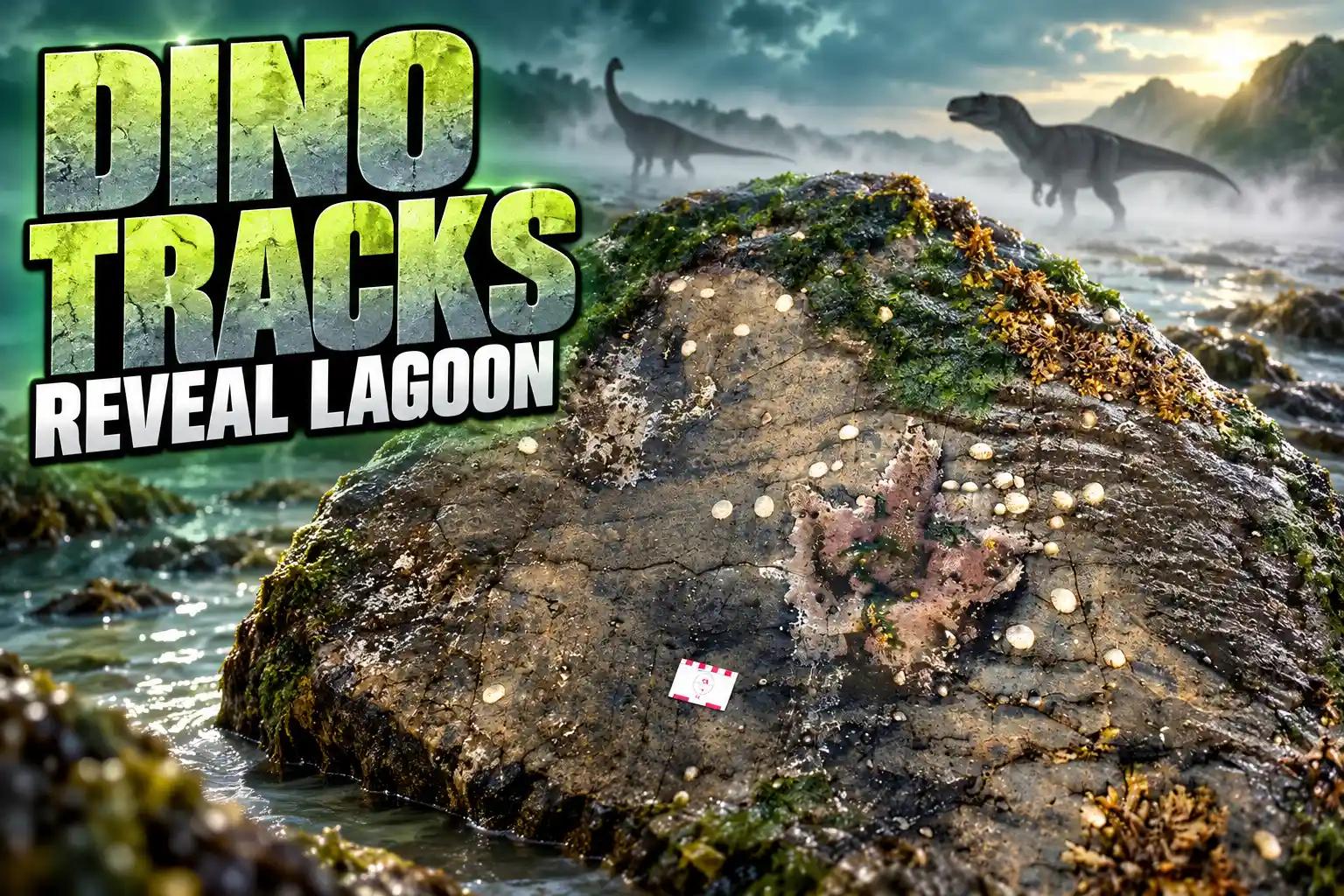
Researchers logged 131 dinosaur tracks at Prince Charles’s Point on Skye, a Middle Jurassic lagoon where meat-eaters outnumbered long-necked sauropods. The prints sit in rippled sandstone of the Kilmaluag Formation, laid down about 167 million years ago on the Trotternish Peninsula. They were published on 2 April 2025 by Tone Blakesley and colleagues at the University of Edinburgh.
The site was billed as a shared drinking spot. The trackways themselves show slow walking, mixed headings, and animals that used the shallows at slightly different times, a lagoon that later Skye papers now place on a split coast rather than a single pool.
131 Prints on a Boulder Shore
Geologists in the early 1980s took some of the round hollows for fish resting burrows. In 2019 Blakesley, then a graduate student in Edinburgh’s School of GeoSciences, found three-toed prints in the same rippled beds and started a master’s project that grew into several field seasons.
The team flew a drone along the remote northwest shore and built 3D models from about 4,500 overlapping photographs. Paige E. dePolo, Thomas J. Wade, Dugald A. Ross of the Staffin Museum, and Stephen L. Brusatte, professor of palaeontology at Edinburgh, are co-authors. The PalAlba work on Skye was backed by the National Geographic Society (GEFNE185-16) and a Philip Leverhulme Prize to Brusatte.
Blakesley later made a feature-length film of the fieldwork.
THE PRINCE CHARLES’S POINT TALLY
- The count: The open-access study reports 131 in-situ dinosaur tracks, graded for preservation.
- The split: Sixty-five are theropod, 58 sauropod, and eight unidentified.
- The size: Prints run 25-60 cm long; a striking three-toed example is about 45 cm, and measured sauropod hind prints average 52.8 cm by 38.9 cm.
- The paths: The longest trackways exceed 12 metres, among the longest yet recorded on Skye.
Seventy-seven prints were measured. Sixteen theropod and 27 sauropod examples were used to sort two shape groups, then four subgroups, most likely large megalosaurid meat-eaters and sauropods that were either non-neosauropods or early neosauropods, compared with British bones of animals like Megalosaurus and Cetiosaurus.
The Lagoon Where Meat-Eaters Outnumbered Long-Necks
On other Skye lagoon shores, long-necks usually leave the denser record. At Prince Charles’s Point the meat-eaters lead, 65 to 58. Blakesley put it plainly: the theropod prints dominate the sauropods, with more individuals here than at any other lagoonal setting yet recorded on the island. He and the team do not read that as a hunting pack. They read it as a preference for this freshwater margin.
Most tracks lie in bed 2, a fine sandstone about 10 cm thick, with more in bed 5, about 5 cm thick. The logged sequence is under 2 metres and nine beds. A lack of drying cracks in and around the prints points to a surface that was still shallowly under water. Freshwater ostracods in the beds match a closed, low-salt lagoon on a river delta, flipping between wet and dry.
HOW THE ANIMALS MOVED
- Slow walks: Two theropod ways give hip heights of about 1.80 m and 1.83 m, with speeds of 7.74-8.53 km/h and 7.60-8.42 km/h.
- Still slower giants: One sauropod way is estimated at 5.22-5.80 km/h with a hip about 2.11 m; another is 2.27-2.48 km/h with a hip about 2.01 m.
- No shared heading: Spacing and orientation show milling, not a column on the move, and little sign the animals were reacting to one another.
- A print in a print: On a later visit the team found what looked like a theropod print inside a sauropod way, a meat-eater stepping where a long-neck had already been.
- Missing groups: No stegosaur or ornithopod prints were logged here, though both groups are known from other Skye shores.
Blakesley called the place a kind of service station for the Middle Jurassic. The paper is more careful about time. The ways are short, mixed in direction, and treated as a time-averaged sample of animals that used the same shallows on different visits.
The footprints at Prince Charles’s Point provide fascinating insight into the behaviors and environmental distributions of meat-eating theropods and plant-eating, long-necked sauropods during an important time in their evolution. On Skye, these dinosaurs clearly preferred shallowly submerged lagoonal environments over subaerially exposed mudflats. Intriguingly, the site also has some historical significance, as a place on Skye where Bonnie Prince Charlie landed and hid during his flight across Scotland following the Battle of Culloden.
Tone Blakesley, Paige E. dePolo, Thomas J. Wade, Dugald A. Ross and Stephen L. Brusatte, PLOS One, 2 April 2025
Brusatte later said it boggles his mind to think that when Bonnie Prince Charlie was being pursued in 1746, he might have been following dinosaur prints to safety on Skye. The headland still carries the Young Pretender’s name. The photogrammetric models of the trackways now sit in the Dryad archive, while the live shore still goes under the tide.
Skye’s Other Shores Tell a Different Story
Prince Charles’s Point is one bed in a thicker island record. The Great Estuarine Group, about 170 to 166 million years old, holds lagoon, beach, and river-delta rocks across Trotternish. Bones are scarce. Tracks are not. The first scientifically described Scottish dinosaur print, GLAHM V1980, came from Rubha nam Bràthairean (Brothers’ Point) in 1982. Sauropod ways at Duntulm, mixed prints at later Brothers’ Point sites, and small theropods in the Valtos Sandstone and at Lùb Score have filled in the rest.
SKYE TRACKSITES BY HABITAT
| Site | Rock and setting | Track count | Who dominates |
|---|---|---|---|
| Prince Charles’s Point | Kilmaluag Formation, freshwater lagoon margin | 131 in situ | Theropods (65) over sauropods (58) |
| Duntulm, Cairidh Ghlumaig Bay | Duntulm Formation, shallow lagoon | More than 150 on the main platform, at least 35 in older beds | Sauropods, with sparse theropods |
| Valtos and Lùb Score | Valtos Sandstone and Kilmaluag Formation | 185 described in 2025 | Small theropods |
The visitor trail still sells a single three-toed print at An Corran beach, Staffin, visible at low tide and often under sand or weed. That is a fair stop. It is not the map the papers now draw. Kilmaluag tracks, formed in and near freshwater lagoons, have been rarer than prints from beaches, brackish lagoons, and river mouths, which is why a 131-print Kilmaluag shore matters beyond a local curiosity.
A Later Paper Maps the Split Coast
On 17 September 2025, Blakesley, dePolo, Ross, Neil D. L. Clark and Brusatte described 185 theropod tracks from Valtos and Lub Score in Royal Society Open Science. They grouped them into a new Hebridean shape series. Smaller types are more common in the closed freshwater lagoon at Lùb Score than the larger types in the river-delta Valtos Sandstone. Scarce multi-print surfaces hint at foraging at Valtos and possible post-hatchling care at Lùb Score. Brusatte posted that the set ran from mid-sized megalosaurs to tiny coelurosaurs, or babies.
On 21 September 2026, dePolo led the first full map of the Duntulm sauropod shore in Papers in Palaeontology, the site Brusatte and Tom Challands first clocked more than a decade earlier as odd tyre-sized rock pools. The main platform is the most extensive in-situ dinosaur tracksite known from Skye. Brusatte called the sauropods the size of three elephants put together.
We have finally published the full description of the Duntulm 'dinosaur disco'. With detailed maps made by drones. Handprints and footprints, made by sauropods the size of three elephants put together, some 170 million years ago when Scotland was a subtropical paradise! pic.twitter.com/Z9wNbIN0QP
— Steve Brusatte (@SteveBrusatte) September 22, 2026
WHAT THE 2026 MAPPING FOUND
- Lagoon long-necks: The Duntulm platform is dominated by small to medium sauropod prints under 75 cm, in several preservation styles, including casts that still show toes.
- Narrow ways: Short, narrow-gauge trackways show a walking gait and mixed headings, with no sign the animals moved as a herd.
- A coast divided: Island-wide, the study finds a sauropod preference for lagoonal substrates, while theropods, thyreophorans and ornithopods are more abundant on dry mudflats.
- A hard check: The authors say the trend still holds even if half of Skye’s sauropod prints were misidentified as other dinosaurs, and that sauropods are, so far, absent from those dry mudflats.
That finding does not erase the 65 theropod prints at Prince Charles’s Point. It frames them. Sauropods still used that lagoon; 58 round prints prove it. Meat-eaters used it more than they do at Duntulm. The 2025 paper already flagged that mismatch. The 2026 paper then showed the island’s lagoons and mudflats were not one habitat with one crowd.
Dugald Ross Built the Island’s Fossil Memory
Every recent Skye track paper in this run carries Dugald Ross’s name. He was the Staffin crofter who found dinosaur prints as a boy, was not believed by his teachers, and later built the Staffin Museum with his own hands. Brusatte, who worked with him for more than a decade, called him Scotland’s dinosaur guy, and said there would be no Dinosaur Island without him.
Ross received an honorary doctorate of science from the University of Edinburgh in November 2024. He died on 28 October 2025, aged 68, while the Duntulm paper was still in review. The published version lists him as a co-author and is dedicated in his honour. His daughter Caroline has been keeping the museum going. The collection remains the public face of Scottish Middle Jurassic fossils, even as the live tracks sit on tidal rock that the sea keeps rewriting.
FORTY YEARS ON A DINOSAUR COAST
- 1982: The first scientifically described Scottish dinosaur print is recorded at Brothers’ Point.
- 2015: The Duntulm sauropod shore below the castle is recognised as a major lagoon tracksite.
- 2018-2020: New Brothers’ Point sites add sauropod, theropod, and stegosaur-type prints after storms strip the beach.
- 2019: Blakesley recognises three-toed dinosaur prints at Prince Charles’s Point, later the basis of the 131-track study.
- 2 April 2025: The Prince Charles’s Point assemblage is published in PLOS One.
- 17 September 2025: The Valtos and Lùb Score theropod set is published.
- 28 October 2025: Dugald Ross dies; the Duntulm manuscript is still under review.
- 21 September 2026: The full Duntulm map is published, arguing for environmental partitioning across Skye.
The scientific argument has moved faster than the public one. Posts and tour notes still send people to An Corran’s single megalosaur print. The papers now describe a peninsula of several shores, each with a different mix of feet.
Why Middle Jurassic Bones Are So Scarce
The Middle Jurassic, about 174 to 164 million years ago, is when several major dinosaur groups spread in size and form. Dated family trees say so. The bones often do not. Rock of that age is patchy worldwide, which is why a Hebridean lagoon with walkable trackways is treated as more than a Scottish oddity.
On Skye the Great Estuarine Group supplies that missing window. Body fossils from the island still fit in a short list: sauropod teeth, vertebrae and a humerus; a thyreophoran ulna and radius; theropod teeth and a tail vertebra; a stegosaur-type fibula from nearby Eigg. Tracks do the heavier work, placing large megalosaurids, early long-necks, stegosaurs and possible ornithopods in subtropical shallows that then sat near 42.8 degrees north in the Sea of the Hebrides basin.
Blakesley has said the prints are mostly worn, with a few that keep claws and pads, and that more remain to be found. The tide that hid the Duntulm pools for years is the same tide that still covers Prince Charles’s Point. The 3D models will outlast the next winter storm. The rock may not.
Frequently Asked Questions
Where Can You See Dinosaur Footprints on the Isle of Skye?
An Corran beach at Staffin is the usual public stop, with prints that vanish at high tide and under drifting sand. Score Bay and the shore south of Duntulm Castle show sauropod prints at low tide. Brothers’ Point is harder to reach. Prince Charles’s Point is a remote northwest Trotternish shore with no signed visitor trail; the published work is based on in-situ rock, not a museum slab, so the Staffin Museum remains the place to see collected Scottish dinosaur fossils under a roof.
How Old Are the Prince Charles’s Point Dinosaur Tracks?
They sit in the late Bathonian Kilmaluag Formation, correlated at about 167 million years old, inside the Great Estuarine Group (about 170 to 166 million years). The correlation is supported by the freshwater ostracod Darwinula in most of the nine-bed sequence, which is less than 2 metres thick and records a closed, low-salt lagoon on a river delta.
What Dinosaurs Made the Skye Lagoon Footprints?
The Prince Charles’s Point makers are identified as large megalosaurid theropods and sauropods that were either non-neosauropods or basal neosauropods, compared with British skeletons of Megalosaurus-type meat-eaters and Cetiosaurus-type long-necks. Four theropod shape subgroups leave open the chance of more than one meat-eating species leaving similar feet. Stegosaurs and ornithopods known from other Skye sites did not leave prints in this particular lagoon bed.
Why Is the Middle Jurassic Dinosaur Record So Poor?
Rocks from about 174 to 164 million years ago are scarce on land worldwide, even though this is when sauropods, ornithischians and several theropod lines spread. Much of the family tree for that interval is inferred from dates on later fossils rather than from skeletons of the right age. Skye’s Great Estuarine Group is one of the UK’s richest sedimentary sequences for that window, which is why a single lagoon margin with 131 prints is treated as a global sample, not only a Highland find.

The BMW iX4 Undercuts Mercedes and Trails Its Twin

Scotland’s Ten Big Supermarkets Already Hold the Weekly Shop

Scotland EMS Faces a State Probe After a Wagram Death

Meritz Signs Ripple to Race Korea’s 2027 Token Rules

Pocognoli’s First Camp Leaves Scotland Third and Exposed

Volkswagen Sells the Osnabruck Plant to Clear a Board Fight

Tata Motors’ Iveco Tender Opens as Holders Still Decide

Saksham Gaur Finds He Is His Own Company’s Client

Onimusha Way of the Sword Preload Hits a Windows 11 Wall

Simple Wave Chases Range as Ather Konarc Cuts Price
-
 AUTO1 month ago
Volkswagen Sells the Osnabruck Plant to Clear a Board Fight
-
 AUTO1 month ago
Tata Motors’ Iveco Tender Opens as Holders Still Decide
-
 BUSINESS1 month ago
Saksham Gaur Finds He Is His Own Company’s Client
-
 GAMING1 month ago
Onimusha Way of the Sword Preload Hits a Windows 11 Wall
-
 AUTO1 month ago
Simple Wave Chases Range as Ather Konarc Cuts Price
-

 BUSINESS1 month ago
Hyderabad 22-Carat Gold Jumps After a False Bargain
-

 BUSINESS1 month ago
UltraTech Ultravolt Launch Splits Friday Stocks to Watch
-

 NEWS1 month ago
Apple’s Foldable iPhone Hinges on Samsung Display Supply