
BUSINESS
Two Power Transformers Finish a 74 km Scottish Haul
deugro and dteq landed two German-built power transformers at Leith, then spent 74 km on an 18-axle girder frame the Scottish grid now depends on.

deugro and dteq delivered two power transformers from a German plant to a Scottish substation site.
The units travelled by barge down the Rhine, by coaster to the Port of Leith, then 74 kilometres on an 18-axle girder frame more than 64 metres long.
Deugro Rolls Two Transformers From the Rhine to Leith
deugro, the project logistics firm, said on 12 October 2026 that both transformers had reached a substation expansion in Scotland on schedule. dteq Transport Engineering Solutions, the deugro group engineering company, designed the lashings, the barge stools and the lift plans, then stood on the berths while the kit moved.
The tanks were collected at the German factory and taken to a nearby roll-on/roll-off jetty. They were rolled onto a barge, set on pre-fitted grillage and stools, and sea-fastened to dteq’s drawings under deugro Germany and dteq staff. The barge then spent three days on the Rhine to the Port of Rotterdam, where the transformers came off for the coastal ship.
deugro chartered a coaster for the North Sea leg. Loading, stowage and securing followed dteq’s lift and lashing plans, watched by dteq and deugro Netherlands. After another three days at sea the ship arrived on time at Leith, where deugro UK ran the discharge as a tandem lift, two cranes sharing each tank.
THE FIVE LEGS FROM GERMANY TO THE PAD
- Factory road: Both transformers moved from the German plant to a nearby roll-on/roll-off jetty under dteq’s lashing design.
- Rhine barge: A three-day inland transit carried the tanks to Rotterdam on pre-installed grillage and stools.
- Coaster voyage: A second three-day sea passage took them from Rotterdam to the Port of Leith.
- Tandem discharge: deugro UK lifted both units off the ship with paired cranes before the road convoy formed.
- Girder-frame haul: An 18-axle frame more than 64 metres long ran the last 74 kilometres to the laydown area.
That chain is how heavy electrical kit now reaches Scottish sites when the factory sits on the Rhine. The water legs took six days between them. The part that still needs a survey, escorts and a special trailer is the road after Leith.
WHAT WE KNOW
- The cargo: Two power transformers for a substation expansion in Scotland, collected at a German manufacturing plant.
- The path: Rhine barge to Rotterdam, coaster to Leith, then an 18-axle girder frame for 74 kilometres.
- The finish: Both units reached the designated laydown area on schedule and went in by a single-direction jack-and-skid.
WHAT IS UNCONFIRMED
- The client: deugro did not name the utility, the substation or the town at the end of the 74 kilometre run.
- The plant: The German manufacturer and the transformers’ MVA rating were not published.
- The weight: No tonne figure was released for either tank or for the loaded girder frame.
SSEN Transmission, by contrast, posts dates, harbour names and overnight closures when it moves supergrid tanks through Argyll and Perthshire, because those convoys close public roads. This job stayed inside the logistics firms’ own account, which is why the last-mile length is public and the destination is not.
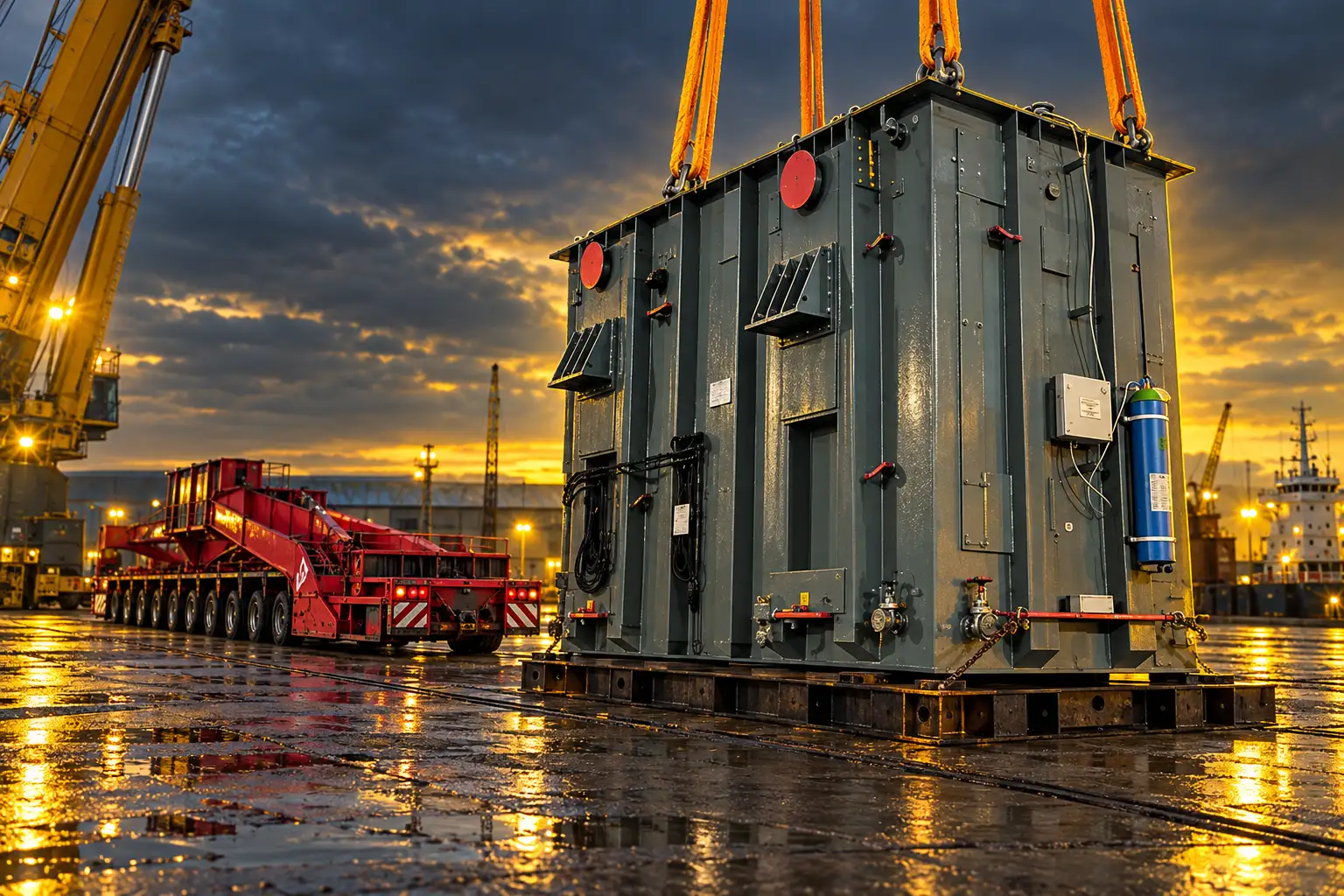
The 64-Metre Frame That Ran 74 Kilometres
deugro UK put each transformer on an 18-axle girder frame with an overall length of more than 64 metres. The combination is longer than many village high streets. The route from Leith to the site is 74 kilometres, about 46 miles, and had been walked in advance for pinch points, low structures and tight corners.
Project managers rode with the load. Escort vehicles and ground staff sat at the front and the rear so the frame could be steered through bottlenecks without clipping kerbs or street furniture. That is ordinary practice on UK abnormal loads, not a flourish. A girder frame cradles the tank between two beams so the transformer sits as low as the axles allow, then spreads the weight through the axle lines instead of putting a single heavy bogie on a weak bridge.
The same harbour has already seen a heavier night-time version of this theatre. Inch Cape’s Cockenzie substation took two 610 MVA supergrid transformers in January 2025 after they came in through Leith. The 82-metre girder-frame run from Leith had a rigid length of 59 metres and a combined vehicle-and-load weight of about 470 tonnes. Police Scotland escorted it. After 18 months of road and bridge surveys, only one route worked, via the A1, the A198 at Bankton Junction, the B6371 and the B1348. A 20-metre hedge had to come out at East Lorimer Place and be replanted. No transformer was allowed to leave Leith before 9pm.
deugro’s published combination is shorter than that Inch Cape vehicle, and the firm gave no tonne figure, so the two jobs should not be read as the same load. They share a harbour, a trailer type and the same basic problem: once a transformer is on Scottish tarmac, the map shrinks to the few corridors that can take it.
FOUR TRANSFORMER HAULS INTO SCOTLAND
| Haul | Entry port | Road kit | Last mile |
|---|---|---|---|
| deugro substation job | Port of Leith | 18-axle girder frame, more than 64 m | 74 km |
| Inch Cape, Cockenzie | Port of Leith | 82 m vehicle, about 470 tonnes all-up | Night move, one viable route |
| Crossaig North | Campbeltown Harbour | 14-axle trailer | 24 km access track after the A83 |
| Creag Dhubh | Clydebank | Allelys and Fracht | About 90 miles to Cladich |
West-coast jobs do not even try to start at Leith. SSEN shipped Crossaig’s tanks to Campbeltown and Creag Dhubh’s tanks to Clydebank because those sites sit on roads that a 64-metre frame from Edinburgh cannot reach.
Port of Leith Already Handles Supergrid Cargo
Forth Ports has spent over £100 million turning Leith into a renewables berth as well as a city cargo dock. The port sits less than three miles from Edinburgh city centre, with a 175-acre renewables hub at Leith, 4,000 metres of internal quays and a heavy-lift quayside rated at 35 tonnes per square metre. It can take ships up to 50,000 deadweight tonnes.
LEITH IN FIGURES
- Investment: Over £100 million spent by Forth Ports on the port’s conversion.
- Yard: 175 acres set aside for marshalling, logistics and industrial use.
- Quay rating: 35 tonnes per square metre on the heavy-lift quayside.
- Wind kit: Inch Cape’s 72 foundations, with monopiles up to 105 metres and 2,700 tonnes, have used the same harbour.
That is why a coaster with two transformers can still find a crane window in a port that is also marshalling jackets and XXL monopiles. Tandem lifting is a quayside skill, not a novelty. The constraint after the hooks come off is the public road, which is why Inch Cape’s tanks left after 9pm and why deugro surveyed 74 kilometres before the girder frame rolled.
Scotland’s Transformer Hauls Ran All Year
The deugro announcement sits on a 2026 conveyor of the same cargo. SSEN Transmission has been feeding supergrid transformers into Argyll and Highland substations all year, each one a multi-agency road job with police, trunk-road contractors and temporary closures.
In May, two replacement transformers for Lochay substation, next to Lochay Power Station, went through Killin on 12 and 13 May 2026, across Dochart Bridge and along the A827, hauled by JB Rawcliffe. In June, SSEN closed stretches of the A82 overnight to get two supergrid units from Clydebank toward Creag Dhubh, a run of about 90 miles to the site near Cladich, with Hitachi Energy as the kit supplier and Allelys and Fracht on the road. Transport Scotland, BEAR Scotland, Police Scotland, BT and local councils were all on the plan.
On 1 September 2026 SSEN said the first supergrid transformer into Crossaig North had arrived. That tank weighed around 200 tonnes, a figure the company compared to 33 adult African elephants. It came by sea from Poland to Campbeltown Harbour, ran the A83 under police escort, then transferred to a remote-operated 14-axle trailer for the last 24 kilometres on a dedicated access track. Crossaig North is a new 275 kV substation in the Argyll and Kintyre programme. A second transformer was already in the harbour, waiting for its own road slot.
The successful delivery of our first transformer to Crossaig North is a major milestone for the Argyll & Kintyre project and reflects the significant planning and collaboration involved in transporting equipment of this scale safely to site.
Ali Awada, Project Manager, SSEN Transmission
Further south, Collett & Sons, the Halifax heavy haulier, said in October 2025 that it had discharged, stored, moved and installed three transformers at New Cumnock substation in East Ayrshire. National Highways North-West has also been warning motorists about supergrid transformer convoys on the M6, including Heysham-to-Harker moves, which is the England side of the same border-link work. The pattern is a queue, not a one-off.
THE TRANSFORMER CALENDAR
- 9 January 2025: Two 610 MVA Inch Cape transformers arrive at the Port of Leith from Rotterdam.
- 1 April 2026: SP Energy Networks starts its RIIO-T3 rewiring period in central and southern Scotland.
- 12 and 13 May 2026: Two Lochay replacement transformers pass through Killin on the A827.
- June 2026: Creag Dhubh supergrid units move from Clydebank under overnight A82 closures.
- 1 September 2026: The first Crossaig North transformer reaches SSEN’s 275 kV site from Campbeltown.
- 12 October 2026: deugro says both German-built units are on the Scottish pad after the 74 kilometre Leith haul.
Each of those dates is a port, a police escort and a trailer configuration. The electrical work only starts after the tank is on the plinth.
What an 18-Axle Girder Frame Has to Clear
A girder frame is the trailer you use when a transformer is too heavy, too tall or too brittle for a standard low-loader. The load hangs in a spine between the axle groups, which keeps the bushings under bridge soffits and keeps individual axle weights inside what a surveyed structure can take. deugro’s frame used 18 axles and ran out at more than 64 metres, which is why the route had to be walked before the convoy moved.
dteq’s job on a move like this is the paperwork that becomes steel: route studies and operational supervision, seafastening drawings, lift plans and the stool geometry on the barge. deugro sells that pairing as the way it takes cargo across interfaces. On this job the interfaces were a German jetty, a Rhine barge, a Rotterdam discharge, a coaster hatch, a Leith tandem lift and a Scottish road that had to accept a 64-metre combination.
WHAT THE FRAME IS FIGHTING
- Height: The tank sits in the beams so bushings and conservators clear bridges that a flatbed would hit.
- Axle load: Eighteen lines spread the weight instead of punching a short, heavy bogie through a weak deck.
- Length: More than 64 metres means roundabouts, junctions and parked cars have to be treated as design features.
- Escorts: Front and rear vehicles, plus staff on the ground, keep the combination off kerbs and street furniture.
UK abnormal-load rules kick in well below this size. A vehicle-and-load combination over 44 tonnes, 2.9 metres wide or 18.65 metres rigid already leaves ordinary construction-and-use limits. A 64-metre girder frame is in Special Order territory, which is why the heaviest transformers are supposed to come in through the nearest workable port rather than run the length of the country by road. Leith was that port for this job. Campbeltown and Clydebank were the ports for SSEN’s Argyll tanks. The sea is used because the road cannot be.
Twelve New Substations Need the Same Heavy Kit
SP Energy Networks, ScottishPower’s transmission business, started its five-year £12bn rewiring programme on 1 April 2026. The plan covers central and southern Scotland through to 2031. It includes 12 new major substations and over 570 kilometres of lines upgraded or replaced, plus 1,400 direct jobs and more than 11,000 roles in the supply chain.
Between now and 2031 we are undertaking the biggest overhaul of the electricity grid since its inception, with tens of thousands of people helping transform and modernise aging infrastructure.
Nicola Connelly, CEO, SP Energy Networks
Kirby Group Engineering, the Limerick contractor on SP Energy Networks’ strategic framework, is one of 19 suppliers sharing up to £5.4 billion of work over ten years. It now employs 180 people on the back of that book, with 70 extra jobs already added. Every one of those 12 substations will need transformers. Each transformer will need a port, a frame and a surveyed road, whether the logistics badge is deugro, Allelys, Collett, Fracht or JB Rawcliffe.
North of that patch, SSEN Transmission’s RIIO-T3 business plan set out at least £22 billion of grid spend from 1 April 2026 to 31 March 2031, with an estimate of up to 37,000 UK jobs, 17,500 of them in Scotland. Pathway to 2030 is the name on the north-of-Scotland build: new 400 kV substations, HVDC converter stations and the onshore ends of the Western Isles and Spittal to Peterhead links. Fanellan, still in planning trouble over access, has already shown what happens when a 400 kV site cannot get construction traffic over an old bridge. The kit is only as close as the weakest structure on the route.
Front and Rear Escorts to the Laydown
On the deugro job the escorts were not a press-release extra. They were how a combination more than 64 metres long got through 74 kilometres of Scottish road without hitting the obstacles the survey had already listed. The same method put SSEN’s 200-tonne tank up the A83, put Lochay’s replacements across Dochart Bridge, and put Inch Cape’s 610 MVA units onto the B1348 after dark.
Both of deugro’s transformers were placed on the site’s designated laydown area and installed on the project timeline by a single-direction jack-and-skid. Jack-and-skid means the tank is lifted a short way on jacks, then slid sideways onto its pad rather than being craned in from above. One direction, two units, no second reverse pass.
The client, the German plant and the tonne figures remain unpublished. The geometry is not. A barge, a coaster, a tandem lift at Leith and an 18-axle frame got two transformers to a Scottish substation pad, and the 74 kilometre road was the part that had to be engineered by hand.

Edinburgh Opens a 2027 Tour Built for Time Trials

Korda Maps Auður From Meðalland to Irvine Bay

Apple Music Films Its New Logo in Mineral Oil

Oppo Prices the Pad Mini Above India’s iPad Mini

Austen Soaks Scotland Before Boelo Brings Weekend Gales

Volkswagen Sells the Osnabruck Plant to Clear a Board Fight

Apple’s Foldable iPhone Hinges on Samsung Display Supply

Tata Motors’ Iveco Tender Opens as Holders Still Decide

Saksham Gaur Finds He Is His Own Company’s Client

Onimusha Way of the Sword Preload Hits a Windows 11 Wall
-
 AUTO2 months ago
Volkswagen Sells the Osnabruck Plant to Clear a Board Fight
-
 NEWS2 months ago
Apple’s Foldable iPhone Hinges on Samsung Display Supply
-
 AUTO2 months ago
Tata Motors’ Iveco Tender Opens as Holders Still Decide
-
 BUSINESS2 months ago
Saksham Gaur Finds He Is His Own Company’s Client
-
 GAMING2 months ago
Onimusha Way of the Sword Preload Hits a Windows 11 Wall
-

 BUSINESS2 months ago
Hyderabad 22-Carat Gold Jumps After a False Bargain
-

 ENTERTAINMENT3 years ago
What is SD on Amazon Prime? – All You Need to Know
-

 NEWS2 months ago
iQOO 16 Locks 8,400 mAh While 100W Charging Holds