
NEWS
CMF Bets on 100 Million Phones as an Indian Company
Carl Pei is spinning CMF into a majority Indian-owned company aimed at 100 million phones a year, OPPO-scale volume, with no new CMF phone in 2026.

Nothing is spinning CMF into a majority Indian-owned company aimed at 100 million phones a year. Founder and CEO Carl Pei set that out on September 21, 2026, in a letter titled “India Is Inevitable.” Nothing keeps a stake and stays on as the software and supply partner.
The split turns a London sub-brand into an Indian company with its own headquarters, team, and research work. It also asks CMF to grow from a few million phones a year to the annual volume of OPPO, in a market that is getting smaller and more expensive at the prices CMF sells.
The Letter That Spins CMF Into a Wager
Pei, a Swede who spent eight years in China and runs Nothing from London, wrote that CMF will stop being a product line inside a British company. It will be incorporated in India, controlled in India, and majority owned by Indian shareholders, with its own team and R&D in the country.
“Nothing stays as a shareholder and partner. CMF becomes Indian,” he wrote. The engineering work he wants done locally includes chassis design, camera systems, software, and antenna tuning. He also wants CMF to build more of its own manufacturing muscle in India, rather than only assembling phones designed somewhere else.
He posted the letter on X the same day. The post is the primary text of the move, not a press kit rewrite.
— Carl Pei (@getpeid) September 21, 2026
We’re spinning CMF out of Nothing into a standalone Indian company: majority Indian owned, headquartered in India, with its own team and R&D in the country. Nothing stays as a shareholder and partner. CMF becomes Indian.
Carl Pei, CEO of Nothing, in “India Is Inevitable”
Pei did not name the Indian buyers who will hold the majority, and he did not set a close date. He did say the software, supplier ties, and brand engine built at Nothing come with the new company. That is the shape of the wager: Indian control and Indian engineers on the volume brand, with London still on the cap table.
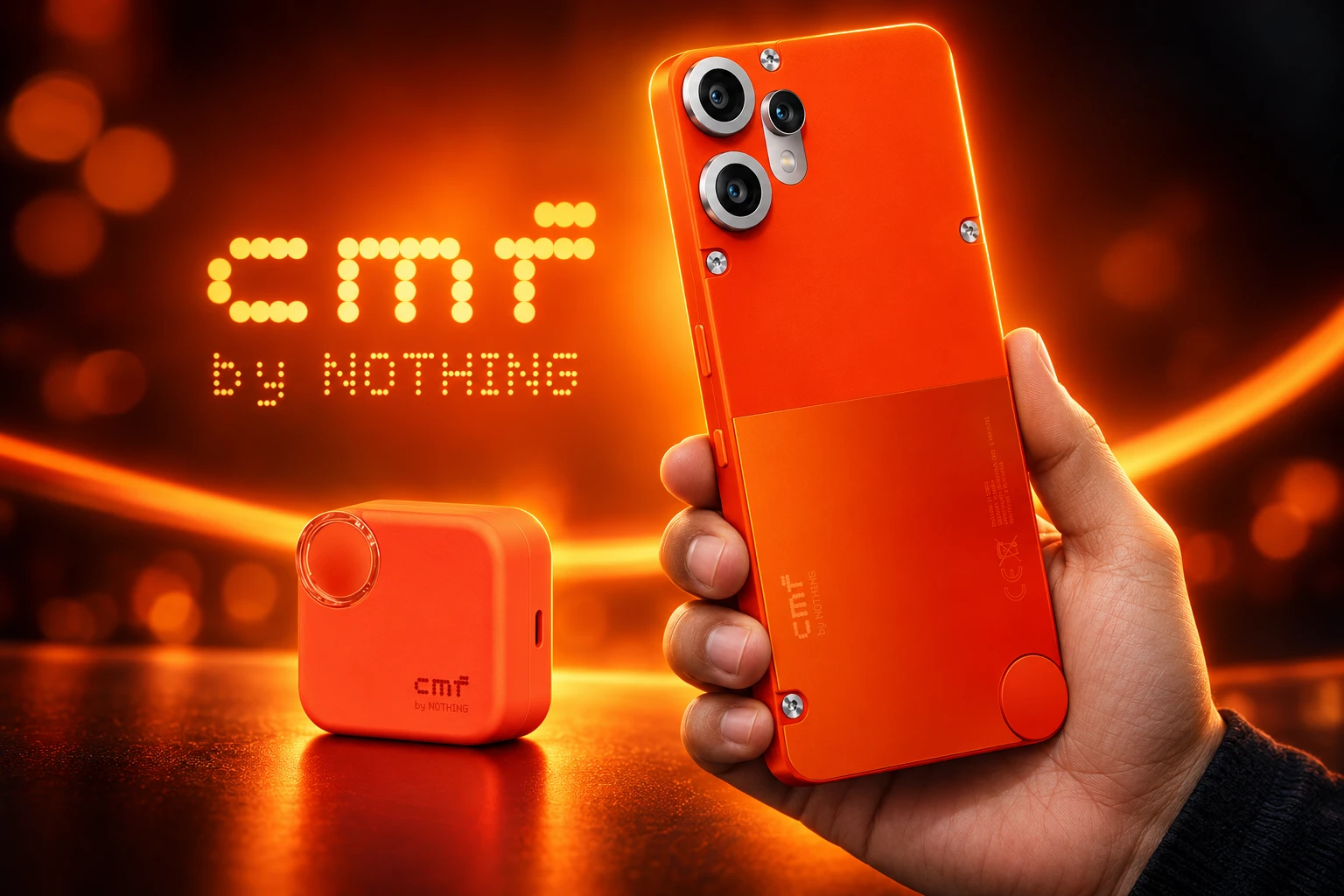
100 Million Phones Is OPPO Territory
Pei called 100 million phones a year “the line between a brand and a platform.” Below it, he wrote, a company is a customer of the supply chain. Above it, suppliers build to its spec, and the cost of an OS team, a camera team, and an AI stack is spread across a huge base.
Only a handful of firms live on that line. In 2025, according to Omdia, OPPO shipped 100.7 million phones, and vivo shipped 105.3 million. Apple led the world at 240.6 million, with Samsung at 239.1 million. Xiaomi was at 165.4 million. The whole market was about 1.25 billion phones.
Omdia counts OnePlus inside that OPPO total. Pei co-founded OnePlus, left, and started Nothing in 2020. He is now aiming CMF at the annual volume of the group that still carries the brand he helped build.
WHERE 100 MILLION SITS
| Name | Annual phones |
|---|---|
| CMF long-term goal (Pei) | 100 million |
| OPPO, 2025 (Omdia) | 100.7 million |
| vivo, 2025 (Omdia) | 105.3 million |
| Xiaomi, 2025 (Omdia) | 165.4 million |
| Apple, 2025 (Omdia) | 240.6 million |
| Nothing now, per Pei | A few million a year |
He wrote that Nothing has spent six years building for “a few million people a year.” Getting from that base to 100 million is not a product refresh. It is a jump into the top tier of global volume brands, with no public deadline attached.
India Is Buying Fewer Cheap Phones
Pei’s letter treats India as the last big opening for a new volume brand. IDC counted 152 million smartphones in 2025, up 0.5% from the year before. Pei rounded that demand to “over 150 million” phones a year. He also wrote that 99% of phones sold in India are now made there, up from almost none a decade ago.
The 2026 tape is harsher, and it hits the band CMF lives in. Counterpoint Research said India’s shipments fell 10% year on year in the April to June quarter, the weakest June quarter in six years. Research director Tarun Pathak said memory prices have risen nearly 4x since September 2025 and may head toward 5x, and he expects the full year to fall 13%.
We expect India’s smartphone market to remain under pressure through the rest of the year, as elevated memory and component costs continue to keep device prices high. Smartphone memory prices have increased nearly 4x since September 2025 and are expected to rise further, potentially reaching 5x in the coming months. As a result, we expect the market to decline by 13% YoY for the full year.
Tarun Pathak, research director, Counterpoint Research
The cheap end took the blow. Counterpoint said the sub-Rs 15,000 segment fell 45% in that quarter. IDC, looking at 2025, already had the $100 to $200 mass-budget band shrinking 8%, with its share sliding from 44% to 41%. CMF’s phones sell under $200. The CMF Phone 2 Pro went on sale in India in May 2025 from Rs 16,999 with launch offers.
THE INDIA MARKET UNDER THE BET
- 2025 volume: IDC counted 152 million phones, up 0.5%.
- Cheap band: IDC’s $100 to $200 segment fell 8% and held 41% of 2025 shipments.
- 2026 so far: Counterpoint has Q2 down 10% and the full year down 13%.
- Entry crash: Sub-Rs 15,000 shipments fell 45% in Q2 2026, per Counterpoint.
CMF was still the fast-growing name in that squeeze. Counterpoint had CMF up 83% in 2025, with 59% growth in the fourth quarter, calling it the fastest-growing brand in its segment. IDC had Nothing, as a brand, up 45% in 2025. In Q2 2026 Counterpoint had Nothing up 105%, the ninth time in ten quarters it led India on growth, led by Phone (4a) and Phone (4a) Pro, and it counted that figure without CMF.
Growth from a small base can look spectacular and still be a long walk to 100 million. The bet is that Indian ownership and local engineering can keep that growth going after the easy gains, in a year when memory costs are pushing buyers out of CMF’s price band.
The Noida Plant Built for a Smaller Number
Monday’s letter is a second move, not a first one. On September 25, 2025, Nothing said CMF would run as an independent subsidiary based in India for operations, R&D, and making phones. It signed a manufacturing joint venture with Optiemus Infracom, the Noida electronics firm that also builds for other global brands.
The Optiemus filing on BSE said the two sides would invest over $100 million (about Rs 887 crore) and create more than 1,800 jobs in India over three years, by 2028. Nothing said it had already put more than $200 million into the country. That India spend is separate from the $200 million Series C, at a $1.3 billion valuation, led by Tiger Global, with Zerodha co-founder Nikhil Kamath among the new backers, which the same filing noted.
Ashok Gupta, executive chairman of Optiemus, said the deal would help the firm make export-ready products “designed in India.” At the time, Optiemus was set to hold 65% of the manufacturing joint venture. That 65% is the plant, not the CMF brand company Pei is now putting under Indian majority owners. Mixing those two would overstate how much of CMF already belongs to an Indian factory group.
The Noida unit was described at launch as having initial capacity of 500,000 phones a month, which is 6 million a year. Pei’s 100 million goal is more than 16 times that first annual run rate. The plant can grow. The gap still shows what kind of scale he is talking about.
HOW CMF GOT TO THIS LETTER
- 2020: Nothing is founded in London. The later Optiemus filing says the firm has passed $1 billion in lifetime revenue.
- September 2023: CMF launches as Nothing’s lower-priced line, two years before the India subsidiary plan.
- May 2025: CMF Phone 2 Pro goes on sale in India from Rs 16,999 with offers.
- September 25, 2025: CMF becomes an India-based subsidiary and forms the Optiemus joint venture.
- September 21, 2026: Pei says CMF will be majority Indian owned, with Nothing as a shareholder and partner.
Himanshu Tandon was already named VP of CMF Business when the 2025 deal landed, and CMF’s global marketing had moved to India. The new letter changes who is meant to own the company, not the fact that India was already the operating base.
Nothing Keeps the Software and a Stake
Pei is not describing a clean break. Nothing remains a shareholder and a partner on the operating system, proprietary tech, engineering skill, and supply network. CMF still inherits Nothing OS, which Pei called a full in-house Android build with its own camera processing, updated on schedule for every device since 2021, and recently voted India’s top Android experience in his telling.
He listed five checks for whether a brand actually does R&D, or just picks a phone off a partner’s catalog.
PEI’S FIVE R&D CHECKS
- The structure: Who engineers the materials, heat, and durability, beyond the colours?
- The camera: Who picks the sensors and builds the imaging pipeline?
- The software: Who writes the OS and commits to years of updates?
- The radios: Who retunes and certifies the antennas when the design changes?
- The parts: Who sits with suppliers to co-engineer displays, chipsets, and camera modules?
If the honest answer to most of those is the manufacturing partner, Pei wrote, the brand is picking a phone, not engineering one. A brand that can only choose from what already exists mostly competes on price, and someone cheaper always shows up. A brand that owns the work can cut cost by removing markup rather than quality, he argued, and get better each year.
That is also why the ownership change is the bet’s legal form. Pei wrote that a partner, in his sense, is “owned in India, run from India, engineered in India,” so the scale compounds inside the country’s suppliers and engineers. Foreign brands, he said, have come for demand, kept the engineering offshore, and left India with assembly lines.
Delhi is pushing the same direction with money. Union minister Ashwini Vaishnaw said indigenous phones with Indian-owned IP should reach the market in 10 to 14 months under the Rs 62,500-crore Mobile Phone Manufacturing Scheme, and that the screen for Indian brands would be strict on copycats. Pei’s letter followed that policy turn. It does not say CMF is in the scheme.
What 2015 Taught Pei About Indian Brands
The letter’s sharpest passage is not about Nothing. It is about the last time Indian phone brands looked unstoppable. In 2015, Pei wrote, they sold close to half the phones in the country, and one of them was briefly the best-selling brand, ahead of Samsung.
“It looked like the start of something. It wasn’t,” he wrote. Foreign brands arrived with better cameras, tighter software, and a better phone every year. The domestic names, in his account, were licensing an off-the-shelf design, changing the back cover, and adding a logo. By 2025 they held less than 1% of a market they once led.
He is using that collapse as the design brief for CMF. The opening for a new Indian brand is there again, he wrote, and new names are walking into it. The hard part comes later, “when the window closes and only the product is left.” The better engineered phone wins.
He has seen the other version of this cycle. He moved from Stockholm to Shenzhen in 2012. Korean displays and Japanese camera modules led then, he wrote, and Chinese suppliers made the cheaper stuff. By the time he left in 2020, Chinese suppliers were among the biggest in the world. Chinese phone makers, in his telling, refused the catalog and forced thinner modules, brighter panels, and hinges that survive 200,000 folds. Suppliers became engineering partners.
“Last cycle, I moved to the country that was about to do this,” he wrote. “This time I’d like to help build the cycle.” That is the personal stake under the cap table. It is also the risk. CMF has to prove it is not the 2015 model with a better logo, and Pei has volunteered the test.
A Year With No New CMF Phone
The letter lands in a year when CMF is not putting a new phone on shelves. Nothing co-founder Akis Evangelidis said in 2026 that the company had been working on a successor to the CMF Phone 2 Pro and chose not to launch it, because rising memory prices made it hard to deliver a real upgrade at a CMF price. He said the firm would rather wait than ship a phone it was not proud of.
CMF is still shipping other hardware. Evangelidis said it would launch products in new categories in 2026, with a focus on IoT, and look again at phones when costs ease. CMF Buds Neo arrived in August 2026. The volume target, though, is a phone target. A platform of 100 million units is not built on earbuds.
People who follow the brand treated the ownership news as a promise of a stronger 2027 phone, because the 2026 slot is empty. That reading is fair. The org chart can be Indian, and the factory can be in Noida, and the OS can still come from Nothing. None of that substitutes for a phone CMF is willing to price.
WHAT WE KNOW
- The structure: CMF is to be an Indian company, majority owned by Indian shareholders, with Nothing as a shareholder and partner.
- The money already pledged: The 2025 Optiemus deal is more than $100 million and more than 1,800 jobs by 2028.
- The 2026 phone: Evangelidis said the Phone 2 Pro successor is postponed, not cancelled in public.
WHAT IS UNCONFIRMED
- The majority owners: Pei has not named the Indian shareholders who will hold control of CMF.
- The close: No date is public for when operational control actually moves.
- The 100 million clock: There is no year attached to the target.
Pei wrote that when the decision was made, what he felt was adrenaline. Six years of design awards, a real OS, and a real engineering team had still left a ceiling. India, he argued, is the market that will decide the next decade of consumer electronics, and CMF is the vehicle he is willing to put under Indian owners to chase it.
The letter makes CMF an Indian company on paper. The 100 million figure makes it a volume bet against OPPO’s scale, a Noida plant that started at 6 million phones a year, and a 2026 calendar with no new CMF phone on it.

Edinburgh Opens a 2027 Tour Built for Time Trials

Korda Maps Auður From Meðalland to Irvine Bay

Apple Music Films Its New Logo in Mineral Oil

Oppo Prices the Pad Mini Above India’s iPad Mini

Austen Soaks Scotland Before Boelo Brings Weekend Gales

Volkswagen Sells the Osnabruck Plant to Clear a Board Fight

Apple’s Foldable iPhone Hinges on Samsung Display Supply

Saksham Gaur Finds He Is His Own Company’s Client

Tata Motors’ Iveco Tender Opens as Holders Still Decide

Onimusha Way of the Sword Preload Hits a Windows 11 Wall
-
 AUTO2 months ago
Volkswagen Sells the Osnabruck Plant to Clear a Board Fight
-
 NEWS2 months ago
Apple’s Foldable iPhone Hinges on Samsung Display Supply
-
 AUTO2 months ago
Tata Motors’ Iveco Tender Opens as Holders Still Decide
-
 BUSINESS2 months ago
Saksham Gaur Finds He Is His Own Company’s Client
-
 GAMING2 months ago
Onimusha Way of the Sword Preload Hits a Windows 11 Wall
-

 ENTERTAINMENT3 years ago
What is SD on Amazon Prime? – All You Need to Know
-

 BUSINESS2 months ago
Hyderabad 22-Carat Gold Jumps After a False Bargain
-

 NEWS2 months ago
iQOO 16 Locks 8,400 mAh While 100W Charging Holds