
BUSINESS
Pennylane and Qonto Founders Back Benford’s Audit Bet
Pennylane, Qonto and firstminute capital are backing Benford, a licensed Norwegian audit firm, with €5 million after the Big Four sold off Nordic mid-market offices.

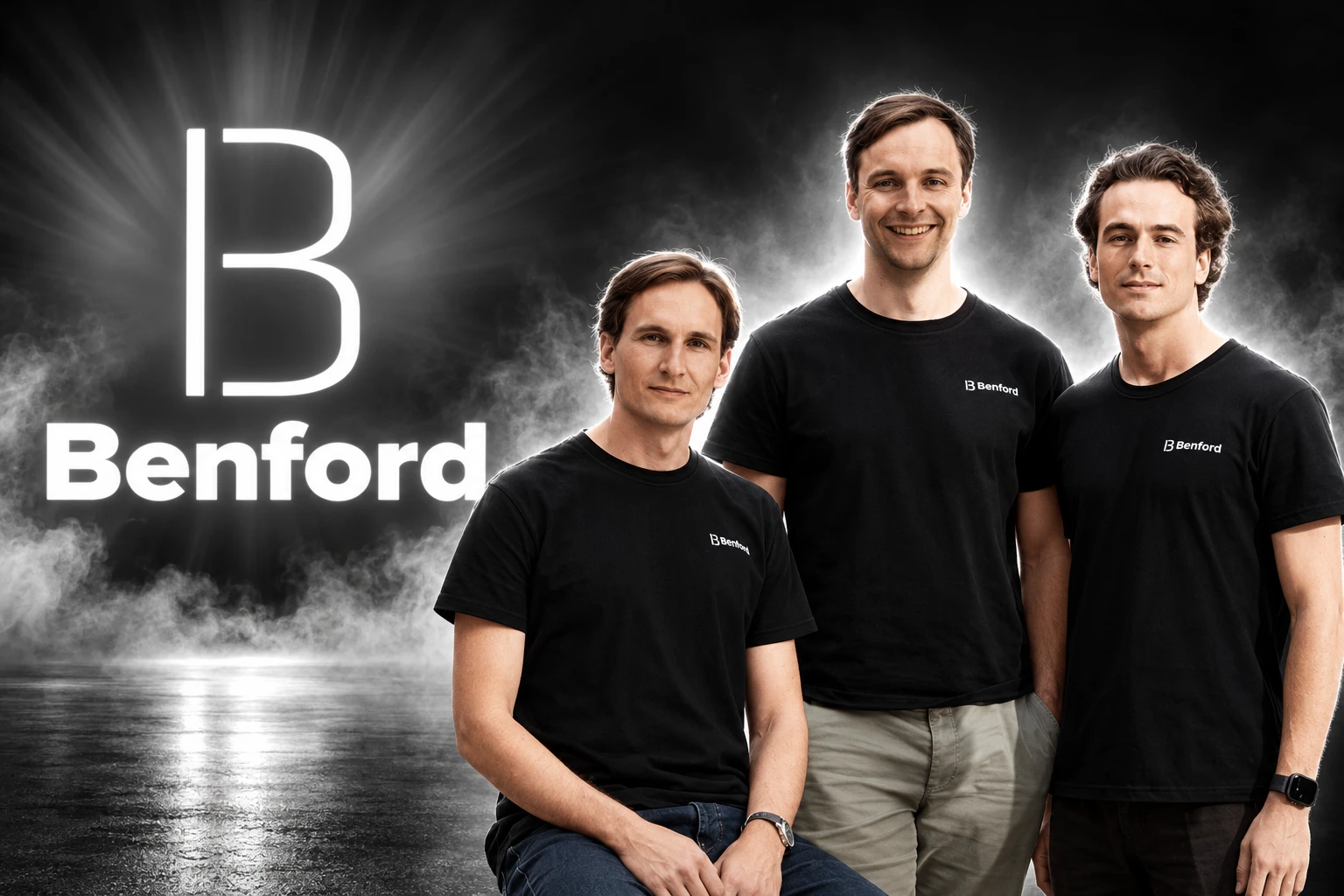
Benford raised €5 million of pre-seed capital on 22 September 2026 to run statutory audits as a licensed firm, from a client’s books to a signed opinion. The Oslo and London company already holds a Norwegian audit licence and is live on client work with AuditOS, its own engine.
On the cap table sit firstminute capital, Global Founders Capital, Sondo, and the people who built Pennylane, Qonto, HSO and Amesto. That is the wager: own the licence, own the software, employ the person who signs.
Pennylane and Qonto Founders Wrote the Cheque
The round was led by firstminute capital, Global Founders Capital and Sondo. firstminute, the London seed firm founded in 2017 by Spencer Crawley and Brent Hoberman, manages $500 million and cheques of £1 million to £3 million into European pre-seed and seed companies. Michael Stothard, a partner there, put the firm on the ticket.
The rest of the money is not generic fintech angel noise. It comes from people whose products already sit on the books Benford wants to sign.
THE CAP TABLE
- Arthur Waller and Quentin de Metz: Co-founders of Pennylane, the French accounting platform used by growing companies that still need a statutory auditor.
- Alexandre Prot: Co-founder of Qonto, the business account those same companies often run beside the books.
- Peter ter Maaten: From HSO, which implements the ERP systems AuditOS is built to read.
- The Spandow family: Behind Amesto, a Nordic accounting and staffing group that already lives next to the audit file.
- David Sainteff: Partner at Global Founders Capital, which joined firstminute on the lead.
Mads Bogen Øye and Thibault Mallion, co-founders and co-CEOs, come with Andreas Rystad. The three are alumni of Palantir, Goldman Sachs and One Peak. Rystad, born in 1999, is managing director of Benford Teknologi AS, the Oslo software company incorporated on 8 June 2026 at Ørakerveien 16 C, organisation number 937 951 612. The company register lists 10 staff on that software entity and a purpose limited to building and licensing software for the audit and accounting trade.
The founders’ pitch to that cap table is blunt. Mallion said audit is one of the few services where the customer experience has gotten worse every year while the bill has gone up. They are changing how it is delivered, he said, not what an audit is.
The Big Four Already Sold the Neighbourhood
Stothard’s note that the Big Four are pulling back from the mid-market is not a slogan in Norway. Through 2025 the four firms sold the local offices that served smaller companies, and they said they were doing it so they could concentrate on larger, more complex clients.
THE NORDIC OFFICE SALES
| Firm | Announced | What moved | Buyer |
|---|---|---|---|
| Deloitte Norway | 11 August 2025 | 13 offices, 290 staff, 27 partners | Cedra (Adelis Equity) |
| PwC Norway | 15 September 2025 | 20 offices, about 260 staff, 20 partners | IK Partners vehicle |
| KPMG Norway | September 2025 | 10 offices, about 220 staff | Cedra |
| EY Norway | 10 December 2025 | 13 offices, about 300 staff | Cedra |
Those four deals cover 56 offices. Cedra, whose Swedish business the Deloitte release put at about 1 billion SEK, more than 500 staff and 25 offices, took the Deloitte, KPMG and EY books in Norway. PwC’s offices went to a vehicle backed by IK Partners.
Deloitte’s own statement is the cleanest primary record. Cecilia Flatum, chief executive of Deloitte Norway, said the sale of 13 regional offices and 290 staff would let the firm sharpen its work toward large, mid-sized and growth companies, with 1,700 partners and staff left in Norway. Torgeir Dahle, who had led Deloitte’s audit practice, became chief executive of Cedra Norge. The offices on that list run from Florø and Førde through Haugesund, Kristiansand, Drammen, Gran and Gjøvik.
Leif Arne Jensen, PwC Norway’s senior partner and chief executive, said the firm was concentrating on medium-sized and large companies and on growth companies. Rune Skjelvan at KPMG framed the same split: Cedra in the small and mid-sized segment, KPMG on larger clients in Oslo, Bergen, Stavanger, Trondheim, Drammen, Kristiansand and Hamar. Arbab Dar at EY called the 13-office sale a step toward work that needs more breadth and depth, in line with the network’s “All in” plan.
So the empty space Benford is walking into is not an empty map. Private equity already bought the desks, the local names and the client lists. Adelis and IK Partners now own the old mid-market of the Big Four. Benford is not bidding for those offices. It is betting that a different kind of client, already on modern ledgers and business accounts, will take a licensed firm that starts in software rather than in a regional partnership.
Twenty Years of Tools Never Touched the Firm
Øye’s line is the one that separates this raise from the rest of audit tech. Every attempt to modernise audit, he said, has been aimed at the auditor’s desk, and the firm around it was left untouched. Benford holds the licence, builds the platform, and employs the qualified auditors who scope each job, rule on every exception, and sign the opinion.
For twenty years, innovation in audit has meant selling tools to auditors, and most audits are still done the old way. Audit is a huge, structurally overlooked market that nobody has tried to rebuild from first principles.
Michael Stothard, partner, firstminute capital
The other model is still raising more money. Cortea, founded in 2024 by Valentin Neumann and Philipp Hövelmann, closed a €12 million seed round for audit review on 16 June 2026, led by Dawn Capital, with Cherry Ventures, Mosaic Ventures and Larry Bradley, former global head of audit at KPMG. Cortea sells Audit Quality Agents that sit on top of a firm’s existing process and check reports, statements, notes and workpapers before sign-off. Over the last season those agents helped review more than 4,000 audit reports.
Bradley’s test is the same one Benford will meet on the other side of the licence. If AI cannot improve quality, transparency and professional judgement, he said, it has no place in the audit process. Cortea’s answer is a layer for the firms that already sign. Benford’s answer is to be the firm that signs. The €12 million went to the layer. The €5 million went to the licence.
Hilde Blomme, deputy chief executive of Accountancy Europe, told ICAEW in July 2026 that in many European countries the total number of auditors is falling, and that in some places more auditors are retiring than new trainees are joining, across both public-interest and other work. Pascal Jauffret, chief executive of Forvis Mazars, said demand for large-scale international audit is rising while the number of firms able to deliver it is narrowing. Those debates about an auditor shortage are usually about listed groups. The Norwegian sales show the same pressure further down the file, where the work is still mandatory and the economics no longer fit a global partnership.
How AuditOS Carries Last Year’s File
AuditOS is the piece the cheque is supposed to compound. It connects to the systems a company already runs, then keeps the file so the second year does not start at zero. Sainteff’s point is the one finance teams already know: clients pay twice, once on the invoice and once in the hours their own people spend feeding the auditor.
WHAT AUDITOS CONNECTS
- The sources: ERP, subledgers, invoices, banks and other operating systems feed one audit file that deepens through each job.
- The tests: Every test runs against that file, and every input is logged, traced to its source and assigned to a named auditor.
- The follow-ups: Queries live in one shared interface, which is the part of the cost that never appears on the bill.
- The next year: Each job is scoped to what that company needs, and the work is carried forward so year two starts where year one stopped.
That last point is the product claim that PE roll-ups cannot copy by buying offices. A consolidator inherits last year’s working papers in whatever format the old partnership used. Benford says it keeps a single audit brain and re-uses it. If that holds, the second engagement is cheaper for the client and faster for the firm. If it does not, Benford is another small practice with a nicer portal.
No process is better suited to automation than audit’s groundwork, and few are less automated. It is the clients who pay the price, both in fees and in the internal hours spent facilitating a process that software should be doing.
David Sainteff, partner, Global Founders Capital
The European Commission, using 2021 figures for the EU and Norway, counted 200,484 statutory auditors and 22,427 audit firms. The Big Four still took 59% of public-interest entity statutory audits by count, down from 70% in 2018, and 86% of the fees on that work. The mid-market below that line is where fees have kept rising while the service, in Mallion’s words, has got worse. ICAEW’s mid-tier survey found 49% of responding firms expected to take more school-leaver trainees and 40% expected to take fewer graduates, a patch on a pipeline that is still thin.
Oslo Holds the Licence
Software companies do not sign audit opinions. Finanstilsynet does not let them. A company that wants approval as a Norwegian audit firm must be a partnership, limited company or co-operative, keep a board on which a majority of members and deputies are authorised auditors, give more than half the votes in the top body to authorised auditors or audit firms, and show it can meet its debts as they fall due. The supervisor aims to process an application in 30 days. Authorised firms and state-authorised auditors go on a public register, and a firm authorised in another EEA state can take Norwegian statutory work if it names a state-authorised auditor for the job and is entered in that register.
Benford says it already has the Norwegian licence and that AuditOS is running live client audits. That is the whole product. The company employs the people who scope the work, decide the exceptions and sign. Judgement stays with those people; the engine does the groundwork. Øye’s “desk was left untouched” line is the reason they incorporated an audit firm rather than a vendor.
The software entity on the Oslo register is three and a half months old. A separate licensed audit firm has to satisfy the board and voting tests above, which a pure technology company cannot meet on its own. Benford’s public claim is that the group already clears that bar. The supervisor’s public register search is the check any client’s board should run before it hands over a year-end file, and the company has not published a register number in the raise materials.
Sweden is the next market on the plan, which only works if a Norwegian firm can staff a local signing auditor and meet the host country’s register rules. London is already an office, not yet a second home-country licence. The money has to hire both the engineers who extend AuditOS and the authorised people whose names go on the opinion. Without the second group, the first group is back to selling tools.
What the €5 Million Has to Cover
The raise will grow the London and Oslo offices, take the firm into Sweden and further European markets, and pay for hiring across audit and engineering. That is the entire use of proceeds the company has given. It has not named current clients, fee levels, or how many opinions it has already signed.
FROM THE SALES TO THE RAISE
- 11 August 2025: Deloitte Norway agrees to sell 13 regional offices, 290 staff and 27 partners to Cedra Norge.
- September 2025: PwC Norway moves 20 offices and about 260 staff to an IK Partners vehicle; KPMG Norway moves 10 offices and about 220 staff to Cedra.
- 10 December 2025: EY Norway agrees to sell 13 local offices and about 300 staff to Cedra.
- 8 June 2026: Benford Teknologi AS is incorporated in Oslo, with Andreas Rystad as managing director.
- 16 June 2026: Cortea raises €12 million to sell AI review agents to existing audit firms.
- 22 September 2026: Benford raises €5 million as a licensed firm that runs the audit itself.
Three months after the software company was formed, the people who already own the ledgers, the business accounts, the ERP implementations and the Nordic accounting roll-ups put money behind a signer. Cedra and the IK Partners vehicle still hold the offices, the local partners and more than a thousand people from those four sales. Benford holds a licence, a live engine and a cap table that looks like the stack its target clients already use.
The firm is hiring in Oslo and London. Sweden is next if the register and the staffing follow the money. The clients, for now, are not named.

Edinburgh Opens a 2027 Tour Built for Time Trials

Korda Maps Auður From Meðalland to Irvine Bay

Apple Music Films Its New Logo in Mineral Oil

Oppo Prices the Pad Mini Above India’s iPad Mini

Austen Soaks Scotland Before Boelo Brings Weekend Gales

Volkswagen Sells the Osnabruck Plant to Clear a Board Fight

Apple’s Foldable iPhone Hinges on Samsung Display Supply

Saksham Gaur Finds He Is His Own Company’s Client

Tata Motors’ Iveco Tender Opens as Holders Still Decide

Onimusha Way of the Sword Preload Hits a Windows 11 Wall
-
 AUTO2 months ago
Volkswagen Sells the Osnabruck Plant to Clear a Board Fight
-
 NEWS2 months ago
Apple’s Foldable iPhone Hinges on Samsung Display Supply
-
 AUTO2 months ago
Tata Motors’ Iveco Tender Opens as Holders Still Decide
-
 BUSINESS2 months ago
Saksham Gaur Finds He Is His Own Company’s Client
-
 GAMING2 months ago
Onimusha Way of the Sword Preload Hits a Windows 11 Wall
-

 ENTERTAINMENT3 years ago
What is SD on Amazon Prime? – All You Need to Know
-

 BUSINESS2 months ago
Hyderabad 22-Carat Gold Jumps After a False Bargain
-

 NEWS2 months ago
iQOO 16 Locks 8,400 mAh While 100W Charging Holds