
NEWS
Basecamp Research Raises $140 Million to Reprogram Cells
Nvidia and Anthropic already helped build Basecamp’s gene atlas; a $140 million Series C now buys them into in-vivo cell therapy.

Basecamp Research raised $140 million on September 23, 2026, in a Series C that values the London AI lab at $800 million. S32 led the round. Nvidia and Anthropic’s Anthology Fund joined a list that also includes the NATO Innovation Fund and the UK’s Sovereign AI unit.
Nvidia and Anthropic were already named partners on the genomic set that trains Basecamp’s models. The new money turns that data work into a stake in a company that wants to rewrite a patient’s cells inside the body, and to do it before any of its named drugs has left the earliest formal stage of preclinical work.
S32 Values the London Lab at $800 Million
Basecamp Research on September 23, 2026, announced an oversubscribed $140 million Series C led by S32, the California firm founded by Bill Maris, who also founded GV. Andy Conrad, a general partner at S32 and former chief executive of Google’s Verily, joins the board.
The round lifts total equity raised to $225 million. Dealroom’s company file lists a $20 million Series A in December 2022 at $80 million and a $60 million Series B in October 2024 at $240 million, led by Singular. Those two rounds account for $80 million of the $85 million raised before this one.
BASECAMP RESEARCH FUNDING
| Round | Date | Amount | Valuation |
|---|---|---|---|
| Series A | December 2022 | $20 million | $80 million |
| Series B | October 2024 | $60 million | $240 million |
| Series C | September 2026 | $140 million | $800 million |
The Series C more than triples the Series B price. Conrad said the mix of AI, biological data and scientific insight could change how disease is understood and how medicines are found, and he called Basecamp a technology platform at the centre of that chance.
Alongside the funds, André Hoffmann, vice-chairman of Roche, invested as an individual. Richard Pearce, formerly of Biogen, becomes chief business officer, hired to widen pharmaceutical partnerships. The company is based in London, with offices and labs in Cambridge, Massachusetts.
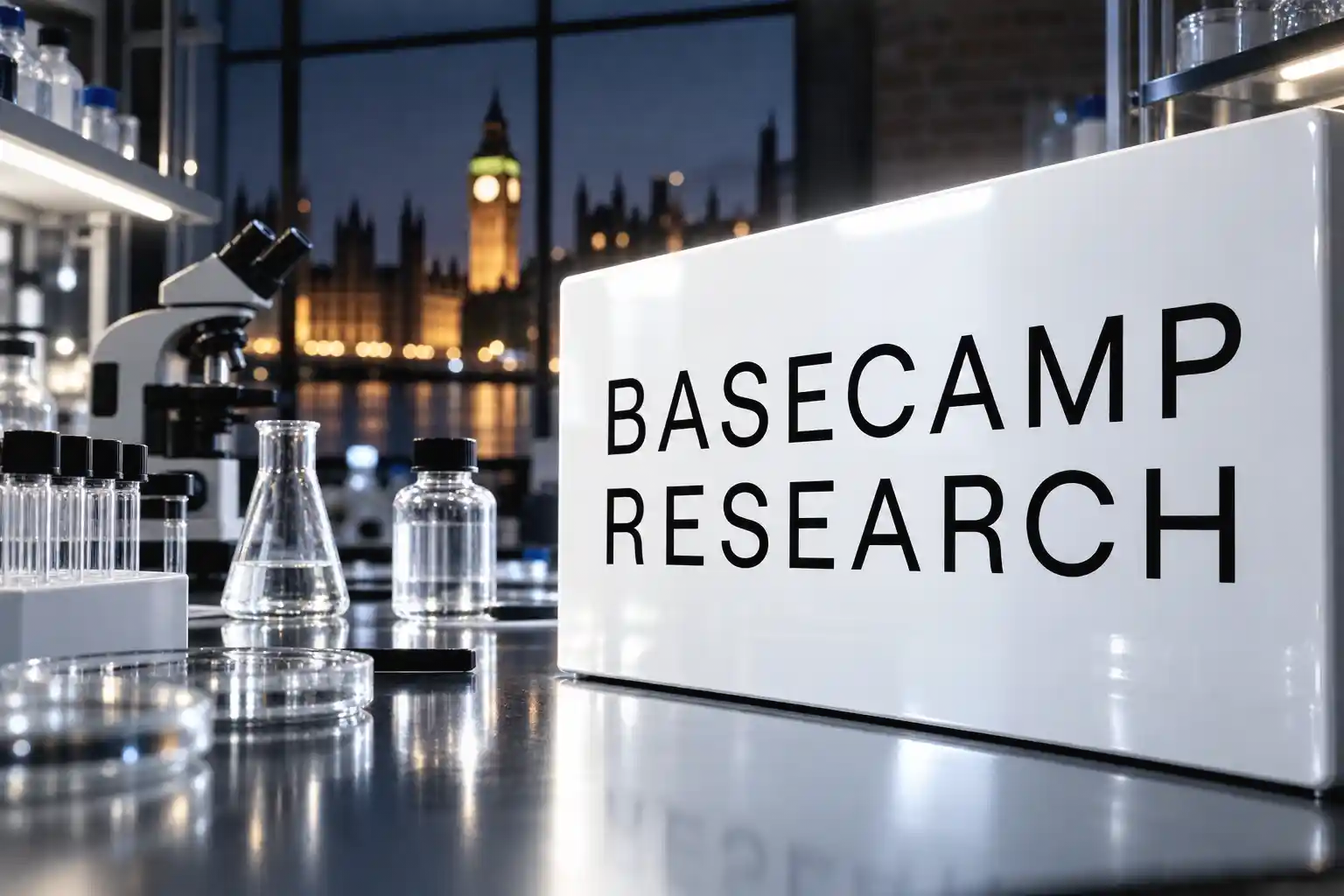
The Trillion Gene Atlas Already Had Nvidia and Anthropic
At the centre of the pitch is the Trillion Gene Atlas, which Basecamp calls the largest proprietary biological training set yet built. The September 23 announcement names Nvidia, Anthropic, PacBio and Ultima Genomics as partners on that atlas. Samples come through access and benefit-sharing deals in more than 30 countries across all seven continents.
The company’s homepage now puts the haul at over 100 billion novel genes and more than 100 trillion tokens. Sovereign AI, in its own note on the round, says the database is drawn from over a million previously undiscovered species. EDEN, the flagship model, has 28 billion parameters and was first published in January 2026 with Nvidia and Microsoft among the labs on the work.
Two of EDEN’s tools, antibiotic design and antigen immunogenicity prediction, already sit inside Claude Science, Anthropic’s research workbench. That is the part of this round the celebrity names do not explain on their own. Anthropic is not arriving as a tourist. It is putting money, through Menlo Ventures’ $100 million Anthology Fund, into a lab whose models already run on Claude. Daniela Amodei, Anthropic’s president, said at the fund’s launch in July 2024 that the vehicle would look for healthcare and scientific research among other fields. Menlo finances the fund; startups get model access and credits.
Vega Shah, who works in portfolio management at NVentures, Nvidia’s venture arm, marked the close by pointing at the fieldwork, not the term sheet.
Congratulations to Basecamp Research, an NVentures portfolio company, on their $140M Series C announced today. Particularly interested in this one — in a past life, I spent time as a scientist mining the natural world for novel genes and metabolic pathways. @Basecamp_Res… pic.twitter.com/aIh8q3yY45
— Vega Shah (@dr_alphalyrae) September 23, 2026
“Particularly interested in this one,” Shah wrote. “In a past life, I spent time as a scientist mining the natural world for novel genes and metabolic pathways.” The scarce input is not another 28 billion weights. It is sequence collected under consent, with the genomic neighbourhood still attached, at a scale public databases do not match.
NATO and Britain’s Sovereign AI Fund Join the Cap Table
The rest of the syndicate is the part a normal biotech C does not attract. Official participants named with S32 include Catalio Capital Management, European Tech Collective, Firebrand River Capital, Inception Fund, King Philanthropies, the NATO Innovation Fund, Nvidia, PostScriptum, Redalpine, the Rockefeller Foundation, Singular, Sovereign AI and True Ventures.
THE STRATEGIC NAMES ON THE ROUND
- Sovereign AI: Britain’s £500 million venture unit, writing the cheque as its sixth equity deal, with typical tickets described in the £1 million to £10 million range.
- NATO Innovation Fund: A €1 billion vehicle backed by 24 Allies, with biotechnology listed among its priority fields.
- Anthology Fund: Menlo’s $100 million partnership with Anthropic, aimed at companies building on Claude in health and science.
- Nvidia: Compute partner on EDEN and a named builder of the Trillion Gene Atlas, now back as an equity holder.
- The Rockefeller Foundation and André Hoffmann: A philanthropic balance sheet and Roche’s vice-chairman sitting beside the model labs.
Basecamp is the sixth company to receive equity investment from Sovereign AI. Josephine Kant, the unit’s head of ventures, used the Arctic origin story as the reason for the cheque, and said Glen Gowers and Oliver Vince, who met as Oxford undergraduates, “dragged a portable lab to the Arctic to do something no one had done before: sequence DNA completely off-grid.”
The NATO Innovation Fund has not issued a Basecamp-specific note. Its own biotech essay, published in October 2025 by Ana Bernardo-Gancedo, sets the mandate at healthcare preparedness and supply chain security, and at the ability to design and make countermeasures when natural and engineered biological threats blur. A lab that can prompt a model for an antimicrobial peptide, or insert a long DNA payload without cutting the genome, sits inside that brief even if the first billed product is a cancer cell therapy.
Why In Vivo Cell Therapy Comes First
Basecamp is applying EDEN first to in vivo cell therapy, meaning the rewrite happens inside the patient. Current cell therapies, the company says, are limited in how complex a payload they can deliver, and by a manufacturing process that costs hundreds of thousands of dollars per patient. Cells leave the body, get engineered in a plant, and come back. That chain is slow, expensive, and hard to customise.
The proposed swap is a designed DNA sequence plus large serine recombinases that slot it into the genome at a chosen site. The company says those enzymes need no guide RNA, no landing pad, and no double-strand break. If that holds in people, a dose that reprograms T cells in place would cut out the factory. That is a manufacturing argument as much as a molecular one, and it is why a model lab is raising like a foundation-model shop.
We believe the future of medicine lies in reprogramming the body to repair itself. We design the models and the medicines to teach it how. AI-based approaches promise to change what’s possible for patients who currently have few alternatives. This funding brings this technology closer to those who need it most.
Glen Gowers, co-founder and CEO, Basecamp Research Series C announcement
Hoffmann, from the other side of the industry, put the same claim in longer history. He said the biotechnology shift that began fifty years ago changed how medicines are made, and that personalised, AI-designed drugs are the next turn of that wheel. Basecamp, he said, has the stack from biological data through trained models to designed therapies.
Six Programs Remain in Lead Optimization
The company says it has strong preclinical results across several modalities and disease areas, and that a pipeline of EDEN-designed drugs, beginning with in vivo cell therapy, is moving toward clinical development. It has not said which program will enter humans first, or when. A pipeline chart published with the round lists six programs. Four sit in lead optimization, the stage where candidates are refined before animal efficacy studies as named drug assets. Two remain in earlier research.
THE SIX PROGRAM PIPELINE
| Program | Modality | Stage on the chart |
|---|---|---|
| In vivo CAR-T for blood cancer | Large serine recombinases | Lead optimization |
| In vivo CAR-T for an unnamed autoimmune disease | Large serine recombinases | Lead optimization |
| Liver gene therapy for phenylketonuria (PKU) | Gene insertion | Lead optimization |
| Antimicrobial peptides for drug-resistant bacteria | Peptide design | Lead optimization |
| CAR-T for solid tumors | Cell therapy | Early research |
| Peptides for diabetes | Peptide design | Early research |
Lead optimization is still a long way from a prescription. Animal efficacy and safety work, an application to test in humans, then three trial phases, sit after it, and most candidates that enter the clinic do not finish. The $140 million is meant to train a new generation of EDEN models and to push this list toward that first human study, not to skip it.
A Peptide Worked in Mice at Last-Line Strength
The lab result the company leans on hardest is not a named pipeline asset completing animal efficacy as a drug program. It is a model test. In a June 23, 2026 technical note, Basecamp said EDEN designed peptides against pathogens on the WHO priority list, in work with Cesar de la Fuente-Nunez at the University of Pennsylvania. Of those peptides, 97% showed micromolar activity in vitro, and most of those cleared human cytotoxicity tests. A lead then matched a last line antibiotic in a mouse model, with no optimisation, structure prediction or binding experiments on the way.
EDEN IN THE LAB
- Model size: 28 billion parameters, trained as a single general model rather than a stack of narrow task networks.
- Peptide hit rate: 97% showed micromolar activity in vitro against WHO-priority pathogens.
- Animal check: One lead matched a last-line antibiotic in mice, reported as a zero-shot design.
- Training set: Over 100 billion novel genes and more than 100 trillion tokens, from more than 30 countries.
The company has also said EDEN showed zero-shot activity in primary human T cells, and that cancer-fighting DNA integrated into those cells cleared more than 90% of tumor cells in laboratory assays. Those are dish results. They sit beside the mouse peptide, not on top of it, and none of them is a human outcome. The honest read of the science, on the day the money landed, is that a general model trained only on evolutionary sequence has produced working molecules in a dish and one working peptide in a mouse, while the six billed programs have not yet been taken through animal efficacy as drugs.
From Vatnajökull, They Built a DNA Supply Chain
Gowers, a synthetic-biology doctorate, and Vince founded the company in 2019 after a trip to Iceland’s Vatnajökull ice cap, where they ran what they describe as the first off-grid DNA sequencing operation. Kant’s line about the portable lab is the same story told from the state’s side of the cap table. The instinct they are selling now is unchanged: go where the public databases are empty, come back with sequence nobody else can train on, and scale that into a model that designs a medicine from a disease prompt.
FROM ICE CAP TO SERIES C
- 2019: Off-grid sequencing on Vatnajökull; Basecamp Research is founded in London.
- December 2022: Series A, $20 million, $80 million valuation.
- October 2024: Series B, $60 million, $240 million valuation, led by Singular.
- January 2026: First EDEN model published, 28 billion parameters.
- March 2026: Trillion Gene Atlas announced with Anthropic, Nvidia, PacBio and Ultima Genomics.
- September 23, 2026: Series C, $140 million, $800 million valuation.
Kant said the pair could build this company anywhere and are set on doing it in the UK. The £500 million Sovereign AI brief is to keep that kind of lab on British soil, with compute and visas attached. NATO’s fund is trying to make sure Allied health systems can design and produce what they need when a pathogen, natural or not, moves faster than a factory. Anthropic and Nvidia are buying a downstream use of the models they already helped scale.
What none of them is buying, on the figures disclosed with the round, is a drug in the clinic. They are buying a 28 billion-parameter model, a licensed planetary genome, and a plan to write long DNA inside a patient so that cell therapy no longer has to leave the building. The next EDEN generation will be trained on this cheque. The six programs will have to survive animal studies before that plan meets a person.
Disclaimer: This article is news reporting and analysis of a completed funding round and of scientific claims made by Basecamp Research and its investors. It is informational only and does not constitute medical advice, a recommendation to start, stop or change any treatment, or investment, legal or tax advice. Readers who are patients should consult a qualified physician before making any decision about cell therapy, gene therapy or other medicines, and readers who are considering any financial interest should consult a licensed financial adviser. Figures, valuations, pipeline stages and scientific results reflect the company, government and fund statements cited here and may change as further studies, filings or financings appear.

Edinburgh Opens a 2027 Tour Built for Time Trials

Korda Maps Auður From Meðalland to Irvine Bay

Apple Music Films Its New Logo in Mineral Oil

Oppo Prices the Pad Mini Above India’s iPad Mini

Austen Soaks Scotland Before Boelo Brings Weekend Gales

Volkswagen Sells the Osnabruck Plant to Clear a Board Fight

Apple’s Foldable iPhone Hinges on Samsung Display Supply

Saksham Gaur Finds He Is His Own Company’s Client

Tata Motors’ Iveco Tender Opens as Holders Still Decide

Onimusha Way of the Sword Preload Hits a Windows 11 Wall
-
 AUTO2 months ago
Volkswagen Sells the Osnabruck Plant to Clear a Board Fight
-
 NEWS2 months ago
Apple’s Foldable iPhone Hinges on Samsung Display Supply
-
 AUTO2 months ago
Tata Motors’ Iveco Tender Opens as Holders Still Decide
-
 BUSINESS2 months ago
Saksham Gaur Finds He Is His Own Company’s Client
-
 GAMING2 months ago
Onimusha Way of the Sword Preload Hits a Windows 11 Wall
-

 ENTERTAINMENT3 years ago
What is SD on Amazon Prime? – All You Need to Know
-

 BUSINESS2 months ago
Hyderabad 22-Carat Gold Jumps After a False Bargain
-

 NEWS2 months ago
iQOO 16 Locks 8,400 mAh While 100W Charging Holds