
AUTO
Bailey Manufacturing Bets a Bigger Plant on Scotland County
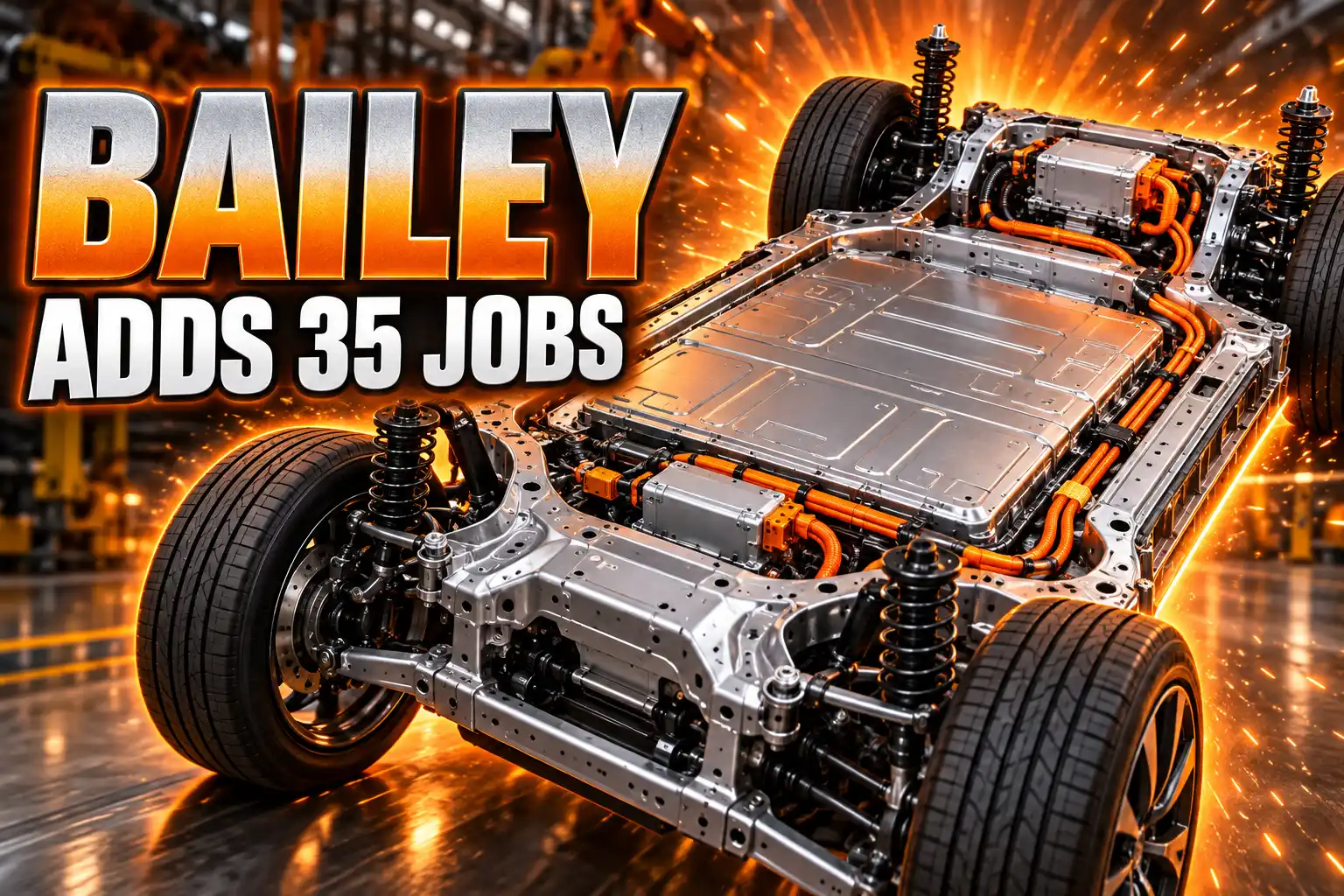
Bailey Manufacturing is hiring in Laurinburg for 35 pledged auto-parts jobs, while Scotland County’s factory payroll keeps sliding.

Bailey Manufacturing is hiring in Laurinburg for a Scotland County auto-parts plant pledged at more than $4.3 million. On April 8, 2025, Gov. Josh Stein said the New York stamper would add 35 new jobs in Scotland County at an average of $52,000, above the county’s then-average of $46,708.
Listings at 17560 Wallace Way now seek press operators, toolmakers, and a shipping lead. State and local development sources had put occupancy around October 1, 2025. The company still describes a production ramp built to last through 2028.
A Plant Larger Than the New York Shop
Bailey Manufacturing Co., LLC stamps, machines, welds, and assembles metal parts from Forestville, a hamlet south of Buffalo. Its own site lists a 40,000-square-foot shop, minority ownership, and New York and New Jersey supplier certifications, with work running since 1948.
The Laurinburg building is listed at 50,000 square feet, larger than that headquarters floor. Commerce Secretary Lee Lilley said the extra room would double output for a company that already ships 13 million parts a year across the United States, Mexico, China, and South Africa. The footprint covers manufacturing, warehousing, and offices.
The bet did not start in North Carolina. On December 19, 2023, the County of Chautauqua Industrial Development Agency approved a $130,000 loan for a Forestville warehouse next to the existing plant. President John Hines called that building a needed efficiency add-on. Eighteen months later he was thanking Scotland County for a southeast floor.
Parker Poe Consulting’s Nelson Lindsay handled site selection and incentive talks. Partners named by the state included the Economic Development Partnership of North Carolina, Richmond Community College, North Carolina’s Southeast, the Scotland County Economic Development Corporation, and the City of Laurinburg.
THE PROJECT CALENDAR
- December 19, 2023: Chautauqua County’s industrial agency approves a $130,000 warehouse loan at the Forestville shop.
- April 8, 2025: Stein announces more than $4.3 million and 35 jobs for a 50,000-square-foot Laurinburg plant.
- October 1, 2025: State and local development sources list planned occupancy of the new space.
- August 2026: Stein announces a separate $40 million lumber plant for the same county.
Hines said the southeast plant would let Bailey serve a growing customer list. Stein called the choice more proof that North Carolina draws firms in every industry and that its factory history still pulls work into rural counties.
What the 35 Jobs Pay in Laurinburg
The state paired the 35 jobs with a $52,000 average, about 11 percent above Scotland County’s $46,708 private-sector figure at the time of the announcement. At that average, 35 seats would put more than $1.8 million a year on local payroll. The posted floor jobs sit under that average; the skilled and salaried lines sit on it or above it.
Bailey’s Laurinburg listings have included a first-shift press setup operator at $18 to $22 an hour, a shipping and receiving lead at $20 an hour, a second-shift tool and die maker at $25 to $30 an hour, and salaried roles advertised between $70,000 and $80,000. The press job runs Monday through Friday, 7:30 a.m. to 4 p.m., 40 hours a week, with benefits after 60 days.
POSTED PAY VERSUS THE $52,000 AVERAGE
| Role | Posted pay | Full year at 40 hours |
|---|---|---|
| Press setup operator | $18-$22 an hour | $37,440-$45,760 |
| Shipping and receiving lead | $20 an hour | $41,600 |
| Tool and die maker | $25-$30 an hour | $52,000-$62,400 |
| Salaried listings | $70,000-$80,000 a year | $70,000-$80,000 |
| Announced average for 35 jobs | $52,000 a year | $52,000 |
The press listing asks for progressive-die experience in steel and aluminum and the strength to lift 30 pounds on a standing shift. Duties run from loading coils to clearing scrap, with authority to stop a press if parts go bad. Applications go through the company site.
The same listing calls the Laurinburg shop a metal fabrication plant and a supplier to Toyota, BMW, and VW, and it cites zero PPM, zero customer disruptions, and an excellence award from GM Customer Care and Aftersales. The April 2025 state release named General Motors among Bailey’s auto customers and left the rest as “many others.”
Scotland County Remains a Tier 1 Economy
Scotland County still sits in the state’s Tier 1 distress ranking for 2026, among the 40 most distressed of 100 counties. Commerce builds that rank from unemployment, median household income, population change, and property tax base per person. The designation sets how rich a One North Carolina grant can be, and how little the county must match.
In June 2026, Commerce counted a 4.6 percent unemployment rate in Scotland County, with 611 people out of work in a labor force of 13,155. North Carolina’s statewide rate that summer ran near 3.5 percent. The Laurinburg micropolitan area moved with the county, not with the Triangle.
THE COUNTY LABOR FILE
- Jobless rate: 4.6 percent in June 2026, with 611 unemployed in a labor force of 13,155.
- Factory peak: 2,582 private manufacturing jobs in January 2025, the month before the Bailey announcement season.
- 2025 average: 2,512 manufacturing jobs for the full year, per the Bureau of Labor Statistics.
- Later count: 2,331 manufacturing jobs in March 2026, preliminary, a drop of 251 from that January 2025 mark.
Thirty-five pledged seats cannot reverse a slide of 251 factory jobs on their own. The BLS series also cannot prove how many Bailey hires were on the books by March 2026. What it does show is a county that is still trying to hold a manufacturing base while it recruits the next plant.
No State Check Until the Headcount Lands
The sweetener is a $120,000 performance grant from the One North Carolina Fund. That is about $3,429 of state cash per pledged job, against more than $4.3 million of company spending, or about $123,000 of plant money per seat. Companies get no money up front.
In a Tier 1 county, the local government must put up at least $1 for every $3 from the state. On a $120,000 award, that floor is $40,000 in cash, fee waivers, in-kind work, infrastructure, or donated assets. The grant can pay for equipment, building work, or utility lines. It cannot land until jobs and investment hit the contract.
HOW THE $120,000 IS SUPPOSED TO MOVE
- The slice rule: Commerce pays OneNC awards in 25 percent increments as a company creates the promised jobs.
- The stay rule: The firm must keep at least 90 percent of the new jobs, at the site or another approved North Carolina location, for up to two years after the grant ends.
- The wage rule: The project has to meet the county average wage test, which the $52,000 average was written to clear.
- The health rule: The company must offer health insurance and pay at least 50 percent of premiums for participating employees.
N.C. Sen. Danny Earl Britt said local workers were ready to stand the Laurinburg operation up. N.C. Rep. Garland E. Pierce said the decision showed Scotland County as a place where growing firms can work. Both comments hitch the county’s reputation to a headcount that the grant itself treats as unproven until the payroll files arrive.
Thirteen Million Parts Needed a Southeast Floor
Forestville is a long haul from the car and truck plants that buy stamped brackets, welded assemblies, and machined pieces. Lilley placed Bailey inside a state supply chain of more than 250 auto manufacturers, with 20 of the top global OEM suppliers already on the ground and what he called the largest manufacturing workforce in the Southeast.
Bailey Manufacturing is excited to join the growing list of automotive suppliers in North Carolina. Our new southeast facility will allow us to better serve our growing customer base.
John Hines, President, Bailey Manufacturing Company
Hines also thanked the state, Scotland County, the county economic development corporation, and the City of Laurinburg. The Reshoring Initiative logged the project as a domestic add, citing government incentives and lead time. That is the industrial logic in one line: put steel closer to the assembly plants and stop shipping every blank from western New York.
Lilley went further on logistics, pointing to one of the largest state-run road networks for moving parts. Richmond Community College was named as a training partner, which is the usual rural bargain in North Carolina: the community college feeds press crews, and the stamper feeds GM aftersales and whoever else will sign a print.
When the April 2025 expansion announcement went out, the political frame was rural jobs. The industrial frame was capacity. A 50,000-square-foot floor that doubles a 13-million-part book is a production decision first. The 35 jobs are how that decision is staffed in a Tier 1 county.
The Next Factory Check Is for Lumber
Scotland County did not stop at one stamp shop. In August 2026, Stein announced that Great Southern Wood-NC would build a pressure-treated lumber plant at Laurinburg-Maxton Airport, a $40 million project with 43 jobs at an average of $60,827. That pairing used a 2026 county average wage of $49,091, a later Commerce figure than the $46,708 used for Bailey.
TWO SCOTLAND COUNTY FACTORY BETS
| Item | Bailey Manufacturing | Great Southern Wood-NC |
|---|---|---|
| Announcement | April 8, 2025 | August 2026 |
| Investment | More than $4.3 million | $40 million |
| Jobs pledged | 35 | 43 |
| Average pay cited | $52,000 | $60,827 |
| OneNC grant | $120,000 | $200,000 |
| Site | Laurinburg | Laurinburg-Maxton Airport |
The lumber plant is nearly ten times Bailey’s stated capital and still a modest headcount. Both awards are performance grants. Both need local matches. Both land in a county whose factory employment, on the BLS count, was lower in March 2026 than in January 2025.
Bailey’s public face on that point is not a ribbon-cutting speech. It is a help-wanted line. The company has been recruiting at Wallace Way while its homepage tells buyers it is ramping up production through 2028. The $120,000 stays in Raleigh until those 35 jobs are real and stay filled.

The BMW iX4 Undercuts Mercedes and Trails Its Twin

Scotland’s Ten Big Supermarkets Already Hold the Weekly Shop

Scotland EMS Faces a State Probe After a Wagram Death

Meritz Signs Ripple to Race Korea’s 2027 Token Rules

Pocognoli’s First Camp Leaves Scotland Third and Exposed

Volkswagen Sells the Osnabruck Plant to Clear a Board Fight

Tata Motors’ Iveco Tender Opens as Holders Still Decide

Saksham Gaur Finds He Is His Own Company’s Client

Onimusha Way of the Sword Preload Hits a Windows 11 Wall

Simple Wave Chases Range as Ather Konarc Cuts Price
-
 AUTO1 month ago
Volkswagen Sells the Osnabruck Plant to Clear a Board Fight
-
 AUTO1 month ago
Tata Motors’ Iveco Tender Opens as Holders Still Decide
-
 BUSINESS1 month ago
Saksham Gaur Finds He Is His Own Company’s Client
-
 GAMING1 month ago
Onimusha Way of the Sword Preload Hits a Windows 11 Wall
-
 AUTO1 month ago
Simple Wave Chases Range as Ather Konarc Cuts Price
-

 BUSINESS1 month ago
Hyderabad 22-Carat Gold Jumps After a False Bargain
-

 BUSINESS1 month ago
The Rs 4.66 Lakh Crore IPO Queue Is Mostly Paper
-

 BUSINESS1 month ago
UltraTech Ultravolt Launch Splits Friday Stocks to Watch