
BUSINESS
Axis Bank’s Profit Jump Could Not Save It From a Selloff
Axis Bank’s 38% profit rise still led a private-bank selloff after RBI-backed FCNR deposits cut its net interest margin to 3.36%.

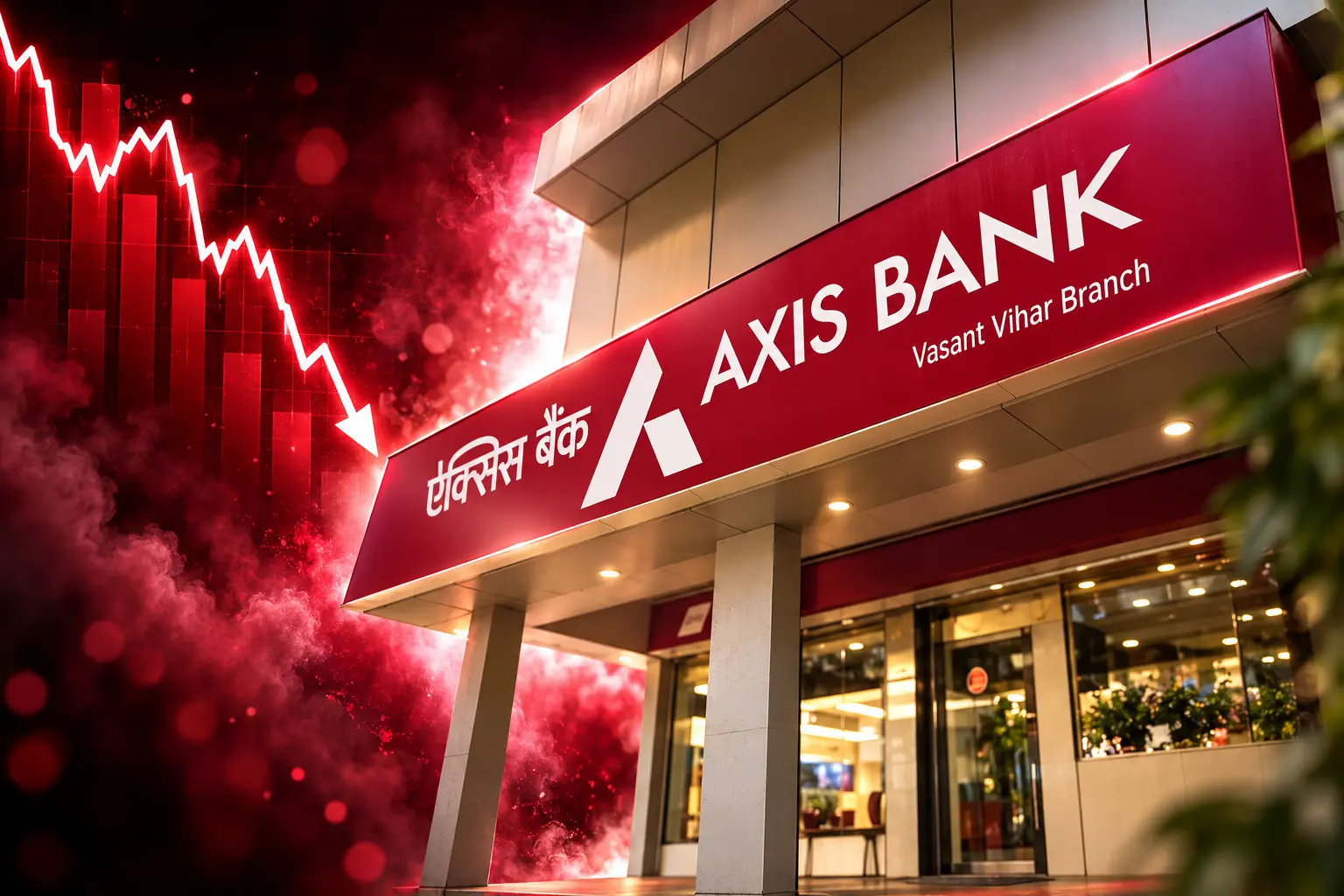
Axis Bank shares closed at ₹1,236 on October 19, down 4.19%, after a 38% rise in quarterly profit to ₹7,003 crore. The Nifty Private Bank index fell 1.85% as HDFC Bank and ICICI Bank also printed thinner net interest margins.
The market treated a fat profit number as a warning. Axis Bank had just raised ₹1,018 billion of foreign-currency deposits under a Reserve Bank of India swap, and those inflows took 11 basis points off the reported margin.
The 4.19% Drop After a 38% Profit Print
Results landed on Saturday, October 17, with cash markets shut. When the tape opened on Monday, Axis Bank was the heaviest weight on the private-bank index, after touching an intraday low of ₹1,225.30, 5.0% under Friday’s ₹1,290 close, before settling at ₹1,236.
MONDAY’S PRIVATE-BANK PRINT
- Axis Bank: Closed at ₹1,236, down 4.19%, after a low of ₹1,225.30.
- HDFC Bank: Closed at ₹712, down 2.31%, after a low of ₹711.70.
- Nifty Private Bank: Settled at 27,189.10, down 511.45 points, or 1.85%.
- Benchmarks: The Nifty ended at 22,888.95, down 1.11%; the Sensex closed at 73,852.90, down 1.17%.
Standalone net profit of ₹7,003 crore was the figure the bank put on the tape, a sequential slip of 2% from ₹7,114 crore in the June quarter. Analysts had been working with ₹7,132 crore, so the print sat 1.8% under that poll, even as net interest income of ₹15,371 crore beat a ₹14,970 crore estimate by 2.7%.
Operating profit rose 6% year on year to ₹11,083 crore and still fell about 5% from the June quarter, after staff costs jumped on a labour-code adjustment. Core operating profit, which strips trading noise, rose 11% to ₹10,998 crore. The stock did not wait for that distinction.
The Swap Window That Shaved 11 Basis Points
Reported net interest margin came in at 3.36%, down 10 basis points from 3.46% in the June quarter and 37 basis points from 3.73% a year earlier. Strip out FCNR (B) deposits and the bank says the margin was 3.47%, up 1 basis point from the prior quarter. The gap is the whole argument.
Axis Bank’s 38 percent rise in net profit sat on a deposit harvest the central bank had invited. The lender raised FCNR (B) deposits of ₹1,018 billion, about $10.6 billion at the ₹95.8254 conversion used in its own presentation, including ₹438 billion backed by advances from international branches and ₹449 billion backed by standby letters of credit.
That book exists because of a dollar-rupee swap for FCNR deposits the Reserve Bank opened on June 8. Authorised dealer banks could sell dollars to the central bank and buy them back at the same rate, a par swap aligned with three- to five-year deposits, after the June policy announcement on forex inflows. The window ran through October 16 for deposits mobilised by September 30.
THE FCNR SWAP CALENDAR
- June 5, 2026: Governor Sanjay Malhotra announces the special forex dispensation.
- June 8, 2026: Circular RBI/2026-27/99 sets a par US dollar-rupee swap for fresh three- to five-year FCNR (B) deposits.
- September 30, 2026: Last date to mobilise eligible deposits, and Axis Bank’s quarter-end.
- October 16, 2026: The swap facility closes.
- October 17, 2026: Axis Bank reports NIM of 3.36%, or 3.47% excluding the FCNR drag.
- October 19, 2026: The stock falls 4.19% on the first full session after the print.
CFO Rajeev Mantri told analysts the 11-basis-point hit mixed two effects: grossing up self-leveraged FCNR deposits, and a liquidity carry while surplus dollars sat in low-yielding securities before they were deployed. Cost of funds actually fell 8 basis points year on year. The margin still compressed because the new foreign book bloated the denominator and because the loan mix leaned harder into wholesale, where corporate advances rose 34%.
We have seen roughly around 11 basis points impact on the NIM which have come through because of the FCNR(B) funds coming through, and also because of the deployment of the FCNR which took some time. We should be able to see some bit of an uplift on that basis. We are working towards improvement in the NIM.
Rajeev Mantri, CFO, Axis Bank, on the Q2 earnings call
Excluding those deposits, advances still grew 19% and deposits 17%. The headline 23% loan growth and 21% deposit growth are the inflated versions. Month-end CASA sat at 36%, and 35% on a quarterly-average basis, against about 40% a year earlier, as term deposits and the FCNR slug diluted cheap current and savings balances.
Provisions Did Half the Work on Profit
Provisions and contingencies fell 52% to ₹1,694 crore, including specific loan-loss provisions of ₹1,564 crore. Annualised credit cost dropped to 0.45%, down 28 basis points year on year and 18 basis points from the June quarter. That is the cleanest way to manufacture a 38% profit rise when net interest income is growing 12% and fees are growing 6%.
Asset quality did improve, which is why the provision release was available. Gross non-performing assets fell to 1.16% from 1.28% in June and 1.46% a year earlier. Net NPAs fell to 0.35% from 0.39% and 0.44%. Fresh slippages declined to ₹4,762 crore from ₹5,696 crore a year earlier. The provision coverage ratio held at 70%, and aggregated coverage including standard and additional overlays stood at 164% of GNPAs, with ₹15,860 crore of extra buffers sitting outside the NPA math.
AXIS BANK’S Q2 QUALITY CHECK
- Credit cost: 0.45% annualised, down 28 basis points year on year and 18 basis points sequentially.
- Gross NPA: 1.16%, down 30 basis points year on year and 12 basis points from June.
- Net NPA: 0.35%, down 9 basis points year on year and 4 basis points from June.
- Trading income: ₹85 crore, against ₹498 crore a year earlier, which is why other income slipped 1% to ₹6,531 crore.
Fee income rose 6% to ₹6,381 crore, with granular fees 90% of the pile and retail fees 70%. Interest earned rose 17.6% to ₹36,419 crore, while interest expenses rose 22.2% to ₹21,047 crore, the spread that the FCNR gross-up then made look worse on a margin ratio. Cost to assets still improved to 2.14%, down 6 basis points sequentially and 24 basis points year on year. CET-1 stood at 14.61% after 23 basis points of accretion in the first half, with a capital adequacy ratio of 16.27%.
Retail loans grew 16% and were 54% of net advances at ₹7,39,905 crore. Executive director Subrat Mohanty said the bank wants that retail share back above 55% over the medium term and did not guide for a bottom. Corporate growth paid for current-period volume and billed next period’s mix problem.
How Did HDFC and ICICI Margins Compare?
HDFC Bank, ICICI Bank and Axis Bank all reported on October 17, and all three showed narrower margins. The common ingredient was the same FCNR window. The share-price ranking on October 19 still followed whose headline NIM looked worst, not whose loans grew fastest.
Q2 MARGINS AT THE THREE PRIVATE BANKS
| Bank | Reported NIM | QoQ change | Profit YoY | Loans YoY | Deposits YoY | Oct 19 close |
|---|---|---|---|---|---|---|
| Axis Bank | 3.36% | -10 bps | +38% | +23% | +21% | -4.19% |
| HDFC Bank | 3.16% | -10 bps | +4.7% | +16.3% | +18.8% | -2.31% |
| ICICI Bank | 4.18% | -18 bps | +20.1% | +30% | +27.1% | -1.15% |
HDFC Bank’s NIM of 3.16% on total assets was 10 basis points under the 3.26% June print. Deposits rose 18.8% to ₹33.27 lakh crore while gross advances rose 16.3% to ₹32.20 lakh crore, so the largest private lender is now paying for funds it has not fully put to work. Standalone profit rose 4.7% to ₹19,510 crore. Treasury trading gains collapsed to ₹780 crore from ₹2,390 crore, and CASA sat at 31.6%. Gross NPAs improved to 1.11%. Shashidhar Jagdishan, HDFC Bank’s chief executive, said margins should start to improve from the next quarter.
ICICI Bank still has the fattest margin of the three at 4.18%, but that was 18 basis points under 4.36% in June. Profit rose 20.1% to ₹14,843 crore and net interest income rose 17.7% to ₹25,339 crore. Loans grew 30%, or 24.1% excluding FCNR; deposits grew 27.1%, or 17% excluding FCNR. Gross NPAs were 1.20%. The stock, at ₹1,381, fell 1.15%, the mildest of the three, because the growth engine was still visible under the margin line.
A provision-heavy 38% jump is now read as a warning, not a trophy. That is why Axis Bank, which grew loans faster than HDFC Bank and posted the largest profit increase of the trio, took the largest share-price hit. The tape is grading the quality of the rupee, not the size of it.
Public Sector Lenders Took the Other Side of Monday
The Nifty PSU Bank index rose 2.19% on the same session the private-bank basket fell 1.85%. Punjab National Bank led the public-sector bid, with Canara Bank, Union Bank of India, Bank of India and Bank of Baroda also higher. State Bank of India traded in the green while Axis Bank, HDFC Bank, Yes Bank (down 3.54% to ₹16.88) and Bandhan Bank (down 2.21% to ₹163.80) went the other way. Kotak Mahindra Bank, which had not yet reported, still slipped 1.14% to ₹442.30.
Bad loans are not the scare. Gross NPAs improved at the private names that have reported, and Axis Bank’s 1.16% and HDFC Bank’s 1.11% sit in a tight band. The split is about who is paying up for deposits, who stuffed the FCNR window, and who still has a margin the market believes. Public-sector lenders, whose funding is stickier and whose starting NIMs were not the ones investors had paid a premium for, caught the bid as a relative trade against that squeeze.
Brent crude near $108 a barrel and foreign selling added a second weight to the session, which is why the Nifty and Sensex fell more than 1% even beyond the bank names. The private-bank index was still the weakest sector sleeve, and HDFC Bank alone knocked about 32 points off the Nifty, with Axis Bank about 20, on trader tallies of the close.
Management Kept the 3.8% NIM Ambition
Axis Bank is not walking away from its medium-term structural NIM target of 3.8%. Mantri said the FCNR drag was concentrated in the September quarter, that high-cost non-retail term deposits should be retired through the second half, and that sequential margin improvement is the working plan. He did not attach a date to 3.8%. Advances were ₹13,73,727 crore and deposits ₹14,52,066 crore at September 30, on a ₹20,46,240 crore balance sheet, up 22% year on year. First-half profit was ₹14,117 crore, up 30%, on first-half net interest income of ₹30,018 crore, up 10%.
Amitabh Chaudhry, managing director and chief executive, used the press release to talk about digital payments, Apple Pay, and partnerships rather than the margin. Return on assets for the quarter was 1.38% annualised and return on equity 13.30%. Average liquidity coverage was about 119%.
WHERE ANALYSTS SPLIT ON THE PRINT
- Jefferies: Buy, target ₹1,700, arguing on October 20 that core performance was ahead, core NIMs were stable once FCNR is stripped out, and the FCNR drag was slightly heavier than modeled.
- Bernstein: Outperform, target ₹1,600, calling the quarter mixed because a 52% drop in credit costs did the earnings work while expenses and the headline margin went the wrong way.
- The poll: Net profit missed ₹7,132 crore; net interest income beat ₹14,970 crore. The stock sold the miss and the margin, not the beat on core income.
IndusInd Bank reports on October 23 and Kotak Mahindra Bank on October 24. Those two prints will show whether Axis Bank’s 11-basis-point FCNR scar was an outlier or the template for every private lender that used the window. Until then, a 38% profit rise is the easy number, and 3.36% is the one the market is using.
Disclaimer: This article is news reporting and analysis of Axis Bank’s September-quarter results and the October 19 market move, and it is for information only. It is not investment advice, a recommendation to buy or sell Axis Bank, HDFC Bank, ICICI Bank or any other security, and it is not a research report under Indian securities rules. Readers should consult a SEBI-registered investment adviser or other qualified professional before making any investment decision. Profit, margin, deposit and share-price figures reflect company filings dated October 17, 2026, and market closes on October 19, 2026, and those figures can change in later sessions and later quarters.

Edinburgh Opens a 2027 Tour Built for Time Trials

Korda Maps Auður From Meðalland to Irvine Bay

Apple Music Films Its New Logo in Mineral Oil

Oppo Prices the Pad Mini Above India’s iPad Mini

Austen Soaks Scotland Before Boelo Brings Weekend Gales

Volkswagen Sells the Osnabruck Plant to Clear a Board Fight

Apple’s Foldable iPhone Hinges on Samsung Display Supply

Tata Motors’ Iveco Tender Opens as Holders Still Decide

Saksham Gaur Finds He Is His Own Company’s Client

Onimusha Way of the Sword Preload Hits a Windows 11 Wall
-
 AUTO2 months ago
Volkswagen Sells the Osnabruck Plant to Clear a Board Fight
-
 NEWS2 months ago
Apple’s Foldable iPhone Hinges on Samsung Display Supply
-
 AUTO2 months ago
Tata Motors’ Iveco Tender Opens as Holders Still Decide
-
 BUSINESS2 months ago
Saksham Gaur Finds He Is His Own Company’s Client
-
 GAMING2 months ago
Onimusha Way of the Sword Preload Hits a Windows 11 Wall
-

 BUSINESS2 months ago
Hyderabad 22-Carat Gold Jumps After a False Bargain
-

 ENTERTAINMENT3 years ago
What is SD on Amazon Prime? – All You Need to Know
-

 NEWS2 months ago
iQOO 16 Locks 8,400 mAh While 100W Charging Holds