
GAMING
Arc X1 Puts Enthusiast Controls Behind a Waitlist
Arc’s X1 puts TMR sticks and a 9,300mAh cell on a Snapdragon G2 handheld, then sells the cheap batch only to its India waitlist.

Arc’s first handheld, the X1, sells for ₹29,500 (about $307) to waitlist members when pre-orders open on 2 October. Everyone after that community batch pays ₹33,500.
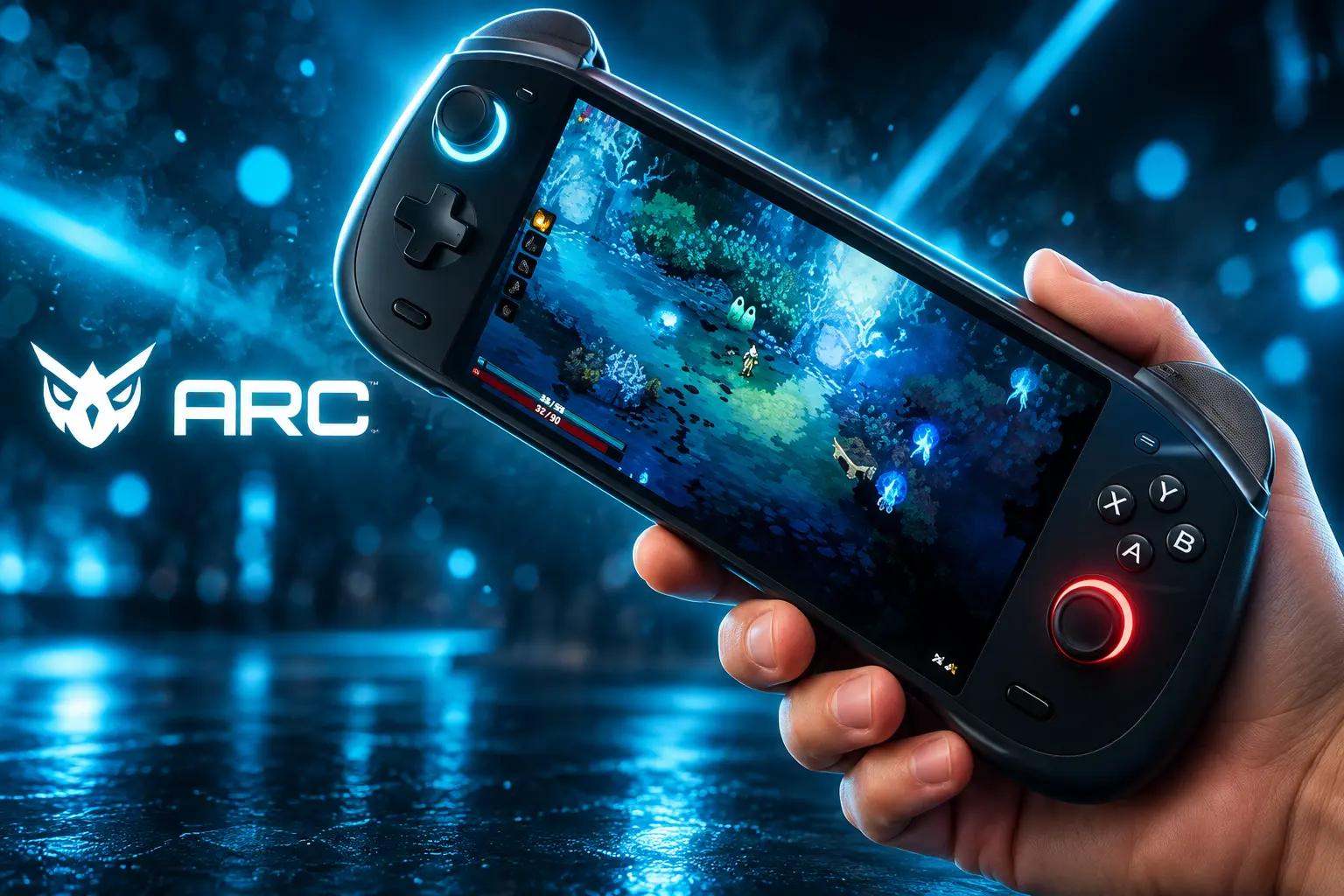
The parts list is the kind mail-order handheld buyers already hunt: zero-drift TMR sticks, Hall-effect triggers, microswitch face buttons, a 7-inch 120Hz panel, and a 9,300mAh cell you can swap. The storefront is a rupee waitlist, a ₹999 token, and a Bengaluru company that has said it is building for India and other emerging markets.
The Cheap Batch Is a Waitlist Prize
Arc posted the spec sheet and a new site on 18 September. Pre-order day is 2 October, and the cheap number is not the list price. A community batch drop at ₹29,500 is reserved for people already on the waitlist. Every later batch is ₹33,500, a ₹4,000 step up the company frames as thanks for early support.
Holding a unit takes a ₹999 token. That is a reservation, not a review unit and not a shipping date. The waitlist page does not publish how many community-batch devices exist, or when those boards leave the factory.
WHAT THE TWO PRICES BUY
| Ticket | Price | Who it is for |
|---|---|---|
| Community batch | ₹29,500 | Waitlist members, from 2 October |
| Later batches | ₹33,500 | Anyone after the community drop |
| Reservation token | ₹999 | Paid to hold a device |
The company is Jobin Joseph and Kaustubh K. Jadhav’s Arc, a first-product hardware shop in Bengaluru. It spent 16 months on the X1 with community testers, then asked that same list to pay to get in line. On 18 September the official account said the spec dump was late because the new site was still being packed.
YES, THE SPECS & NEW WEBSITE ARE OUT, GUYS! 🦉🔥
We know you’ve been waiting and trust us, we’ve been waiting just as eagerly to show you.
Sorry for the delay. We were busy getting everything ready, including our new website packed with the specs, answers, and details you’ve… pic.twitter.com/f7pW62nNdH
— ARC (@PlayARCX1) September 18, 2026
Snapdragon G2 Gen 2 Already Has a Global Sibling
The processor is Qualcomm’s Snapdragon G2 Gen 2 Gaming Platform, a 4nm part with an eight-core Kryo CPU and an Adreno A22 GPU. Arc pairs it with 8GB of LPDDR5X at 8,533 MT/s and 128GB of UFS 3.1, plus a microSDXC slot up to 1TB. Qualcomm rates the platform for QHD+ output at up to 144 fps and for Wi-Fi 7. The X1’s panel is 1,920 × 1,080 at 120Hz, and its radio is Wi-Fi 6E.
That chip is not a mystery box. Qualcomm’s March 2025 G-series launch put it on a road map with AYANEO, ONEXSUGAR and Retroid Pocket, and claimed 2.3x the CPU of G2 Gen 1 and 3.8x the GPU. Retroid’s Pocket G2 already shipped the same silicon in a smaller Android body.
SAME CHIP, TWO BODIES
| Spec | Arc X1 | Retroid Pocket G2 |
|---|---|---|
| Processor | Snapdragon G2 Gen 2 | Snapdragon G2 Gen 2 |
| Memory / storage | 8GB / 128GB | 8GB / 128GB |
| Screen | 7-inch LCD, 120Hz, 500+ nits | 5.5-inch AMOLED, 60Hz |
| Battery | 9,300mAh, 27W | 5,000mAh, 27W |
| Weight | 450 to 500 g | about 280 g |
| Launch price | ₹29,500, then ₹33,500 | $219 retail after a $199 window |
Arc’s bet is the bigger 16:9 LCD, the 9,300mAh pack, active cooling with a centrifugal fan that pulls from the back and dumps out the top, and controls that cost more than a phone gamepad. The trade is weight, an LCD instead of OLED, and a sales path that does not look like Retroid’s public cart. People who already own a G2 handheld will treat the silicon as settled. They will argue about OwlOS, the screen, and whether a waitlist in rupees is a product or a club.
A Custom Android Fork Has to Carry This Device
OwlOS is Arc’s own controller-first shell on the Android Open Source Project. The spec sheet does not list a Google Mobile Services badge. It lists a unified library, native Android play, cloud gaming, per-game performance profiles, button remaps, resolution scaling, an FPS overlay, custom fan curves, Quick Resume, and over-the-air updates, plus an OwlOS account that syncs across the system.
OWL OS ON THE SPEC SHEET
- Controller-first UI: Menus are built for a pad, not a finger on a phone launcher.
- One library: Local Android titles and cloud apps sit in the same list.
- Per-game profiles: Performance, maps, resolution and fan curves can be saved per title.
- Quick Resume: The sheet promises a fast jump back into a game, with OTA firmware on top.
Sideloaded emulators will likely run because the base is AOSP, and the launch copy already pointed at cloud apps such as GeForce NOW. That is still a software promise on a device nobody outside Arc’s tests has kept for a week. The G2’s limits are already on video. OwlOS is not.
We believe the future of gaming hardware lies in efficient performance, not just raw power. For markets like India, performance-per-watt is key to delivering portability, battery life, and accessibility.
Jobin Joseph, Co-Founder, Arc, on the Qualcomm tie-up
Jadhav has also talked about adding a Proton-style layer so some indie and AA PC games could run on the ARM handheld. That line is not on the public spec table. Until a build ships with it, it stays founder talk sitting on top of an unreleased fork.
Chimera and Mixi Funded Arc’s First Build
On 8 September Arc said Chimera VC, MIXI Global Investments and Dhruv Vohra, Meta’s APAC director investing in a personal capacity, had joined a pre-seed round. Coverage of the round put the cheque at ₹10.5 crore, earmarked for hardware engineering, factory readiness, supply chain, and more people on OwlOS. Krish Anurag, managing partner at Chimera VC, backed the wider stack of hardware, OS, developers and content, not a one-off console. Tomoharu Urabe, MIXI’s managing director for investment, pointed at India’s player base and the shortage of cheap dedicated hardware.
THE MONEY AROUND THE WAITLIST
- Pre-seed: ₹10.5 crore, announced by Arc on 8 September.
- Waitlist: More than 50,000 sign-ups by 7 September, before the spec sheet went public.
- Token: ₹999 to reserve a unit when pre-orders open.
- First product: The X1 is Arc’s debut hardware, with more devices already hinted.
A pre-seed that size is a thin cushion for a custom chassis, a custom OS, TMR modules, Hall triggers and a 9,300mAh pack. The waitlist is also a cash and demand tool. People who signed up early get the ₹29,500 batch. People who arrive after 2 October fund the company at ₹33,500 and skip the thank-you price. Qualcomm’s name on the board helps a first-time maker look like a platform partner, and Joseph’s own post on 31 August treated the Qualcomm India tie-up as the moment the project stopped being a prototype story.
Spare Sticks Come Standard, a Dock Does Not
The control deck is the part of the sheet that reads like an enthusiast import. Sticks are tunnel magnetoresistance units Arc says will not drift, with higher precision and lower draw than Hall sticks, plus on-device calibration. Triggers are analog Hall sensors with mechanical locks. Face buttons and the d-pad are microswitches. Two rear buttons are programmable. Dual linear resonant actuators handle rumble, RGB rings sit at the stick bases, and a Bosch six-axis sensor covers motion. Arc quotes controller latency under 4ms.
The chassis is injection-moulded polycarbonate with textured grips, Gorilla Glass over the LCD, an anti-fingerprint rear coat, and a 3.5mm jack that a lot of phones have already dropped. Speakers are dual front-facing stereo. USB-C is 3.1 Gen 1 with display output and OTG. Wireless pads are supported. Official play time is 8+ hours, with up to 10 days on standby, 27W USB Power Delivery, and a user-replaceable cell.
BUILT TO OPEN, NOT TO DOCK
- Service bay: The sheet lists a replaceable battery pack and joysticks, modular daughterboards, and spare parts on sale.
- No dock: Display-out exists on USB-C. Dock support is listed as no.
- Radio cut: The G2 platform is specified with Wi-Fi 7. The X1 ships Wi-Fi 6E and Bluetooth 5.4, with no 5G modem.
- One colour: Black, 450 to 500 g, LCD at a 1,000:1 contrast rating, 10-point touch.
That is a serious input deck on a body meant to be repaired, then a list of living-room features the company simply did not fund. Buyers who wanted a mini PC in a shell already have Windows handhelds for several times this price. Buyers who wanted a cheap OLED slab already have the Pocket G2. The X1 sits between them, heavier than the 5.5-inch G2 machines, brighter-specified than a typical phone, and still unreviewed as a fan-and-grip object you hold through a two-hour commute.
What Indian Buyers Are Being Asked to Trust
Jadhav’s pitch is not that India needs another 8.8-inch Windows slab. He has said a PC that can run a game like Red Dead Redemption 2 or GTA still lands around ₹1 lakh, a PlayStation around ₹75,000, and a proper gaming laptop between ₹1.4 lakh and ₹1.8 lakh, numbers an average buyer will not spend. He also described a day in which many Indians are outside for 12 to 14 hours with about two hours on the move, so the device has to be holdable, sturdy, and good for a session that is not a desk session.
If you really want to play a game like Red Dead Redemption 2 or GTA, you need a PC build that can cost around ₹1 lakh, or a PlayStation that is currently around ₹75,000. That isn’t something an average Indian consumer would necessarily expect to pay.
Kaustubh K. Jadhav, Co-Founder, Arc
Those prices make ₹29,500 look like a different product class, which is the point of the waitlist thank-you. They do not make OwlOS a console library. Native Android, cloud streams, and whatever the AOSP base will sideload are the games this board can promise on day one. A Proton layer, if it lands, would be the jump from “phone games with a pad” to “some PC indies in the backpack.” Until then the X1 is asking Indian players to pay console-adjacent money, by local standards, for a first-time OS and a G2 chip they could already import in another shell.
The heat chamber, Arc says, was designed with warmer climates in mind, and silent-mode play is the 8+ hour claim. That has not been measured on a commuter train in April. The company ran a pre-launch beta from the waitlist, with a second phase from 1 August, which is useful and also circular: the same community that will buy the cheap batch already helped tune the unit it is being asked to trust.
Pre-Orders Open on 2 October
The calendar is now short and public. Qualcomm’s G2 Gen 2 has been in the channel since 2025. Arc spent 16 months on a local shell, posted the Qualcomm India collab at the end of August, closed a ₹10.5 crore pre-seed in early September, and put numbers on the site on 18 September. The next date that matters is 2 October, when the token window opens for people who joined the list in time.
FROM CHIP LAUNCH TO TOKEN DAY
- March 17, 2025: Qualcomm announces Snapdragon G2 Gen 2 and names Retroid Pocket among the first handheld partners.
- August 31, 2026: Arc posts that its Qualcomm India collaboration is official.
- September 7, 2026: Arc says more than 50,000 people are on the waitlist.
- September 8, 2026: Arc names Chimera VC, MIXI Global Investments and Dhruv Vohra as pre-seed partners.
- September 18, 2026: Specs, pricing and the new site go live.
- October 2, 2026: Waitlist pre-orders open at ₹29,500 with a ₹999 token.
WHAT WE KNOW
- The hardware sheet: TMR sticks, Hall triggers, microswitch buttons, 7-inch 120Hz LCD, 9,300mAh cell, G2 Gen 2, 8GB / 128GB.
- The till: ₹29,500 for the community batch, ₹33,500 after that, ₹999 to reserve, rupee storefront only on the official site.
- The backers: ₹10.5 crore pre-seed and a Qualcomm India partnership for emerging-market handhelds.
WHAT IS UNCONFIRMED
- OwlOS in the wild: No public long-term review of the fork, the fan curve, or Quick Resume.
- Proton: Founder comments only; not an official spec-sheet feature.
- Export: Arc has described India and emerging markets as the design target and has not posted a global cart.
- Factory dates: Pre-order day is set. A ship window for the community batch is not.
On 2 October the waitlist finds out how many boards that ₹999 token actually holds. The spec sheet is already the most ambitious first handheld India has put on a rupee price list. The software, the batch size and the repair parts still have to show up with it.

Edinburgh Opens a 2027 Tour Built for Time Trials

Korda Maps Auður From Meðalland to Irvine Bay

Apple Music Films Its New Logo in Mineral Oil

Oppo Prices the Pad Mini Above India’s iPad Mini

Austen Soaks Scotland Before Boelo Brings Weekend Gales

Volkswagen Sells the Osnabruck Plant to Clear a Board Fight

Apple’s Foldable iPhone Hinges on Samsung Display Supply

Saksham Gaur Finds He Is His Own Company’s Client

Tata Motors’ Iveco Tender Opens as Holders Still Decide

Onimusha Way of the Sword Preload Hits a Windows 11 Wall
-
 AUTO2 months ago
Volkswagen Sells the Osnabruck Plant to Clear a Board Fight
-
 NEWS2 months ago
Apple’s Foldable iPhone Hinges on Samsung Display Supply
-
 AUTO2 months ago
Tata Motors’ Iveco Tender Opens as Holders Still Decide
-
 BUSINESS2 months ago
Saksham Gaur Finds He Is His Own Company’s Client
-
 GAMING2 months ago
Onimusha Way of the Sword Preload Hits a Windows 11 Wall
-

 ENTERTAINMENT3 years ago
What is SD on Amazon Prime? – All You Need to Know
-

 BUSINESS2 months ago
Hyderabad 22-Carat Gold Jumps After a False Bargain
-

 NEWS2 months ago
iQOO 16 Locks 8,400 mAh While 100W Charging Holds