
NEWS
Acer, ASUS and Lenovo Googlebooks Share a Glowbar Bet
Acer, ASUS and Lenovo Googlebooks share a mandatory Glowbar as Google opens pre-orders September 21 without listing prices or HP and Dell machines.

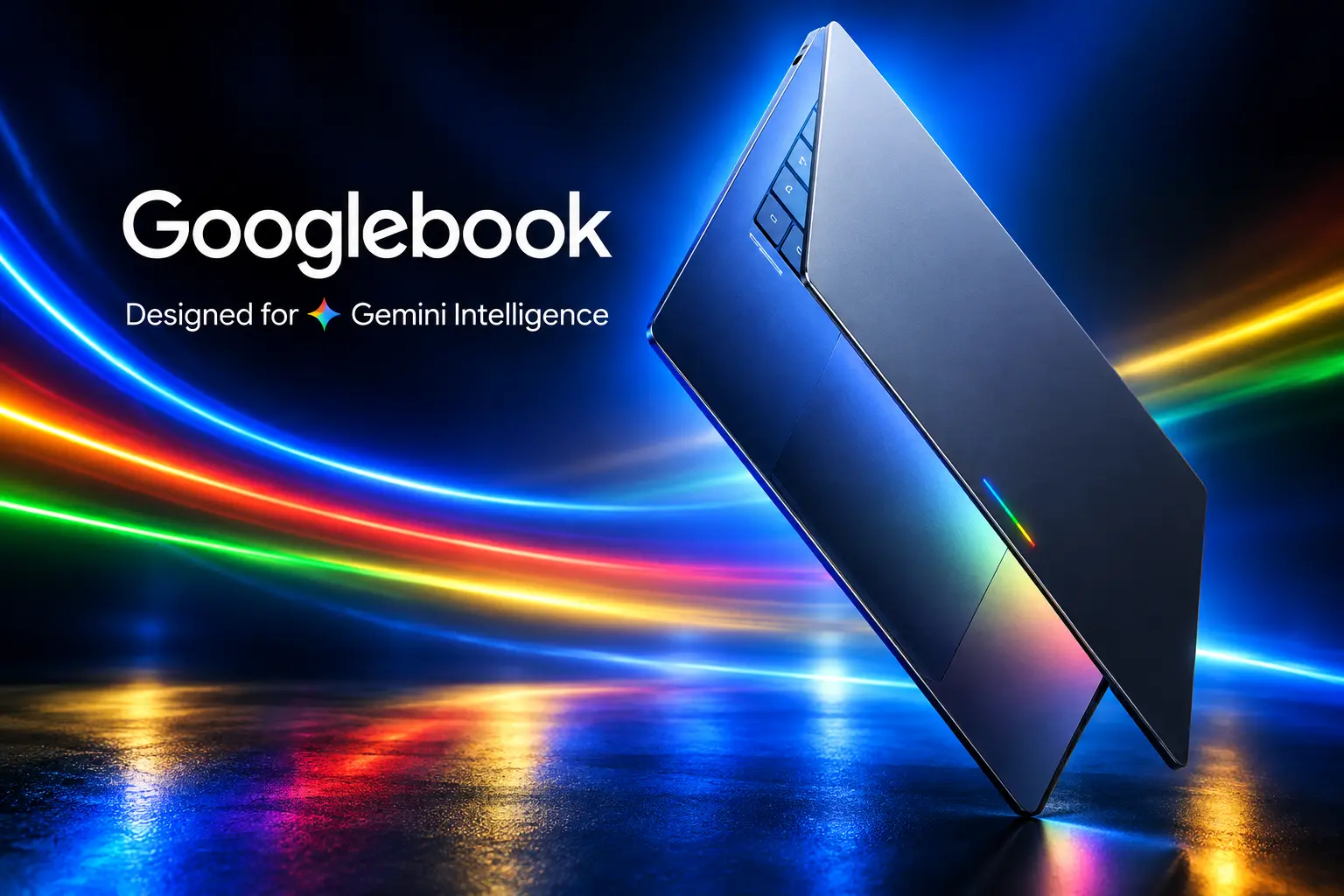
New photos show Googlebooks from Acer, ASUS and Lenovo sharing a rainbow Glowbar on the lid. Pre-orders open September 21, and Google has still not posted a price.
Google named five hardware partners on May 12, 2026. Only three of those machines have now been seen in one frame, which is how the bet looks with the cart about to open.
Three Lids Share One Glowbar
The shots, published September 16, put an Acer clamshell, an ASUS clamshell and a Lenovo clamshell in a single lineup, then isolate each chassis. Every lid carries the same thin, multicolor LED strip near the hinge line. Google has said you will know a Googlebook by that mark.
Each body is thin, and the left edge on all three is busy with ports. The right edge is out of frame in the group shot, so the full I/O map is only solid for the Lenovo machine whose product sheet later spelled both sides out. The Glowbar is the part that does not change with the badge.
WHAT THE PHOTOS LOCK IN
- Shared lid mark: A Glowbar strip sits on the Acer, ASUS and Lenovo lids in the same place, in Google blue, red, yellow and green.
- Partner badges stay: Lenovo lettering, an ASUS mark and Acer’s lid identity remain; Google is not covering the OEMs with its own logo wall.
- Ports are not hidden: The left sides show multiple connectors, a break from the USB-C-only habit on a lot of thin laptops.
- A second Lenovo shape exists: Lenovo is also building a Googlebook 2-in-1 tablet, separate from the 15.3-inch clamshell in the new set.
That last point already splits the Lenovo buy. One Google staff reply thread on the pre-order date had a reader trying to choose between the laptop and the tablet before either machine had a public tag.
Google Is Betting the Partners This Time
Googlebook is not a new Chromebook badge. On May 12, Alex Kuscher, Google’s senior director for laptops and tablets, introduced a first laptops designed for Gemini Intelligence, built on Android technology plus Chrome, and sold as a flagship category. Chromebooks keep going for schools and light daily use. These machines are the other stack.
Google is not building the hardware in its Pixel shops. Acer, ASUS, Dell, HP and Lenovo are. The Glowbar is the contract those five signed, a single light that has to appear on every lid so the category reads as one product from across a room. Kuscher told an interviewer the team did not want to plaster names over the metal, and that the strip is a brand element for a unified category.
It’s a brand element that presents you as a unified category. Plus, we were able to make it something that is functional. It doesn’t just glow the Google colors. It has a few other functions and Easter eggs that make it a bit more fun and functional. Like, it’s actually deliberate that this is facing away from you when you open the laptop.
Alex Kuscher, Senior Director, Laptops and Tablets, Google
The light is for the people sitting opposite the owner. That is a different job from a power LED the user watches. Lenovo’s own sheet is more prosaic: on the Googlebook 15, the Glowbar is an at-a-glance battery and charging indicator. Both can be true. The strip still has to be there whether the laptop is an Acer 14-inch or a Lenovo 15.3-inch.
Google already tried a premium lid of its own, then left the factory floor. This round, the wager sits with the OEMs who already ship Chromebooks, Windows laptops and, in Lenovo’s case, a lot of office metal. If the Glowbar fails as a signal, Google has no Pixelbook of its own to point at.
A 2013 Light Bar Becomes a Platform Rule
The reference is not subtle. The 2013 Chromebook Pixel carried a four-segment light bar in Google’s logo colors along the top of the lid. Google priced that machine at the top of the laptop market, put a 2,560 x 1,700 panel in a 12.85-inch body, and treated the bar as decoration with a few tricks. Developer notes still list the original 2013 Chromebook Pixel specs, including an Intel Core i5-3427U, 4GB of RAM and 32GB or 64GB of SSD.
FROM PIXEL LIGHT BAR TO GLOWBAR
- February 21, 2013: Google ships the Chromebook Pixel with a four-segment lid light in logo colors.
- March 1, 2017: The Pixel line of Chromebooks is discontinued; the Pixelbook 2-in-1 follows later that year.
- 2019: Pixelbook Go arrives as a cheaper Pixel-branded Chromebook.
- 2022: Google winds down the next Pixelbook and leaves laptop making.
- May 12, 2026: Kuscher announces Googlebook, names five OEM partners, and makes the Glowbar the visible rule.
- Early September 2026: Acer says at IFA that its first Googlebook is “coming soon,” with no price.
- September 14, 2026: Mishaal Rahman, who handles Android community engagement at Google, writes that pre-orders open September 21.
- September 16, 2026: Photos show the Acer, ASUS and Lenovo lids together.
The Pixel bar was a Google-made flourish on a Google-made chassis. The Glowbar is a spec the partners have to tool. That shift is the whole hardware strategy: Google writes the software and the silhouette rule, and Acer, ASUS and Lenovo spend the mold money.
What Acer, ASUS and Lenovo Put on Paper
Lenovo is the only partner whose full product sheet is in circulation. The machine is listed as GB 15IPH12, running software the sheet labels Googlebook OS. Google’s public pages still do not post a separate consumer name for that OS.
Lenovo’s 15.3-Inch Sheet
The display is a 15.3-inch OLED touchscreen at 2880 x 1800, 16:10, 120Hz, 500 nits and 100% DCI-P3. The chip is an Intel Core Ultra 5 325 with integrated graphics. Memory is 16GB or 32GB of LPDDR5x. Storage is 256GB or 512GB. The battery is 70Wh, with Lenovo quoting up to 11 hours in controlled video playback. The metal body in Cloud Grey starts at 1.29kg, or 2.84 pounds, and measures 341 x 236 x 15.9mm.
Intel’s own SKU page for the Core Ultra 5 325 with a 47 TOPS NPU lists 8 cores (4 performance cores and 4 low-power efficient cores), 8 threads, a 4.5 GHz max turbo, 12MB of cache, a 40 TOPS GPU with 4 Xe-cores, 25W base power and 55W maximum turbo power. That is the silicon under the Lenovo lid, and it is also the chip Acer is using on one of its two listed setups.
Lenovo put a dedicated Google “G” key between Fn and Alt, a 150 x 95mm haptic pad, a 5MP RGB camera with a physical shutter, four Dolby Atmos speakers, a fingerprint reader and Google facial authentication. Left side: Thunderbolt 4, USB 3.2 Type-A, headphone jack. Right side: Thunderbolt 4 and HDMI 2.0. Wireless is Wi-Fi 7 and Bluetooth 5.4. An “AI Mouse” shows up on the accessory list with the same multicolor accent, without a public explanation of the AI part.
Acer Teased a 14-Inch Lid at IFA
Acer was first to speak in public. At IFA 2026 it said its first Googlebook is “coming soon,” showed a brief teaser next to a Pixel phone, and left price and date blank. Prior listings and the September 16 photos align on a 14-inch OLED clamshell. Chip options on the leaked sheets are the Intel Core Ultra 5 325 and the Core Ultra 7 355. Some European retailer copy has also listed a 120Hz 2.8K panel, 16GB of RAM and a 256GB drive on a GP714-91N unit; Acer has not posted those numbers itself.
ASUS Built the CX9406 Around Weight
ASUS’s machine is identified in filings as the CX9406. Leaked renders match the Glowbar-and-ports language of the new photos: a 14-inch 16:10 touch panel, a Gemini key, and a ceramic-alloy lid. Prototype benches have shown a Core Ultra 5 325 setup and a Core Ultra 7 setup, with RAM figures that swing from a 16GB retailer listing to 64GB on early boards. Treat the 64GB number as a prototype ceiling, not a shipping SKU. ASUS has not published a weight. The design copy that circulated put the target under 1 kilogram.
THE THREE MACHINES ON PAPER
| Machine | Screen | Chip | What is firm |
|---|---|---|---|
| Lenovo Googlebook 15 | 15.3-inch 2880 x 1800 OLED, 120Hz | Core Ultra 5 325 | Lenovo sheet: 16GB or 32GB, 1.29kg, 70Wh, G key, Glowbar |
| Acer Googlebook 14 | 14-inch OLED | Ultra 5 325 or Ultra 7 355 | Acer IFA line “coming soon”; chip pair from leaked specs |
| ASUS CX9406 | 14-inch 16:10 touch | Ultra 5 325 and a Core Ultra 7 option | Filings and renders; RAM and weight still unofficial |
None of those rows carries a retail price. Lenovo’s sheet also skipped a street date. The hardware argument is already in the OLED panels, the Core Ultra silicon and the port lists. The commercial argument is still empty.
Magic Pointer Lives in the Cursor
Google’s software pitch is Gemini sitting in the OS, not in a side panel. Magic Pointer is the demo that leads. Wiggle the cursor over a date, a photo or a block of text, and Gemini offers a next step beside the pointer. Kuscher’s post says the feature was Magic Pointer built with DeepMind. Point at a date in mail to start a meeting, or select two images and ask the model to combine them.
Create My Widget is the other headline trick. A prompt can build a live desktop tile from Gmail, Calendar and the web, so a trip’s flights, hotels and a countdown sit in one place. Google’s product film for that software is already on the official hub.
WHAT THE SOFTWARE STACK CLAIMS
- Magic Pointer: Gemini reads whatever the cursor is on and offers actions next to it.
- Create My Widget: A prompt builds a custom desktop widget from Google apps and the web.
- Cast My Apps: Phone apps open on the laptop with no extra install, on a phone running Android 17 or newer.
- Quick Access: Phone files show up in the laptop’s file browser without a manual copy.
Google’s product site draws a hard line versus Chromebooks. Googlebooks are flagship machines that mix ChromeOS and Android, with higher-grade materials and phone continuity. Chromebooks stay on ChromeOS and stay aimed at simple, fast, cheap daily use. Kuscher has said Chromebooks will keep getting updates, some for as long as 10 years, because so many sit in classrooms. Googlebook, he said, is a different kind of laptop.
Play Store apps are meant to be first-class on the larger screen, with access to hardware that the older Chromebook Android layer did not give them. That claim is still a claim until reviewers sit on the September hardware. Gemini Intelligence on the Lenovo sheet is limited to select countries and languages, and to users 18 and older.
Two Partners Still Missing From the Photos
Dell and HP are on Google’s partner list. They are not in the September 16 lineup. Google’s May post put all five names in one sentence, and the official hub still says the first wave this fall comes from Acer, ASUS, Dell, HP and Lenovo. The unseen pair may still land in that wave. They have not been shown with the Glowbar in the same marketing set.
The platform also supports ARM and x86, which leaves room for Qualcomm machines beside the Intel Panther Lake clamshells already on paper. Until Dell and HP publish sheets, that is a socket fact, not a SKU list.
WHAT WE KNOW
- Five names: Acer, ASUS, Dell, HP and Lenovo are the launch partners Google has posted.
- Three lids: Only Acer, ASUS and Lenovo appear in the September 16 photos.
- One full sheet: Lenovo’s Googlebook 15 is the only machine with a complete leaked spec table.
- Chromebooks stay: Google says the education and everyday ChromeOS line is not being retired.
WHAT IS UNCONFIRMED
- Price: No OEM and no Google page has posted a dollar figure.
- Which SKUs go on sale September 21: The pre-order date is platform-wide; the mix of models is not.
- Dell and HP hardware: Partner status is confirmed; photos and sheets are not.
- Consumer OS name: Lenovo’s sheet says Googlebook OS; Google has not posted a separate OS brand.
The silence on price is doing more work than the missing Dell lid. A 15.3-inch 120Hz OLED with Thunderbolt 4 and 32GB of RAM does not land next to a $300 Chromebook, and Google has used the word premium since May. Until a number is on the cart, the Glowbar is asking people to pre-order a category.
September 21 Opens the Cart Without a Price
Google’s hub now states that pre-orders open September 21. Rahman posted the same date on September 14 and pointed at that page. The page still does not list SKUs, colors, storage steps or a figure in any currency. “Unbox it this fall” is the shipping line.
Introducing Googlebook, the first laptop designed for Gemini Intelligence. It’s crafted for heavyweight performance, built with Gemini at the core and perfectly synced with your Android phone. Coming this fall. 💻✨#TheAndroidShow pic.twitter.com/rn4pztApmp
— Google (@Google) May 12, 2026
The May film called Googlebook the first laptop designed for Gemini Intelligence, with heavyweight performance and a Glowbar on every partner lid. That promise is now close enough to touch. The three machines in the new photos are the first public proof that Acer, ASUS and Lenovo actually tooled the strip. HP and Dell still have to show their work. The cart opens September 21 anyway.
Google is asking buyers to take the partner hardware, the mandatory light and the Android-stack software as one product, without a price on the tag. The Glowbar already faces the room. The number on the invoice does not.

Edinburgh Opens a 2027 Tour Built for Time Trials

Korda Maps Auður From Meðalland to Irvine Bay

Apple Music Films Its New Logo in Mineral Oil

Oppo Prices the Pad Mini Above India’s iPad Mini

Austen Soaks Scotland Before Boelo Brings Weekend Gales

Volkswagen Sells the Osnabruck Plant to Clear a Board Fight

Apple’s Foldable iPhone Hinges on Samsung Display Supply

Saksham Gaur Finds He Is His Own Company’s Client

Tata Motors’ Iveco Tender Opens as Holders Still Decide

Onimusha Way of the Sword Preload Hits a Windows 11 Wall
-
 AUTO2 months ago
Volkswagen Sells the Osnabruck Plant to Clear a Board Fight
-
 NEWS2 months ago
Apple’s Foldable iPhone Hinges on Samsung Display Supply
-
 AUTO2 months ago
Tata Motors’ Iveco Tender Opens as Holders Still Decide
-
 BUSINESS2 months ago
Saksham Gaur Finds He Is His Own Company’s Client
-
 GAMING2 months ago
Onimusha Way of the Sword Preload Hits a Windows 11 Wall
-

 ENTERTAINMENT3 years ago
What is SD on Amazon Prime? – All You Need to Know
-

 BUSINESS2 months ago
Hyderabad 22-Carat Gold Jumps After a False Bargain
-

 NEWS2 months ago
iQOO 16 Locks 8,400 mAh While 100W Charging Holds