
TRAVEL
Corryvreckan Whirlpool: A Guide to the Tides and the Legends
The Corryvreckan whirlpool runs only when a spring tide hits the rock wall between Jura and Scarba. Time that hour for the waves, and keep a small boat clear.

The Corryvreckan whirlpool lies between the north end of Jura and the island of Scarba, in a narrow gulf off the Argyll coast. It runs when a strong tide crosses a rock wall just under the surface, so the same strait can look almost flat on a neap and rough on a spring.
Most people arrive with a Norse prince, a winter hag and the third largest claim already in mind. Those tales belong to this coast, and the day you actually get still depends on the tide you book.
The rest of this page walks through the place, the seabed, flood and ebb, the old names, and the choice between a boat trip and the long walk on Jura.
The Gulf Between Jura and Scarba
The Gulf of Corryvreckan is the short strait at the north end of the Sound of Jura. Scarba closes the north side, Jura closes the south, the Sound of Jura lies to the east, and the water opens west into the Firth of Lorn. The Gazetteer for Scotland whirlpool overview calls the whirlpool the third largest in the world, a ranking that usually places Norway’s Saltstraumen and Moskstraumen ahead of it.
The odd drive of the tide starts before the gulf. Crinan and Lochgilphead are only six miles apart, yet a flood that has come up from the Mull of Kintyre can leave the tide high at one and low at the other. Water squeezed north through the Sound of Jura then has this short gap as its way out toward the open Atlantic.
On the Jura ferry, smaller whirlpools can already show on the surface between Islay and Jura when the tide is pushing. The gulf is that same tidal water forced through a much tighter gap, which is why a rippled ferry crossing is a fair warning rather than a separate curiosity.
- Narrowest point: 1.1 kilometres, from a survey by the Scottish Association for Marine Science.
- Length of the deep channel: 3.2 kilometres on that same survey.
The place is easy to point at on a chart. The show is harder to pin down, because the whirlpools form along a moving line of current and then drift, rather than spinning in one hole you could mark with a buoy.
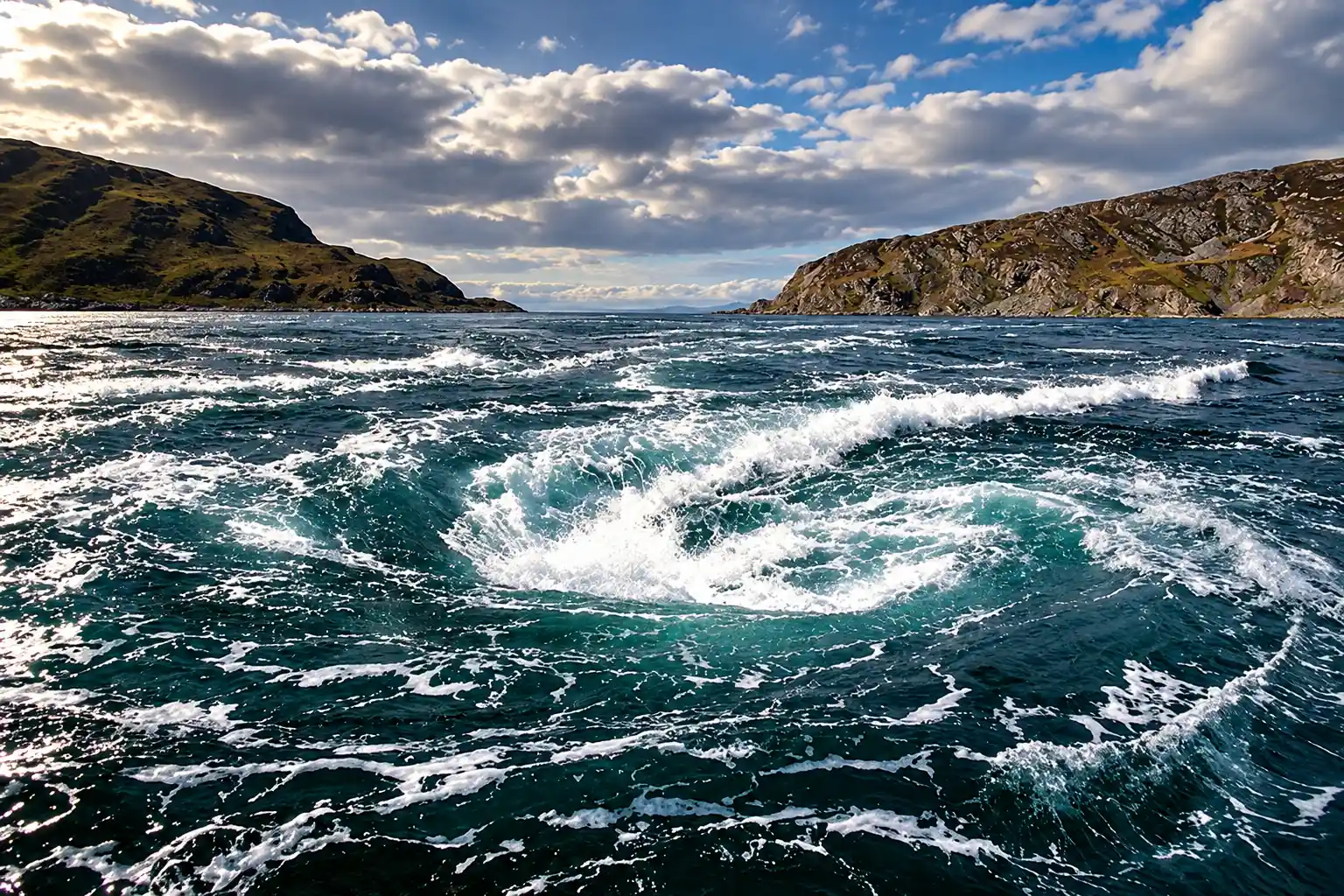
The Rock Wall Under the Corryvreckan
East of the worst of the race, the seabed drops into a hole that reaches 219 metres. A flood coming up the Sound has already been chopped by reefs and hollows, and that deep hole is the last big drop before the water meets rock off the Scarba shore.
The top of that rock stands 29 metres under the surface. Local pilots have long called it a pinnacle. The SAMS account of the 2012 survey found that the rock levels out toward the shore, so it behaves more like a wall than a needle. The shallowest point on that outcrop matches the 29 metre top sailors already used.
On the flood, the steep east face shoves water upward in pulses. With little wind those pulses spread west and break into whirlpools. West of the wall the flood carries on as a jet known as the Great Race. Drifters in that jet logged speeds over 4 metres a second and bent north as they left the strait. Along Scarba’s south coast the jet rubs against a clockwise eddy, and the whirlpools spin on that join, the way a stream spins where fast water meets slow water.
That is why a boat can be inside the gulf and still miss the single neat spiral people expect from the postcards. You are looking for a line of disturbed water off the Scarba side, plus the standing waves over the wall, not a plughole fixed to one GPS point.
Flood Water and Ebb Water in the Gulf
Flood and ebb do not stir the gulf in the same way. On the flood, the water has already travelled the length of the Sound of Jura, so it arrives restless. On the ebb, it comes in from the open sea with less of that chopped-up flow, and the surface pattern changes with it.
The channel on a full spring tide reaches 8.5 knots as the Sound narrows into the gulf. That figure is the speed of the stream through the gap. The drifter speed in the Great Race is a separate measurement, taken in the jet west of the wall, and the two numbers describe different parts of the same tide.
Slack water is the pause between those streams. It is the hour local boats use when they need to pass, and it is a poor hour if you have come to watch the race. A neap tide turns the volume down even when you are not exactly at slack. A spring tide, around the full and new moon, turns it up.
Direction tells you the pattern. The next section is about how big that pattern gets once the wind takes a hand.
Spring Tides and a West Wind
A west wind meets the upward pulses over the wall and stands the waves up instead of letting them run away. In a westerly those standing waves can reach 5 metres. A wind from the southeast, or from the north and east, puts the gulf in the lee, and you see more of the pure tidal stir with less wind sea on top.
No forecast gives you a guaranteed picture before you arrive. Springs and neaps change the strength, wind against tide changes the height, and the flood and the ebb do not look alike. Use the states below as a field guide, then let the skipper’s call on the day override it.
| Tide and weather | What the surface does |
|---|---|
| Spring flood, light wind | Upward pulses over the rock wall, breaking into whirlpools that drift west |
| Spring flood with a west wind | A standing wave train that can reach 5 metres |
| Wind from the southeast, or from north and east | The gulf sits more in the lee, so the tidal stir shows with less wind sea |
| Ebb | Water arrives from the open sea with less chopping from the Sound of Jura |
| Slack water or a neap | A quieter strait, useful for a passage and a poor show if you came for the cauldron |
If your photograph comes back flat, you have probably met the last row. The gulf has not failed. The tide you booked was the quiet one, and the next spring with a similar push is often about a fortnight away.
Breacan, the Cailleach and the Old Name
Corryvreckan comes from the Gaelic Coire Bhreacain. Coire is a cauldron or a corrie. Bhreacain is read either as the speckled sea, or as a personal name, Breacan or Breakan. Both readings are old, and both have a story attached. The coast tells a Norse romance. Learned Irish tradition knows an earlier man of a similar name, lost in a cauldron that may not have been this one.
The Norse Prince and the Three Ropes
In the version kept on this coast, a Norse prince called Breakan wanted to marry a local chief’s daughter. Her father set a test. The prince had to hold a boat at anchor in the whirlpool for three nights. He put his trust in three ropes, and in the Cailleach.
- Night one: The hemp rope parted, and the crew survived.
- Night two: The wool rope parted, and they survived again.
- Night three: The rope of maidens’ hair broke, taken as a sign that the hair had not come from a pure maiden, and the boat was pulled down.
Breakan’s dog is said to have dragged his body ashore. The Gazetteer places the grave in Breakan’s Cave, Uamh Bhreacain, on the north coast of Jura. It is a love story shaped to fit a place sailors already feared, and it is the telling you will hear on a boat.
The Cailleach and the Winter Plaid
A second tradition puts a winter goddess in the same water. The Cailleach, the hag of winter, washes her great plaid in the gulf as the year turns, then spreads the cloth on the mountains. Because she is the oldest of beings, the plaid comes out white, and that white is the first serious snow.
- The wash explains why the gulf is worst as winter comes on.
- The white cloth explains the first snow on the hills.
- The breaking waves are her handkerchief, and the old warning is that you do not approach her while she wears it.
F. Marian McNeill, in The Silver Bough, records that people on the coast hear the roar of the coming tempest for three days until the cauldron boils, and that her chief seat is Ben Nevis. An older Ordnance Gazetteer note on the name, drawing on P. W. Joyce, says Coire Bhreacain was first applied to a whirlpool between Rathlin Island and the Antrim coast, and was later carried to this Scottish gulf, most likely by the monks of Iona. The Norse romance and the hag can both sit on a name that was already travelling.
Boat Trips to the Corryvreckan Whirlpool
The safe way to see the race at full flow is from a local boat that has timed the tide on purpose. Two established trips cover the usual approaches, one from Easdale to the north of Scarba and one from Craighouse on Jura. Fares below are the prices published on the operators’ own pages as of November 2026.
| Operator | Leaves from | Length | Fare | When it runs |
|---|---|---|---|---|
| Seafari Adventures | Easdale | 1 hour 45 minutes | £58 adult, £48 child | Spring tides only, 30 to 40 times a season, late March to October |
| Jura Boat Tours | Craighouse | 3 hours | £70 adult, £40 under 16 | Timed to the tide; at its best on only about 50 trips in a season |
Seafari’s spring-tide whirlpool trip is the shorter, rougher ride, aimed at the peak of the spring stream rather than a general wildlife cruise. The boat is an open rigid inflatable, the group is capped at 12, and waterproofs and lifejackets are included. You need to be at least 8 years old, able to hold on, and the trip is not for anyone pregnant or anyone with a back or neck problem. Most departures are early or late, because that is when the tide fits, and the crew will not wait if you are late.
Jura Boat Tours from Craighouse gives you a longer look from the island side, in an open rigid inflatable, with the departure shifted when that gives a better chance of seeing the gulf work. The operator is plain that the whirlpool is at its best on only about 50 trips in a season, so a midweek seat on a neap can be the quiet version of the same strait. Allow time before departure for a safety brief and for getting into a lifejacket.
ASK BEFORE YOU PAY
- The tide: Confirm the trip is set for a spring flood if you want standing waves, not merely a cruise past the islands.
- The wind: A west wind builds the waves, and a lee wind gives you a clearer view of the tidal pattern with less spray.
- The clock: These boats leave for a tidal hour, so a late arrival is a missed trip, not a delayed one.
Wildlife is a bonus on both boats, not the product. Seabirds and seals are common, dolphins turn up, and a hard stream can push animals out of the gulf for a while. If you want a gentler introduction, ask the same operators about their wildlife runs, which still pass the gulf without being booked only for the roughest hour.
The Walk to the North End of Jura
You can see the strait from dry land, and the walk is a full day with no facilities. It suits people who are happy on a rough track and who do not need to be on the water to feel they have been there.
- Reach the north of Jura by ferry, then start from the road end beyond Lealt.
- Follow the rough track past Barnhill, the house where George Orwell wrote 1984, and on toward Kinuachdrachd.
- Allow seven miles each way, and carry food, water and waterproofs, because you should not count on a shop, shelter or a phone signal.
- Time the viewpoint for a spring tide if you want to watch the gulf working. You are looking down on it, not entering it.
The track passes the same shore Orwell knew. His own trip onto the water, in a small boat, is the cautionary version of this view, and it belongs with the passage rules below.
Small Boats, Kayaks and the Safe Hour
Watching from a charter boat is a different job from taking your own boat through. In 1947, while he was living at Barnhill and writing 1984, George Orwell and his young son were almost killed in a small boat after he misjudged the tides. They reached the rocks of the islet Eilean Mor, and a passing fisherman took them off. The gulf has not become milder since that picnic went wrong.
BEFORE YOU ENTER THE GULF
- The hour: Pass near slack water on a neap if you must go through, and turn away if a line of breakers is already standing across the strait.
- The boat: Leave full flow to a local skipper in a boat built for it, and keep to the south side of the gulf if you are transiting with local advice.
- Kayaks: Treat the gulf as a place for experienced kayakers who can read a tidal stream, not as a casual paddle from the Sound.
- If it goes wrong: Call 999 and ask for the Coastguard, stay with the boat or the board, and do not spend your strength paddling straight against the tide.
A local paddling note for Jura puts the nearest lifeboat at 45 minutes to an hour, depending on tide and weather, which is a long time in cold water. Open water crossings of the gap have been done, and only at slack with little wind. Jack Hudson of Swimtrek, who has swum it, says “If you jumped into the maelstrom at full force, you would be sucked down and disappear very quickly.”
Divers do reach the rock, and only while the whirlpool is inactive. The quiet does not last. Stay past that window and the stream can push you down. This is widely treated as one of the most serious dives in Britain, which is a reason to hire people who already know the site, not a reason to add it to a holiday list.
Frequently Asked Questions
Is the Gulf of Corryvreckan Officially Unnavigable?
The main gulf is not classed as unnavigable in the way people sometimes claim. Pilot books keep that harder label for parts of the nearby Grey Dogs. What the Admiralty’s West Coast of Scotland Pilot does say is that the Corryvreckan is very violent and dangerous, and that no vessel should attempt the passage without local knowledge while the stream is running. Local boats do use it in fair weather and around slack water.
What Is the Grey Dogs Tidal Race?
The Grey Dogs, also called the Little Corryvreckan, is the narrow channel just north of Scarba, between Scarba and Lunga. Pilot notes treat part of its eastern entrance as a place to avoid, and they allow a passage there only in quiet weather at slack water, even for people who know the coast. In the Gaelic telling, Breacan’s grey dog survives the great gulf, brings the body ashore, then drowns in this second race, which is one reason the gap carries his name. Some whirlpool trips pass the Grey Dogs first, because the step in water level between the sheltered sound and the open Atlantic is easy to see there.
Can You Hear the Corryvreckan From the Shore?
You can, when the gulf is working hard and the wind is quiet enough for the sound to carry. The winter hag tradition, as F. Marian McNeill records it, has people on the coast hearing that roar for three days before the wash is finished. Modern descriptions do not agree on a distance, so treat a roar as a sign the tide is running, not as a range you can plan a walk around. Thomas Campbell, writing in the nineteenth century, compared the noise in calm weather to innumerable chariots.
Which Film Uses the Corryvreckan Whirlpool?
The 1945 Powell and Pressburger film I Know Where I’m Going uses the gulf. The Gazetteer for Scotland notes the whirlpool’s part in that film, alongside the later scare Orwell had in his own boat. The film is a romance with a tide race in it, not a documentary of the seabed, so the standing waves you see on a spring trip will not match a studio sea.
Can Divers Reach the Rock Under the Gulf?
Only while the whirlpool is inactive, and only if you already treat this as an extreme dive. The rock top is 29 metres under the surface, so the depth itself is within sport diving range, but the slack is short and the returning stream can carry a diver down. It is not a site for a first deep dive or for a charter that has not named the slack window in advance.
A calm photograph of the gulf usually means the tide was slack or the moon was at a neap, not that the old stories invented the roar. Skippers will not hold the boat for a late arrival, because that spring flood will not wait, and the next one with the same push is often about a fortnight away.
Disclaimer: This guide is for general information about the Gulf of Corryvreckan and how people visit it. It is not sailing advice, a tide table or a substitute for a local skipper. Check a current tide atlas and the weather, and take advice from a qualified local boat operator or the Coastguard before you enter this water in your own craft. Depths, fares and passage guidance reflect the sources reviewed in November 2026 and can change.

Edinburgh Opens a 2027 Tour Built for Time Trials

Korda Maps Auður From Meðalland to Irvine Bay

Apple Music Films Its New Logo in Mineral Oil

Oppo Prices the Pad Mini Above India’s iPad Mini

Austen Soaks Scotland Before Boelo Brings Weekend Gales

Volkswagen Sells the Osnabruck Plant to Clear a Board Fight

Apple’s Foldable iPhone Hinges on Samsung Display Supply

Saksham Gaur Finds He Is His Own Company’s Client

Tata Motors’ Iveco Tender Opens as Holders Still Decide

Hyderabad 22-Carat Gold Jumps After a False Bargain
-
 AUTO2 months ago
Volkswagen Sells the Osnabruck Plant to Clear a Board Fight
-
 NEWS2 months ago
Apple’s Foldable iPhone Hinges on Samsung Display Supply
-
 BUSINESS2 months ago
Saksham Gaur Finds He Is His Own Company’s Client
-
 AUTO2 months ago
Tata Motors’ Iveco Tender Opens as Holders Still Decide
-
 BUSINESS2 months ago
Hyderabad 22-Carat Gold Jumps After a False Bargain
-

 TECHNOLOGY3 years ago
What Is SD on Amazon Prime?
-

 GAMING2 months ago
Onimusha Way of the Sword Preload Hits a Windows 11 Wall
-

 NEWS2 months ago
The Frame Pro’s $1,200 Labor Day Cut Needs a Soundbar