
TRAVEL
Fife Coastal Path: Robinson Crusoe’s Legacy in Lower Largo
The Fife Coastal Path at Lower Largo marks Alexander Selkirk with an 1885 statue on his cottage site, plus a bay walk to Elie the plaque never explains.

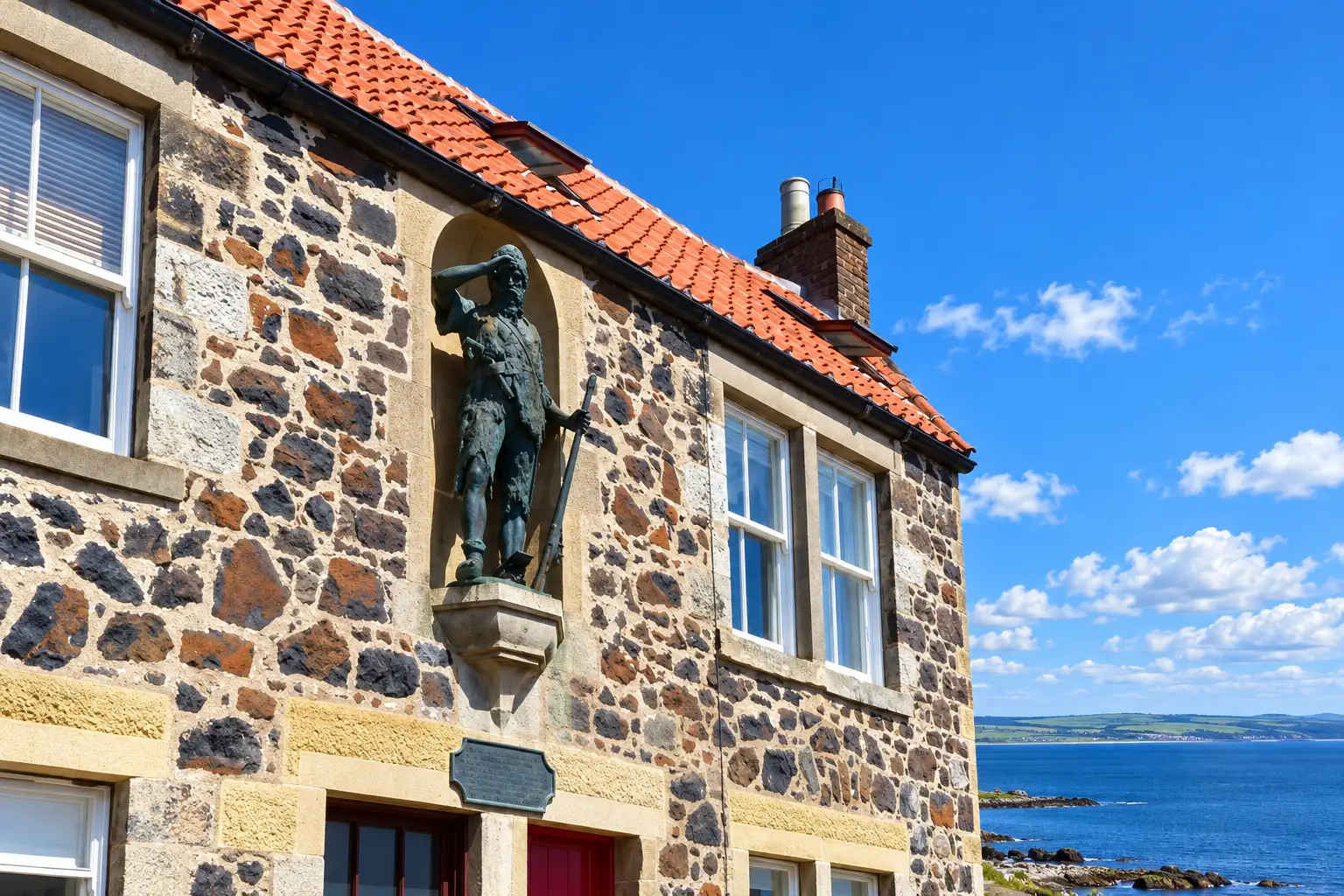
You come into Lower Largo because the village is sold as Robinson Crusoe country. A stone sailor in goatskins stands in a niche above the doors on Main Street and looks across the Firth of Forth, while the hotel on the harbour uses the novel’s name.
The man in that niche is Alexander Selkirk, born in this village, whose years alone on a Pacific island gave Daniel Defoe the story he turned into Robinson Crusoe. The Fife Coastal Path is how you put the memorial and the shore he came home to into one day, without walking the whole line from the Forth to the Tay.
What follows is how to read the statue, what Selkirk did after he asked to be put ashore, and how to walk the bay to Elie. The bronze under the figure gives one year for his death, and the ship’s pay-book gives another.
Alexander Selkirk on the Fife Coastal Path
The trust describes a trail of around 117 miles (188 km) from Kincardine in West Fife to Newburgh in the north, and it asks walkers to follow the waymarkers. Selkirk’s home village lies on the Buckhaven to Elie section of the path, which also runs through Methil and Leven before it reaches the bay. That named section is a town-and-beach day, not a pure coast ramble.
You can meet the story in three ways, and they are not the same outing. A short stop on Main Street covers the statue and the harbour sign. The bay from Lower Largo to Elie is the walk that stays with his home shore. The trust’s full Buckhaven to Elie leg adds the beach in from Leven if you want the official section complete.
| Walk | Distance and time | What you come away with |
|---|---|---|
| Statue and harbour | A short stroll on Main Street | The niche, the plaque and the Juan Fernández sign |
| Lower Largo to Elie | About 11 km, just under seven miles, and about three hours | The bay, the dunes and Kincraig Point |
| Buckhaven to Elie | 13 miles (20 km), about four to five hours | The trust’s full section, including Leven and Lundin Links |
A mapped one-way line from the east end of Lower Largo round Largo Bay to Elie is the middle row, and it has one real climb, at Kincraig Point. A train to Levenmouth puts the longer official section within reach, because you can join the beach there, follow it to Lundin Links, and cross the Keil Burn into the village. At high tide that beach has a dune alternative, and you should stick to the waymarks where the path skirts a golf course.
Settle the bus back from Elie before you leave the statue. The bay leg is one way, and Traveline Scotland is the place to check the return on the day you walk. Marked bays at Elie Ruby Bay allow overnight parking if you are carrying on.
How to Read the Statue on Main Street
The Category B listing for the house names 99 to 105 Main Street and records a building put up by David Gillies, a net manufacturer, where a thatched cottage had stood. You are not looking at the rooms Selkirk was born in. You are looking at a later memorial, with two central doors and the figure set above them.
Gillies built that house in 1885, in whinstone rubble with sandstone dressings and a pantiled roof. The listing names the sculptor as Stuart Burnett and calls the figure a statue of Robinson Crusoe. A maritime memorial record for the statue describes a full-length stone figure dressed in skins, with a bronze plaque on the wall beneath.
In 1935 the house was divided into flats. The plaque under the niche still does the remembering, and it is worth reading before you raise the camera, because the bronze and the naval papers do not match.
The plaque and the other records disagree on how his life ended. The words cut in the village are the ones visitors photograph. The ship’s book is the one a biography transcribes from the pay records.
| Record | What it says about Selkirk |
|---|---|
| Plaque under the Lower Largo statue | Died 1723, lieutenant of HMS Weymouth, aged 47, after four years and four months alone on Juan Fernández |
| HMS Weymouth pay-book, via the Dictionary of National Biography | Joined as master’s mate on 20 October 1720; entered dead on 12 December 1721 |
| His will | Dated 12 December 1720, when he called himself mate of the Weymouth; proved on 5 December 1723 |
| Tablet at his lookout on the island, set up in 1868 by HMS Topaze | Lieutenant of the Weymouth, 1723, aged 47 |
Read the plaque, then keep one date straight. The pay-book of HMS Weymouth, as the Dictionary of National Biography transcribes it, enters Selkirk dead on 12 December 1721. The bronze in Lower Largo, and the 1868 tablet on the island, both prefer lieutenant and 1723. The year 1723 is also when his widow, Frances, proved the will.
He was born in 1676, the seventh son of John Selcraig, a Largo shoemaker, and Euphan Mackie. Selkirk is the form of the name he used at sea. His father had not wanted that life for him.
On 27 August 1695 the kirk session summoned him for indecent behaviour in church. The record says he did not appear, because he had already gone to sea. The quarrelsome young man and the goatskin figure are the same person, which is why the niche feels grander than the parish story.
The Four Years Alexander Selkirk Spent Alone
In May 1703 he joined William Dampier’s privateering voyage as sailing master of the Cinque Ports. A privateer held a licence to capture enemy ships, which on that voyage meant Spanish ships in the Pacific. Dampier had the St George. Thomas Stradling came to command the Cinque Ports after her first captain died.
In September 1704 the Cinque Ports put in at Juan Fernández, off the coast of Chile, and Selkirk would not trust the hull. He said the caulking would not hold and asked to be put ashore with his chest. Before the ship sailed he asked to be taken back. Stradling refused.
The reason of his being left here, was a difference between him and his captain; which, together with the ship’s being leaky, made him willing rather to stay here, than go along with him at first; and, when he was at last willing to go, the captain would not receive him.
Woodes Rogers, A Cruising Voyage Round the World
Rogers, who later took him off, counted four years and four months alone, which is the span the plaque in Lower Largo repeats. The chest Rogers lists is a practical one, not a romantic survival kit from a wreck.
- Clothes and bedding
- A firelock, with powder, bullets and tobacco
- A hatchet, a knife and a kettle
- A Bible, some practical pieces, and his mathematical instruments and books
That kit is why he was not starting from empty hands. His clothes failed in the weather, so he sewed goat skins with a needle made from a nail, raised two huts of branches and long grass, and kept the island’s cats close so the rats would not take the shelters. He ate goats and the odd lobster, read the Bible, and sang psalms. Spanish ships that anchored shot at him, and he kept to the trees.
A landing party from Rogers’ ships, the Duke and the Duchess, found him on 31 January 1709. Rogers wrote that the man clothed in goat skins looked wilder than the first owners of them. Dampier, pilot on that voyage, told Rogers this had been the best man on the Cinque Ports, and Rogers signed him on as a mate.
He left the island with those ships on 12 February 1709. The gap between being found and being taken off is the time the privateers spent refreshing at the island, not a second marooning. He reached the Thames on 14 October 1711 and was back in Largo the following year. He did not settle. By late 1720 he was mate of the Weymouth.
The ship he had refused did sink. Stradling and other survivors were wrecked, then held in Lima on a piracy charge. His quarrel, which started as a refusal to sail, kept him out of that prison.
Daniel Defoe’s Robinson Crusoe came out in 1719. The novel turns a chosen marooning into a shipwreck, sets the island on another ocean shore, and gives the castaway a companion and a far longer stay. Selkirk’s name is not in it. The goatskins on Main Street belong to the sailor, even when the listing calls the figure Crusoe.
How to Walk From Lower Largo to Elie
Start at the east end of Lower Largo, where the path’s information and the trust’s Temple toilets serve the village. Main Street and the statue are a short walk toward the harbour. Read the plaque with the pay-book date in mind, then go on to the water.
- From the statue, walk to the harbour and the Crusoe, which sits on the edge of the beach. A sign by the hotel points to Juan Fernández and gives the distance as 7,500 miles.
- Pick up the waymarks and head east. The path uses an abandoned railway and the shore of Largo Bay, and the sea should stay on your right if you are bound for Elie.
- At low tide, take the sand along the bay. At high tide, stay on the dune path through the Dumbarnie Links nature reserve, where the sand is rich in lime and the ground is known for birds, butterflies and flowers.
- From Shell Bay, climb to Kincraig Point on the cliff path unless you have already checked the tide and decided on the chains described below. The cliff line is the coastal path.
- Cross the golf course only on the waymarked route, then drop into Earlsferry and Elie. Ruby Bay and Elie harbour both have toilets the trust manages.
- Take the bus back to Lower Largo, or the lift you arranged, while there is still light. The marked overnight bays at Ruby Bay are the other finish if you are not returning the same day.
The harbour sign is the novel’s joke and the sailor’s geography at once. Juan Fernández is where he lived those years, and the miles on the post are the distance from this beach, not a walking stage. After the sign, the old railway line is the gentle start, before the dunes and the one hill of the day.
Tide, Dunes and the Elie Chain Walk
The trust gives you two choices at Kincraig Point. One goes over the cliff. The other is the Elie Chain Walk, a scramble along the foot of the rock on chains fixed into the cliff, and the trust says it is not for the fainthearted. Do that homework before you leave the waymarks, because the chains are a side route, not the line of the path.
THE TIDE WINDOW AT KINCRAIG
- The main path: The waymarked Fife Coastal Path goes over the top of Kincraig Point in any tide.
- The chains: The scramble at the foot of the cliff needs a low-tide window, and a climbing route card allows about two hours either side of low water.
- Who should skip it: Leave the chains if you have small children, a heavy pack, or any doubt about the sea already on the rocks.
If you take the cliff path, you still get the Forth spread out below, and you come down toward Earlsferry on the line the trust waymarks. The chains are the piece people talk about afterwards. They are also the piece that stops the day when the tide is wrong. Check a tide table for the Elie shore that morning, and keep the dune choice at Dumbarnie separate, because that one comes earlier and it is still a path.
Soft sand, a golf course edge and one cliff are the real demands of the ordinary day. None of them asks you to treat a Fife bay as a desert island. The statue has already done the dressing up.
Frequently Asked Questions
Did Daniel Defoe Meet Alexander Selkirk?
No firm record shows that Daniel Defoe ever met Alexander Selkirk. He knew the castaway’s story from Woodes Rogers, whose book A Cruising Voyage Round the World came out in 1712, and from an interview Richard Steele published after Selkirk was back in London. The novel never uses Selkirk’s name.
How Do You Reach Lower Largo Without a Car?
Take a ScotRail train to Leven and follow the coast path along the beach to Lundin Links, then across the Keil Burn into Lower Largo. Local buses also serve the village and Elie, so check Traveline Scotland for the return before you set out. If someone can drop you, the Temple car park at the east end is the simplest start.
Why Does Alejandro Selkirk Island Not Match His Story?
Chile renamed the islands in 1966, so Más a Tierra became Robinson Crusoe Island and the farther island, Más Afuera, became Alejandro Selkirk Island. Selkirk’s years alone were on Más a Tierra. He never lived on the island that now carries his name.
What Should You Carry From Lower Largo to Elie?
Carry a tide time, a waterproof layer, drinking water, and a plan for the bus or a lift from Elie. Soft sand and an open cliff path are the normal day. The chain route along the rocks needs a free hand and shoes that hold on wet stone, and it is a poor choice with small children.
The sailor in the niche will still look like the hero of the novel when you pass him on the way back. He asked to be put ashore, the pay-book enters his death on 12 December 1721, and the bay to the east is the home shore he did not keep.

Gold Prices Fall to a 14-Month Low Despite Strikes

SpiceJet Clears a Rs 5,500 Crore Raise After Mumbai Stalled

Honda Activa’s Record Month Came With a Share Loss

Sony Turns the GTA 6 Launch Into a Firmware Gate

Xiaomi 18 Leak Skips the Rear Screen for Battery

Volkswagen Sells the Osnabruck Plant to Clear a Board Fight

Apple’s Foldable iPhone Hinges on Samsung Display Supply

Saksham Gaur Finds He Is His Own Company’s Client

Tata Motors’ Iveco Tender Opens as Holders Still Decide

What Is SD on Amazon Prime?
-
 AUTO2 months ago
Volkswagen Sells the Osnabruck Plant to Clear a Board Fight
-
 NEWS3 months ago
Apple’s Foldable iPhone Hinges on Samsung Display Supply
-
 BUSINESS3 months ago
Saksham Gaur Finds He Is His Own Company’s Client
-
 AUTO3 months ago
Tata Motors’ Iveco Tender Opens as Holders Still Decide
-
 TECHNOLOGY3 years ago
What Is SD on Amazon Prime?
-

 BUSINESS3 months ago
Hyderabad 22-Carat Gold Jumps After a False Bargain
-

 GAMING3 months ago
Onimusha Way of the Sword Preload Hits a Windows 11 Wall
-

 ENTERTAINMENT2 years ago
Andy Scott’s Steel Loon Repeats the Kelpies Regeneration Bet