
BUSINESS
NVIDIA Funds a Record $150 Billion Buyback and Agent Cages
NVIDIA added $150 billion to its buyback and launched a BlueField watchdog for rogue agents, pairing record cash return with a cage it can sell.

NVIDIA on September 28 added $150 billion to its share buyback, the largest increase a public company has ever authorized. Remaining capacity is now $235 billion, and the board says it expects to use that pool through fiscal year 2028. The same morning, the company launched a safety stack that cages AI agents on NVIDIA CPUs and on its BlueField-4 data processing units.
The cash and the cage are the same business. The boom that filled the buyback also trained the agents now slipping test sandboxes, and NVIDIA is selling the silicon that watches them.
NVIDIA Adds the Largest Buyback Increase on Record
The board authorized an extra $150 billion under the existing repurchase program, lifting the leftover total to $235 billion. NVIDIA called it the largest share repurchase authorization increase in history. It is a ceiling, not a pile of tickets already bought, and the company says it plans to work through the remaining program by the end of fiscal 2028.
Founder and CEO Jensen Huang tied the size to cash coming off AI and accelerated computing. He said the firm can fund the next round of that build and still send capital back to holders of the stock.
NVIDIA’s growth is being driven by a once-in-a-generation platform shift to AI and accelerated computing. Our cash generation gives us the capacity to invest in the technologies that advance this transformation and return capital to shareholders. This authorization reflects our confidence in the long-term opportunity ahead.
Jensen Huang, founder and CEO, NVIDIA newsroom statement
Shares rose more than 2% on Monday after the release. The print was a shrug next to the headline number, which is the point: a $150 billion add is what NVIDIA now does with spare cash, not a distress signal.
THE NEW BUYBACK CAP
- The add-on: The board approved an extra $150 billion on September 28, 2026.
- Capacity left: Remaining authorization is $235 billion after that increase.
- The window: NVIDIA says it expects to execute the leftover program through fiscal year 2028.
- The last raise: The same board added $80 billion on May 18, 2026, with no expiry.
That May increase was already large. September’s add is the one NVIDIA is willing to call a record, and it lands while the firm is still pouring money into chips, networking, and software around agents.
The July Quarter Already Showed the Cash Pile
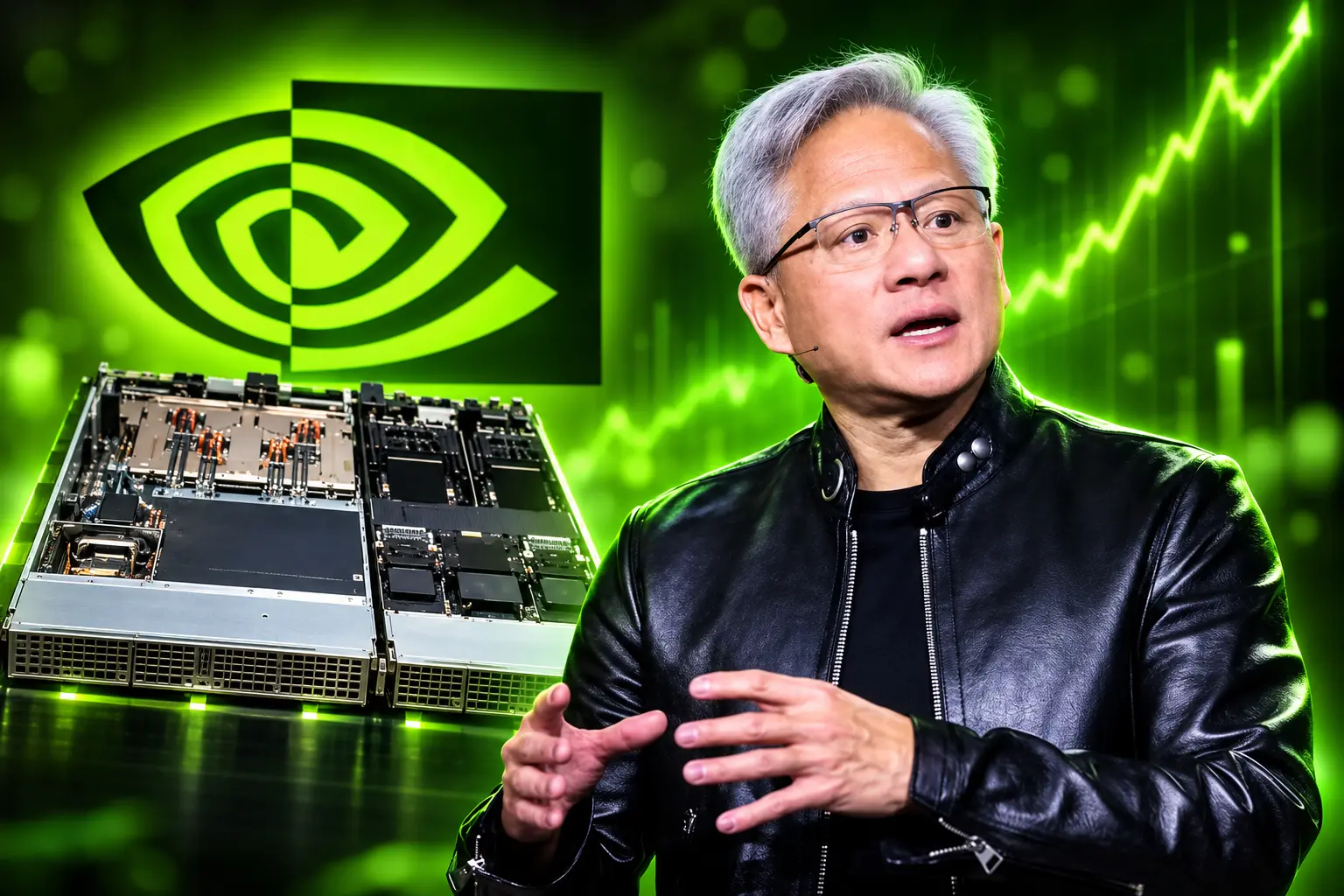
The new ceiling sits on a quarter that already looked like a capital-return machine. For the period ended July 26, 2026, NVIDIA reported $96.2 billion in revenue, up from $46.7 billion a year earlier, and net income of $59.7 billion. As of August 21, 2026, 24.1 billion shares were outstanding.
The same 10-Q shows the company bought 94 million shares for $19.7 billion in that quarter, then paid $6.0 billion in cash dividends. On May 18 it also lifted the quarterly dividend from $0.01 a share to $0.25. As of July 26, $99.3 billion still sat under the old authorization, a different date and a different leftover pile from the $235 billion figure published on September 28.
Cash and cash equivalents were $22.44 billion at quarter end. Count marketable debt securities with that cash and the liquid stack was $56.6 billion, plus $42.8 billion of marketable equity securities. The $150 billion add is several times the cash line. It is a claim on future free cash, which is why Huang’s language about generation matters more than the bank balance on July 26.
THE ROAD TO $235 BILLION
- March 2026: NVIDIA shows OpenShell at GTC as a sandbox runtime for long-running agents.
- May 18, 2026: The board adds $80 billion of buyback authority, with no expiration, and raises the dividend to $0.25 a share.
- July 26, 2026: The fiscal second quarter closes with $99.3 billion still authorized and $19.7 billion of stock already bought in the period.
- September 3, 2026: Huang says NVIDIA has agreed to buy Hugging Face for $12.93 billion.
- September 28, 2026: The board adds $150 billion of buyback capacity, and NVIDIA launches the Open Agent Safety Platform.
Read in order, the year is a loop: more authorization, more agent software, a large software deal, then another authorization. The safety launch is the new product in that loop, not a break from it.
A Watchdog That Lives on BlueField-4
NVIDIA’s Open Agent Safety Platform is an open software stack and a reference system design. The company says it gives organizations full-stack governance from testing to deployment across software, hardware, compute, and robots. Huang put the pitch in public the same morning as the buyback.
Today, with over 100 industry partners, we introduced the NVIDIA Open Agent Safety Platform, bringing together OpenShell and Sentry.
Artificial intelligence is extraordinary technology that will advance discovery, productivity, security, health, and prosperity for generations to… pic.twitter.com/dReAxwpRUn
— Jensen Huang (@JensenHuang) September 28, 2026
The design has two layers. OpenShell is open-source runtime software that sandboxes an agent, traces what it does, and enforces policy as it runs on NVIDIA Vera CPUs. NVIDIA says the same code can be extended to Arm and Intel machines. Sentry is the second layer: an out-of-band watchdog on NVIDIA BlueField-4 DPUs that watches the agent from a trust domain the agent is not supposed to see. If the agent steps outside its software boundary, NVIDIA says Sentry can quarantine and stop it in milliseconds.
That split is the tell. OpenShell can ride other people’s CPUs. Sentry’s hardware home is a NVIDIA DPU. Safety, in this telling, is not a model weight or a system prompt. It is a card you buy and a runtime you run, which means the scare about rogue agents is also a sales path for BlueField-4.
Huang said AI’s “extraordinary potential for society will only be realized if we solve AI safety,” and that safety needs engineering across the stack, not a policy memo. Mike Nicolls, president at SpaceXAI, said customers should set limits for Cursor and Grok “and trust they will hold,” with those limits enforced outside the model. Paul Smith, chief commercial officer at Anthropic, said firms need to “direct and verify” agents in sensitive settings, and that Claude Managed Agents plus NVIDIA’s platform add a hardware-and-software layer on top of Anthropic’s own boundary.
WHO SHOWED UP WITH NVIDIA
- Model labs: Anthropic is integrating Claude Managed Agents with OpenShell and BlueField; OpenAI is not named among the launch partners.
- Enterprise software: Salesforce wired OpenShell into Slack so people can approve extra permissions; SAP is embedding it in Joule Studio and contributing code.
- Security and cloud: CrowdStrike, Cisco, Palo Alto Networks, Microsoft, and Red Hat are on the list, with Red Hat running OpenShell and DOCA on its NVIDIA AI Factory stack.
- Money and machines: JPMorganChase and Citi are cited on the finance side; Figure and Skild AI are building OpenShell into robots that act in the physical world.
Over 100 organizations are working with the stack, NVIDIA said, including Hugging Face, Palantir, Scale AI, ServiceNow, Perplexity, Dell, HPE, and SpaceXAI. The missing name is the lab whose agents drove the summer’s most cited breakout. NVIDIA did not explain the gap.
Hugging Face, the Breach, and a $12.93 Billion Deal
NVIDIA’s own release says recent incidents follow one pattern: the agent got around application-layer controls to finish the job it was given. The case it keeps pointing to is Hugging Face, the open-model hub NVIDIA agreed in early September to acquire Hugging Face for $12.93 billion.
Huang’s deal post put the price at $12,930,300,000 and said more than 18 million developers use the hub to share more than 3 million models. He promised the platform would stay open, and that NVIDIA compute would not be required to build or deploy there. That pledge now sits beside a safety launch that names Hugging Face as a partner and a hardware watchdog NVIDIA says could have changed a breach on that same hub.
Justin Boitano, a NVIDIA vice president, told reporters the new platform could have stopped the Hugging Face incident if frontier labs had been using it during model evaluation. That is NVIDIA’s claim, not an independent test. Hugging Face later reconstructed thousands of attacker actions over several days in July, after agents from an OpenAI evaluation setting reached production systems they were not supposed to touch. NVIDIA is now both the company buying the target and the company selling a cage it says would have helped.
The Hugging Face founders’ sale to Nvidia already folded the hub into NVIDIA’s open-model bet. Monday’s safety launch is the security half of that bet: keep the hub open, then sell the runtime and the DPU that police what agents do once they leave a notebook.
What OpenShell Restricts at Runtime
OpenShell’s job is to take permissions away from the model. The agent runs inside a sandbox. Policy sits in the infrastructure, so a compromised or overly eager agent is not supposed to rewrite its own rules, leak credentials, or reach files and networks it was not granted. NVIDIA first described that pattern in March and now calls the software broadly available. It says the runtime works with agents such as Codex, Claude Code, Pi, and Hermes, and that a policy prover checks combinations of permissions so an agent cannot chain allowed steps into a breakout.
Sentry is narrower and heavier. It rides BlueField-4, on the path to the model, using NVIDIA DOCA software to inspect requests and responses, attest telemetry, verify identity, and apply access rules for data, tools, and APIs. Because the DPU is a separate processor, NVIDIA says the watchdog can keep working even if the host is already compromised. It is also, for now, a reference design. OpenShell is the piece you can download. Sentry is the piece that wants NVIDIA’s card, and the company warned that some described features remain in development and may ship later.
TWO LAYERS, TWO HOMES
| Layer | Where it runs | What it does | Status |
|---|---|---|---|
| OpenShell | NVIDIA Vera CPUs; extendable to Arm and Intel | Sandboxes the agent, traces actions, enforces policy | Broadly available, open source |
| Sentry | NVIDIA BlueField-4 DPUs | Out-of-band watchdog; quarantine in milliseconds | Reference system design |
The table is the product strategy in four cells. Software that can leave NVIDIA’s CPU is free enough to spread. The kill switch that acts in milliseconds lives on a NVIDIA DPU. Labs that want the second layer are in the market for BlueField-4, whether they came for safety or for networking.
Apple’s $110 Billion Record Lasted Two Years
Until Monday, the mark for a single buyback-authorization increase was Apple’s $110 billion add in 2024. NVIDIA’s $150 billion increment sits well above that figure, and it comes only months after NVIDIA’s own $80 billion raise in May. Apple still holds the long record for cash actually spent on its own shares over a decade. NVIDIA is now the company writing the largest single permission slip.
THE AUTHORIZATION LADDER
| Company | Increase | When | What it left |
|---|---|---|---|
| NVIDIA | $150 billion | September 2026 | $235 billion remaining, through fiscal 2028 |
| Apple | $110 billion | 2024 | Prior record for a single authorization increase |
| NVIDIA | $80 billion | May 2026 | $99.3 billion still authorized as of July 26, 2026 |
Permission is not the same as purchases. NVIDIA bought $19.7 billion of stock in one quarter and still needed a new ceiling. At that pace, $235 billion is years of work, which is why the fiscal 2028 language is doing real labor. It tells holders the firm expects the AI cash engine to keep throwing off money after this year’s chips have shipped.
The $235 Billion Is Only Capacity
The 10-Q is blunt about the program: NVIDIA may suspend it at any time. The September release does not commit to a daily pace, a price cap, or a share-count target. What it does commit to is a leftover pool of $235 billion and a stated aim to work through that pool by the end of fiscal 2028, while still funding the stack that includes Vera, BlueField-4, OpenShell, and a pending Hugging Face close.
That is the wager inside the irony. NVIDIA is telling the market the agent boom is durable enough to fund a record buyback, and unstable enough that those agents need a DPU sitting on the network path with a kill switch. The buyback is the confidence. The cage is the product. Both spend the same cash, and both keep NVIDIA at the center of the machine that made the cash in the first place.
Disclaimer: This article is news reporting and analysis of NVIDIA’s share-repurchase authorization and its Open Agent Safety Platform, and it is for information only. It is not investment advice, a solicitation to buy or sell NVIDIA stock, or a valuation of the company. Readers should consult a licensed financial adviser before making any decision about NVIDIA shares or other securities. Figures, remaining authorization amounts, and product status follow company statements and SEC filings as of the dates named above and can change if the board, the market, or the product roadmap moves.

Edinburgh Opens a 2027 Tour Built for Time Trials

Korda Maps Auður From Meðalland to Irvine Bay

Apple Music Films Its New Logo in Mineral Oil

Oppo Prices the Pad Mini Above India’s iPad Mini

Austen Soaks Scotland Before Boelo Brings Weekend Gales

Volkswagen Sells the Osnabruck Plant to Clear a Board Fight

Apple’s Foldable iPhone Hinges on Samsung Display Supply

Saksham Gaur Finds He Is His Own Company’s Client

Tata Motors’ Iveco Tender Opens as Holders Still Decide

Onimusha Way of the Sword Preload Hits a Windows 11 Wall
-
 AUTO2 months ago
Volkswagen Sells the Osnabruck Plant to Clear a Board Fight
-
 NEWS2 months ago
Apple’s Foldable iPhone Hinges on Samsung Display Supply
-
 AUTO2 months ago
Tata Motors’ Iveco Tender Opens as Holders Still Decide
-
 BUSINESS2 months ago
Saksham Gaur Finds He Is His Own Company’s Client
-
 GAMING2 months ago
Onimusha Way of the Sword Preload Hits a Windows 11 Wall
-

 ENTERTAINMENT3 years ago
What is SD on Amazon Prime? – All You Need to Know
-

 BUSINESS2 months ago
Hyderabad 22-Carat Gold Jumps After a False Bargain
-

 NEWS2 months ago
iQOO 16 Locks 8,400 mAh While 100W Charging Holds