
NEWS
Claude Marketplace Turns Committed Spend Into Software Sales
Anthropic’s Claude Marketplace lets firms apply committed spend to 15 partner products, while more than 2,000 connectors fill a separate free aisle.

Anthropic opened Claude Marketplace on September 23, 2026, with more than 2,000 connectors and plugins and a checkout that spends money firms already promised the company. The catalog is public on Claude’s site. Adding a connector is free. Buying partner software is not, and it does not start a new budget line.
That second aisle is the change. A portion of committed Anthropic spend can now pay for Claude-powered products, with Anthropic handling the invoice.
Committed Spend Now Buys Partner Software
Claude already let people hook up the apps they use. The marketplace puts those hooks in one catalog, then adds two other shelves: agents and products you buy, and consultancies that roll Claude out. Anthropic’s own product account put the three jobs in a single post on September 23.
You can now discover tools, agents and expert partners on Claude Marketplace. Use it to:
– Add connectors and plugins like Slack and Notion
– Buy agents and products from companies like Cursor and CrowdStrike
– Scale with service partners like Accenture and Deloitte pic.twitter.com/S5DrmdUkXu— Claude (@claudeai) September 23, 2026
The money path is narrow on purpose. Connectors and plugins are things you enable. Partner software is a purchase against an existing commitment, and the share Anthropic will allow is still described only as a portion. There is no public self-serve checkout. The button is Request to buy, and the next step is the account team.
Power Digital had already centralized a lot of work on Claude when it used that path to expand Snowflake, where client data already lived. Headcount on Claude had gone from about 12 engineers in January to more than 800 people by the time Anthropic published the story.
We’ve centralized so much of how we run on Claude, and we manage hundreds of tools across the company. Claude Marketplace let us bring Snowflake, which holds our clients’ data, into the same Anthropic commitment. By the time we asked, the contract was already being drawn up.
John Saunders, Senior Vice President of Innovation, Power Digital
ThoughtSpot used the same rail for Snowflake’s inference API, so Claude could run against customer data inside Snowflake without opening a fresh purchase. CodeRabbit put part of its Anthropic commitment toward Vercel, where its coding agents run. In each case the software was not new to the buyer. The invoice was.
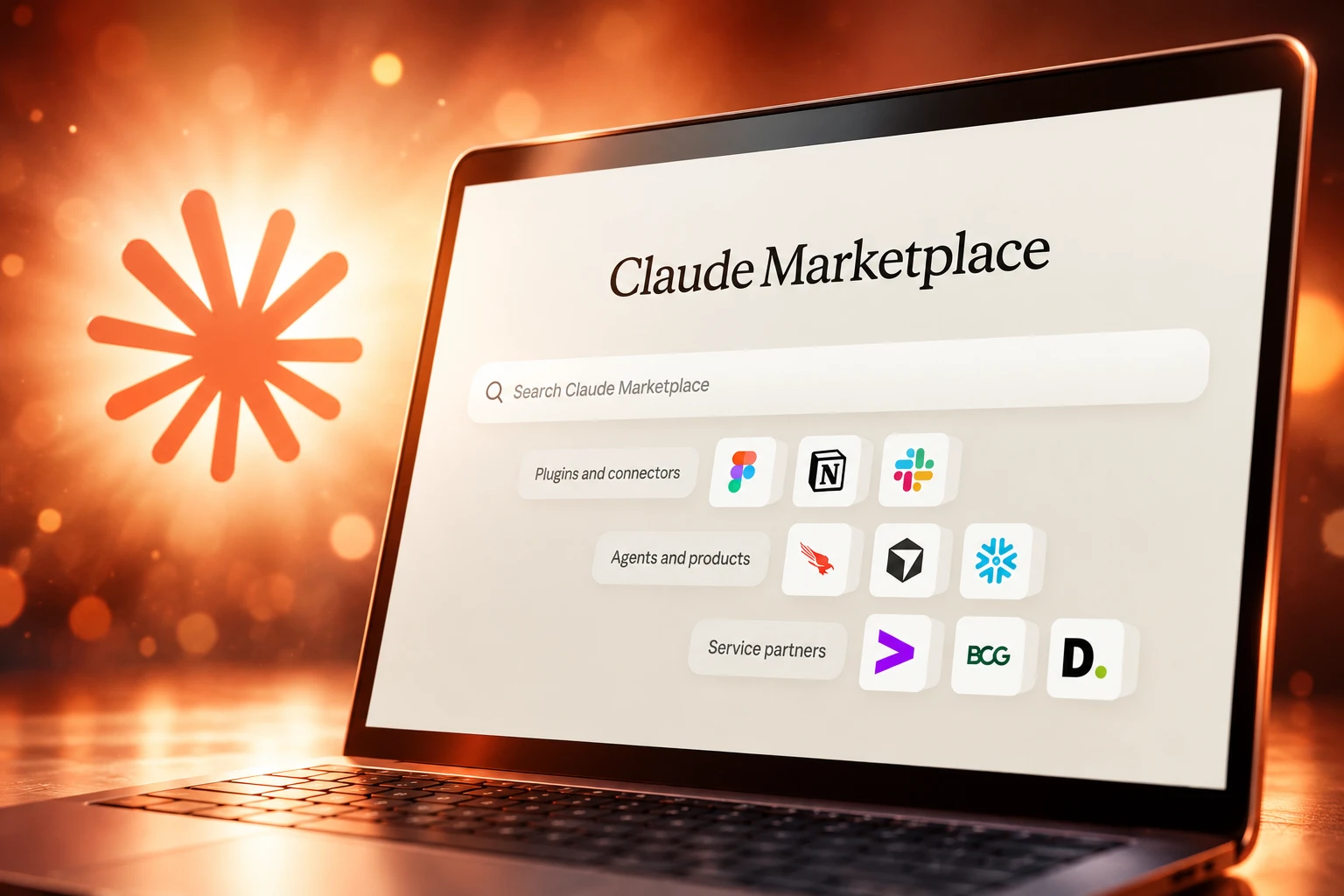
Fifteen Products Sit Behind Request to Buy
The launch post named CrowdStrike, Cursor, Harvey, Legora, Lovable, and Snowflake as the kind of software you can buy this way. The live agents-and-products shelf is wider than that list and still small. It currently shows 15 products behind request to buy, with no prices on the page.
THE 15 PAID PRODUCTS ON THE SHELF
| Product | Category | What the listing sells |
|---|---|---|
| Augment | Code | Agents across the engineering lifecycle |
| Base44 | Code | Internal apps for non-developers |
| CodeRabbit | Code | Review of AI-written code |
| CrowdStrike Charlotte AI | Code | Security agents on Falcon |
| Cursor | Code | AI coding across the software lifecycle |
| Factory | Code | Governed autonomous engineering |
| Gamma | Data | Decks, docs, and sites from existing content |
| GitLab | Code | Agentic tools in the software lifecycle |
| Harvey | Legal | Research, drafting, and review for lawyers |
| Hebbia | Financial Services | Deal and investment research on firm knowledge |
| Legora | Legal | Matters across jurisdictions and languages |
| Lovable | Code | Building and running apps or sites |
| Rogo | Financial Services | An analyst already briefed on the deal |
| Snowflake | Data | Governed AI on enterprise data |
| Vercel | Code | Deploying agents, apps, and sites |
Nine of those 15 listings are tagged Code. Legal, financial services, and data get two each. The mix matches where Claude already has paying teams, not a general software mall. CrowdStrike sits in Code on the page even though the product is a security agent, which tells you how Anthropic is grouping the shelf.
A commit that can be drawn down this way is stickier than a model invoice. If Snowflake capacity, Vercel hosting, and Cursor seats all ride the same Anthropic line, moving the model later means reopening those adjacent buys. Anthropic has not said it takes a cut. It has said it will manage invoicing for partner spend.
Our Agentic Analytics platform runs on Claude, so buying Snowflake’s inference API through Claude Marketplace was the natural path. We applied a commitment we’d already made, so the purchase came out of budget we’d already approved.
Francois Lopitaux, SVP of Product Management, ThoughtSpot
How Developers Land a Listing
Builders reach Claude customers through three doors, and they are not interchangeable. A connector or plugin is submitted as an integration. A Claude-powered product is an application to sell. A consultancy joins the partner network and shows up as a service firm.
THREE DOORS INTO THE CATALOG
- Connectors and plugins: Build with the Model Context Protocol and Agent Skills, then submit through Anthropic’s docs and the directory portal.
- Agents and products: Apply to list Claude-powered software so buyers can spend part of an existing Anthropic commitment on it.
- Service partners: Join the Claude Partner Network through a dedicated form and appear beside Accenture, Boston Consulting Group, and Deloitte.
On September 25, two days after the storefront opened, Anthropic shipped the missing piece for the first door: a directory submission portal for developers on paid Claude plans. A listing is either a single remote MCP connector, pointed at an HTTPS server, or a plugin bundle hosted on GitHub that can pack connectors, skills, commands, hooks, and agents.
Each submission is auto-checked and safety-scanned on the way in. Authors can see review status and recommended changes, then choose when to publish after approval. Once a plugin is live, the portal shows installs by product surface and version, plus which searches lead people to the listing. Anthropic said a single discovery experience would roll out across Claude and Claude Code in the weeks after September 25. Existing directory listings do not need to be resubmitted.
The pipe under those listings is MCP, the open standard Anthropic pioneered for hooking a model to tools and data. Claude now speaks the MCP 2.0 specification, including a stateless core. Optional extensions add interactive UI inside chat (MCP Apps) and zero-touch OAuth for enterprise users (Enterprise Managed Auth). OpenAI, Google, and Microsoft have adopted MCP as well, so a server built once can talk to more than one assistant. Distribution, billing, and review still sit with whoever runs the catalog.
What Each Connector Can Touch
A connector is not a badge. It is permission for Claude to read an outside service and, often, to act in it. Anthropic’s own connector pages warn people to use tools only from developers they trust, and they say Anthropic does not control which tools those developers expose or whether those tools will change later. That sentence is doing a lot of work next to a catalog this large.
Help pages for remote MCP say web connectors are on paid plans (Pro, Max, Team, or Enterprise). On Team and Enterprise, an Owner has to enable connectors before staff can add them. Slack is called out as Team and Enterprise only. That is not the same as the partner-product checkout, and Anthropic still has not said whether Pro and Max subscribers can buy those 15 products the way a firm with a commit can.
WHAT WE KNOW
- Paid-plan connectors: Remote MCP connectors run on Pro, Max, Team, and Enterprise, with an Owner gate on the two workplace plans.
- Portal scan: As of September 25, directory submissions get an automatic safety scan and a visible review status.
- Trust line: Anthropic tells users it cannot verify that third-party tools will work as intended or stay the same.
WHAT IS UNCONFIRMED
- The spend share: “A portion” of a commitment is eligible. The percentage is unpublished.
- Review time: The portal tracks status. Anthropic has not published how long approval takes.
- Pro and Max checkout: It is unclear whether individual subscribers get the same partner-product buys as enterprise buyers.
The worry that follows a catalog this size is not theoretical. In April, OX Security reported that nine of eleven MCP registries accepted a test payload without review, a finding later written up for the Cloud Security Alliance. That work was about public MCP registries in general, not this September storefront. It still names the failure mode: a marketplace that looks curated can behave like an unvetted package feed.
A store that invites any paid-plan developer to submit will fill with thin tools unless that scan is more than a linter. Buying a partner agent against a commit also does not, on its own, give a firm a kill switch for what the agent can do once it is wired into company data. Named owners and a revoke path per skill inside a bundle are still the boring controls that matter, and they are not on the launch homepage.
Accenture, BCG, and Deloitte Get Shelf Space
The third aisle is people. Accenture, Boston Consulting Group, and Deloitte are the names Anthropic put on the launch post for firms that want help with strategy and rollout. They sit in a directory that grew out of the Claude Partner Network, which Anthropic backed in March with a $100 million Claude Partner Network for training, technical support, and shared marketing.
On June 3, Anthropic added a Services Track with published tiers and a Partner Hub that refreshes each partner’s standing daily. Select, the first tier, asks for at least 10 active certified people, at least 2 joint customers in production in the trailing 12 months, and at least 1 public customer story. Those numbers are visible to buyers in the public directory, so a pitch deck is no longer the only proof. Partners can also hook the Hub to Claude through an MCP connector and ask where they stand against the next tier.
For the consultancies, a tile next to Cursor and Snowflake is distribution. For Anthropic, it is a way to staff the gap between a pilot and a system a business will actually run. The same commit logic does not clearly apply to those retainers. Anthropic has not said service work can be paid from model spend the way Snowflake inference can.
March’s Six-Partner Preview Came First
The September catalog is a merge, not a cold start. Claude Marketplace first appeared in a limited preview in March with six product partners: GitLab, Harvey, Lovable, Replit, Rogo, and Snowflake. Listings were added through the year, including CodeRabbit in the spring and a later wave that brought Cursor, CrowdStrike, Factory, Gamma, and Vercel onto the paid shelf. September 23 is when connectors, those products, and the service directory were put under one public roof.
HOW THE STORE WAS BUILT
- December 2025: Anthropic and Snowflake announce a $200 million multi-year deal to put Claude on Snowflake’s platform.
- March 2026: Anthropic launches the Claude Partner Network with $100 million behind it, and Claude Marketplace opens in limited preview with six product partners.
- June 3, 2026: The Services Track and Partner Hub go live, with Select requiring 10 certified people, 2 production customers, and 1 public story.
- September 23, 2026: Claude Marketplace opens publicly with more than 2,000 connectors and plugins, the paid product aisle, and named service partners.
- September 25, 2026: The directory submission portal starts auto-validating plugins and MCP connectors for developers on paid plans.
The Snowflake figure in December and the marketplace buys in September are different contracts. One put Claude inside Snowflake for Snowflake’s customers. The other lets a Claude customer draw down an Anthropic commit to buy more Snowflake. Together they run both directions through the same two logos.
Amazon, a major Anthropic investor, also shipped a Selling Partner connector the same week as the public catalog, so merchants can pull listings, inventory, and performance into Claude and approve each action before it runs. That listing sits on the free aisle. It still shows where this store wants Claude to live: inside the tools a team already cannot drop.
The account team still draws the paperwork. Saunders said Power Digital’s Snowflake add-on was already being written up by the time anyone asked, which is the feature. A catalog of more than 2,000 connectors makes Claude look busy. A 15-product checkout that spends money already on the books is how Anthropic keeps the rest of the stack from leaving with it.

Edinburgh Opens a 2027 Tour Built for Time Trials

Korda Maps Auður From Meðalland to Irvine Bay

Apple Music Films Its New Logo in Mineral Oil

Oppo Prices the Pad Mini Above India’s iPad Mini

Austen Soaks Scotland Before Boelo Brings Weekend Gales

Volkswagen Sells the Osnabruck Plant to Clear a Board Fight

Apple’s Foldable iPhone Hinges on Samsung Display Supply

Saksham Gaur Finds He Is His Own Company’s Client

Tata Motors’ Iveco Tender Opens as Holders Still Decide

Onimusha Way of the Sword Preload Hits a Windows 11 Wall
-
 AUTO2 months ago
Volkswagen Sells the Osnabruck Plant to Clear a Board Fight
-
 NEWS2 months ago
Apple’s Foldable iPhone Hinges on Samsung Display Supply
-
 AUTO2 months ago
Tata Motors’ Iveco Tender Opens as Holders Still Decide
-
 BUSINESS2 months ago
Saksham Gaur Finds He Is His Own Company’s Client
-
 GAMING2 months ago
Onimusha Way of the Sword Preload Hits a Windows 11 Wall
-

 ENTERTAINMENT3 years ago
What is SD on Amazon Prime? – All You Need to Know
-

 BUSINESS2 months ago
Hyderabad 22-Carat Gold Jumps After a False Bargain
-

 NEWS2 months ago
iQOO 16 Locks 8,400 mAh While 100W Charging Holds