
NEWS
Tekever’s $6.4 Billion Round Shows Defence Now Sets the Pace
Tekever’s $580 million Series D at $6.4 billion, plus a €455 million defence fund, shows European late-stage capital is shifting into dual-use industry.

Tekever took the first close of a $580 million Series D on 23 September, valuing the uncrewed-aircraft maker at $6.4 billion. UC Investments and Baillie Gifford led the round in London. The same week, a Hamburg growth firm locked a NATO-aligned defence fund and two public agencies opened a contest to redesign European chips with AI.
Those are not four separate tech stories. They are one shift in where late-stage European capital now goes.
Tekever’s $6.4 Billion Price Follows a British Army Order
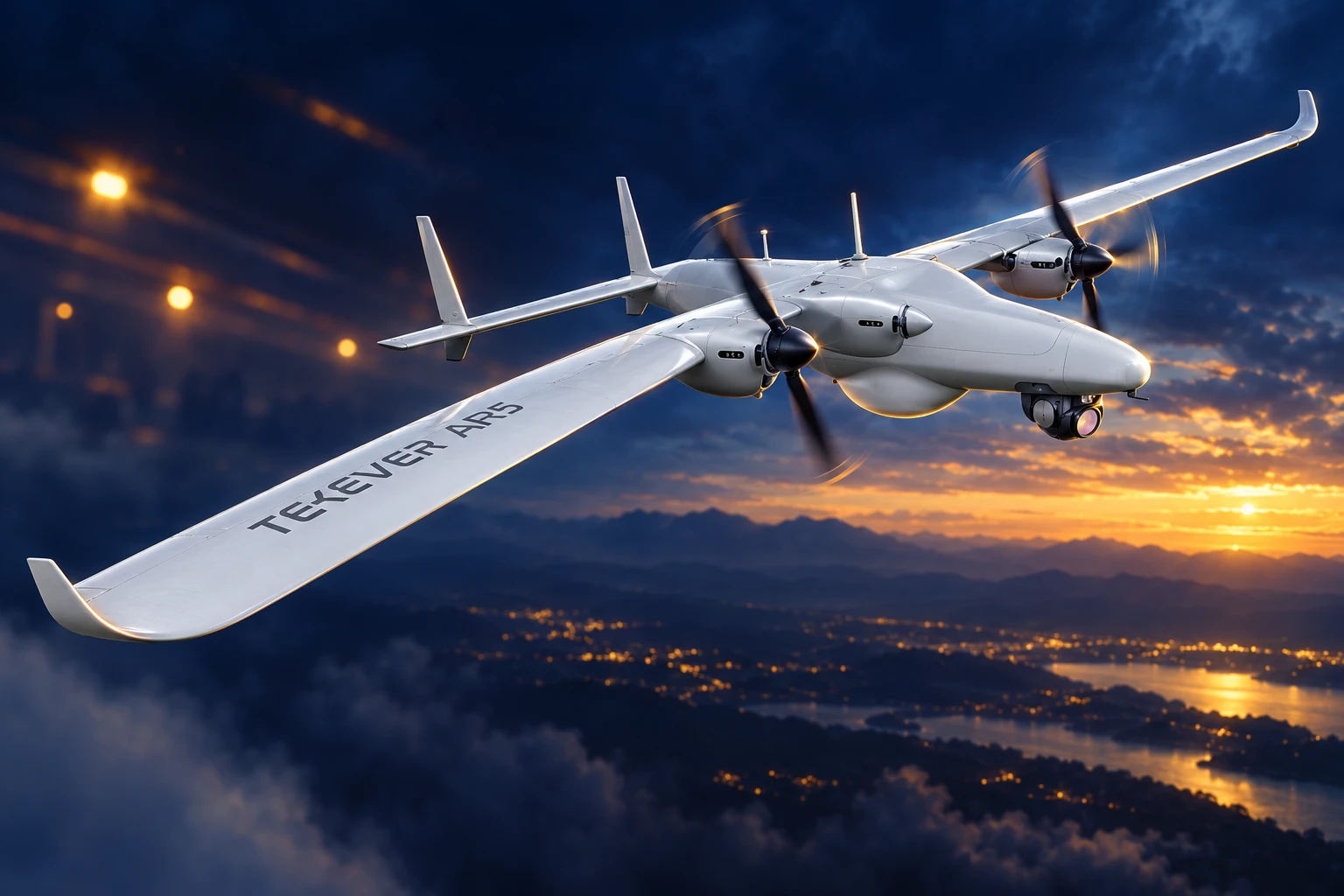
Founded in Lisbon in 2001, Tekever is now headquartered in Britain. It sells uncrewed aircraft together with the sensors, radios and software that turn a flight into a live intelligence feed, and it has used Ukraine as a proving ground since 2022. The company says those systems have logged more than 50,000 operational flight hours there.
The raise was announced days after the UK Ministry of Defence picked Tekever to deliver CORVUS, the British Army’s new surveillance programme. CORVUS is built on Tekever’s AR5 and is worth up to £400 million over ten years. That is a booked sovereign customer, not a slide-deck pipeline, and it is the commercial fact sitting under the new price.
Ricardo Mendes, the founder and chief executive, said in the company’s statement that the first close of its $580 million Series D covers most of the round, with further closings planned in the coming months to bring in more strategic investors. He told an interviewer the same day that Tekever already employs more than 1,500 people and is adding product lines and plants in the UK and France.
TEKEVER AT THE FIRST CLOSE
- The price: The round values the company at $6.4 billion, after a May 2025 mark that had just passed £1 billion.
- The cash: The first close is most of a $580 million Series D, with extra closings still to come.
- The contract: CORVUS is worth up to £400 million over ten years on the AR5 platform.
- The proof: Tekever cites more than 50,000 operational flight hours in Ukraine since 2022.
Tekever is not the dearest of the new European defence names. Munich’s Helsing raised $1.8 billion in July at $18 billion, and Quantum Systems took $1.2 billion the same month at about $8 billion. Cambridge Aerospace raised $300 million in August for drone interceptors, and Stark Defence took in €500 million in June. The pattern was already running. Wednesday’s close made it harder to treat as a side bet.
The New Money Is for Factories and Takeovers
Tekever’s statement lists overseas expansion, industrial and technical capacity, faster work on AI-driven uncrewed systems, and strategic acquisitions. Mendes put the last item in plain language on television: the round is meant to fund growth through deals as well as through new kit, because he expects the defence-tech market to consolidate over the next few years.
The fund raise is precisely designed to support that growth, not only organically, developing new technology, but through acquisitions.
Ricardo Mendes, founder and chief executive, on Bloomberg Television
That is a different use of capital from a software company buying back time. Uncrewed aircraft have to be built, certified, flown and repaired, and Mendes is treating the $6.4 billion price as a platform for folding in other teams rather than waiting for them to raise on their own. He said Tekever will use its existing operations as the route to market for whatever it buys.
Chris Evdaimon, an investment manager for private companies at Baillie Gifford, an existing backer that returned for this round, said the firm’s conviction had grown as Tekever scaled. He pointed to a software-heavy, vertically integrated model that turns technology into fielded kit quickly, and to learning from hard operational use that is difficult to copy. Sir Ben Wallace, the former UK defence secretary, joined the cap table through Merlyn Advisors as a portfolio manager and said Europe’s security will depend on firms that can invent quickly, scale in factories, and ship what armies actually need.
Who Put Up the Money Behind Europe’s New Defence Champion?
UC Investments, the University of California’s investment office, led the round with Baillie Gifford. Tekever said this is UC Investments’ first direct investment in Europe. Jagdeep Singh Bachher, the university’s chief investment officer, said his office looks for firms with technical depth and the ability to execute at scale, and that his conviction rests on Mendes and the team, and on the growing weight of European technology in global markets.
An American public-university endowment writing its first Europe cheque into a British-headquartered Portuguese drone company is a capital-markets event, not a colour line. Defence-tech rounds of this size still sit under AI-software headlines, even when they price a company at $6.4 billion. The people actually wiring the money are no longer only specialist European funds.
THE SERIES D BACKERS
- UC Investments: Co-lead, and the University of California’s first direct investment in Europe.
- Baillie Gifford: Co-lead and an existing shareholder that came back in.
- Merlyn Advisors: New strategic investor; Sir Ben Wallace works there as a portfolio manager.
- Returning funds: Crescent Cove, Ventura Capital and Iberis Capital all added to existing stakes.
Jun Hong Heng, founder and chief investment officer of Crescent Cove, said Tekever sits at the junction of AI, autonomy and defence with a vertically integrated model. Diogo Chalbert Santos, a partner at Iberis Capital, said he has backed the firm from an earlier stage and watched it grow into a company that can compete globally. Mo El Husseiny, managing partner at Ventura Capital, said Tekever is entering a different stage of scale, with a larger industrial footprint and a wider overseas reach.
Hamburg Posts a €455 Million First Close for Defence
On 24 September, DTCP announced the first close of DTCP Defence Fund I, with €455 million in commitments from European institutions and strategics including Deutsche Telekom, Porsche SE, Denmark’s EIFO and Danica, and Estonia’s SmartCap. The vehicle is aiming at €500 million. DTCP manages €5 billion as of September 2026 and is opening a Copenhagen office in 2027 to sit closer to the Nordic defence supply chain.
The fund is Europe-led and NATO-aligned. It will put most of its money into European firms, with selective cheques in other NATO states and close allies when the technology matters to European defence, interoperability or supply chains. The stated sectors are AI, uncrewed systems, cyber defence, secure communications and space, with a bias to Series B and later. Ole Aguirre and Georgia Watson lead a dedicated team. Aguirre spent more than 25 years across the armed forces and commercial defence, including senior roles at Teledyne FLIR and as a co-founder of Prox Dynamics. Watson was a partner at Lakestar and spent seven years in Goldman Sachs’ strategic investments and growth-equity teams.
The fund has already backed Six Robotics, a Norwegian firm writing software that coordinates uncrewed systems, and Kraken Technology Group, a UK builder of uncrewed maritime platforms. A third deal is under way. DTCP’s wider book already includes Quantum Systems and STARK Defence, so the new vehicle is a dedicated sleeve on a thesis the firm had already started to underwrite.
Thomas Preuß, managing partner and chief investment officer of DTCP Growth, said Europe needs more European capital and investors who know how to scale mission-critical technology companies. Tim Höttges, chief executive of Deutsche Telekom, said Europe must take greater responsibility for its own security and that Telekom backed the fund because it runs infrastructure that millions of people and businesses depend on every day. Hans Dieter Pötsch, chairman of the board of management of Porsche Automobil Holding SE, called Porsche SE an anchor investor and said Europe’s resilience will be shaped by choices made now.
The demand story those LPs are underwriting is no longer theoretical. At the 2025 Hague summit, NATO allies pledged to invest 5% of GDP annually by 2035, split into at least 3.5% for core defence and up to 1.5% for broader security-related spending such as infrastructure, networks, civil preparedness and the industrial base. NATO says European allies and Canada raised combined defence spending by nearly 20% in real terms in 2025 against 2024. Peder Lundquist, chief executive of EIFO, called the DTCP cheque the agency’s largest defence investment so far and said too little risk capital is keeping European defence firms on the continent.
DEFENCE CAPITAL THAT CLOSED THIS WEEK
| Name | Type | Size | Status |
|---|---|---|---|
| Tekever Series D | Company round, 23 September | $580 million (first close, most of the round) | $6.4 billion valuation |
| DTCP Defence Fund I | Growth fund, 24 September | €455 million committed | Target €500 million |
| Final Frontier Fund II | Seed fund launch, 21 September | €100 million target | First close due by year end |
| SPRIND and NADI programme | Public challenge, 23 September | €40 million | Applications open until 30 November |
That table is the week in miniature: one company priced for industrial scale, one growth fund built to write Series B cheques, one seed vehicle still raising, and a public contest for the chips those systems will eventually need.
Two Danish Seed Funds Merge to Chase the Same Wave
On 21 September, Final Frontier and Myriad said they would combine under the Final Frontier name and aim at €100 million for Fund II. The first close is expected by the end of 2026. The new vehicle will back pre-seed and seed defence firms across the New Nordics and Ukraine. The two houses together hold 15 companies.
Niels Vejrup Carlsen, a former Seed Capital general partner, founded Final Frontier in late 2024 and closed a €4.5 million first fund in May 2025 with backers including former NATO Secretary General Anders Fogh Rasmussen. Myriad launched a €2 million early-stage fund in August 2025; its partners include Alexander Aghassipour, who helped take Zendesk from a startup to a listed company and later a sale, and Klaus Nyengaard, who scaled Just Eat. Carlsen has said the seed end of defence tech had too many small pots, and that the merger is a bid for combined strength, including kit ruggedised for Arctic and maritime work.
The seed merger and DTCP’s growth close sit on the same ladder. Early cheques in Denmark, Norway and Ukraine are meant to feed the Series B and later rounds that Hamburg is now funded to lead. If Mendes is right about consolidation, some of those seed names will be bought before they ever need a DTCP cheque.
Chip Design Is the Factory Europe Still Lacks
On 23 September, Germany’s Federal Agency for Breakthrough Innovation, SPRIND, and the Netherlands’ new National Agency for Disruptive Innovation, NADI, opened the AI-Native Chip Design Challenge, a €40 million, 20-month programme. NADI itself was unveiled on 15 September, when Dutch Economic Affairs Minister Heleen Herbert announced the agency on Budget Day, with €500 million allocated by the Dutch government for high-risk work private investors often skip. SPRIND, set up in 2019, advised on NADI’s design. This is their first joint funding programme.
The brief is to use AI to compress high-performance chip design from years to weeks and to produce production-ready designs for AI training and inference, with a stress on energy use and cost. SPRIND and NADI want architectures built for AI giga-factories and for European strengths in data security, biotechnology, robotics and mobility. Jano Costard, SPRIND’s head of challenges, described the speed target as several orders of magnitude. Jelle Prins, a NADI co-founder, said Nvidia chips may be powerful but are wasteful for inference, comparing that workload to doing the shopping with a truck.
THE CHIP DESIGN CALENDAR
- 15 September 2026: The Dutch government unveils NADI, with €500 million allocated for high-risk innovation.
- 23 September 2026: SPRIND and NADI open the €40 million AI-native chip contest.
- 30 November 2026, 11:00 CET: Applications close.
- November 2026 to July 2027: Stage 1 runs eight months; seven teams can receive up to €2.6 million each.
- Following 12 months: Stage 2 shortlists three teams at up to €7 million each, so a team that lasts the distance can receive up to €9.6 million across both stages.
Forty million euros will not build a fab. It is a bet that Europe can still own the design step, and that AI agents can take on architecture search, RTL generation and verification that now chew through years of specialist labour. The drones Tekever flies, the maritime platforms Kraken builds, and the software Six Robotics writes all eventually meet a chip. This contest is the part of the week that admits the hardware bottleneck without pretending a new foundry will appear in 20 months.
What Bird’s $450 Million Loan Is Paying For
On the same Wednesday as Tekever’s close, Bird, the Amsterdam-founded communications firm formerly known as MessageBird, said it had secured $450 million in debt financing led by J.P. Morgan, with Capital One and Citi as joint lead arrangers. The package is a $400 million term loan and a $50 million revolving credit facility. Seven banks are in the syndicate. The cash is for liquidity to shareholders, including current and former employee shareholders, while Bird stays private.
That is a dividend recapitalisation, not a growth round. Founder and chief executive Robert Vis said the company generated $165 million of EBITDA in 2025 after heavy automation, and that headcount has fallen from more than 1,000 at its peak to 120. He said the firm did not automate in order to cut staff; staff fell because the work changed. Bird also launched Agentic Harness, a layer that lets AI agents send messages, place calls, manage email and take an eSIM plan on Bird’s network, which the company says already moves trillions of messages a year.
Vis founded the company in 2011. For a decade it was sold as Europe’s answer to Twilio, a single API for email, SMS, WhatsApp and voice. The 2026 version is a 120-person cash machine whose owners can borrow against last year’s earnings. Some channels, Bird says, now cost 90% less than rivals. Banks will lend $450 million against that story. They will not lend Tekever the same way, because Tekever still has to build plants, buy rivals and deliver a ten-year army programme.
The contrast is the capital structure, not a morality play. Software that has already been automated can be levered so staff and early backers get paid. Uncrewed systems that have to be manufactured still raise equity at venture prices, which is why a $6.4 billion mark and a €455 million growth fund landed in the same news cycle as a loan that never touches the income statement as revenue.
Tekever’s remaining Series D closings are still open, DTCP is still filling toward €500 million, and chip teams have until 30 November. Mendes has a chequebook sized for takeovers. The funds raised this week are sized to feed him, and the firms like him, for years.
Disclaimer: This article is news reporting and analysis of company announcements, fund closes and public programmes, and it is for information only. It is not investment advice, a solicitation to buy or sell any security or fund interest, or a recommendation of any defence contractor, lender or public agency named above. Readers who are considering an investment, a subscription to a private fund, or a commercial contract should consult a qualified financial adviser, solicitor or procurement specialist who can review the underlying documents. Figures, valuations, fund targets and programme dates reflect the company statements, fund notices and official pages cited here as of 26 September 2026 and may change with later closings, restatements or contract awards.

Edinburgh Opens a 2027 Tour Built for Time Trials

Korda Maps Auður From Meðalland to Irvine Bay

Apple Music Films Its New Logo in Mineral Oil

Oppo Prices the Pad Mini Above India’s iPad Mini

Austen Soaks Scotland Before Boelo Brings Weekend Gales

Volkswagen Sells the Osnabruck Plant to Clear a Board Fight

Apple’s Foldable iPhone Hinges on Samsung Display Supply

Tata Motors’ Iveco Tender Opens as Holders Still Decide

Saksham Gaur Finds He Is His Own Company’s Client

Onimusha Way of the Sword Preload Hits a Windows 11 Wall
-
 AUTO2 months ago
Volkswagen Sells the Osnabruck Plant to Clear a Board Fight
-
 NEWS2 months ago
Apple’s Foldable iPhone Hinges on Samsung Display Supply
-
 AUTO2 months ago
Tata Motors’ Iveco Tender Opens as Holders Still Decide
-
 BUSINESS2 months ago
Saksham Gaur Finds He Is His Own Company’s Client
-
 GAMING2 months ago
Onimusha Way of the Sword Preload Hits a Windows 11 Wall
-

 BUSINESS2 months ago
Hyderabad 22-Carat Gold Jumps After a False Bargain
-

 ENTERTAINMENT3 years ago
What is SD on Amazon Prime? – All You Need to Know
-

 NEWS2 months ago
iQOO 16 Locks 8,400 mAh While 100W Charging Holds