
NEWS
The High School Sungrazer That Made Quanzhi Ye an Astronomer
Public SOHO coronagraphs let high-school student Quanzhi Ye log a sungrazing comet in 2005, then fed a volunteer pipeline of professional astronomers.

In 2005, high-school student Quanzhi Ye spotted a tiny white dot in a free SOHO coronagraph frame and logged the Sungrazer Project’s 1,019th comet. The joint ESA-NASA Solar and Heliospheric Observatory had been sent to study the Sun, and its public near-Sun images gave a teenager in China a first look at a class of objects ground telescopes almost never catch.
That report became the start of a research career. It also marked a volunteer path that later passed 5,000 comets and several professional astronomers who still work on the dust those sungrazers leave behind.
A Tiny White Dot on a LASCO Frame
Ye was scanning images from SOHO’s Large Angle and Spectrometric Coronagraph, the LASCO C3 telescope, through the NASA-funded Sungrazer Project. NASA later published the frame: a faint white speck beside the blocked-out solar disc, processed by Karl Battams of the U.S. Naval Research Laboratory. The object was a sungrazing comet, and NASA recorded it as the project’s 1,019th comet discovery.
The 2005 SOHO comet table lists the object as a Kreutz-group sungrazer first seen on 23 September 2005. Kreutz fragments skim so close to the Sun that most of them do not come back out. Ye went on to report several more comets on the same platform before he left school, learning to separate a slow, straight track from a cosmic-ray hit or a passing satellite.
Finding a new comet had long meant a telescope, dark skies, and time. Sungrazing comets break that pattern because they brighten only when they are lost in solar glare. A coronagraph that hides the Sun’s disc is often the only way to see them at all, which is why a school computer and a public archive were enough.
SOHO Was Built to Watch the Sun
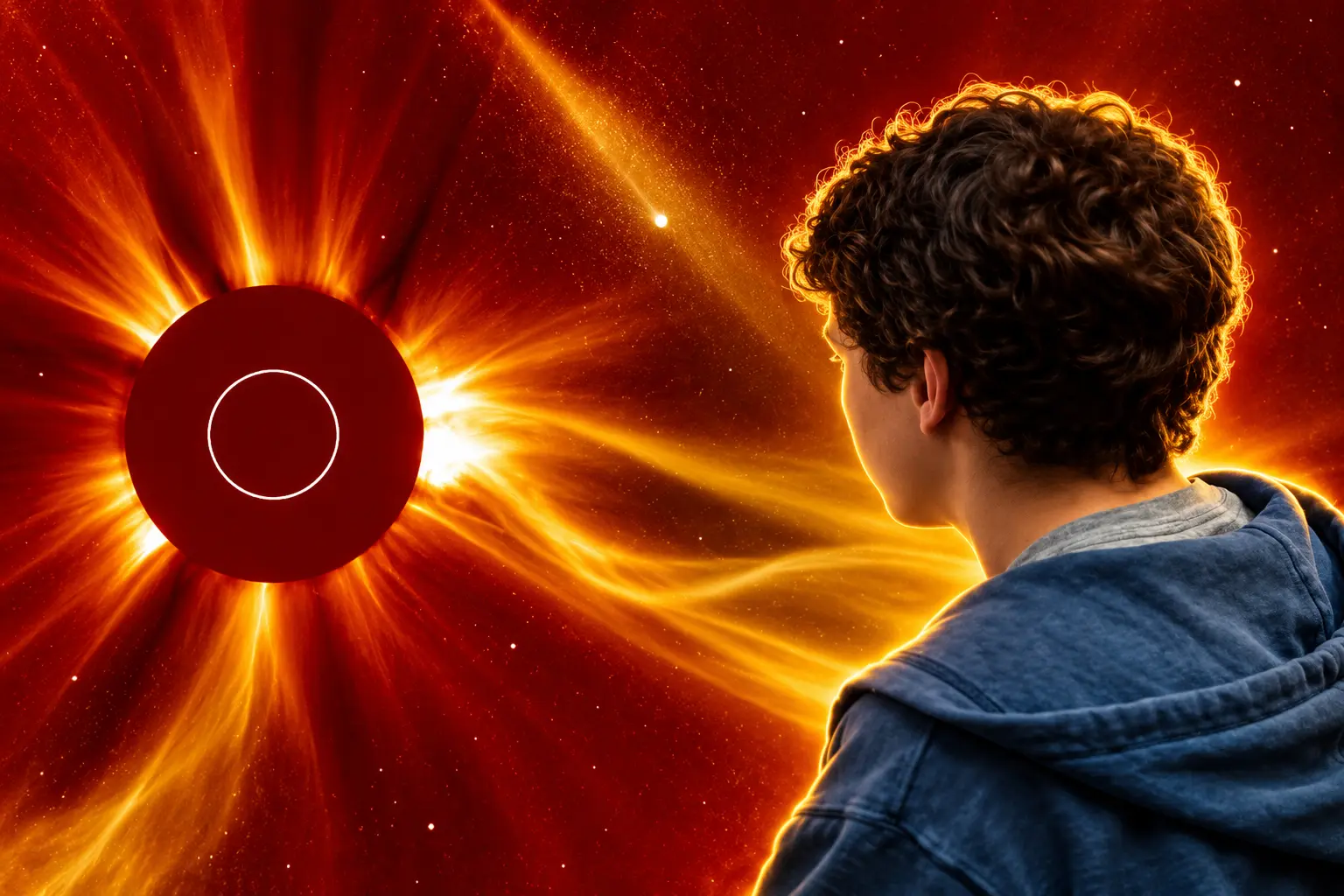
SOHO launched on 2 December 1995 as a two-year ESA-NASA mission to study the Sun from its interior through the corona and the solar wind. It sits in a halo orbit around the Sun-Earth L1 point. LASCO, built by the Naval Research Laboratory, uses an occulting disc to create a standing eclipse so the faint corona can be photographed. The same trick pulls faint comets out of the glare.
People on the ground began emailing in unlisted objects soon after the images went public in 1996. Mission scientists needed a way to keep score. By March 2024, NASA could say SOHO had become the most prolific comet-finder on record, discovering more than half of the comets known today. Most of those reports came from volunteers with no formal training.
SOHO COMET TALLY
- Before SOHO: Karl Battams said only a couple dozen sungrazing comets were on record.
- Share of the catalog: NASA says SOHO has found more than half of all known comets.
- Kreutz family: About 85 percent of SOHO’s finds belong to this sungrazing group.
- Pace: On average the spacecraft yields a new comet about once every three days.
Battams, who is principal investigator for both LASCO and Sungrazer, has been blunt about how unplanned the haul was.
When LASCO was launched, no one had any idea that it would turn out to be the most prolific discoverer in history. The amount of data and science returned has just been beyond our wildest dreams.
Karl Battams, principal investigator, U.S. Naval Research Laboratory
Over 99 percent of the discoveries sit in LASCO C2 and C3 frames. The comets also work as cheap solar probes. Their tails twist and fade as they hit the corona, so a volunteer’s report can feed heliophysics as well as small-body science. NASA has counted more than 70 discoverers from 18 countries in that stream.
How the Sungrazer Project Turns Dots Into Comets
Battams dates the project’s official launch to 2 November 2000, when a bare web page opened so amateurs could file reports they had already been emailing. He has argued that Sungrazer was created by that volunteer community, not handed down as a lab outreach scheme. Anyone with an internet link and a computer can download the latest SOHO or STEREO frames and look for a moving speck.
The scientific bar is higher than a hunch. Kreutz sungrazers typically crawl at less than 10 pixels an hour in C3, or about 70 pixels an hour in C2. A fast jumper is almost never a comet. Around solar maximum the coronagraphs can catch ten or twenty coronal mass ejections in a day, so a bright splash beside a speck is a common coincidence, not proof of a new object.
WHAT A VALID REPORT NEEDS
- Five frames: The object must show up in at least five consecutive images.
- Straight track: It has to move in a straight line at a constant speed.
- Slow crawl: A Kreutz candidate in C3 usually stays under 10 pixels an hour.
- A real computer: The project says phones and tablets are a poor fit for the work.
Confirmed objects get an unofficial SOHO number so hunters can talk about them. They do not get a person’s name. Satellite discoveries are named after the spacecraft, which is why a teenager can find a comet and still watch it enter the books as a SOHO object. Kreutz members can pass as close as 50,000 km from the Sun’s visible surface, and they rarely survive that pass.
The Teenagers Who Kept Looking
NASA’s own write-up of Ye’s prize noted that several young Sungrazer participants had already moved into STEM degrees and astronomy jobs. Battams, announcing comet number 5,000, named teenagers the project has pushed into astronomy, including Ye, Hanjie Tan, Man-To Hui, and Rafal Biros. The pattern is the second product of the archive: unpaid scanners who later show up on faculty pages.
NASA Sun flagged Ye as one of those all-stars in March 2024, while SOHO was still closing in on 5,000, calling him the hobbyist who became a professional.
As SOHO nears its 5,000th comet discovery, we’re highlighting comet-hunting all-stars from @DoNASAScience’s Sungrazer Project. ☀️ ☄️
Many comet hunters are hobbyists, but Quanzhi is a professional! His start with Sungrazer bloomed into a career as an astronomer. pic.twitter.com/fRiq53jCba
— ARCHIVED – NASA Sun & Space (@NASASun) March 12, 2024
FROM THE ARCHIVE TO THE LAB
| Hunter | Sungrazer start | Later post |
|---|---|---|
| Quanzhi Ye | High school, 2005; project comet 1,019 | Associate research scientist, University of Maryland; 2023 Urey Prize |
| Hanjie Tan | Age 13 from 2009; 200-plus comets | Astronomy Ph.D. student in Prague; found SOHO-5000 |
| Man-To Hui | Named by Battams among the inspired teens | Full researcher, Shanghai Astronomical Observatory, from May 2025 |
| Sebastian Hoenig | Sungrazer citizen scientist | Professor, University of Southampton |
Tan’s milestone object, logged on 25 March 2024 in LASCO C2, was a small Marsden-group comet, a family that was unknown until SOHO found it. Only about 75 of the 5,000 belong to that group. NRL said it probably survived, passing about 8.2 million km (5.1 million miles) from the Sun, a little farther out than Parker Solar Probe’s orbit at the time. The group is tied to comet 96P/Machholz, which LASCO sees every 5.3 years.
Since 2009, I’ve discovered over 200 comets. I got into the Sungrazer Project because I love looking for comets. It’s really exciting to be the first to see comets get bright near the Sun after they’ve been traveling through space for thousands of years.
Hanjie Tan, Sungrazer Project participant, NASA briefing on SOHO-5000
Tan started as one of the project’s youngest hunters and was an astronomy doctoral student in Prague when he filed the 5,000th. Hui took a UCLA doctorate in Earth, planetary, and space sciences, then research posts in Hawaii and Macau before Shanghai. The pipeline is not a guaranteed job scheme. It is a repeated accident: a teenager who learns to see motion in LASCO frames and later studies the same small bodies with telescopes and models.
The Urey Prize Came From Meteor Debris
Ye took a Bachelor of Science at Sun Yat-sen University in China, then a master’s and a Ph.D. in astronomy at the University of Western Ontario, finishing the doctorate in 2016. He did postdoctoral work at the California Institute of Technology and joined Maryland’s Department of Astronomy in 2019 as an assistant research scientist. The department’s people list in 2026 names him an associate research scientist.
In 2023 the American Astronomical Society’s Division for Planetary Sciences gave him the Harold C. Urey Prize, which honors early-career work on small inner solar system bodies. The citation focused on the blurry line between active and inactive objects, and on numerical models that tie meteor showers to specific comets and asteroids. Those showers are how Earth samples debris without a spacecraft visit. Ye’s later observing work includes a high-quality spectrum of the interstellar object 1I/‘Oumuamua and Hubble imaging of asteroid (3200) Phaethon during a close Earth pass.
Andrew Harris, then chair of Maryland’s astronomy department, said the prize committee had recognized the breadth of that work. Ye’s Urey lecture at the 55th DPS meeting was titled “Exploring Asteroids and Comets with Meteor Science.” The teenager who clicked through LASCO frames ended up reconstructing parent bodies from the meteors they shed, which is the long echo of a sungrazer that itself may not have survived perihelion.
The papers kept coming. In 2026 he was a co-author on a Planetary Science Journal study of eight outbursts of comet 7P/Pons-Winnecke and the lead author of an Icarus search for the lost comet P/2010 H2 (Vales). He also sits on the IAU working group that names small bodies. The high-school report is no longer the story of his career. It is the first entry in a CV that still chases faint, breaking objects.
Five Thousand Comets, Then a New Camera
Battams wrote in March 2024 that each thousand SOHO comets takes about four to five years, and that 5,000 was probably the last round number the spacecraft would see. He named 31 December 2025 as the mission’s nominal end date and said it would be sad when SOHO stopped. He also said Sungrazer was built to outlive the spacecraft, folding in later heliophysics cameras such as SECCHI and WISPR.
The calendar did not close on cue. ESA marked thirty years of continuous solar watching on 2 December 2025. NASA’s SOHO operations page dated 24 September 2026 listed the spacecraft on mission day 11,255. Confirmations kept landing. In 2025 Battams posted the first comet confirmations from NOAA’s GOES-19 CCOR-1 coronagraph, then later bundles that mixed SOHO/LASCO and CCOR-1 finds through July and August 2025.
THE COMET FACTORY CALENDAR
- 2 December 1995: SOHO launches on a planned two-year solar mission.
- 2 November 2000: The Sungrazer report page opens to volunteer hunters.
- 23 September 2005: Ye’s Kreutz sungrazer is logged as project comet 1,019.
- 2016: Ye completes a Ph.D. in astronomy at the University of Western Ontario.
- 25 March 2024: Tan reports SOHO-5000, a Marsden-group comet in LASCO C2.
- 2 December 2025: ESA and NASA mark 30 years of SOHO operations.
- 24 September 2026: The SOHO operations desk lists mission day 11,255.
Other missions now inherit the same hunt. NASA’s PUNCH spacecraft tracked comet 2025 R2 (SWAN), first spotted by Ukrainian amateur Vladimir Bezugly on 11 September 2025 in SOHO’s SWAN instrument, and kept a four-minute cadence on it into early October. Mid-September 2026 brought a fresh round of sungrazer-candidate clips from GOES-19, which is the habit Sungrazer trained: step through coronagraph frames and wait for a speck that refuses to sit still. A bright wash on those frames is often stray light around equinox, which is why the five-frame rule still earns its keep.
Ye’s first comet remains a white dot in a 2005 C3 image. The second-order result is the queue behind it: thousands of near-Sun objects that would have stayed uncounted, and a handful of hunters who now publish on the debris those objects shed. The next frame is already on a public server.
Frequently Asked Questions
What Do You Need to Hunt for a SOHO Comet?
A desktop or laptop, an internet connection, and software or a web tool for stepping through LASCO frames. Sungrazer says the work is a poor fit for phones and tablets, and it asks for patience rather than a degree. A report is supposed to show the object in at least five consecutive images, moving in a straight line at a constant speed, before anyone should hit send.
Why Are SOHO Comets Not Named After the People Who Find Them?
Discoveries made from satellites take the satellite’s name. The Sungrazer webmaster assigns an unofficial tag such as SOHO-1234 so hunters can refer to a given object and keep a running count, but that tag is not a personal credit in the official designation. Ground-based comet finds can still carry a discoverer’s name; the LASCO pipeline cannot.
Do Sungrazing Comets Ever Become Visible From Earth?
Almost never. The project’s own FAQ says only five SOHO comets have later been seen from the ground. Most are too small and too close to the Sun for ordinary telescopes, which is the whole reason the coronagraph archive matters. Never point binoculars or a telescope at or near the Sun without a proper solar filter.
What Is the Kreutz Group of Comets?
They are the classic sungrazers, about 85 percent of SOHO’s discoveries, and they can pass as close as 50,000 km from the Sun’s visible surface. Hunters see one on average every three days and rarely go more than two weeks without one. Most of them do not survive perihelion, which is why the science often sits in the fragments and the meteoroid streams, not in a returning nucleus.
Does the Sungrazer Project Work With Telescopes Besides SOHO?
Yes. Volunteers also search NASA STEREO images, and in 2025 the project began posting confirmations from NOAA’s GOES-19 CCOR-1 coronagraph alongside LASCO. Battams has said Sungrazer is meant to cover later heliophysics cameras such as SECCHI and WISPR so the hunt continues after SOHO’s last frame.

Edinburgh Opens a 2027 Tour Built for Time Trials

Korda Maps Auður From Meðalland to Irvine Bay

Apple Music Films Its New Logo in Mineral Oil

Oppo Prices the Pad Mini Above India’s iPad Mini

Austen Soaks Scotland Before Boelo Brings Weekend Gales

Volkswagen Sells the Osnabruck Plant to Clear a Board Fight

Apple’s Foldable iPhone Hinges on Samsung Display Supply

Tata Motors’ Iveco Tender Opens as Holders Still Decide

Saksham Gaur Finds He Is His Own Company’s Client

Onimusha Way of the Sword Preload Hits a Windows 11 Wall
-
 AUTO2 months ago
Volkswagen Sells the Osnabruck Plant to Clear a Board Fight
-
 NEWS2 months ago
Apple’s Foldable iPhone Hinges on Samsung Display Supply
-
 AUTO2 months ago
Tata Motors’ Iveco Tender Opens as Holders Still Decide
-
 BUSINESS2 months ago
Saksham Gaur Finds He Is His Own Company’s Client
-
 GAMING2 months ago
Onimusha Way of the Sword Preload Hits a Windows 11 Wall
-

 BUSINESS2 months ago
Hyderabad 22-Carat Gold Jumps After a False Bargain
-

 ENTERTAINMENT3 years ago
What is SD on Amazon Prime? – All You Need to Know
-

 NEWS2 months ago
iQOO 16 Locks 8,400 mAh While 100W Charging Holds