
NEWS
Snap Specs Cost $2,195 and Still Need a Buyer
Snap’s SPECS AR glasses work as standalone computers at $2,195, a Magic Leap-era price that leaves ordinary buyers to Meta and XREAL.

Snap is taking pre-order SPECS for $2,195, standalone AR glasses with a $200 refundable deposit, and Qualcomm put them on faces at Snapdragon Summit. They ship later in fall 2026 in the United States, the United Kingdom, and France.
The demo is a real computer in a pair of glasses. The invoice is the same wall that stopped the last wave of “consumer” AR, and Snap is already adding a carrier plan and a mall kiosk to climb it.
Two Snapdragon Chips Sit in the Temples
SPECS are Snap’s first AR glasses sold to anyone with a card, not a developer badge. Specs Inc., a Snap subsidiary, built the compute into the frame, with no puck and no tether. Two unnamed Snapdragon processors split the work: one for computer vision, one for Lenses, Snap’s name for the overlays.
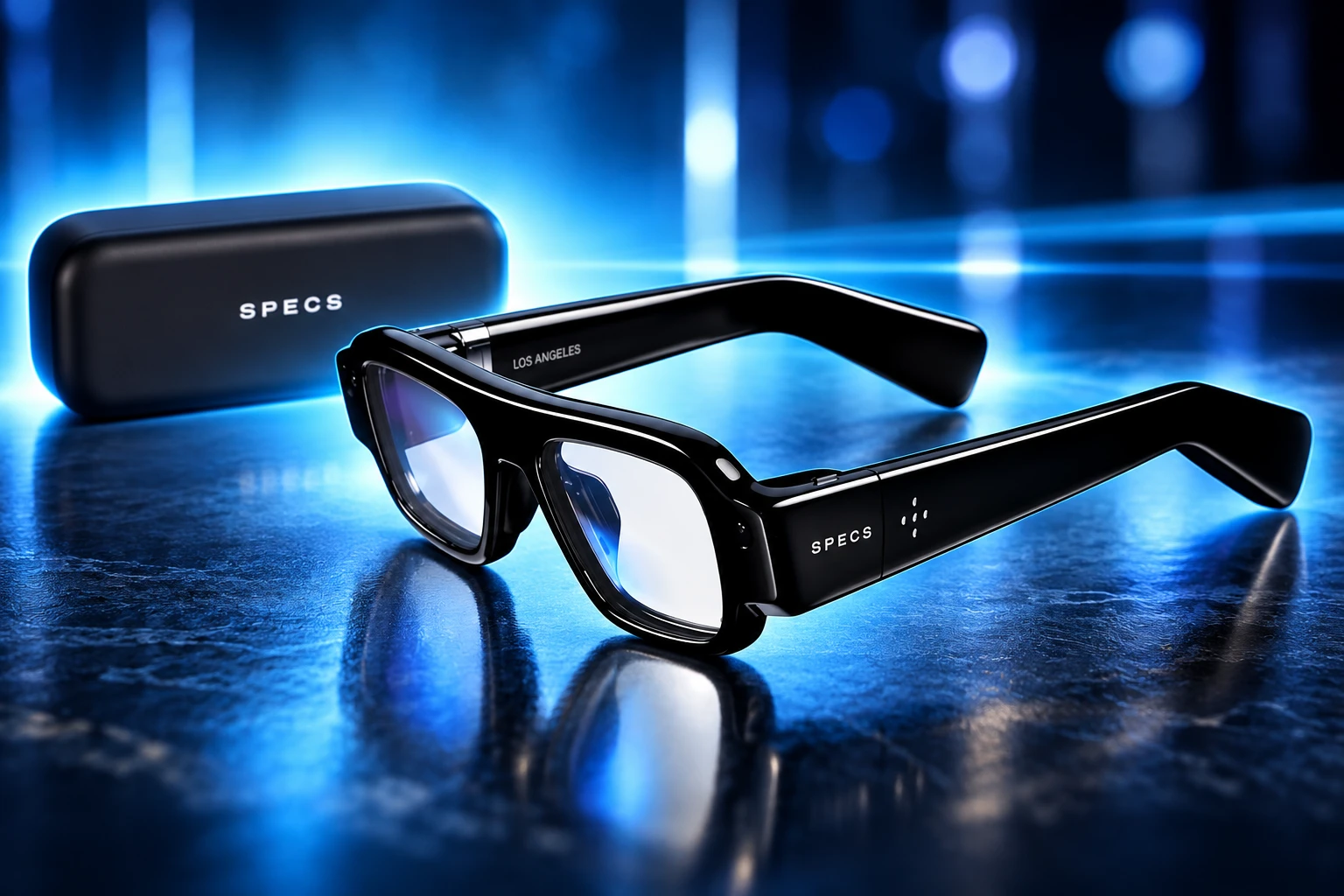
The 47 mm frame weighs 132 grams. The 52 mm frame weighs 136 grams. Both use Swiss TR90 polymer, removable prescription inserts, and Snap’s own liquid-crystal-on-silicon display. Snap rates the field of view at 51 degrees and 16 million colors, and says that window can feel like a 24-inch desktop for work or a 115-inch screen about 10 feet away for a film.
Lenses shift from clear to tinted in 10 seconds, using the same electrochromic trick Snap compares to Boeing 787 windows. Motion-to-photon latency is listed at 7 milliseconds. Mixed use, which Snap says includes video, Lenses, AI help, and Bluetooth alerts, is rated at 4 hours. The case adds four more charges, or 20 hours in total.
WHAT SNAP PUT IN THE FRAME
- Compute: Two Snapdragon chips in the temples, models undisclosed, with no external puck.
- Display: A 51-degree see-through LCoS waveguide that Snap likens to a 24-inch desk or a 115-inch cinema.
- Power: Up to 4 hours of mixed use, then four extra charges in the case for 20 hours.
- Buy-in: $2,195 plus a $200 refundable deposit, with fall 2026 shipping in three countries.
A magnetic cable clips to the side for charging, and that same cable can stream a phone, a computer, or a console onto the glasses. Bluetooth still ties them to a phone for calls, alerts, and music. Standalone here means the computer is on your head, not that the pair never talks to anything else.
The $2,195 Sticker Matches an Old AR Habit
Snap spent more than a decade getting to a pair you can order on specs.com. The number on that order form is not new. Google sold the Glass Explorer Edition for $1,500 in 2013. Magic Leap One went on sale in August 2018 for $2,295, billed as a creator product that still asked ordinary buyers to pay headset money.
SPECS undercut that Magic Leap tag by $100 and drop the belt pack. They keep the same basic bet: charge like a computer, look as close to glasses as the hardware allows, and hope a market appears once the thing is real. Snap has not published pre-order totals.
THE $2,000 AR PRICE BAND
- 2013: Google sells the Glass Explorer Edition for $1,500 as an early wearable screen.
- August 2018: Magic Leap One goes on sale for $2,295, a creator headset with a pack on the hip.
- June 2026: Snap opens SPECS pre-orders at $2,195 after showing them at Augmented World Expo.
- September 16, 2026: Snap and Verizon price a cellular case bundle at $2,395.
- October 1, 2026: SPECS First Look is set to open at Westfield Century City in Los Angeles.
The June announcement did not age into a bargain. It aged into a second product: a case with its own radio, sold so the glasses can leave Wi-Fi without a phone hotspot doing the quiet work.
A Display for $799 and a Puck Capped at $1,500
Fall 2026 is a crowded shelf, and the other glasses on it do not ask for Magic Leap money. Meta already sells the Meta Ray-Ban Display at $799, Neural Band included, in a 69-gram frame Meta rates at 6 hours of mixed use. Those are a monocular in-lens display and an AI pair, not a two-eyed AR computer, and they sit on your face like glasses people already wear.
XREAL’s Aura, built with Google’s Android XR, takes the other shortcut. XREAL says the glasses weigh under 95 grams and puts Qualcomm’s Snapdragon Reality Elite in a puck on a cable. The field of view on that spec sheet is 70 degrees. XREAL says the base model will not exceed $1,500 before tax, and it is also aimed at fall 2026.
THE FALL 2026 GLASSES SHELF
| Glasses | Price | Weight on the face | Where the computer sits | Field of view |
|---|---|---|---|---|
| Snap SPECS | $2,195 | 132 g or 136 g | Two Snapdragon chips in the frame | 51 degrees |
| Meta Ray-Ban Display | $799 | 69 g | On the glasses, with a Neural Band | Monocular in-lens display |
| XREAL Aura | Will not exceed $1,500 | Under 95 g, plus a puck | Snapdragon Reality Elite in a puck | 70 degrees |
That table is the whole product argument. Snap paid, in grams and in dollars, to keep the computer on the head. XREAL paid in a cable to keep the face light and the sticker lower. Meta stayed in the Ray-Ban business and put a small private screen in one lens. Anyone shopping this fall can buy a display, or a puck, without writing a $2,195 check.
Tracking Clears the Bar at Snapdragon Summit
Qualcomm’s Snapdragon Summit in September 2026 made wearables the day’s theme, and SPECS were in the room. A reviewer who tried an earlier Specs demo two years ago said the hand gestures came back within 5 minutes, with no coaching from the Snap staff. The frames still look large. The weight is spread through the temples, so they hug the face instead of sliding the way Meta’s display glasses can.
Jitesh Ubrani, who leads wearables and XR coverage at IDC, tried a pair around the summit and said the clips online flatten what you see. “Had a chance to try them out yesterday and frankly the YouTube videos don’t do it justice. It’s a HoloLens or Magic leap shrunken down to something that’s far more comfortable,” Ubrani wrote.
Other hands-on notes from the same week were cooler on the glass itself. Tracking and hand input are what make the overlays stick. The waveguides still look optically rough for the money, which is a polite way to say first-generation true AR still shows the seams. Qualcomm, for its part, used the summit to run on-device AI on wearables, including glasses, which is the chip story hiding under Snap’s product story.
In April, Qualcomm and Specs Inc. announced a multi-year Snapdragon agreement with Snap to put Snapdragon XR silicon in future Specs. The same company also supplies Meta’s lighter glasses and the Reality Elite puck inside Aura. Qualcomm gets a design win whichever architecture shoppers pick. Snap has to sell the expensive one.
The $2,395 Connected Case Bundle
On September 16, 2026, Snap tried to turn a $2,195 gadget into a phone-plan product. The SPECS Charging Case with Cellular is sold separately and still gives four extra charges, with a radio inside so the glasses can leave Wi-Fi. In the United States the carrier is Verizon. Orange is the partner in France, EE in the United Kingdom.
THE COMMERCIAL STACK AROUND SPECS
- The bundle: Verizon’s Connected Case bundle for $2,395 is $200 above the glasses alone.
- The plan: Connected Wearable data starts at $10 a month for Verizon customers and $20 a month for everyone else, with a 36-month payment plan for eligible buyers.
- The assistant: SPECS Intelligence, an anticipatory AI service, is in preview on iPhone in the United States for people 18 and older, with a Mac waitlist, and it also runs on the glasses.
- The workplace: Snap listed Salesforce, Amazon Web Services, NVIDIA, Trifork, and Hololight as enterprise partners for factory floors, stores, and field jobs.
That stack is a tell. If SPECS were a slam-dunk living-room buy, Snap would not need a 36-month carrier sheet and a factory-floor pitch in the same week as Harry Potter Lenses and NBA drills. The extra $200 does not buy a faster chip. It buys a way to stay online when the phone stays in a pocket, plus a monthly bill that makes the hardware look like a line item.
Who Are These Glasses For?
Snap is selling SPECS as everyday glasses for work, play, and walking around, at $2,195, while the people who already wear screens on their faces can buy Meta’s display pair for $799 or wait for XREAL’s puck glasses under a $1,500 cap. The remaining buyer is someone who wants true two-eyed AR with no dongle, will wear 132 grams, and will accept about 4 hours away from the case.
Evan Spiegel, Snap’s co-founder and CEO, put the pitch in human terms, which is the only way a $2,195 pair of glasses gets talked about as a companion instead of a kit.
SPECS are built from the ground up to make computing more human. They’re incredibly easy to use and bring new experiences into the world that you can share together with friends and family. I’m so excited about the new ways SPECS can help you get things done, with your head up and your hands free.
Evan Spiegel, co-founder and CEO, Snap Inc.
The software list tries to make that sentence true. Translation covers 60 languages with captions in view. Navigation drops arrows on the street. Shopify lets you drop a 3D product on your floor. Snapchat on SPECS takes a Snap with a finger snap. Connected Lenses share a chessboard or Jimmy Butler’s dominoes in the same room. HBO Max is building a Harry Potter Lens around the new series due at Christmas. That is not a reason to ignore the price. It is the reason Snap can argue the price is for a computer, not for sunglasses with a camera.
Developers already treat the hardware as a small headset. A spatial shooter is running on SPECS with index-pull firing, which is the sort of thing you do on a device you believe will actually ship. The temples still read as thick because that is where the two chips live. The joke writes itself, and it writes the same sentence the invoice does: these are glasses only if you squint, and they are a computer if you pay.
A First Look Opens October 1 in Los Angeles
Snap’s consumer answer is to let people try before the boxes go out. Beginning October 1, SPECS First Look at Westfield Century City is scheduled to run hands-on demos in Los Angeles, with Snap saying the space will change through the holiday season. Verizon says the glasses will also show up at select stores, on verizon.com, and in the My Verizon app, with financing attached.
Shipping is still “later this fall” in three countries, with no day on the calendar. Until a pair shows up on a doorstep, SPECS remain a product you can reserve, demo, and finance, at a number the last AR boom already tested. The summit overlay looked anchored. The case can take a 5G radio. The mall can take a queue on October 1. The receipt still starts at $2,195.

Edinburgh Opens a 2027 Tour Built for Time Trials

Korda Maps Auður From Meðalland to Irvine Bay

Apple Music Films Its New Logo in Mineral Oil

Oppo Prices the Pad Mini Above India’s iPad Mini

Austen Soaks Scotland Before Boelo Brings Weekend Gales

Volkswagen Sells the Osnabruck Plant to Clear a Board Fight

Apple’s Foldable iPhone Hinges on Samsung Display Supply

Saksham Gaur Finds He Is His Own Company’s Client

Tata Motors’ Iveco Tender Opens as Holders Still Decide

Onimusha Way of the Sword Preload Hits a Windows 11 Wall
-
 AUTO2 months ago
Volkswagen Sells the Osnabruck Plant to Clear a Board Fight
-
 NEWS2 months ago
Apple’s Foldable iPhone Hinges on Samsung Display Supply
-
 AUTO2 months ago
Tata Motors’ Iveco Tender Opens as Holders Still Decide
-
 BUSINESS2 months ago
Saksham Gaur Finds He Is His Own Company’s Client
-
 GAMING2 months ago
Onimusha Way of the Sword Preload Hits a Windows 11 Wall
-

 ENTERTAINMENT3 years ago
What is SD on Amazon Prime? – All You Need to Know
-

 BUSINESS2 months ago
Hyderabad 22-Carat Gold Jumps After a False Bargain
-

 NEWS2 months ago
iQOO 16 Locks 8,400 mAh While 100W Charging Holds