LIFESTYLE
How Much Is a Mule?
How much is a mule depends on the ring you shop: Ada colts averaged $1,300 in 2025, catalog mules $6,365, and one 2026 premier mule sold for $100,000.

A finished trail mule and a yearling that has never carried a saddle are different purchases. How much is a mule depends on the sale you are in and the work the animal already does.
The price you pay on sale day is the smaller part of the commitment. Feed, hoof care, and veterinary work continue for the rest of the mule’s life.
Sale results from a regular Oklahoma mule sale and from a sifted Utah premier sale show the spread. A year of basic care sits next to those prices, with the checks that matter before you hand the money over.
What Does Each Mule Market Charge?
On October 4, 2025, buyers at the Ada, Oklahoma, mule sale could bid on young colts, on mules in the open ring, and on catalog riding mules that had already been asked to work a trail course. Those were three prices in one building. A premier sale the following May, Chrome in the Canyon at Bryce Canyon Mule Days in Tropic, Utah, was a fourth market: a small group that had been vetted and sifted before it ever entered the ring.
| Market | What the price covers | Reported price |
|---|---|---|
| Ada colts, October 4, 2025 | Nine colts, 2 years old and under | $450 to $2,800, average $1,300 |
| Ada open ring, same sale | Open-consignment average | $2,290 |
| Ada catalog, same sale | Catalog average after the trail course | $6,365 |
| Ada catalog, top of the sale | Each of the two high sellers | $24,000 |
| Chrome in the Canyon, May 9, 2026 | High seller and reserve high seller | $100,000 and $68,000 |
The gap inside that one Ada weekend is the number worth keeping. Catalog mules averaged $6,365. Open-ring mules averaged $2,290. That is a gap of $4,075. The catalog group was not a luckier draw from the same pen. Catalog mules had to complete a judged trail course on the Thursday before the sale, with bridling and foot handling before they even entered the arena.
The sale reported 68 riding mules and six driving teams, plus nine horses. Of the catalog mules, 44 were mollies (females) and 24 were johns (males), and 32 of the 68 were under 14 hands. Nine colts, all two and under, sold from $450 for an 18-month-old john to $2,800 for a 2-year-old molly, and they averaged $1,300. Four donkeys sold the same day, outside the mule catalog. A jack price from that side of the bill is not a mule quote.
How Do Age and Training Change a Mule’s Price?
Age by itself did not sort the Ada prices. The cheap group was the unproved group. The money at the top of the catalog sat on mules already old enough to have a work history.
Prices for Mule Colts at Ada
A colt average of $1,300 buys a young mule, not a trail partner. The nine head in that group were two years old or younger. You are paying for size, breeding, and whatever handling the farm already put on the animal. Miles under saddle, a packing record, and a quiet trailer load are still ahead of you, either in your own time or in a trainer’s bill.
WHAT A COLT PRICE LEAVES OUT
- A finished ride, pack, or drive
- Proof the mule stands for the farrier and the vet
- The years of feed and hoof care until it is ready to work
That does not make a colt a bad buy if you already train equines and you want the years of use that come with a young animal. It does mean the low sticker is the start of the spend, not the whole of it. The same sale’s open ring, at a $2,290 average, still sat well under the catalog, which is the pattern to expect when training has not been demonstrated in public.
What Did the Catalog Trail Course Ask?
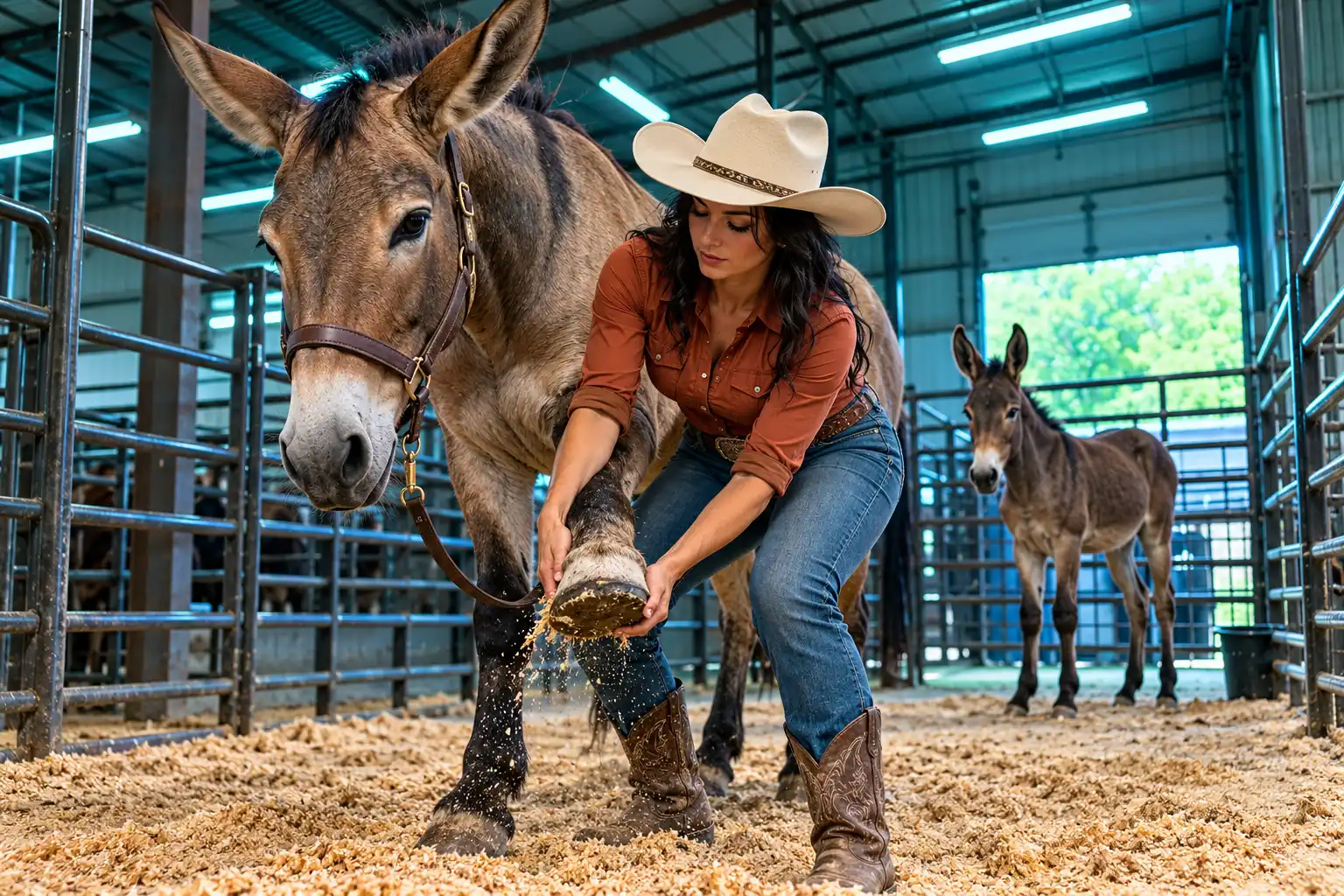
Riding mules faced two tasks before the arena, bridling and lifting all four feet, then nine inside it. Driving teams were scored on ease of hook, walk, trot, and stand, with another mule circling them to imitate a wagon-trail distraction. The course winner was Pearl, a 10-year-old gray Appaloosa mule at 13 hands 3 inches, consigned by Mark and Jennifer Bailey of Linden, Texas. Second was Big Casino, an 8-year-old brown john.
- Lead in the arena, then mount
- Cross a bridge and walk through brush
- Lead a pack mule
- Lope a circle, stop, and back
- Turn two full circles each direction
The two high sellers were both eight-year-old johns at $24,000 each. Big Casino, consigned by Loren Basham of Pairadice Mules, stood 15 hands 2 inches. Dudley, an 8-year-old bay john at 15 hands consigned by Jason Griffin, matched that price. One of the two stayed in Oklahoma and the other went to California. Next was George Clooney, a 7-year-old chestnut john at 15 hands, at $17,000. A 10-year-old dun molly, also called Chrome and a different animal from the Utah sale, brought $15,500 even though she had missed the Thursday course and sold after the catalog. The ages at the top of this sale were 7, 8, and 10, not weanling age.
How Much Is a Mule for Trail, Pack, or Driving?
Once you know which ring you are in, the next split is the job. A sale average mixes trail mules, shorter riding mules, and teams. Your price should follow the work you need, not the word mule on the ad.
Trail Riding Mules
The Ada high sellers were riding mules with a public trail test behind them, not prospects. Use those animals as a picture of what a demonstrated ride cost at one fall production sale, not as a ceiling for every state.
- Big Casino, 8-year-old brown john, 15 hands 2 inches: $24,000
- Dudley, 8-year-old bay john, 15 hands: $24,000
- George Clooney, 7-year-old chestnut john, 15 hands: $17,000
A private-treaty trail mule can land anywhere around those figures or well under them, because you are not bidding against a crowd that just watched the same course. Ask to ride the actual terrain you care about, or as close as the farm allows. A quiet circle in a round pen does not show you brush, bridges, or a pack animal at the mule’s hip.
Pack Mules and Driving Teams
Ada consigned six driving teams and did not publish a separate team average, so there is no honest single price for a broke driving mule from that day. What the sale did publish is the test: hook, walk, trot, and stand while another mule circled the team. If you want a wagon mule, that is the work to watch, and a seller who will only drive in a familiar lane has not shown you the hard part.
Packing showed up inside the riding course as one obstacle, leading a pack mule, rather than as its own price class. A mule that packs elk or trail gear for a living is priced for that habit, the saddle it accepts, and the miles already on it. Leading a pack mule once in an arena is a start. It is not the same as a season of dead weight on a steep trail. Pay for the season if you need the season, and do not pay a packing price for a mule that has only been ponied around a pen.
Shorter Mules and Minis
Height was not a discount aisle at Ada. Thirty-two of the 68 catalog mules were under 14 hands, and the trail-course winner stood 13 hands 3 inches. A shorter riding mule can be the one you want if your saddle, your trails, and your own size fit it. A mini mule, small enough for a child or a cart, is a different body with the same categories of cost: hooves, teeth, vaccines, shelter, and a vet who still charges a farm call.
HEIGHT IS NOT A DISCOUNT
- Forage drops with body size, and that is the line that shrinks.
- Hoof care, dental work, and emergency calls do not shrink with the mule.
- A mini still needs safe fencing and a dry place to stand.
If a very small mule is priced like a top trail mule, you are paying for training, temperament, or a color someone wants, not for pounds of animal. Ask what the mule does for that money, and watch it do that job.
What Does a Year of Mule Care Cost?
There is little rigorous research on mule diets. The practical suggestion, in the Merck Veterinary Manual’s February 2026 review of feeding, is that mules be fed like their donkey parent, on feeds high in fiber and low in nonstructural carbohydrates, the sugars and starches in grain and rich grass. Donkeys of a given weight need less energy than horses of that weight.
The manual suggests donkeys do well on about 1.5% of body weight in dry matter each day, with a ration built as 70 to 75% barley straw and 25 to 30% moderate grass hay or pasture, plus a ration balancer and constant water. It does not print a separate mule recipe. It points mules at that donkey pattern rather than at a grain-heavy horse diet. Rich pasture plus sweet feed is how easy keepers get too fat, and the same review warns against starving an overweight donkey because of the risk of hyperlipemia. If your mule is heavy, ask a vet before you slash the ration.
For a planning floor on everything that is not feed quality, Jason Turner’s New Mexico State University guide, revised in May 2022 for an adult 1,100-pound horse, puts a year of basic care in New Mexico in the ranges below. The guide covers equines, and it is explicit that the dollar figures are horse figures. Use them as the categories a mule still needs, not as a mule invoice.
| Line in the May 2022 guide | Printed range for one horse |
|---|---|
| Feed | $1,000 to $2,000 |
| Hoof care | $200 to $550 |
| Basic healthcare | $150 to $300 |
| Those costs for a year | $1,350 to $3,000 |
| Startup with shelter, fence, and tack, not the animal | Can exceed $6,500 |
The low ends of feed, hoof care, and basic healthcare add to the $1,350 floor the guide prints. The guide’s own top for that year is $3,000, a round figure it states on its own rather than as the sum of the three high ends. Set $1,350 beside the Ada gap. Three years at that rate comes to $4,050, which is $25 under the $4,075 difference between the open-ring average and the catalog average. Five years at $1,350 comes to $6,750, which is $385 more than the $6,365 catalog average itself.
Turner told readers, in that May 2022 revision, to consider a 10% increase when they build a budget, because prices were rising. Treat $1,350 as the printed floor, not a quote from your 2026 feed store. The yearly band also leaves out boarding, a truck and trailer, tack you do not already own, dental work beyond a basic plan, and any emergency. Hooves in the horse guide are trimmed every 8 to 10 weeks. A mule still needs a farrier on the interval your farrier sets, and shoes or corrective work sit outside a bare trim.
The same guide asks for at least 150 square feet of shelter per equine, so the animal can get out of severe weather, and for fences 4.5 to 6 feet tall. It notes that many New Mexico city and county rules require at least an acre before you can legally keep livestock. Check the rule where you live before you haul a mule home. A colic, a bad laceration, or a hospital stay is a separate bill. Ask your vet what an after-hours farm call costs in your county while the mule is still healthy.
How Do You Check a Mule Before You Pay?
A production sale like Ada shows you many mules in two days, with a trail score you can watch. A premier sale narrows the group before you arrive. Chrome in the Canyon, in its seventh year, requires a veterinary exam no more than 30 days old on every accepted mule, then sifts for age, limb and wind soundness, and fitness to sell. It also offers try-before-you-buy time. A private seller can match that standard if you ask. A classified ad will not do it for you.
- Watch the mule do your job, including whatever spooks you on your own trails or in your own hitch.
- Catch it, halter it, pick up all four feet, and see it load if you need to haul.
- Read a recent vet exam, and have your own vet watch the mule move if the price is a catalog-level check.
- Ask who trained it and what it refuses, including separation from a buddy.
- Compare the ask with the ring you are actually in: colt, open, catalog, or premier.
A low asking price on an unstarted mule leaves the training for you to buy later, in lessons or in mistakes. If you already start young equines, the Ada colt range is a real market. If this is your first equine, the mules that have already been through a course like Ada’s are the ones whose price includes someone else’s years. Papers and a pretty color do not substitute for that course.
Colby and Codi Gines, who own and operate MM Auction Services, put the top of the premier market in plain words after the May 9, 2026 sale.
The 2026 Chrome in the Canyon Premier Mule Sale was truly one for the history books. After setting a new world record selling mule in 2025 (PairADice Mules), we did it again in 2026 (Petersen Mule Company). Chrome in the Canyon officially became the first mule sale in the world to ever sell a mule for a six-figure price.
Colby and Codi Gines, MM Auction Services
Sugar, lot 34 from Petersen Mule Company, was the mule that brought $100,000. Playgirl, lot 43 from Black Mountain Outfitters, was the reserve at $68,000. The sale’s own channel posted the auctioneer’s call when the high bid hit six figures.
That price describes a sifted molly at a premier sale, not the mule in a local classified. Put an ordinary riding mule next to Ada’s catalog average and its open-ring average, then decide which demonstration of training you are paying for.
Frequently Asked Questions
Can a Mule Earn Its Price by Breeding?
No. You buy a mule for the work it can do, not for foals to sell later. A horse carries 64 chromosomes and a donkey carries 62, so the foal of a male donkey and a female horse ends up with 63. That odd count will not pair into working sex cells, which is why a mule cannot reproduce.
How Long Can a Mule Live?
The oldest mule on record, Tootsie, was 56 when he died in 2019 at The Donkey Sanctuary in the United Kingdom. For a budget, use the span New Mexico State University gives a horse, 20 to 30 years. At $3,000 a year, that guide says lifetime care can exceed $60,000.
Is a Mini Mule Cheaper to Keep?
A smaller mule eats less forage than a full-size one, and that is the line that shrinks. Hoof trims, dental work, vaccines, and a vet’s farm call do not get a short-mule discount. A mini still needs a safe fence, a companion, and a dry place to stand, so the purchase price is the wrong place to look for the savings.
Are Donkey Prices a Guide to Mule Prices?
No. A donkey and a mule can share a sale bill and still be different markets. At Ada, jacks sold outside the mule catalog, and those donkey prices do not tell you what a riding mule should cost. Price the mule by its training and by the ring it is in.
A premier weekend in Utah lets buyers watch a trail course and sit on the mule before the bid. Ask a private seller for the same kind of afternoon. If you cannot catch the mule, pick up its feet, and see the job you need, the asking price is still a guess.


Edinburgh Opens a 2027 Tour Built for Time Trials

Korda Maps Auður From Meðalland to Irvine Bay

Apple Music Films Its New Logo in Mineral Oil

Oppo Prices the Pad Mini Above India’s iPad Mini

Austen Soaks Scotland Before Boelo Brings Weekend Gales

Volkswagen Sells the Osnabruck Plant to Clear a Board Fight

Apple’s Foldable iPhone Hinges on Samsung Display Supply

Saksham Gaur Finds He Is His Own Company’s Client

Tata Motors’ Iveco Tender Opens as Holders Still Decide

What Is SD on Amazon Prime?
-
 AUTO2 months ago
Volkswagen Sells the Osnabruck Plant to Clear a Board Fight
-
 NEWS2 months ago
Apple’s Foldable iPhone Hinges on Samsung Display Supply
-
 BUSINESS2 months ago
Saksham Gaur Finds He Is His Own Company’s Client
-
 AUTO2 months ago
Tata Motors’ Iveco Tender Opens as Holders Still Decide
-
 TECHNOLOGY3 years ago
What Is SD on Amazon Prime?
-

 GAMING2 months ago
Onimusha Way of the Sword Preload Hits a Windows 11 Wall
-

 BUSINESS2 months ago
Hyderabad 22-Carat Gold Jumps After a False Bargain
-

 NEWS2 months ago
The Frame Pro’s $1,200 Labor Day Cut Needs a Soundbar