
LIFESTYLE
How Many 16.9 Ounces Make a Gallon?
How many 16.9 ounces make a gallon? Seven full bottles leave you 9.7 fl oz short of a US gallon, so the line sits partway through bottle eight.

The question of how many 16.9 ounces make a gallon starts with the single-serve bottle from a US grocery pack, the one you are about to pour into a jug, a cooler, or a daily total you already chose. That bottle is a volume of liquid, and the gallon on a US jug is a US liquid gallon, which falls between two whole bottles rather than on one of them.
You pass a US gallon partway through the eighth bottle. Seven full bottles fall short, and eight full bottles run past the line.
A gallon defined in the UK takes more of the same bottles. Below, you get the US count, the pour that hits the line, what the 16.9 ounce label leaves off a 500 milliliter fill, and the checks for a half gallon, a case, and a kitchen scale.
What a US Gallon Holds in Fluid Ounces
A US liquid gallon is the volume on a US milk jug and a US water cooler, and it is fixed by law rather than by the bottle in your hand. The NIST Handbook 44 liquid volume table sets that gallon at 231 cubic inches.
That same gallon is 128 US fluid ounces. Every bottle count on this page starts by dividing 128 by the fluid ounces printed on the label you are holding.
- Quart: 32 fluid ounces, and four quarts fill the gallon.
- Pint: 16 fluid ounces, and eight pints fill the gallon.
- Cup: 8 fluid ounces, and sixteen cups fill the gallon.
In metric units, the same table lists the gallon as 3.785411784 liters, which is 3,785.411784 milliliters. You need that milliliter figure when the bottle is filled to a metric line and the ounce number on the front is a rounded label.
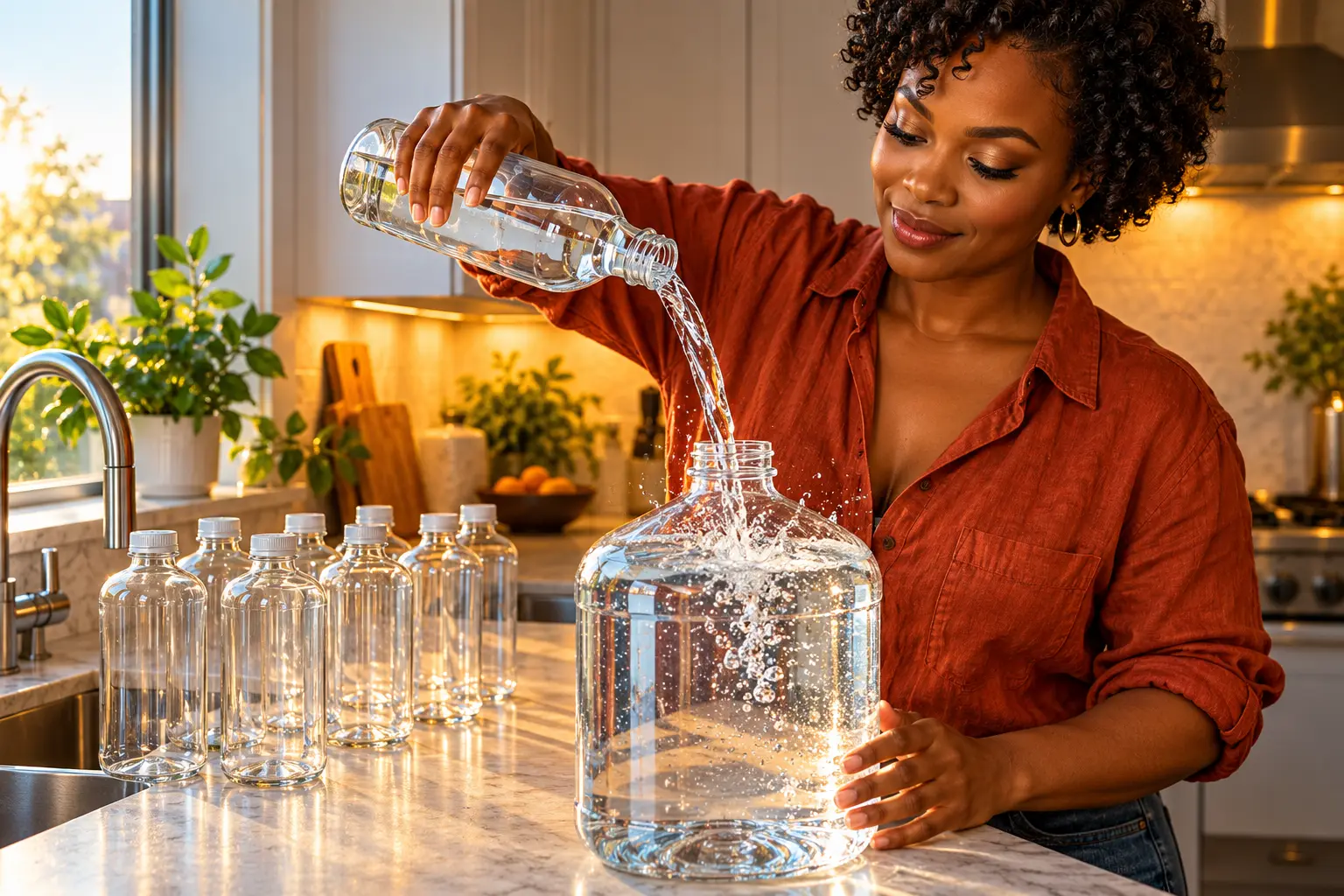
How Many 16.9 Ounces Make a Gallon of Bottled Water?
Divide 128 by 16.9. Rounded to two decimal places, the result is 7.57 bottles, so one US gallon of these bottles lands between the seventh bottle and the eighth.
Seven bottles labeled 16.9 fluid ounces hold 118.3 fluid ounces. You are still 9.7 fluid ounces short of the gallon, and that shortfall is a bit more than half of the next bottle.
Eight full bottles are the right call only when you need whole, sealed bottles and you can accept going over. The volume that matches the gallon is 7.57 bottles, which means seven bottles poured out and part of an eighth.
Seven Bottles, Eight Bottles, and the Gallon Line
The gap between those two whole bottles is small on paper and obvious in a jug. Seven bottles leave a gap under a one-gallon line, and the eighth bottle, emptied all the way, climbs past it.
| What you pour | Fluid ounces | Compared with 128 fl oz |
|---|---|---|
| 7 bottles | 118.3 fl oz | 9.7 fl oz short |
| The gallon itself | 128 fl oz | 7.57 bottles of 16.9 fl oz |
| 8 bottles | 135.2 fl oz | 7.2 fl oz over |
Take eight sealed bottles when you cannot pour a partial and you only need to clear a gallon. You will be 7.2 fluid ounces over, a few swallows rather than another full bottle. When the jug has a fill line, stop 9.7 fluid ounces into the eighth bottle.
There is a quick check on what is left. The eighth bottle holds 16.9 fluid ounces, and 16.9 minus 9.7 leaves 7.2 fluid ounces still in that bottle when the jug is full. If you empty it, those 7.2 fluid ounces are the same 7.2 you went over.
Pouring the Eighth 16.9 Ounce Bottle
After seven full bottles, the jug holds 118.3 fluid ounces. Pour 9.7 fluid ounces from bottle eight and stop. On a label that says 16.9 fluid ounces, 9.7 is about 57 percent of the bottle.
A measuring cup is the sure way to hit that pour. One US cup is 8 fluid ounces, so fill the cup once from bottle eight, empty it into the jug, and add another 1.7 fluid ounces. The jug is then one US gallon, and bottle eight is not empty.
A mark halfway up the plastic is only a rough guide, and only on a bottle with straight sides. Curved sports bottles hide the real halfway point, so the cup beats a guess when the gallon has to be exact.
Say the cooler has no markings and you want one gallon in it. Empty seven bottles into the cooler, then move 8 fluid ounces plus 1.7 fluid ounces from an eighth bottle through a measuring cup. You can drink or cook from what remains in bottle eight without losing track of what the cooler holds.
People who log eight finished bottles as one gallon are logging 135.2 fluid ounces. That is a full gallon plus the 7.2 fluid ounces that should have stayed in the last bottle, and the extra is in the total every time the eighth bottle is finished.
Why Does the Label Say 16.9 Ounces?
The 16.9 on a standard US water bottle is the rounded name for a 500 milliliter fill, not a second size of bottle. NIST lists one US fluid ounce as 29.57353 milliliters, and 500 divided by that figure is 16.907 fluid ounces, which the label rounds to 16.9.
Run the conversion the other way and 16.9 fluid ounces is 499.79 milliliters. The bottling line is set to 500 milliliters, a small step past the volume the rounded ounces name.
Use the 500 milliliter fill against the US gallon of 3,785.411784 milliliters and you still get 7.57 bottles when you round to two decimal places. Seven of those bottles are 3,500 milliliters, so the jug still needs about 285 milliliters from the eighth bottle, which is 57 percent of a 500 milliliter fill.
The label method asks for 9.7 fluid ounces, and the fill method asks for about 285 milliliters. Those two last pours differ by only a few milliliters. You still open an eighth bottle, and you still stop before that bottle is empty. For a cooler or a daily log, either reading is the same decision.
Other Bottle Sizes, Half Gallons, and Cases
The same division, 128 fluid ounces split by the size on the label, covers the other bottles in the fridge. A 16 fluid ounce bottle is the one that lands on a whole number: eight of them are one gallon, which is the count people borrow when a nearby label looks close to 16.
| Bottle on the label | Bottles in one US gallon |
|---|---|
| 8 fl oz | 16 |
| 12 fl oz | 10.67 |
| 16 fl oz | 8 |
| 16.9 fl oz | 7.57 |
| 20 fl oz | 6.4 |
| 24 fl oz | 5.33 |
| 32 fl oz | 4 |
| 33.8 fl oz (1 liter label) | 3.79 |
| 64 fl oz | 2 |
Any other label works the same way, including a reusable bottle you refill. Read the fluid ounces on that bottle and divide 128 by them. A bottle marked 20 fluid ounces needs 6.4 fills, and a bottle marked 32 fluid ounces needs 4 fills, because 32 times 4 is 128.
A half gallon is 64 fluid ounces, so it takes 3.79 bottles labeled 16.9 fluid ounces. A quart is 32 fluid ounces, which is 1.89 of those bottles. Read the row for the bottle you actually have before you borrow the eight-bottle line from the 16 fluid ounce size.
Packs run the same math in the other direction. A 24-pack of 16.9 fluid ounce bottles is 405.6 fluid ounces, which comes to 3.17 gallons.
A flat of 40 of those bottles is 676 fluid ounces, which comes to 5.28 gallons. When you buy water by the case, 5.28 gallons is the figure to write on a flat of 40.
If that flat is filled to 500 milliliters rather than to the rounded label, 40 bottles are 20 liters. Divide 20 by 3.785411784 liters per gallon and you still land on 5.28 gallons at two decimal places.
Check the letters in front of the ounce mark before you divide. The bottle you want says fl oz, or it shows 500 mL beside the ounces. A plain oz with no fluid mark, on a snack bag or a scale, is weight, and dividing 128 by that number will not give you a gallon of liquid.
An Imperial Gallon and the 16.9 Ounce Bottle
An imperial gallon is a larger measure, and it is still called a gallon on UK packaging and in older recipes. An imperial gallon is 4.54609 liters in the UK units schedule for the gallon.
That gallon is divided into 160 imperial fluid ounces, while the US gallon is divided into 128 US fluid ounces. The imperial fluid ounce is also a different size from the US one, so a US 16.9 ounce label cannot keep the 7.57 count once the gallon is imperial.
Count 500 milliliter bottles against 4.54609 liters and the imperial gallon holds 9.09 of them. Nine full bottles are 4.5 liters, which leaves about 46 milliliters still to pour from a tenth bottle. Ten sealed bottles clear an imperial gallon with room to spare.
The 16.9 figure itself is a US fluid ounce, tied to the 128 ounce gallon. Treating it as an imperial fluid ounce would shrink the bottle on paper and push the count further from 7.57. When the bottle also shows 500 milliliters, divide 4.54609 liters by 0.5 liters. That is the 9.09 count, and it does not depend on which ounce the printer chose.
A British recipe, or any measure that still names an imperial gallon, means this larger gallon. If the source is a US jug, a US cooler, or a US water label, stay with 7.57. If it is an imperial gallon, use 9.09 of the 500 milliliter bottles and the small extra pour.
Fluid Ounces, Weight Ounces, and a Kitchen Scale
A kitchen scale answers a weight question, and the bottle label is a volume question. Fluid ounces measure space in the jug. Ounces on a scale measure how heavy that liquid is, and the two meet only for a specific liquid at a specific temperature.
A US gallon of water at 62 degrees Fahrenheit weighs about 8 and one third pounds, or 133 and one third weight ounces, which is the comparison in the NIST note on gallon weight. The same gallon is still 128 fluid ounces. A scale that reads 128 has not found a gallon of water.
Milk, juice, and oil move the scale again, because a gallon of each does not weigh what a gallon of water weighs. That does not change the bottle count. Stay with the fluid ounces on the label, or with the milliliter fill, and leave the scale for a recipe that asks you to weigh the ingredient.
Frequently Asked Questions
How Many 16.9 Ounce Bottles Make Two Gallons?
Two US gallons are 256 fluid ounces, so you need 15.15 bottles labeled 16.9 fluid ounces. Fifteen of those bottles hold 253.5 fluid ounces, which leaves 2.5 fluid ounces to pour from a sixteenth bottle.
How Many Cups Are in a 16.9 Ounce Bottle?
One 16.9 fluid ounce bottle holds 2.11 US cups. A US cup is 8 fluid ounces, and dividing 16.9 by 8 rounds to 2.11 cups, a little over two level cups.
Do Milk, Juice, and Oil Use the Same Bottle Count?
Milk, juice, and cooking oil use the same bottle count as water, because the fluid ounce on the label measures volume. A kitchen scale will not match from one of those liquids to another, so keep the scale out of this conversion and pour by the label.
Is a UK Pint the Same as a 16.9 Ounce Bottle?
A UK pint is not the standard US single-serve water bottle. Britain’s pint is larger than the fill US labels round into the ounce figure on that bottle, so use the volume printed on the UK bottle instead of the US gallon count.
Once you know which gallon is printed on the jug, the bottle in your hand is a measuring cup you already own. Hit the line with a partial last bottle when the volume has to be exact, and open one more sealed bottle only when you are counting whole bottles or full cases.

Edinburgh Opens a 2027 Tour Built for Time Trials

Korda Maps Auður From Meðalland to Irvine Bay

Apple Music Films Its New Logo in Mineral Oil

Oppo Prices the Pad Mini Above India’s iPad Mini

Austen Soaks Scotland Before Boelo Brings Weekend Gales

Volkswagen Sells the Osnabruck Plant to Clear a Board Fight

Apple’s Foldable iPhone Hinges on Samsung Display Supply

Saksham Gaur Finds He Is His Own Company’s Client

Tata Motors’ Iveco Tender Opens as Holders Still Decide

What Is SD on Amazon Prime?
-
 AUTO2 months ago
Volkswagen Sells the Osnabruck Plant to Clear a Board Fight
-
 NEWS2 months ago
Apple’s Foldable iPhone Hinges on Samsung Display Supply
-
 BUSINESS2 months ago
Saksham Gaur Finds He Is His Own Company’s Client
-
 AUTO2 months ago
Tata Motors’ Iveco Tender Opens as Holders Still Decide
-
 TECHNOLOGY3 years ago
What Is SD on Amazon Prime?
-

 GAMING2 months ago
Onimusha Way of the Sword Preload Hits a Windows 11 Wall
-

 BUSINESS2 months ago
Hyderabad 22-Carat Gold Jumps After a False Bargain
-

 NEWS2 months ago
The Frame Pro’s $1,200 Labor Day Cut Needs a Soundbar