
NEWS
The iPhone 18 Pro Cooler Is Making Screen Repairs Harder
iFixit still scores the iPhone 18 Pro 7 out of 10, even after a larger cooler left display frames cracking on three of four teardowns.

iFixit cracked the plastic display frame on three of four iPhone 18 Pro phones it opened, then still scored the handset a provisional 7 out of 10. The outside matches last year’s Pro. The inside is a larger cooler, a new A20 Pro chip, and a main camera that now blinks with six mechanical blades.
The repair grade did not move. The path into the phone did. Most jobs still start by heating off the screen, and that is where the new cooling stack may be fighting the glue.
Three of Four Screens Lost Their Plastic Frame
On September 20, 2026, iFixit published its iPhone 18 Pro and 18 Pro Max teardown. The back glass came off cleanly. Almost nothing serviceable sits behind it except the wireless charging coil, so the real work still begins at the front glass.
The panels themselves kept working. The white plastic frame around them cracked or pulled away in three openings. That frame is part of the display assembly, not a clip you reorder. Fresh perimeter glue will not mend broken plastic, and a damaged frame will not sit flush or seal against water the way the original did.
Four phones are too few to establish a failure rate. Adhesive strength, heating, technique or a difference in the plastic could all matter. That plastic frame has been present since the 15 Pro. But it hasn’t given us nearly as much trouble in previous years.
Liz Chamberlian and Carsten Frauenheim, iFixit director of sustainability and repairability engineer, iFixit teardown
Zach Nelson, who tears phones down on JerryRigEverything, did not snap the frame on his unit. He said an experienced tech could swap the screen in about 5 minutes and gave Apple a thumbs up for that step. He also said Apple’s out-of-warranty screen job is $329, with replacement part prices still unlisted.
You can watch iFixit’s own opening sequence here, including the frame that would not go back together.
WHAT WE KNOW
- The sample: iFixit opened four iPhone 18 Pro and 18 Pro Max units and damaged the frame on three.
- The spare: Apple does not sell that plastic frame on its own, so a break means a full display module.
- The other teardown: Nelson pulled his display without the same break and praised the screen-off step.
WHAT IS UNCONFIRMED
- The rate: iFixit says four phones cannot set a failure rate, and other openers have avoided the crack.
- The cause: glue strength, heat, method, a plastic change, or the new cooler could each be in play.
- The score hit: the broken frames have not cut the 7 out of 10 yet, because the team cannot yet repeat the failure on demand.
Put the working panel back without that frame and it will not sit flush with the body. For a shop, that turns a cracked screen into a forced full-display order even if the glass swap itself went fine.
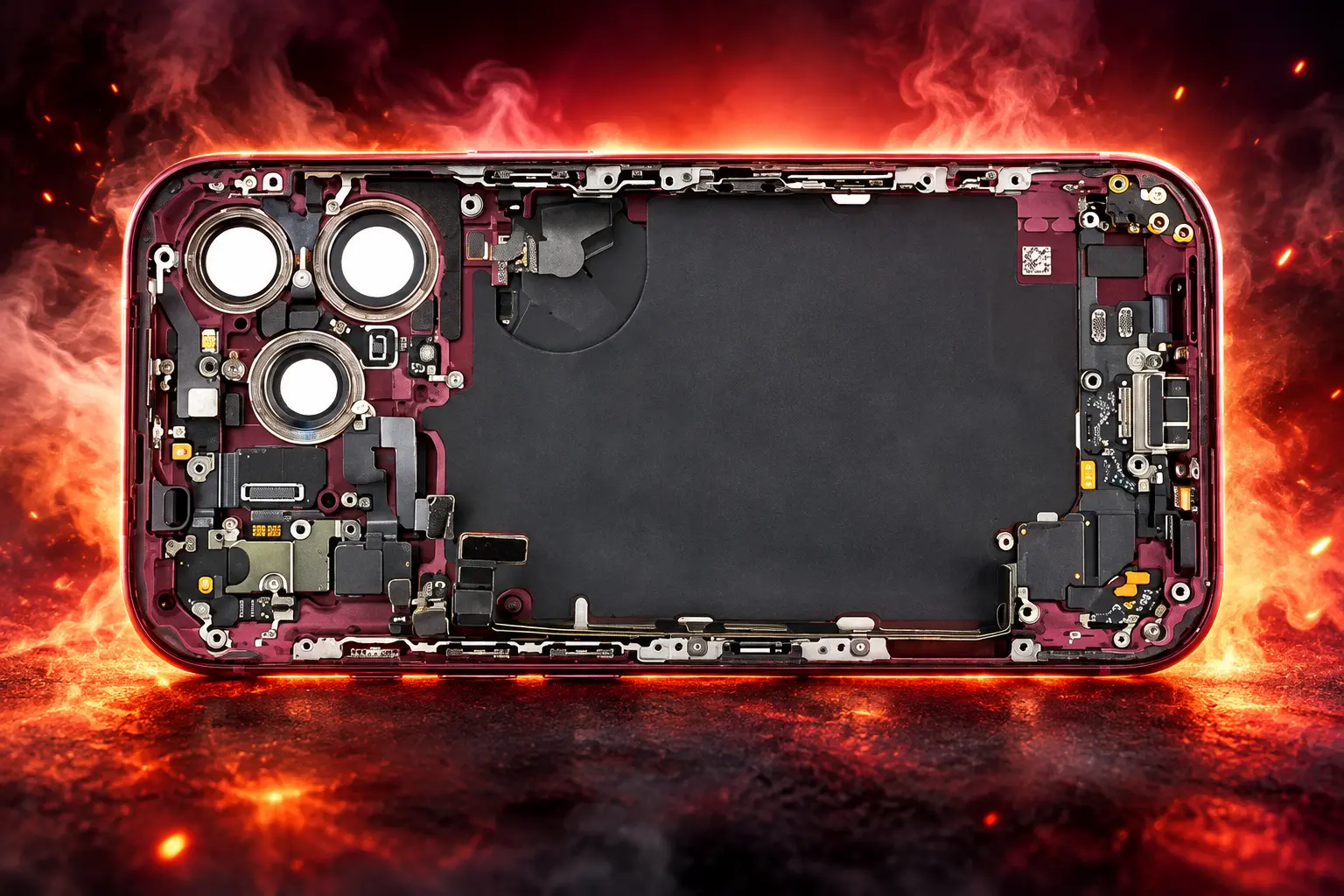
The Bigger Cooler May Be the Problem
Apple’s September 9, 2026 launch pitch leaned on a next-generation vapor chamber Apple announced with the A20 Pro, sold as the way the phone holds peak speed. iFixit found the chip moved to the outside of the logic board, with thermal material pressing it into a much larger chamber that runs across a wide stretch of the body.
That is a win while the phone is on. It is a problem when someone is trying to melt display adhesive. iFixit asked whether the improved thermals are pulling too much heat away from the seam, so the glue never quite lets go.
The one screen that came apart intact was heated for 15 minutes at 70 degrees Celsius, then another 10 minutes at 72. That is a long bake for a panel you hope to reuse. Apple’s own self-service steps tell techs to use the heated display removal fixture Apple specifies, then cut the adhesive and tilt the glass onto suction cups. iFixit says isopropyl alcohol might make removal more consistent, and it still wants more tests before it treats the crack as a design defect.
Independent openers who are not sitting on that long heat cycle keep getting the glass off without snapping the frame. That split is why the cooler matters more than a story about suddenly brittle plastic. The same white frame has been in the Pro since the iPhone 15 Pro. It started failing in a year Apple also put a much larger heat spreader under the display glue.
Six Hair-Thin Blades, One Camera Bill
The main camera is the other new moving part. iFixit pried the lens stack until the cover popped and aperture blades flew across the room. Six overlapping polymer-composite leaves, each about as thin as a human hair, ride pins and slots so the opening stays close to round. A magnet drives the motion. Hold a magnet near the leftover hardware and the iris still opens.
Apple’s Camera app offers four presets: f/1.48, f/1.8, f/2.8, and f/4.0. At f/1.48 the opening is about 4.6 mm on a 6.8 mm lens, and iFixit measured about 7.3 times more light than at f/4.0. The background still does not fall away like a big glass lens. In iFixit’s own test shots, the shop logo on the wall stayed readable even wide open.
THE MAIN CAMERA’S FOUR STOPS
- f/1.48: Widest iPhone main-camera opening yet, about 4.6 mm across, with the most background smear the tiny sensor can give.
- f/1.8: Close to last year’s default, and the stop most owners will still shoot.
- f/2.8: A middle step that trims light and tightens the plane of focus a little.
- f/4.0: Smallest preset, the sharpest of the four in iFixit’s wall test.
Variable aperture is not new in phones. Nokia shipped one on the N86 in 2009, and Samsung put one in the Galaxy S9 in 2018 before dropping the idea. Stuck blades and oily leaves are known failure modes on real cameras. iFixit is not calling the iPhone doomed. It is saying the replacement path is the whole module.
We dismantled the main camera and concluded that an aperture-only repair isn’t going to be feasible: If your aperture gets stuck, you’ll be looking at replacing the entire main camera assembly.
Liz Chamberlian and Carsten Frauenheim, iFixit, iPhone 18 Pro teardown
Apple has not put 18 Pro camera kits in the store. The 17 Pro camera assembly still lists at $249, and iFixit expects the extra mechanism to push that number up. The module itself is easy to unplug and lift once the screen is off. The catch is getting the screen off without breaking a frame you cannot buy, then paying for a camera you cannot rebuild if one hair-thin leaf jams.
Why the Battery Swap Still Starts at the Glass
Shops will replace far more batteries than stuck irises. The 18 Pro keeps last year’s better idea: a metal battery tray held with screws, plus electrically released adhesive on the cell. iFixit’s photos show that adhesive peeling in a clean sheet. Apple’s 18 Pro Max battery procedure has techs pull the display first, then remove 14 4IP screws and lift the tray as a unit. Nelson noted that Apple’s official battery part arrives already mounted to a new mid-frame, so the tray just screws in.
You still cannot start that job from the back. Front-entry-only, inherited from the 17 Pro, means the glued screen is the door to the cell. A battery repair now carries the same frame risk as a glass repair.
IPHONE 18 PRO BATTERY CAPACITIES
| Model | SIM setup | Capacity |
|---|---|---|
| iPhone 18 Pro | SIM card + eSIM | 4,056 mAh |
| iPhone 18 Pro | eSIM only | 4,288 mAh |
| iPhone 18 Pro Max | SIM card + eSIM | 5,391 mAh |
| iPhone 18 Pro Max | eSIM only | 5,567 mAh |
eSIM-only 18 Pro and 18 Pro Max units ship in the United States, Canada, Mexico, Japan, Bahrain, Kuwait, Oman, Qatar, Saudi Arabia, the UAE, Guam, and the U.S. Virgin Islands. Those models use the space a SIM tray would have taken. Apple rates video playback at up to 36 hours on the 18 Pro and up to 45 hours on the 18 Pro Max for those eSIM phones, and it says a compatible 60W-class adapter can add about 50 percent charge in around 15 minutes.
The larger cell is the easy political win in a teardown. It does not change the entrance. If the frame keeps cracking under heat, the battery tray’s screws will not save a shop from ordering a whole display it never meant to touch.
Apple’s Parts List Stops at the Display Module
Apple posted 18 Pro Max repair manuals on September 18, 2026, the day the phones reached customers. Display adhesive, cowlings, grounding springs, and color-matched pentalobe screws (Black, Silver, Burgundy, Glacier) are all called out. The plastic display frame is not. iFixit’s writers noted that the manuals also stay silent on what to do if that frame cracks, which happened to them three times in a row.
The US Self Service store still listed no iPhone 18 kits on September 19, 2026, a day after the manuals went live. Until those kits land, even a careful DIY job is a guide without parts.
Software pairing is in better shape than it was when the 15 Pro first scored 4 out of 10. Apple’s September 18 parts policy says the 18 Pro and 18 Pro Max accept used Apple parts Apple will now pair for the back glass, battery, camera, display, enclosure, front camera, main microphone, speakers, Taptic Engine, and USB-C connector. The camera footnote is stricter than the rest: Repair Assistant or a factory restore is required to enable it, and Repair Assistant is required for Apple Reference Image. Face ID on a used front camera also needs Repair Assistant.
USED PARTS APPLE WILL PAIR ON IPHONE 18 PRO
- Daily jobs: Display, battery, back glass, speakers, Taptic Engine, and USB-C can run as used parts from the same model.
- Cameras: Rear and front modules are allowed, with Repair Assistant (or a restore on the rear camera) before they fully come back.
- The gap: The white display frame is not a line item, so a cracked frame has no legal used-part path except a full screen.
That is the shop-floor squeeze. Apple will sell you a display, and it will let you calibrate a used one. It will not sell the strip of plastic that lets a reused panel sit flush. Nelson’s warning sits next to that gap: aside from screen and battery, he said Apple still makes every other repair painfully hard, and USB-C is the example iFixit keeps citing, because the port is buried behind a stack of internals.
iFixit Held the Score at 7 out of 10
The number looks like a shrug. It is also the grade the Pro has worn since Repair Assistant arrived. iFixit credits the screw-down battery tray and the modular camera assemblies, plus Apple’s manuals and pairing tools, even while Repair Assistant still has calibration work left on supported parts. The score takes a hit because almost every repair still goes through the screen. The damaged frames have not cut it further, on purpose.
IPHONE PRO REPAIR SCORES SINCE 2023
- September 2023: iPhone 15 Pro ships with the plastic display frame; iFixit first scores it 4 out of 10, mainly over parts pairing.
- October 9, 2024: iFixit raises 15-series phones to 7 out of 10 after Repair Assistant can calibrate harvested parts on the device.
- September 2024: iPhone 16 Pro lands at 7 out of 10 with dual-entry, so some jobs can start from the back glass.
- September 2025: iPhone 17 Pro stays at 7 out of 10, drops dual-entry, and adds the screw-down battery tray.
- September 20, 2026: iPhone 18 Pro and 18 Pro Max get a provisional 7 out of 10; iFixit waits on parts, pairing tests, and whether the frame cracks spread.
iFixit’s public scoreboard still leads with older models and has not locked the 18 Pro in as a finished card. That matches the write-up. The 7 is a placeholder with unfinished business, not a verdict that the frame is fine.
Loud takes that the phone is unfixable by design are aimed at the wrong layer. A dual-layer logic board is a headache for a chip-off data lab. It is not the 3 p.m. job on a cracked front glass. The 7 out of 10 is honest about screws, trays, and software. It is quiet about a $329-class screen repair that can, in iFixit’s room, destroy a part with no SKU.
The Memory Chips Moved Into the Board
Moving the A20 Pro to the outside of the board is how Apple got the die against the vapor chamber. The trade is that NAND storage now sits inside that board sandwich. iFixit says any repair that has to reach those chips starts by splitting layers, adding heat and a chance to wound a phone that was already hurt. That is a data-recovery problem, not a battery-and-glass problem, and it should stay in that bucket.
Face ID’s infrared camera now lives under the display, which let Apple shrink the Dynamic Island. Fine for photos. Another reason you do not want to gamble with a heating pad on a panel you plan to keep.
Colors are Black, Silver, Glacier, and Burgundy. Storage runs 256GB to 2TB. That does not change the opening sequence. Until iFixit can take a fifth and sixth phone apart without snapping the frame, or Apple sells that strip of plastic, the cooler that keeps the A20 Pro from throttling is also the part of the story a cracked-screen customer will feel.

Edinburgh Opens a 2027 Tour Built for Time Trials

Korda Maps Auður From Meðalland to Irvine Bay

Apple Music Films Its New Logo in Mineral Oil

Oppo Prices the Pad Mini Above India’s iPad Mini

Austen Soaks Scotland Before Boelo Brings Weekend Gales

Volkswagen Sells the Osnabruck Plant to Clear a Board Fight

Apple’s Foldable iPhone Hinges on Samsung Display Supply

Saksham Gaur Finds He Is His Own Company’s Client

Tata Motors’ Iveco Tender Opens as Holders Still Decide

Onimusha Way of the Sword Preload Hits a Windows 11 Wall
-
 AUTO2 months ago
Volkswagen Sells the Osnabruck Plant to Clear a Board Fight
-
 NEWS2 months ago
Apple’s Foldable iPhone Hinges on Samsung Display Supply
-
 AUTO2 months ago
Tata Motors’ Iveco Tender Opens as Holders Still Decide
-
 BUSINESS2 months ago
Saksham Gaur Finds He Is His Own Company’s Client
-
 GAMING2 months ago
Onimusha Way of the Sword Preload Hits a Windows 11 Wall
-

 ENTERTAINMENT3 years ago
What is SD on Amazon Prime? – All You Need to Know
-

 BUSINESS2 months ago
Hyderabad 22-Carat Gold Jumps After a False Bargain
-

 NEWS2 months ago
iQOO 16 Locks 8,400 mAh While 100W Charging Holds