
BUSINESS
Big Tech’s $300 Billion Guarantees Bet Against Chip Lifespans
Nvidia, Meta, Broadcom and Alphabet wrote about $300 billion of AI residual-value guarantees.

Technology companies have written as much as $300 billion of residual-value guarantees for AI data centers and chips over the past year. Most of that exposure never shows up as ordinary debt.
The same firms set the replacement cycle for the gear inside those buildings. Nvidia’s largest backstop floors land, power and shell. It does not floor the GPUs.
Residual Value Guarantees Put a Floor Under Tomorrow’s Scrap
A residual-value guarantee is a promise about an object. Investors lend to a special-purpose vehicle that owns a data center or a rack of accelerators. The tech company says that if the asset is later sold or re-let below an agreed floor, it will cover part of the gap.
Because the borrower is the vehicle, the debt sits with the vehicle. The guarantor records a contingent commitment, often as a credit derivative or a footnote, and books only the loss it thinks is probable. Rating desks still fold the backstop into leverage math. Equity screens that sort on reported debt do not.
The product spread in 2025 and 2026 because cash flow no longer covers the build. Union Bancaire Privée’s September note finds hyperscaler capex is set to outrun cash flow, with 2026 spending near $820 billion against about $750 billion of operating cash. Silicon and servers are about 60 percent of a new site. A building can carry a 20-year lease. A leading-edge chip does not.
HOW A SHORTFALL REACHES THE GUARANTOR
- The trigger: The tenant misses rent or becomes insolvent, which is the event that opens the contract.
- The first salvage: The landlord must try to re-let the hall at the same price before anyone else pays.
- The second salvage: If that fails, the landlord tries to sell the premises or the kit.
- The cap: Only the remaining gap to the guaranteed minimum is due, and only up to a stated ceiling.
That waterfall is why lenders accept coupons close to the tenant’s own debt. They are buying a floor written by a name with a fortress balance sheet. They are also buying a floor under assets whose makers are already selling the next generation.
Nvidia’s $105 Billion Floor Covers Land and Power
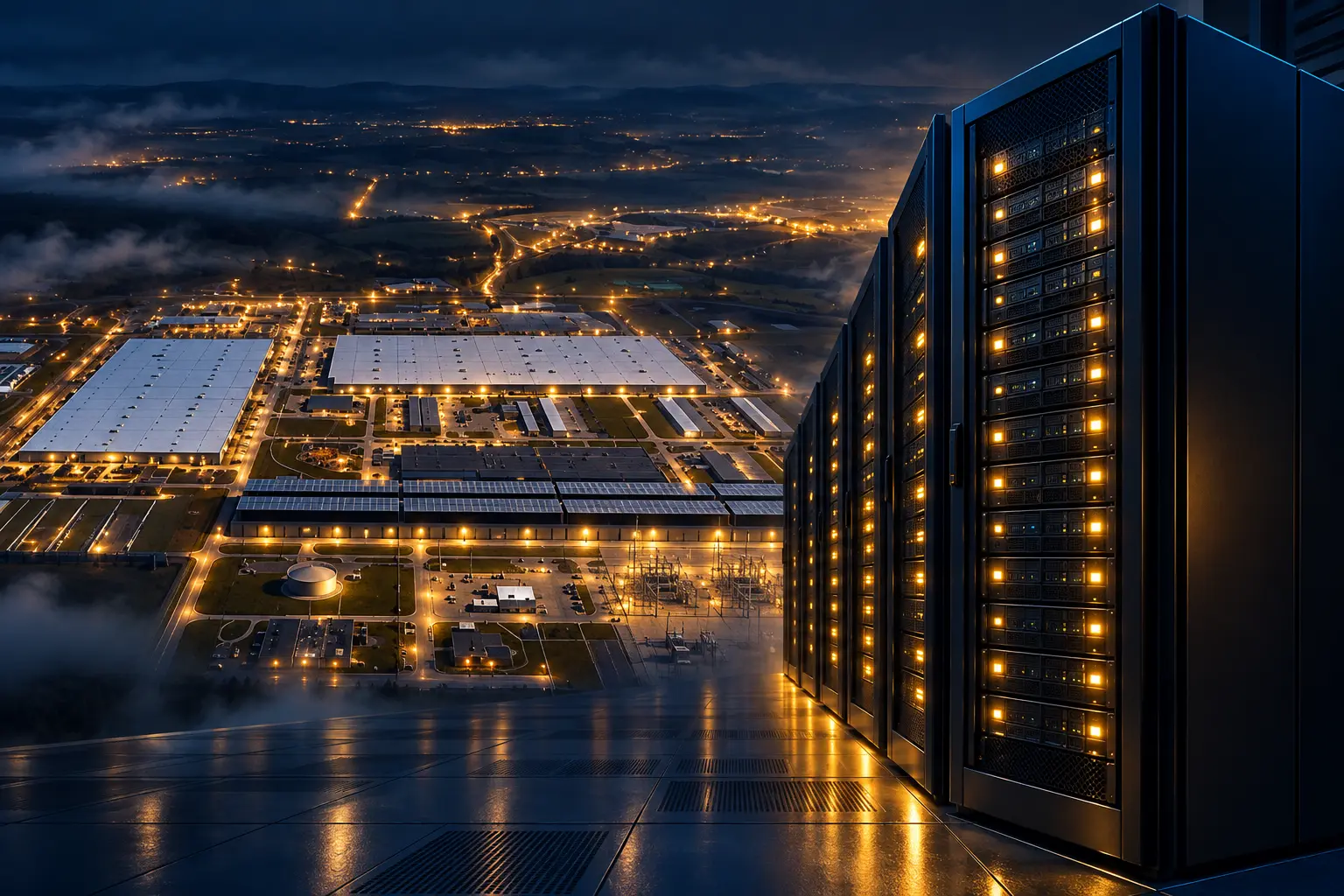
On August 17, Nvidia filed residual value guaranties capped at $105 billion with SB Energy, the SoftBank-backed developer of the PORTS-Pike campus in Pike County, Ohio. The initial cover is about 4.25 gigawatts of IT load. Nvidia may add support for about 3.8 gigawatts more, taking the campus to about 8 gigawatts. OpenAI is the tenant on a 20-year lease. Nvidia is the exclusive compute supplier.
Payment starts only after halls are ready for service, expected in 2028, which is Nvidia’s fiscal 2029. If OpenAI defaults, Nvidia covers the shortfall between the guaranteed minimum and whatever SB Energy recovers by re-letting or selling. Nvidia can assume the lease, force a re-let, start a sale, allow a termination, or defer for up to a year. OpenAI has agreed to reimburse Nvidia for any cash that actually goes out. A claim on a tenant that has run out of money is worth whatever that estate can pay.
The filing is careful about the collateral. Nvidia’s later quarterly language describes land, power and shell support. Other AI-cloud lease backstops add $3.5 billion, for $108.5 billion of disclosed gross exposure. The company is putting $1.5 billion of cash into SB Energy. Each generation of kit at the site could mean about 1.5 million GPUs, or $150 billion to $200 billion of Nvidia revenue, with several upgrade cycles over 20 years.
That is the tell. The firm that sets used-GPU prices will not write a public floor under used GPUs. It will write a floor under concrete, substations and empty halls, then lock the halls to its own silicon. A data-center shell depreciates over decades. A GPU is three architectures old in six years.
In some cases, NVIDIA may provide a residual-value support mechanism for up to 25% of an opportunity, assessed carefully on a project-by-project basis. That support is limited, residual-value based and designed to complement, not replace, independent underwriting.
Jensen Huang, chief executive, Nvidia, August 10 post
The 25 percent figure is the platform product, announced a week before Ohio. It is not the $105 billion cap. Ohio is a building residual. The platform is a thinner slice of project cost, offered so Apollo, BlackRock, Blackstone, Brookfield, Goldman Sachs and KKR can try to mobilize more than $500 billion of outside money against “AI factories.”
Alphabet Books Almost None of a $43.8 Billion Backstop
Alphabet’s instrument is a lease-payment backstop, booked as a credit derivative. Its June 30 10-Q shows credit derivatives of $43.8 billion in notional, up from $16.9 billion on December 31, 2025, a $26.9 billion rise in six months. It has also agreed about $24.1 billion of further backstops still being documented, plus $7.6 billion of energy-related financial guarantees, and $85.2 billion of data-center leases that have not yet started.
On a default, Alphabet can take the underlying lease for its own use or sublease it. The notional shrinks as tenants pay. Almost none of the $43.8 billion sits as conventional debt. The investigation that tallied the sector’s guarantees put the recorded loss estimate at under 2 percent of that notional.
Google’s TPU push uses the same credit. Fluidstack, an AI cloud, leases halls stuffed with those chips and rents the capacity to Anthropic. Alphabet standing behind Fluidstack’s rent is what lets lenders treat the paper as near-Alphabet risk. Broadcom, which builds the TPUs, took about $29 billion of guarantee exposure on a $35 billion vehicle, anchored by Apollo and Blackstone, that buys the racks and leases them to Anthropic.
THE FOUR LARGE BACKSTOPS
| Company | Cap | What is floored | Project |
|---|---|---|---|
| Nvidia | $105 billion | Land, power and shell | PORTS-Pike, OpenAI tenant |
| Alphabet | $43.8 billion | Lease-payment backstops | Third-party data centers, including Fluidstack |
| Broadcom | $29 billion | AI chips and racks | Anthropic lease vehicle |
| Meta | $28 billion | Campus residual value | Hyperion, Louisiana |
Those four caps are the visible core of the $300 billion guarantee tally. They are not Morgan Stanley’s separate estimate of more than $3.1 trillion in off-balance-sheet commitments at seven cloud and chip firms, a mix of unstarted leases, purchase orders and credit support. The $300 billion is the guarantee layer. The $3.1 trillion is the wider pipeline.
How Meta’s Hyperion Deal Became the Template
Meta opened the playbook last year on Hyperion, a roughly 2-gigawatt campus in Louisiana. A Delaware vehicle, Beignet Investor, raised about $27 billion of project debt from lenders including Pimco, BlackRock and Apollo, plus about $3 billion of equity. Blue Owl holds 80 percent of the development venture. Meta holds 20 percent and is the sole tenant. Meta wrote about a $28 billion residual-value guarantee, which is what let the notes price only a little wider than Meta’s own bonds.
The debt does not sit on Meta’s balance sheet as a loan. Meta argues it is not the party that has to find a replacement tenant. Credit committees still treat the guarantee as Meta paper. That is the point of the structure. It borrows Meta’s rating without borrowing Meta’s debt capacity in the same line item.
A similar pattern showed up in El Paso, where BlackRock holds 80 percent of a Texas campus and Meta is again the tenant and a 20 percent owner. Once landlords and private-credit desks had a Meta-shaped residual, chip vendors copied it onto racks.
THE YEAR THE FLOOR WENT INDUSTRIAL
- October 2025: Meta’s Hyperion vehicle raises about $27 billion against a residual-value guarantee of about $28 billion, with Blue Owl as majority owner.
- March 2026: CoreWeave’s $8.5 billion DDTL 4.0, secured on GPUs and a $14.2 billion Meta offtake, is rated A3 by Moody’s, the first investment-grade mark on that collateral.
- June 2026: Broadcom takes about $29 billion of exposure on the Anthropic chip vehicle.
- August 10, 2026: Nvidia announces financing platforms meant to mobilize more than $500 billion, with residual-value support of up to 25 percent.
- August 17, 2026: Nvidia files the $105 billion PORTS-Pike guaranties on land, power and shell.
- September 20, 2026: Sector guarantees over the past year are tallied at as much as $300 billion.
CoreWeave’s loan is the other half of the irony. Disclosed GPU-collateralized facilities since 2023 add up to about $12.2 billion. Nvidia’s $500 billion platform target is about 41 times that history. The rating on CoreWeave’s paper was a rating on Meta’s willingness to pay, with GPUs as a fallback. Used-accelerator value still has no accepted index, no appraisal convention, and no deep second-hand market. That is why the biggest number in the sector now attaches to buildings.
The Last Time Vendors Financed the Buildout
Telecom-equipment makers ran a simpler version of this in 1999 and 2000. Lucent’s customer-financing commitments reached $7.2 billion. Across nine vendors, including Lucent, Nortel, Cisco, Motorola and Ericsson, outstanding vendor loans were later put at $25.6 billion. The pitch was the same: lend the customer the money to buy your iron, keep the factories full, and sell the loans onward.
When competitive carriers failed, the loans came home. Winstar’s bankruptcy left Lucent with about $500 million of bad credits on a facility that had been committed up to $2 billion. Nortel’s vendor-financing write-offs climbed as a share of those sales into 2001. The equipment makers had financed demand for their own products, then discovered that residual network gear was worth little once traffic forecasts broke.
The 2026 version is larger, cleaner, and better lawyered. Vehicles are bankruptcy-remote. Caps are explicit. Disclosures sit in 10-Q notes. That does not change the circularity. Microsoft invests in OpenAI and sells it cloud. Amazon is a large Anthropic investor and its main cloud. Nvidia and Broadcom take equity or guarantees alongside chip orders. Google supplies TPUs, holds a stake in Anthropic, and backstops the halls those chips occupy. Moody’s has called the result a more circular system that could mask true demand.
UBP’s note puts more than $1.25 trillion of compute commitments on OpenAI and Anthropic together, and says a large share of $2.3 trillion of contracted cloud revenue at the four largest providers is owed by those two private labs. Anthropic has reported an operating profit on about $65 billion of annualized revenue. OpenAI is expected to burn more than $200 billion of cash through 2029. Lease bills still start on a calendar, centered on 2027 and 2028, whether lab revenue has caught up or not.
The Paper Sits With Insurers and Private Credit
The hidden party is not the guarantor. It is the buyer of the vehicle’s notes. Insurers take long amortizing tranches because the duration matches their liabilities. Bond funds take hyperscaler unsecured paper. Private credit takes construction risk. Loan funds take neoclouds. Banks underwrite, warehouse and hold pieces that never appear in a bond index.
Those buyers are not underwriting GPU resale in any serious way. They are underwriting Meta, Alphabet, Nvidia and Broadcom. The residual-value clause is how a B-rated operator issues paper that behaves like A-rated credit. Moody’s and S&P are participants here. Their willingness to look through a guarantee is what lets a speculative-grade cloud raise money at investment-grade prices.
WHERE THE MONEY IS CONCENTRATED
- Guarantee layer: As much as $300 billion of residual-value and lease backstops written over the past year.
- Wider pipeline: More than $3.1 trillion of off-balance-sheet leases, purchase orders and credit support at seven firms, per Morgan Stanley.
- Ohio cash versus cap: $1.5 billion of Nvidia equity into SB Energy against a $105 billion contingent ceiling.
- Chip share of a site: About 60 percent of a new leading-edge campus is silicon and servers, the short-lived slice.
Credit has been less relaxed than equity. Broadcom and Nvidia five-year default swaps have traded near their widest levels of this cycle as the guarantee stack grew. New hyperscaler bonds have often cheapened after issue even while the rest of investment grade stayed tight. That is the market telling you the backstops are real claims, not marketing.
Huang Wants GPUs Treated Like Power Plants
Nvidia’s answer is to recast the chip as infrastructure. Huang’s August 10 post said AI factory compute is becoming an investable asset class, that CUDA keeps raising the output of installed hardware, and that the A100, launched in 2020, is still in commercial use six years later. He published H100 rental prints of about $1.70 per GPU-hour in October 2025 and about $2.35 in March 2026, and said the financing partners will underwrite each project on their own.
— Jensen Huang (@JensenHuang) August 10, 2026
That argument is the bull case for residual value. If software keeps lifting old silicon, and if a failed tenant’s cluster can be re-let the next week because every cloud speaks CUDA, then a 25 percent tail guarantee is cheap insurance and a building residual is almost boring. The A100 still earning rent is the specimen he wants credit committees to remember.
The conflicting specimen is the company’s own Ohio filing. If used GPUs were already infrastructure in the way Huang describes, the $105 billion floor would sit on the chips. It sits on the shell. Hyperscalers still depreciate AI servers over five or six years. Nvidia still ships a new data-center architecture on a roughly two-year drumbeat. A 20-year exclusive supply clause is how the vendor captures the refresh. The residual-value clause is how the landlord and the lender sleep.
This is not hidden in the illegal sense. The 8-Ks and 10-Qs carry the notionals. The irony is in the asset they chose to floor. Chipmakers are writing decades of value onto halls whose useful computing life they intend to keep resetting, and they are doing it with contingent paper that reports as a footnote until a tenant misses rent.
Nvidia’s Ohio obligation phases in from 2028 and falls as OpenAI pays. By the first upgrade cycle, the original accelerators in those halls will already be a generation behind the ones Nvidia is selling. The floor will still be attached to the concrete.
Disclaimer: This article is news reporting and analysis of disclosed guarantees, filings and credit research. It is informational only and is not investment advice, a recommendation to buy or sell any security, or a valuation of any residual-value contract. Readers should consult a licensed financial adviser or credit analyst who can review the specific filings, caps and trigger language before making any investment decision. Figures and statuses reflect company filings and research notes as dated in the piece and can change as new 10-Qs, 8-Ks and project documents are posted.

Edinburgh Opens a 2027 Tour Built for Time Trials

Korda Maps Auður From Meðalland to Irvine Bay

Apple Music Films Its New Logo in Mineral Oil

Oppo Prices the Pad Mini Above India’s iPad Mini

Austen Soaks Scotland Before Boelo Brings Weekend Gales

Volkswagen Sells the Osnabruck Plant to Clear a Board Fight

Apple’s Foldable iPhone Hinges on Samsung Display Supply

Saksham Gaur Finds He Is His Own Company’s Client

Tata Motors’ Iveco Tender Opens as Holders Still Decide

Onimusha Way of the Sword Preload Hits a Windows 11 Wall
-
 AUTO2 months ago
Volkswagen Sells the Osnabruck Plant to Clear a Board Fight
-
 NEWS2 months ago
Apple’s Foldable iPhone Hinges on Samsung Display Supply
-
 AUTO2 months ago
Tata Motors’ Iveco Tender Opens as Holders Still Decide
-
 BUSINESS2 months ago
Saksham Gaur Finds He Is His Own Company’s Client
-
 GAMING2 months ago
Onimusha Way of the Sword Preload Hits a Windows 11 Wall
-

 ENTERTAINMENT3 years ago
What is SD on Amazon Prime? – All You Need to Know
-

 BUSINESS2 months ago
Hyderabad 22-Carat Gold Jumps After a False Bargain
-

 NEWS2 months ago
iQOO 16 Locks 8,400 mAh While 100W Charging Holds