
ENTERTAINMENT
Ari Emanuel’s Memoir Covers a Bet He Already Placed
Roll the Calls sells the Hollywood superagent, but Ari Emanuel already moved the growth engine to TKO after a $1.1 billion-a-year UFC deal.

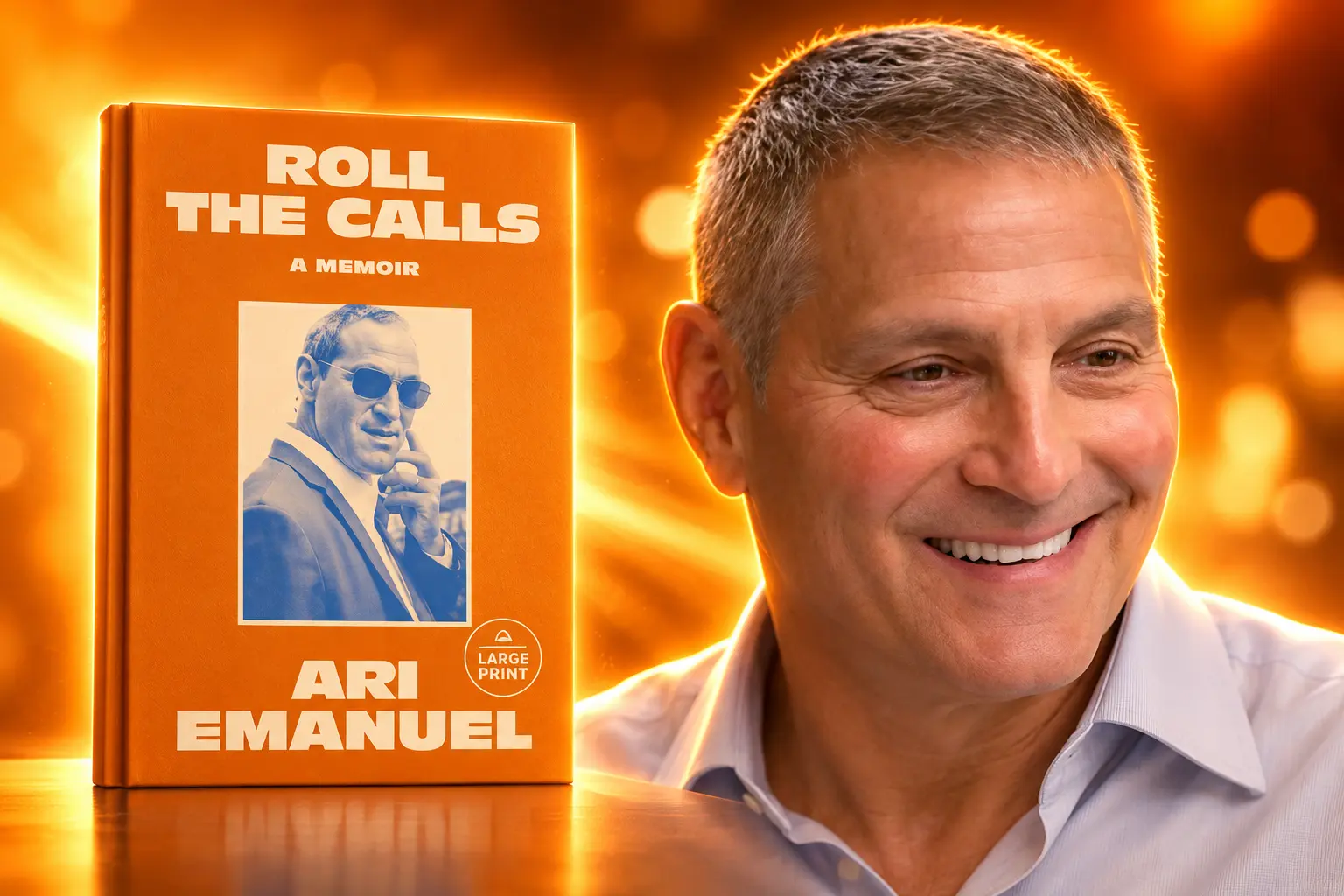
Ari Emanuel’s memoir Roll the Calls lands on Sept. 22, after he has already parked the growth engine at TKO, the public company that owns UFC and WWE. The 65-year-old sat with Turner Classic Movies host Ben Mankiewicz as the Hollywood superagent who inspired Ari Gold on Entourage. The filings and the rights deals describe a different job.
Knopf is selling the mailroom, the rage, and the client list. The cash register is live fights, sold without a pay-per-view window, inside a company Silver Lake already took off the public board.
The Memoir Arrives After the Money Moved
Alfred A. Knopf will publish the 432-page memoir due Sept. 22 at $35, with a first printing of 250,000 copies the house set when it announced the book in January. J.R. Moehringer, the Pulitzer winner who worked on Prince Harry’s Spare and Andre Agassi’s Open, is the collaborator. Bob Odenkirk reads the audio.
The jacket copy still leads with Hollywood. Emanuel traces dyslexia, the CAA mailroom, and a start-up agency that signed Larry David, Quentin Tarantino, Denzel Washington, Billie Eilish, Martin Scorsese, and Oprah Winfrey. Mankiewicz’s interview added Adele, Matt Damon, Ben Affleck, Bruno Mars, and Adam Sandler to the reel.
The author bio on the same publisher page is blunter about where he works now. Emanuel leads TKO as executive chair and CEO and is executive chairman of WME Group. Since co-founding Endeavor in 1995 he merged it with William Morris, bought IMG and UFC, and put WWE and UFC under TKO. The bio then names MARI, his events company, and the Las Vegas Raiders among current ventures.
He told Mankiewicz he is “satisfied-ish” and “happy-ish,” and that he does not like to say he is more competitive. He also said he created a culture people follow, then added that he still might be a moron. The shrug is part of the act. The calendar is not.
Paramount Pays $1.1 Billion a Year for UFC
On Aug. 11, 2025, Paramount and TKO announced a seven-year U.S. media rights agreement that made Paramount the exclusive home of UFC events in the United States, starting in 2026. The average annual value is $1.1 billion, with payments heavier toward the back of the term.
All 13 numbered events and 30 Fight Nights stream on Paramount+, and select numbered cards are simulcast on CBS. The pay-per-view extra charge is gone. David Ellison, Paramount’s chairman and CEO, called live sports a cornerstone of the company’s plan. Emanuel called the pact a landmark for UFC and said TKO wanted a partner that would use technology to improve the viewing experience.
UFC’s own fact sheet around that announcement is the industrial version of the memoir’s fight talk. The promotion stages about 43 live events a year, counts about 100 million fans in the United States, and says its programming reaches nearly 950 million households across more than 210 countries and territories in 50 languages, with a roster of about 600 athletes from 75 countries.
The money showed up in TKO’s accounts well before the book tour. On Aug. 3, 2026, the company reported second-quarter revenue of $1.547 billion for the period ended June 30, up 18 percent, or $238.7 million, from a year earlier. Adjusted EBITDA was $649.9 million, up 23 percent. The quarter’s net income of $303.9 million sat beside a raise in full-year guidance, now $5.775 billion to $5.825 billion of revenue and $2.275 billion to $2.305 billion of adjusted EBITDA. Year to date it had returned more than $1.3 billion to equity holders through buybacks, dividends, and related distributions.
TKO’S SECOND QUARTER BY BRAND
| Brand | Q2 2026 revenue | Increase from Q2 2025 |
|---|---|---|
| UFC | $535.7 million | $119.8 million |
| WWE | $620.9 million | $64.7 million |
| IMG | $354.7 million | $48.1 million |
Those three lines do not add to the whole company increase, and TKO did not pretend they did. UFC’s jump came with the Paramount money, sponsorship, and licensing. WWE’s premium live events, including WrestleMania, moved onto ESPN’s U.S. platforms in 2026 after a five-year deal Mark Shapiro, TKO’s president and COO, described as putting the E back in ESPN. IMG, which now includes On Location hospitality, rode World Cup demand. Shapiro is the day-to-day face. Dana White still runs UFC. Nick Khan still runs WWE. Emanuel’s name is on the holding company.
The $27.50 Take-Private Left TKO Public
The agency that made him famous is no longer a stock anyone can buy. Silver Lake completed its purchase of Endeavor on March 24, 2025, paying $27.50 a share and folding the representation businesses into WME Group. Emanuel shifted from Endeavor CEO to executive chairman of that private shop. Shapiro became president and managing partner. Patrick Whitesell, the former Endeavor executive chairman, left to run a separate Silver Lake-backed venture and to take WME’s football business with him.
The take-private paperwork shows Emanuel received $173.8 million in cash and rolled $290.27 million of equity into the private company, more than the rollover he first agreed. TKO stayed listed. That is the split that the memoir’s publicity keeps blurring: WME is a private talent shop with a famous name; TKO is the public sports company Wall Street can still mark to market.
THE BETS THAT LEFT THE AGENCY BUSINESS
- 1995: Emanuel co-founds Endeavor after leaving CAA.
- Sept. 12, 2023: TKO Group Holdings lists, combining UFC and WWE, with Emanuel as CEO.
- Feb. 28, 2025: TKO takes in IMG, On Location, and Professional Bull Riders from Endeavor.
- March 24, 2025: Silver Lake closes the Endeavor take-private at $27.50 a share; the agency brand becomes WME Group.
- Aug. 11, 2025: Paramount locks UFC U.S. rights at $1.1 billion a year for seven years.
- October 2025: Emanuel launches MARI to hold tennis events that used to sit inside Endeavor, including the Miami Open and Madrid Open.
- Sept. 22, 2026: Knopf publishes Roll the Calls.
A class-action later attacked the $27.50 price as too low. An Endeavor spokesperson called those claims flawed and meritless. The point for the book is simpler. By the time Mankiewicz turned up with a camera, the Hollywood agency was private again and the fighting brands were the ones still reporting quarters.
He Smashed a Tray and Lifted a Chair
The interview still had to do the origin work, because that is what a superagent memoir is for. Emanuel grew up near Chicago with a civil-rights-activist mother, a doctor father, and two older brothers, Rahm and Zeke, whose grades went up on a board at home. A C-minus meant you were grounded. He was the baby. Zeke was the smart one. Rahm was the artist. Dyslexia put him in special ed, and bullying put a lunch tray in his hands.
Grades Went Up on the Kitchen Board
He told Mankiewicz he asked a football player to stop mocking a classmate, got nowhere, and smashed the tray in the other boy’s face. One client, he writes in chapter one, simply calls him a “ragent.” He is fine defending himself and people he cares about, and he does not do well with people who threaten him. That is the childhood chapter every profile needs. It is also a mission statement for a company that sells sanctioned violence as mass entertainment.
The Ovitz Meeting Went Sideways
When he left CAA, he said, Mike Ovitz gave him the speech about never working in this town again. Emanuel stood, grabbed a chair, raised it, and asked if Ovitz was threatening him. “It was an extreme moment,” he said. Early on it was shoot, then aim. He laughed that the red button can still get hit.
The book opens that fight in the street. In an excerpt Knopf cleared for publication, it is early summer 1994, after a morning of rolling calls to 50 or 60 people. He eats an omelet at Kate Mantilini’s, steps off the curb at Doheny and Wilshire, and a black pickup takes his knees. He has been a wrestler, a brother in a rough house, a man in bar fights. He writes that he had never felt anything like that truck.
It’s so clear now: Life is not a dress rehearsal. Everyone says this. Sooner or later, everyone in this town repeats this truism. But few act on it.
Ari Emanuel, Roll the Calls, excerpted by Knopf
Parents’ stories in that chapter have one moral, he writes: life’s a fight. The memoir needs that line to sound like Hollywood. TKO needs it to sound like a slate.
AI Cannot Fake a Fight Card
Mankiewicz got him onto the future of show business, which is where the two jobs finally collide. Emanuel is upbeat about movies and television even as studios cut rooms and streamers chase cheaper hours. He wants the argument. He does not want a legacy question, which he called a bulls**t phrase and complete crap.
Telling stories is human nature. It’s always been around. It’s not going anywhere. Is AI and other things going to make it better? I think so.
Ari Emanuel, executive chair and CEO of TKO, to Ben Mankiewicz
He said there will actually be more movies and more television. He also said a writers’ room that used to be 12 people might be eight, and that people will argue whether that is good or bad. Then: let’s have that argument. The concession sits next to a business that does not need the room at all.
WHAT STILL HAS TO HAPPEN IN A BUILDING
- UFC numbered nights: Thirteen marquee cards a year now live on Paramount+, with no extra PPV fee, and bodies in a cage the model cannot generate.
- Fight Nights: Thirty more dates, the volume play, still require weigh-ins, cuts, and a gate.
- WWE premium events: WrestleMania and the rest of the PLE calendar moved to ESPN in 2026, live and loud, with Shapiro selling the entertainment half of the acronym.
- Hospitality: On Location’s World Cup work is the unglamorous cousin, rooms and tickets around events nobody will watch as a deepfake.
He can be right that stories survive. He already placed a second bet in case the rooms get smaller. Live fighting is the product AI cannot write, and it is the product Paramount agreed to pay $1.1 billion a year to stream. The memoir talks like an agent. The guidance talks like a sports owner.
WWE’s Content Chief Cut the Book Promo
Paul Levesque, WWE’s chief content officer, posted the friendly version of the rollout on Sept. 18. Congrats to his friend, pre-order today, hashtag on the title. The replies treated it as what it was: the boss’s book, assigned to the people who already work the live events.
Congrats to my friend @AriEmanuel on his new book #RollTheCalls…pre-order today!https://t.co/jFhjM06wLs pic.twitter.com/O7MXe5eYVe
— Triple H (@TripleH) September 18, 2026
That is the publicity map. Knopf can send Emanuel through bookstores. TKO can put him in front of the audience that already buys the cards. A Hollywood reading of Roll the Calls looks for packaging lore and Ovitz gossip. The louder official channel is wrestling, because that is whose parent company still files 8-Ks.
Some early readers came away wanting more agenting than they got, which tracks with the job he actually does. He still talks like a man who takes dreams and makes people realize them, who fights a studio when it gets in the way. He also chairs the company that ended UFC pay-per-view in the United States and moved WrestleMania onto ESPN. The calls he rolls now are as likely to be rights, arenas, and buybacks as they are a script on a night run from the mailroom.
Tickets Are on Sale for the Book Tour
Emanuel posted the tour himself on Sept. 8, a pair of shots and a link, taking the calls on the road. The audio pitch went up in August with a thank-you to Odenkirk. Preorder graphics ran through his account all summer. The machinery is ordinary for a lead fall title. The author title in the bio is not: TKO first, WME second, MARI third.
We’re taking the calls on the road. 🎟️ Book tour dates + tickets at the link below 👇 https://t.co/GDFZ5Qx69V pic.twitter.com/hQO3h0wpD2
— Ari Emanuel (@AriEmanuel) September 8, 2026
Asked about legacy, he refused the premise and picked a different split. Would he rather have a meaningful life or a pleasurable one? Definitely meaningful. He said he has done everything he wanted to do, and that he keeps enjoying the creative process of making the puzzle in his own little world. He is not worried what his legacy is going to be. On Sept. 22 the puzzle gets a hardcover. The fights were already on the calendar.
Disclaimer: This article is news reporting and analysis of a memoir, an interview, and public company disclosures. It is for information only and is not investment advice, a recommendation to buy or sell TKO Group Holdings or any other security, or a prediction of book sales. Anyone considering a trade should consult a licensed financial adviser who can review their own holdings and risk. Revenue, guidance, deal terms, and titles are taken from the cited company and publisher materials as dated in those documents and can change with later filings or reprints.

Edinburgh Opens a 2027 Tour Built for Time Trials

Korda Maps Auður From Meðalland to Irvine Bay

Apple Music Films Its New Logo in Mineral Oil

Oppo Prices the Pad Mini Above India’s iPad Mini

Austen Soaks Scotland Before Boelo Brings Weekend Gales

Volkswagen Sells the Osnabruck Plant to Clear a Board Fight

Apple’s Foldable iPhone Hinges on Samsung Display Supply

Saksham Gaur Finds He Is His Own Company’s Client

Tata Motors’ Iveco Tender Opens as Holders Still Decide

Onimusha Way of the Sword Preload Hits a Windows 11 Wall
-
 AUTO2 months ago
Volkswagen Sells the Osnabruck Plant to Clear a Board Fight
-
 NEWS2 months ago
Apple’s Foldable iPhone Hinges on Samsung Display Supply
-
 AUTO2 months ago
Tata Motors’ Iveco Tender Opens as Holders Still Decide
-
 BUSINESS2 months ago
Saksham Gaur Finds He Is His Own Company’s Client
-
 GAMING2 months ago
Onimusha Way of the Sword Preload Hits a Windows 11 Wall
-

 ENTERTAINMENT3 years ago
What is SD on Amazon Prime? – All You Need to Know
-

 BUSINESS2 months ago
Hyderabad 22-Carat Gold Jumps After a False Bargain
-

 NEWS2 months ago
iQOO 16 Locks 8,400 mAh While 100W Charging Holds