
ENTERTAINMENT
The Weight Brings Oregon Gold Fever From Bavaria
Ethan Hawke’s The Weight reached US theaters as a 1933 Oregon gold trek that was shot in Bavaria, funded in Germany, and argued over as a 1970s throwback.

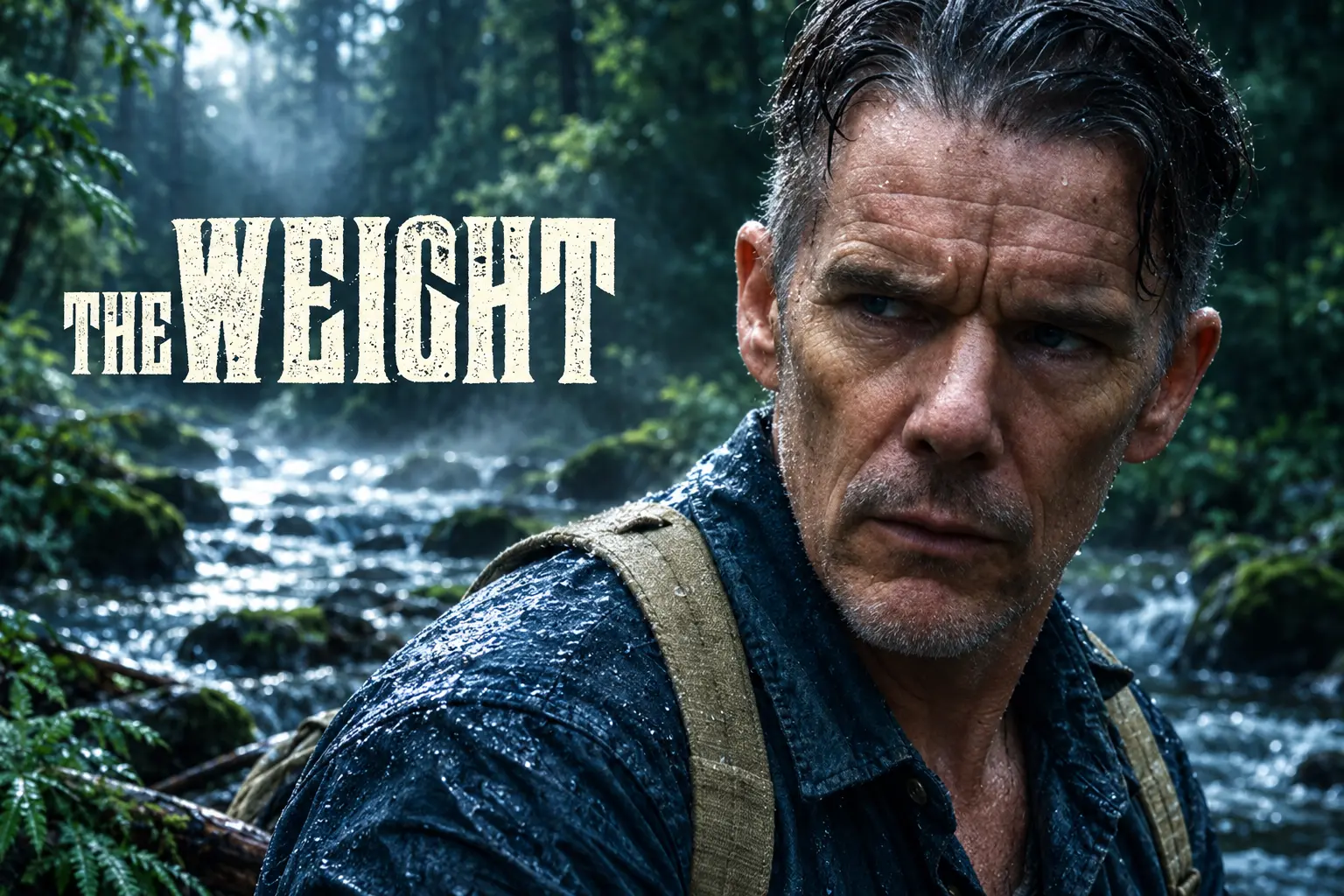
Padraic McKinley’s The Weight opened in US theaters on September 18, a Depression gold-heist shot entirely in Bavaria. Ethan Hawke plays Samuel Murphy, a widowed World War I veteran in 1933 Oregon who is torn from his daughter Penny and dumped in a labor camp. Russell Crowe’s Warden Clancy offers a pardon if Murphy can walk stolen gold through country that will kill him first.
Vertical is selling that trek as old-fashioned American adventure. The trees, the river, and a large share of the money are German, and the argument in the reviews is whether the film earns the 1970s movies it keeps summoning.
Bavaria Stands In for Depression Oregon
Producer Jonas Katzenstein, speaking during the shoot, told Bavarian radio why the company did not film in the United States. American studios, he said, chase very large pictures or very small genre jobs, and The Weight sits in the middle. “And for that, Germany is simply super.” He put the whole budget between 10 and 15 million euros, with about half of that money coming from Germany, including 2 million euros from Bavarian film funds.
The FilmFernsehFonds Bayern and the town of Viechtach both say the film was Viechtach’s forests as Oregon cover, with more work in Bodenmais, Tutzing on Lake Starnberg, Schliersee, and the Bavaria Studios. Katzenstein, walking the local branding, said the region already calls itself Bavarian Canada. In the future, he said, they could call it Bavarian Oregon. Americans who had seen early images, he added, found the cheat believable.
WHERE BAVARIA PLAYED OREGON
| Place | What the crew used it for |
|---|---|
| Schwarzer Regen, Viechtach | Hawke crossing a river up to his neck |
| Höllensteinsee | A large water set on the lake |
| Hochfall, Bodenmais, and the Großer Arber | Waterfall and mountain country |
| Quarry at Patersdorf | Broken ground for the labor-camp world |
| Pullman City in Eging am See | A standing western town |
| Bavaria Studios, Tutzing, Schliersee, Tegernsee | Interiors and more forest and lake cover |
Viechtach’s first mayor, Franz Wittmann, said the town was proud that its so-called Bavarian Canada could “embody the landscapes of Oregon.” Tourism chief Monika Häuslmeier wanted the extra name recognition. District administrator Ronny Raith admitted he had not expected American movies with international stars in the Regen district. The crew around them numbered about 130 people, and the shoot was closed to the press.
Five Years, Then Four and a Half Months
McKinley, a longtime editor making his first feature, came to the script through producers Simon and Nathan Fields of Fields Entertainment. He sent it to Hawke because the world felt cool even while the pages were still loose. Hawke was cutting a Paul Newman documentary at the time and wanted a role that lived in the pauses, then brought in writer and composer Shelby Gaines, a collaborator from The Good Lord Bird and Wildcat, for a rewrite. McKinley sent that draft to Crowe, who signed on, and the stalled project finally moved.
FROM REWRITE TO US SCREENS
- July 2025: Cameras roll in and around Viechtach, with Ryan Hawke producing for Under the Influence alongside Jonas Katzenstein and Maximilian Leo of augenschein Filmproduktion and Construction Filmproduktion in Munich.
- August 7, 2025: Katzenstein talks on the record about the budget and the Bavarian locations after weeks of secrecy.
- January 26, 2026: The film has its world premiere in the Premieres section at Sundance, listed at the time as a Germany/USA picture running just under two hours.
- February 17, 2026: It plays as a Berlinale Special Gala in February, the European premiere of McKinley’s debut.
- March 19, 2026: Vertical takes North American rights and dates a US theatrical release for September 18.
- June 25, 2026: Vertical puts out the official trailer.
- September 18, 2026: The film opens in US theaters, including AMC’s Artisan Films program, at 1 hour 55 minutes, rated R for language and some violence and bloody images.
McKinley compressed the last stretch into a sprint. “They said it took five years to get going and four and a half months from the day we started pre-production to the last time on the AVID,” he said. Hawke later said the movie would not have existed without Ryan Hawke on the ground, and that The Weight was one of the projects she worked hardest to force into being.
Vertical Put a Sundance Pickup in Theaters
Sundance programmer copy called the film a tense Depression-era crime drama about convicts moving through country that is physically and morally treacherous, and it pointed at the introspective action films of the 1970s. Pete Hammond, writing from Park City, called it a strong bet for a distributor that still wanted adult movies in theaters. Vertical took that bet in March and held the date through the summer.
The official trailer makes the bargain plain. Clancy drawls that a problem shared is a burden halved, and Murphy answers that his problem is a daughter who, in a month, will be a ward of the state. Even with good time, he is looking at six more months inside. Clancy has a friend who needs help moving gold that “is trouble,” and desperate people who think it ought to belong to them. Do this, he says, and your time is done.
That clip is doing a lot of the selling. It is also a two-hander pitch. The finished film uses Clancy as the man who starts the engine. Once Murphy’s crew is in the trees, Crowe recedes, which is how the plot is built, even if the poster still promises a Hawke-Crowe night.
Hawke Chased the Quiet of Cool Hand Luke
Hawke has talked more than he acts in a lot of his best work. He took Murphy because he wanted the opposite. The title, which he and McKinley both liked, comes from The Band’s 1968 song. The method was the hard summer in the German woods, ticks and Lyme disease and logs in the face, with everyone trying to take care of each other because the clock was short and the budget had no spare toys.
I’m a person who loves to talk, right? I can’t shut myself up, and I like verbiage in a performance. [The reason to do the movie] I was sitting there cutting this documentary about Paul Newman, and staring at Hud and staring at Cool Hand Luke and staring even at Butch, where the nonverbal moments are the moments.
Ethan Hawke, actor and producer, at Sundance
He also argued that audiences can smell a production that runs on private planes. “It’s fun to have a lot of toys, but it’s also more fun not to because then you have to get really inventive,” he said, “and then it puts pressure on the movie to be the movie we said we wanted it to be.” Austin Amelio, who plays prisoner Rankin, said McKinley arrived each day knowing the shot, even when a scene ran four hours.
McKinley had already cut The Good Lord Bird and The Loudest Voice and directed episodes of Kingdom, Fightworld, and Debris. Matteo Cocco shot the picture. McKinley edited with Matthew Woolley. Shelby Gaines wrote with Matthew Booi, from a story Booi shared with Leo Scherman and Matthew Chapman, and Gaines scored the film with his brother Latham. That is a small circle, and it shows. The movie looks expensive in the trees and cheap in the way it refuses to explain itself twice.
Why Some Critics Keep Pointing to Sorcerer
Rotten Tomatoes lists 93% of reviews as positive, with a critics’ consensus that the stripped-down tale becomes a hard-hitting thriller on Hawke’s work and McKinley’s direction. Metacritic has it at 70, generally favorable, with a posted split of 17 positive notices, 7 mixed, and 1 negative. Those are strong numbers for a first feature with no franchise. They are not a truce about the script.
THE SCORES THAT TRAVELED WITH THE FILM
- Rotten Tomatoes: 93% of reviews counted as fresh, average rating 7.3/10, theatrical runtime listed at 1 hour 55 minutes.
- Metacritic: 70, generally favorable, with one clearly negative notice in the posted mix.
- The argument underneath: Hawke and the set pieces are the common praise; the last act and the borrowed plot are the common flinch.
Matt Zoller Seitz called it a prison movie, a wilderness adventure, a psychological thriller, and a political fable about capital and labor, and said it works in every department. Bilge Ebiri, posting as the film reached theaters, wrote that it was one of the best films at both Sundance and Berlin and that he wished there was more hoopla around it. Peter Travers found it predictable and still gave it three stars out of four, seeing Cool Hand Luke in the prisoner and the warden. Mitchell Beaupre reached for John Huston’s The Treasure of the Sierra Madre and William Friedkin’s Sorcerer and meant it as a compliment.
WHERE CRITICS SPLIT
- The revival camp: Seitz and Ebiri treat the film as a form Hollywood barely funds, a trek movie with brains and dirt, and they want people in the room.
- The photocopy camp: Beatrice Loayza found the Booi and Gaines script forced, the racial lines blunt, and Julia Jones’s Anna a device who enters the plot because the story needs her.
- The last-act camp: Katie Walsh wanted the men changed by what they carried and walked out unconvinced that they had been. Several otherwise friendly notices say the same thing in plainer language: the walk is the movie, and the finish is not.
That split is the honest reception. The 93% is real. So is the sense, even among people who like the picture, that you have seen this job done with nitroglycerin in a truck and with gold in the Sierra Madre, and that McKinley is walking the same ridge on foot.
A Socialist, a Runaway, and a Rope Bridge
Murphy is jailed after a collision with undercover cops while he is trying to keep Penny housed. Avy Berry plays the girl, and the film keeps cutting her fate against the clock Clancy sets. In camp, Murphy proves useful. He can fix a car and move rock without dynamite. Clancy notices, then makes the offer that the trailer already spoiled.
WHO WALKS WITH THE GOLD
- Samuel Murphy: Hawke’s quiet technician, a father bargaining his body for a child the state is about to take.
- Rankin: Amelio’s prisoner, the volatile American muscle on the line.
- Singh: Avi Nash as an immigrant inmate whose socialism is the charge that actually stuck, a man Seitz watched lighting cigarettes like Burt Lancaster.
- Olson: Lucas Lynggaard Tønnesen as a young Scandinavian prisoner.
- Anna: Julia Jones as an Indigenous runaway who falls in with the crew as cook and medic, the character most likely to be called either the film’s conscience or its most convenient invention.
- Amis: Sam Hazeldine as Clancy’s man, the reminder that the warden’s deal was never only Murphy’s.
Greed gets into the packs, because that is the genre. Title cards mark the days out, a six-day haul across country in the version of the story that has been circulating with the release, and Cocco’s camera crowds the lightning, the rope bridge, and the fire so the audience is inside the dirt. One sequence, men and sacks on a bridge that should not hold, is the piece people describe first when they like the film. Walsh, who did not fully buy the ending, still granted McKinley the water work and a killing in a thunderstorm.
Jones is the test case for whether the movie is as tough-minded as its labor talk. Anna’s backstory includes a boarding-school slogan, “Kill the Indian, save the man,” which she says did neither. If that line lands, the trek is about more than gold. If it plays like homework, Loayza’s objection stands, and Anna is there to make a crew of white and immigrant convicts look complete.
The Finish Does Not Match the Trek
Hawke is the reason to buy a ticket, and he knows it. He has been this reliable for a long time, and Murphy gives him a stoic he has been circling since that Newman documentary. Crowe, in shorter bursts, still sounds like a man who owns the camp. The period clothes, the German forest, and the refusal to sand the profanity off a 1933 work gang are all doing their jobs. The R rating is earned in the mouth more than in the gore.
What the film cannot invent is surprise. McKinley staged the action cleanly and still left some viewers, including ones who enjoyed the night, asking for more heat and for the last scenes to pay the bill the river had opened. Walsh put it without kindness or cruelty: people want to see these men carry the weight. The closing reels mean to satisfy. A share of the audience does not believe them.
US viewers now get the version Vertical dated in March. German audiences will get Capelight’s later release. Viechtach already has the production stills and a mayor who would like the next crew to come back. On American screens, Murphy is still trying to beat the state’s clock through a wilderness that was, for one closed summer, a river in Lower Bavaria.

Edinburgh Opens a 2027 Tour Built for Time Trials

Korda Maps Auður From Meðalland to Irvine Bay

Apple Music Films Its New Logo in Mineral Oil

Oppo Prices the Pad Mini Above India’s iPad Mini

Austen Soaks Scotland Before Boelo Brings Weekend Gales

Volkswagen Sells the Osnabruck Plant to Clear a Board Fight

Apple’s Foldable iPhone Hinges on Samsung Display Supply

Tata Motors’ Iveco Tender Opens as Holders Still Decide

Saksham Gaur Finds He Is His Own Company’s Client

Onimusha Way of the Sword Preload Hits a Windows 11 Wall
-
 AUTO2 months ago
Volkswagen Sells the Osnabruck Plant to Clear a Board Fight
-
 NEWS2 months ago
Apple’s Foldable iPhone Hinges on Samsung Display Supply
-
 AUTO2 months ago
Tata Motors’ Iveco Tender Opens as Holders Still Decide
-
 BUSINESS2 months ago
Saksham Gaur Finds He Is His Own Company’s Client
-
 GAMING2 months ago
Onimusha Way of the Sword Preload Hits a Windows 11 Wall
-

 BUSINESS2 months ago
Hyderabad 22-Carat Gold Jumps After a False Bargain
-

 ENTERTAINMENT3 years ago
What is SD on Amazon Prime? – All You Need to Know
-

 NEWS2 months ago
iQOO 16 Locks 8,400 mAh While 100W Charging Holds