
NEWS
Open Cosmos Raises €300 Million as Europe Warns on AI
Open Cosmos closed €300 million the same day Europe was told it holds 5% of AI compute. The week’s cheques bought satellites, chips and device locks, not models.

Open Cosmos secured €300 million in funding on 14 September 2026 to expand satellite intelligence and connectivity. That is about $346 million. Hours from the same desk, a group of economists and former EU officials published a strategy that says Europe risks permanent marginalisation in transformative AI.
Christine Lagarde, president of the European Central Bank, told an audience in Vienna the same day that the United States hosts three-quarters of the world’s AI computing capacity and Europe hosts 5%. Private capital still wrote large cheques that week. It wrote them for satellites, an inference chip and locks on machines, not for the data-centre build she priced.
Four Cheques in Eight Days
The money arrived in a tight window. A French space firm closed first. The British-Spanish satellite maker followed on the Monday of the warning. A Dutch chip startup and a Roman cyber firm reported their rounds on Tuesday.
THE EIGHT-DAY RUN
- 8 September 2026: The Exploration Company closes a $450 million Series C for its Nyx capsule and Storm engine, which it calls the largest-ever Series C by a European space company.
- 14 September 2026: Open Cosmos closes €300 million. The Transformative AI Strategy for Europe is published. Lagarde speaks in Vienna on growth, sovereignty and AI.
- 15 September 2026: Eindhoven-based EUCLYD signs a Series A of more than €200 million and names former ASML chief Peter Wennink chairman. Rome-based Exein raises $270 million at a $1.7 billion valuation.
A European tech roundup covering the same stretch counted more than 70 funding deals worth over €1.7 billion. Four of the largest tickets sat in space, silicon and device security. Trackers still listed consumer and software rounds. They were not the cheques that moved the week.
Europe Still Holds 5% of Global AI Compute
The strategy is an independent paper written between May and September 2026. It received no commissioning from a government or EU body. Margrethe Vestager, the former Commission executive vice-president, is on the senior expert council with Nobel economist Philippe Aghion, ifo president Clemens Fuest and Monika Schnitzer, chair of Germany’s council of economic experts.
The authors state that Europe hosts only three times as much AI computing capacity as a single data-centre site being finished in Malaysia in 2026. European model developers, they write, collectively earn less than 2% of the revenue of just two US counterparts. They also say European companies and institutions were recently cut off from frontier AI in cyberdefence and in AI research itself.
THE GAP Lagarde AND THE STRATEGY BOTH CITE
- Share of compute: Lagarde put the United States at about 75% of world AI computing capacity and Europe at 5%.
- Model count: She said the United States produced 59 notable models last year and China 35, while France and the UK produced one each.
- The 2030 target: The strategy wants Europe’s share of global AI data-centre capacity at 15% by 2030, three times today’s 5%.
- Two price tags: Lagarde put the cost of closing Europe’s data-centre gap over the next decade at up to €600 billion, chips included. Schnitzer separately said Europe needs 45 gigawatts of extra energy for data centres by 2030, and put that build at about €1.3 trillion.
Those are different bills. One is a ten-year catch-up on halls and chips. The other is the power those halls would draw. Neither was the product sold in the Open Cosmos, EUCLYD or Exein round.
We cannot allow Europe to become a playground for foreign powers. Our citizens are already bearing the economic and social consequences of decisions taken elsewhere. If the value is created outside our borders, we will face these changes with fewer means to address them.
Margrethe Vestager, former executive vice-president of the European Commission, on the Transformative AI Strategy for Europe
Aghion, in the ifo Institute’s release of the paper, said Europe runs an acute risk of being left on the sidelines and that the Union needs to multiply its effort by ten. Fuest said European institutions are not set up for a fast, rough shift to transformative AI. Anton Leicht, a Carnegie fellow who contributed recommendations, put the political choice more sharply on X: spend on the order of a trillion euros to build frontier AI, or stop treating smaller sovereignty announcements as a substitute.
Researchers who train open models pushed back on the size of that cheque. Chinese labs, they note, have reached the frontier with far less capital than a trillion-euro programme. The paper itself spends more space on guaranteed access to foreign frontier systems than on a full European model lab, because the authors call a successful domestic frontier project extremely expensive.
A Factory Built to Make One Satellite a Day
Open Cosmos is a satellite maker and operator with plants in Europe and offices in the UK, Spain, Portugal and Greece. It employs close to 400 people. The company said it can build one satellite a day from four factories, and that it has delivered five straight years of profitable growth. It has signed more than $370 million in customer contracts over the past three and a half years.
Lightrock led the new round among European investors. ETF Partners, Institut Català de Finances, Entrepreneurs First and two international pension funds joined. Convex Group, the UK’s National Security Strategic Investment Fund, Phoenix Court and Claret Capital Partners also took part. Ashish Puri, a Lightrock partner, said in the company’s statement that Lightrock was leading the round.
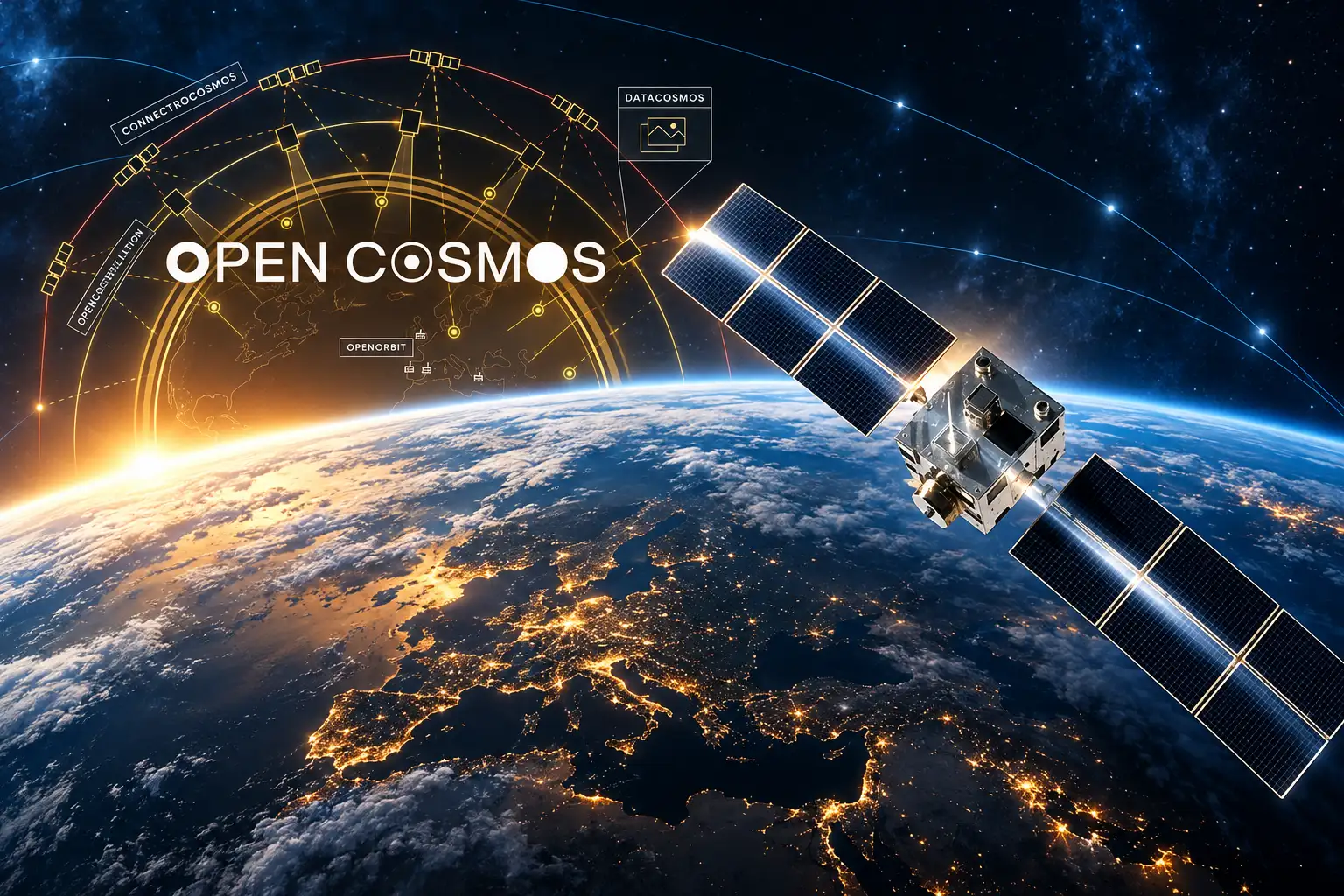
The cash is earmarked for mass production and for three product lines. OpenConstellation is a shared Earth-observation fleet. ConnectedCosmos is a communications layer between satellites and the ground. DataCosmos turns imagery and sensor feeds into operational intelligence. Next-generation OpenConstellation satellites are meant to cut delivery of Earth-observation intelligence from as long as 48 hours to as little as 30 minutes, using onboard AI and links between satellites.
PitchBook’s space-tech snapshot, cited in the Open Cosmos statement, put global venture investment in space at $11.3 billion in the first half of 2026, above $10.1 billion for the whole of 2025. Inside two months of securing access to Liechtenstein’s Ka-band filings, the company said it had already launched its first ConnectedCosmos satellites.
Space infrastructure is becoming as critical as energy, digital networks and transport. Governments and enterprises increasingly require secure communications and operational data delivered through resilient systems. But infrastructure alone isn’t enough.
Rafel Jorda Siquier, founder and chief executive of Open Cosmos, company statement, 14 September 2026
Baroness Lloyd, the UK space minister, called the round a vote of confidence in Britain’s space sector and pointed to the new UK Space Strategy. National security capital is on the cap table through NSSIF. Catalonia’s public development bank is on it too. The buyers the company names are governments, space agencies and large energy and infrastructure firms that want pictures and links they do not have to lease from a non-European constellation.
Why the Dutch Chip Round Does Not Fill the Gap?
EUCLYD, based at High Tech Campus Eindhoven, more than €200 million in Series A money, about $230 million, on 15 September 2026. Samsung, Somerset Capital Partners, the EQT-managed Scaleup Europe Fund and Innovation Industries co-led. EIFO, imec.xpand, the Brabant Development Agency and Quadri joined. The Scaleup Europe Fund is aiming at €5 billion of public and private capital for European deep tech, AI and life sciences.
Founders Bernardo Kastrup and Atul Sinha are building craftwerk, which they call agentic AI silicon, and a rack called craftwerk station CWS. The pitch is processor-memory co-design for inference, the running of models rather than the training of them. Kastrup said the raise speeds a push for lower cost per token and broader access to advanced AI. Wennink said Europe has world-class capability in semiconductors, advanced manufacturing and systems engineering, and that EUCLYD can turn that into a competitive AI infrastructure platform.
Ted Persson, a partner at EQT and co-head of the Scaleup Europe Fund, said the firm was backing European engineering depth against the hardest constraints in AI infrastructure. Dede Goldschmidt, a Samsung Electronics senior vice president, said the next phase of AI will be defined by the efficiency of the kit under the models, not only by the models.
That is a real bet. It is also a multi-year silicon project. The financing statement does not name a process node, a foundry partner, a customer or a date when a rack ships. Trade briefings have floated a late-decade launch. Even on a clean path, this round does not put a European alternative to Nvidia into a hall in 2026. It does not move the 5% compute share Lagarde recited. It funds a design team that wants to sell local inference later to enterprises, governments and hyperscalers.
Physical AI Security Is Now a $1.7 Billion Company
Exein, founded in Rome in 2018 by Gianni Cuozzo, announced $270 million of new equity at a $1.7 billion valuation on 15 September 2026. Headline led. Sofina, Goldman Sachs, the European Investment Bank Group through the European Tech Champions Initiative, KfW Capital and T.Capital came in with existing backers including Balderton and Lakestar. The company said the round was heavily oversubscribed. It also increased a revolving credit line led by J.P. Morgan, with KfW as an extra lender, to fund deals in Europe and the United States.
Exein said its valuation has risen thirty-fold in two years. Annual recurring revenue in the first half of 2026 was four times the same stretch of 2025. About half of revenue already comes from Asia-Pacific. The firm says its software sits on more than two billion connected devices. It is training a foundation model on machine data, with first models pencilled for the first quarter of 2027, and it plans a Bay Area office.
THE MACHINES EXEIN SAYS IT IS BUILT TO LOCK
- Vehicles and drones: Runtime security at the kernel, so a hacked stack cannot wait for a human on a helpdesk.
- Factory and energy kit: On-device detection for industrial automation and power equipment already in the field.
- Robots and other moving systems: A security layer for machines that use AI to act in the physical world, which the company now treats as its core market.
Cuozzo has said AI is moving out of the cloud and into that physical world, and that Exein was built for the shift. Clarey Zhu, a Headline partner, called securing robots, vehicles and critical kit one of the defining cyber problems of the next decade. The raise makes Exein the most valuable cybersecurity scaleup in Europe on the company’s own ranking. It still secures other people’s models and other people’s chips. It does not host them.
What the Four Rounds Pay For?
Line up the four tickets and the pattern is blunt. Each firm sells a layer around intelligence: getting to orbit, seeing the ground, running a model on less power, or stopping a robot from being hijacked. None of them is a European OpenAI. None of them is a 45-gigawatt power plan.
WHERE THE MONEY GOES
| Company | Announced | Amount | What it funds | What it does not buy |
|---|---|---|---|---|
| The Exploration Company | 8 Sep 2026 | $450 million | Nyx reusable capsule and Storm high-thrust engine | A finished European heavy launcher; the firm says another raise is still required |
| Open Cosmos | 14 Sep 2026 | €300 million | Four-factory satellite output, OpenConstellation, ConnectedCosmos, DataCosmos | Frontier model training or a share of world AI compute |
| EUCLYD | 15 Sep 2026 | More than €200 million | craftwerk inference silicon and CWS racks, engineering hires | A shipping alternative to current AI accelerators this year |
| Exein | 15 Sep 2026 | $270 million at $1.7 billion | Physical AI security, US and Asia hiring, a machine-data model | The data-centre halls Lagarde said Europe still lacks |
The Exploration Company, founded by Hélène Huby, described its round as the largest-ever Series C financing by a European space company, and as the largest round ever for an EU-headquartered firm led by a woman chief executive. Bessemer Venture Partners, Atomico and the Scaleup Europe Fund co-led. Total funding is now about $680 million. The company says it holds more than $2 billion in contracts and commitments, including work with the European Space Agency. Huby said the money is to get Nyx to the International Space Station and back, and to push Storm, a methane and oxygen engine meant for a future reusable heavy launcher.
That launcher is still a plan. Huby has already said the present raise is not enough to build the large rocket she has in mind. In that sense the French round and the Dutch chip round rhyme. Both sell a European hardware path. Both leave the last, expensive piece for a later date.
Private Capital Funded Satellites, Silicon and Locks
Monday 14 September 2026 now sits in the diary as a split screen. Vestager and Aghion told governments to treat AI as a hard-power problem and to get compute onto European soil. Lagarde said a cut-off in access would hit every sector at once, and that Europe already has too little data-centre capacity for its own demand, a shortfall she said could grow more than sixfold in a decade. Open Cosmos, the same morning, raised €300 million from European funds, two pension pots and a UK national security vehicle to stamp out small satellites and sell pictures in half an hour.
The following day Samsung and European growth funds put more than €200 million under an Eindhoven inference design, and Headline led $270 million into a Roman firm that locks robots. Add Huby’s $450 million capsule round from 8 September and the private market’s answer to the week’s alarm is visible. It is paying for factories, constellations, a chip roadmap and device security. It is not paying Lagarde’s bill of up to €600 billion for halls and chips, and it is not paying Schnitzer’s €1.3 trillion power build.
Open Cosmos will hire engineers, factory staff and software people in the UK, Spain, Portugal and Greece. EUCLYD will expand its engineering group and try to sell sovereign inference. Exein will hire in the United States and Asia and look for acquisitions. Europe’s share of world AI compute, on the figures Lagarde used on 14 September, is still 5%.

Edinburgh Opens a 2027 Tour Built for Time Trials

Korda Maps Auður From Meðalland to Irvine Bay

Apple Music Films Its New Logo in Mineral Oil

Oppo Prices the Pad Mini Above India’s iPad Mini

Austen Soaks Scotland Before Boelo Brings Weekend Gales

Volkswagen Sells the Osnabruck Plant to Clear a Board Fight

Apple’s Foldable iPhone Hinges on Samsung Display Supply

Saksham Gaur Finds He Is His Own Company’s Client

Tata Motors’ Iveco Tender Opens as Holders Still Decide

Onimusha Way of the Sword Preload Hits a Windows 11 Wall
-
 AUTO2 months ago
Volkswagen Sells the Osnabruck Plant to Clear a Board Fight
-
 NEWS2 months ago
Apple’s Foldable iPhone Hinges on Samsung Display Supply
-
 AUTO2 months ago
Tata Motors’ Iveco Tender Opens as Holders Still Decide
-
 BUSINESS2 months ago
Saksham Gaur Finds He Is His Own Company’s Client
-
 GAMING2 months ago
Onimusha Way of the Sword Preload Hits a Windows 11 Wall
-

 ENTERTAINMENT3 years ago
What is SD on Amazon Prime? – All You Need to Know
-

 BUSINESS2 months ago
Hyderabad 22-Carat Gold Jumps After a False Bargain
-

 NEWS2 months ago
iQOO 16 Locks 8,400 mAh While 100W Charging Holds