
BUSINESS
The 8th Pay Commission Turns Basic Pay Into a Multiplier
A higher 8th Pay Commission fitment multiplies DA, HRA, NPS and pensions, which is why the panel’s brief already protects the fisc.

The 8th Pay Commission is still writing its report, but its terms already treat a higher basic pay as a bill that compounds. The Cabinet told the panel to weigh fiscal prudence and unfunded pension costs, plus the copycat bill for states, before it touches salaries.
Staff unions still want a 3.833 fitment and fatter allowances on the same payslip. Those two asks do not cost the same, and the people who will live with the invoice are not only the employees filling in suggestion forms.
Five Constraints Sit in the Cabinet Brief
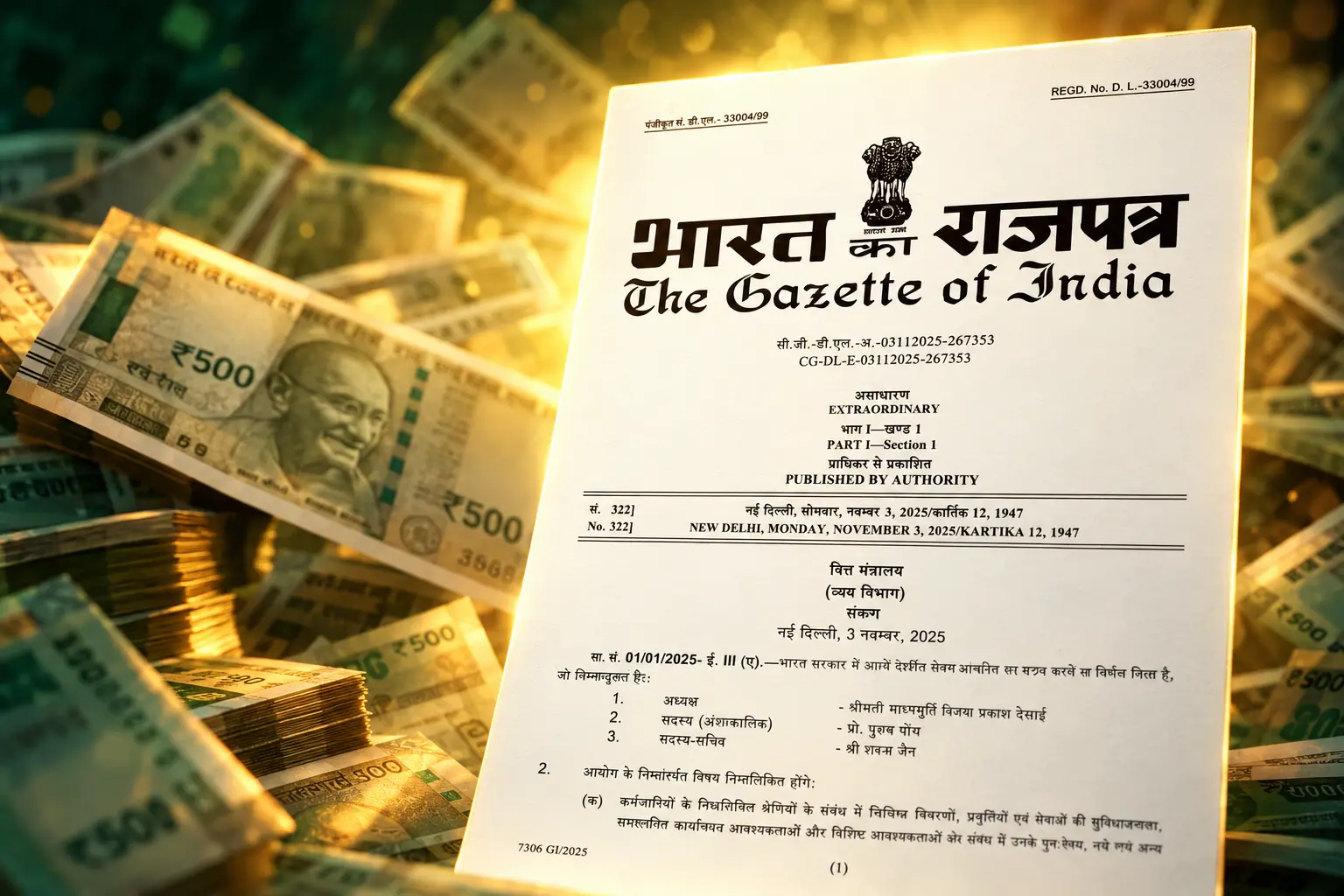
The Union Cabinet cleared the terms of reference on 28 October 2025. The Finance Ministry then constituted the panel by a resolution dated 3 November 2025, with former Supreme Court judge Justice Ranjana Prakash Desai as chairperson, IIM Bangalore professor Pulak Ghosh as part-time member, and Pankaj Jain as member-secretary.
The brief is not a wishlist. It is a spending filter. The Commission has 18 months from 3 November 2025, so until 3 May 2027, and it may file interim reports. Pay commissions usually land every ten years, and the government said the effect would normally be expected from 1 January 2026. Arrears can still follow a later Cabinet decision. The multiplier cannot.
While making the recommendations the Commission will keep in view the economic conditions in the country and the need for fiscal prudence; the need to ensure that adequate resources are available for developmental expenditure and welfare measures; the unfunded cost of non-contributory pension schemes; the likely impact of the recommendations on the finances of the State Governments which usually adopt the recommendations with some modifications; and the prevailing emolument structure, benefits and working conditions available to employees of Central Public Sector Undertakings and the private sector.
Union Cabinet, Terms of Reference, Press Information Bureau, 28 October 2025
Minister of State for Finance Pankaj Chaudhary told the Lok Sabha on 10 August 2026 that the Commission had not submitted its recommendations. He put Central Government civilian staff at about 35.77 lakh as on 1 March 2026, and pensioners and family pensioners at about 33.76 lakh as on 31 December 2025, excluding defence pensioners. The Gazette also covers defence forces, All India Services, Union Territories, audit staff, and some court establishments, so the full headcount is larger than the civilian slice.
THE FIVE CONSTRAINTS IN THE BRIEF
- The fisc: Economic conditions and the need for fiscal prudence come before any new pay matrix.
- The rest of the budget: Money must still be left for developmental spending and welfare.
- Old pensions: The unfunded cost of non-contributory pension schemes is an explicit item, not a footnote.
- The states: Most states copy the Centre with tweaks, so a central fitment becomes a state invoice.
- The labour market: CPSU and private pay are the comparison set, not union slogans.
That list is why the popular frame, bigger basic or more allowances, is the wrong question. Staff do not get to pick. The panel recommends. The Cabinet accepts, rejects, or stages the payout. And a rupee put into basic pay does work that a rupee put into a named allowance does not.
The 2.57 Fitment Was Mostly Old Dearness Allowance
Fitment is the multiplier that turns today’s basic pay into the new matrix. Under the 7th CPC it was 2.57. The 6th CPC had used 1.86. Minimum basic pay in the present matrix is Rs 18,000, so a 2.57 multiple looks like a jump to Rs 46,260. That is the number that travels on salary calculators. It is also the number that misleads.
When the 7th CPC was built, dearness allowance stood at 125 percent of basic pay. The Commission folded that DA into the new basic, then added a real rise it put at 14.29 percent. The working was 1.00 plus 1.25, which is 2.25, times 1.1429, which is 2.57. The 157 percent-looking multiple was mostly old inflation compensation changing its name.
The same method with today’s DA points much lower. The Department of Expenditure, by Office Memorandum No. 1/1(i)/2026-E.II(B) dated 22 April 2026, raised Dearness Allowance to 60 percent of basic pay from 1 January 2026, from 58 percent. A 2 percentage point DA rise was put at Rs 6,791.24 crore a year. If the 8th CPC again merges DA and repeats a 14.29 percent real rise, the implied fitment is 1.60 times 1.1429, which is 1.83. On Rs 18,000 that is a new basic of Rs 32,940, not Rs 69,000.
DA will also reset toward zero once it is merged, the way it did in January 2016. Then it will climb again, twice a year, on the new basic. That is the compounding engine. It is also why a viral 2.86 or 3.68 multiple, with no government paper behind it, keeps getting treated as a leaked decision when it is still an argument.
What a Rupee of Basic Pay Still Buys
House rent allowance is a percentage of basic pay, now 30 percent in X cities, 20 percent in Y cities and 10 percent in Z cities after DA crossed 50 percent. Transport allowance carries a DA-linked top-up. Gratuity and leave encashment sit on basic pay. For staff on the old pension rules, pension is half of last basic, and dearness relief then rides on that pension. For staff who joined on or after 1 January 2004, the National Pension System takes 10 percent of basic pay plus DA from the employee and 14 percent from the government. HRA and other named allowances are outside that NPS base.
So the fight over fitment is a fight over the base that every later formula uses. Compare three published figures on the Level 1 floor of Rs 18,000, against the Rs 28,800 that this employee already takes as basic plus 60 percent DA.
THE LEVEL 1 MATH AT THREE FITMENT FACTORS
| Fitment | New basic (Rs) | Rise versus Rs 28,800 (basic plus DA) | Where the number comes from |
|---|---|---|---|
| 1.83 | 32,940 | 14.4% | Same real rise the 7th CPC used, after merging 60% DA |
| 2.57 | 46,260 | 60.6% | Repeat of the 7th CPC multiplier, not its real rise |
| 3.833 | 68,994 | 139.6% | NC-JCM and allied union demand, often rounded to Rs 69,000 |
Take the middle row and watch NPS move. On Rs 18,000 plus Rs 10,800 DA, the contribution base is Rs 28,800. The employee puts in Rs 2,880 a month and the government puts in Rs 4,032, a combined Rs 6,912. If basic becomes Rs 46,260 and DA resets to zero, the employee’s 10 percent becomes Rs 4,626 and the government’s 14 percent becomes Rs 6,476, a combined Rs 11,102. That extra deposit is not an allowance the Cabinet can later freeze. It is a claim on the new basic, every month, until retirement.
X-city HRA at 30 percent is Rs 5,400 on today’s Rs 18,000. The same 30 percent on Rs 46,260 would be Rs 13,878, if the rate is left untouched. Last time it was not left untouched. The 7th CPC reset HRA to 24, 16 and 8 percent, and the rate only climbed back to 30, 20 and 10 percent after DA crossed 50 percent in January 2024. A higher basic still feeds a higher HRA even after a rate reset. The reset just delays the bill.
Allowances Arrived 18 Months After the Pay Hike
The last round already showed how the government splits the two. Pay and pension were revised from 1 January 2016. Allowances other than DA were sent to a Committee on Allowances, which reported on 27 April 2017. Cabinet approved the package, with 34 modifications, on 28 June 2017. The gazette then made the revised allowances from 1 July 2017.
As per the established practice relating to implementation of earlier Central Pay Commission’s recommendations on allowances, the recommendations of the Seventh Central Pay Commission on allowances have been implemented prospectively with effect from 01.07.2017.
Arjun Ram Meghwal, Minister of State for Finance, Rajya Sabha, 18 July 2017
That gap is 18 months, the same length as the 8th CPC’s filing window. During those months, staff kept drawing allowances at the old rates on the old structure, “as if the pay had not been revised,” in the Finance Ministry’s own words. The 7th CPC had examined 197 allowances, recommended abolishing 53 and folding 37 into others. A higher HRA or transport line is useful in the month it is paid. It is also the line the government has already shown it can stage, trim, and refuse to backdate.
THE PAY AND ALLOWANCES CALENDAR
- 1 January 2016: 7th CPC pay and pension take effect, with DA reset after merger into the 2.57 fitment.
- 25 July 2016: Government refers allowances other than DA to the Committee on Allowances.
- 1 July 2017: Revised allowances begin, with no arrears to January 2016.
- January 2025: Government announces formation of the 8th Pay Commission.
- 28 October 2025: Cabinet approves the terms of reference.
- 3 November 2025: Gazette resolution constitutes the panel.
- 1 January 2026: DA rises to 60 percent; this is also the date the government said the 8th CPC would normally take effect from.
- 10 August 2026: Government tells the Lok Sabha that the report has not been submitted.
If that staging is repeated, a win on allowances is a win on a delayed, prospective line. A win on fitment is a win on the base that DA, HRA, NPS and pension all read from, including for months that may later be paid as arrears.
House Rent Allowance No Longer Cuts the Tax Bill
The usual case for fatter allowances is cash for rent and fuel, plus a smaller taxable income under the old tax regime. That second leg is already thinner. The new tax regime is the default. The HRA exemption is not available on that default path, and most other named allowances travel with it. Staff who stay on the default slabs pay tax on the HRA they receive, even when they pay rent.
The exemption still exists for people who opt out and file under the old regime, with the usual three-way cap of actual HRA, rent minus 10 percent of salary, and 50 or 40 percent of salary by city. From 1 April 2026 the 50 percent city list also adds Bengaluru, Hyderabad, Pune and Ahmedabad to Delhi, Mumbai, Kolkata and Chennai. That is a bigger old-regime tool, not a default-regime tool. For anyone who does not opt out, a larger HRA is a larger taxable receipt.
NPS treatment is the other way around. The employee’s 10 percent still leaves the payslip. The government’s 14 percent still lands in the pension account. Employer NPS contributions remain one of the few retirement deposits the default regime still recognises. Moving money from HRA into basic pay, which then lifts the NPS base, is the structure the tax code now rewards, whether or not a union memorandum says so.
State Budgets Copy the Centre, Then Pay for It
The ToR’s state clause is the sleeper. Most states adopt the central award with modifications. A 3.833 fitment in Delhi is not a closed event in Delhi. It becomes a demand in every secretariat that still benchmarks to the CPC, including for teachers, police and state pensioners who never sat in a central office.
The Union Budget for 2026-27, presented on 1 February 2026, already shows how tight the committed side is. PRS Legislative Research’s expenditure analysis puts total spending at Rs 53,47,315 crore. Pension spending is estimated at Rs 2,96,214 crore on pensions, 3 percent above the 2025-26 revised estimate. Establishment spending of the Centre is put at Rs 8,24,114 crore. Salaries, pensions and interest together take 65.3 percent of revenue receipts. The fiscal deficit target is 4.3 percent of GDP.
THE COMMITTED BILL IN THE 2026-27 BUDGET
- Total spend: Rs 53,47,315 crore, 7.7 percent above the 2025-26 revised estimate.
- Pensions: Rs 2,96,214 crore, before any 8th CPC award.
- Establishment: Rs 8,24,114 crore for the Centre’s own running costs.
- The squeeze: 65.3 percent of revenue receipts already go to salaries, pensions and interest, with the deficit aimed at 4.3 percent of GDP.
Those figures are the pre-award baseline. They do not include a new matrix. They also do not include the state copy. The ToR’s line on unfunded non-contributory pensions is aimed at the old pension rules that still cover a large retiree stock, where a higher last basic becomes a higher lifelong pension plus dearness relief. NPS staff get the contribution lift instead, which is cheaper in the first years and still expensive over a 30-year career once the base has been reset.
Minimum pension under the 7th CPC is Rs 9,000, which is half of Rs 18,000. A 3.833 multiple on that floor would take the notional basic to Rs 68,994 and the half-pension slogan to about Rs 34,500. A 1.83 multiple would take the same pension to Rs 16,470. The gap between those two outcomes is why pensioner groups have lined up behind the 3.833 demand, and why the Cabinet wrote unfunded pensions into the brief before the first consultation.
Unions Asked for 3.833, Then Got 2.57
The National Council of the Joint Consultative Machinery, the All India Defence Employees’ Federation, the Federation of National Postal Organisations, the All India New Pension Scheme Employees Federation and the Bharat Pensioners Samaj have put 3.833 on the table, with a Rs 69,000 minimum basic. Bharatiya Pratiraksha Mazdoor Sangh has asked for 4. AITUC has asked for 3. The Indian Railways Technical Supervisors’ Association has spread its asks from 2.92 to 4.38. Conservative working estimates sit between 1.83 and 2. Moderate ones reuse 2.57. None of those figures is a government decision.
The last round is the better guide than the current memorandums. NC-JCM asked for 3.71 last time. The government accepted 2.57. That gap is the working precedent. It is also why a 3.833 graphic is not a leak. It is a bargaining position that already failed in its previous form.
WHERE EXPERTS DISAGREE
- Union floor: NC-JCM and several federations want 3.833, taking Level 1 basic from Rs 18,000 to Rs 68,994.
- Repeat-the-7th-CPC camp: A 2.57 reuse would take the same basic to Rs 46,260, a 60.6 percent rise versus today’s basic-plus-DA, far above the 14.29 percent real rise the 7th CPC itself claimed.
- DA-merger camp: Applying the 7th CPC’s own method to 60 percent DA produces about 1.83 and a new basic of Rs 32,940, which is the only row that matches how 2.57 was actually built.
The sharper split among staff is by career stage, not by slogan. A renter in an X city wants HRA in the hand this month. A person within ten years of retirement wants the last basic as high as it can go, because OPS pension and gratuity read that number. An NPS joiner wants the contribution base lifted, even if a named allowance looks larger on the first revised slip. The Commission can recommend a mix. It cannot make those three groups whole at a 3.833 multiple without shoving the extra into the same budget lines the ToR told it to protect.
Desai’s panel can still send an interim report. The Cabinet will still decide what to accept, and it can again pay revised basic from 1 January 2026 with arrears while holding allowances to a later start. The number that cannot be unwound, once it is in the matrix, is the fitment on basic pay.

Edinburgh Opens a 2027 Tour Built for Time Trials

Korda Maps Auður From Meðalland to Irvine Bay

Apple Music Films Its New Logo in Mineral Oil

Oppo Prices the Pad Mini Above India’s iPad Mini

Austen Soaks Scotland Before Boelo Brings Weekend Gales

Volkswagen Sells the Osnabruck Plant to Clear a Board Fight

Apple’s Foldable iPhone Hinges on Samsung Display Supply

Tata Motors’ Iveco Tender Opens as Holders Still Decide

Saksham Gaur Finds He Is His Own Company’s Client

Onimusha Way of the Sword Preload Hits a Windows 11 Wall
-
 AUTO2 months ago
Volkswagen Sells the Osnabruck Plant to Clear a Board Fight
-
 NEWS2 months ago
Apple’s Foldable iPhone Hinges on Samsung Display Supply
-
 AUTO2 months ago
Tata Motors’ Iveco Tender Opens as Holders Still Decide
-
 BUSINESS2 months ago
Saksham Gaur Finds He Is His Own Company’s Client
-
 GAMING2 months ago
Onimusha Way of the Sword Preload Hits a Windows 11 Wall
-

 BUSINESS2 months ago
Hyderabad 22-Carat Gold Jumps After a False Bargain
-

 ENTERTAINMENT3 years ago
What is SD on Amazon Prime? – All You Need to Know
-

 NEWS2 months ago
iQOO 16 Locks 8,400 mAh While 100W Charging Holds