
BUSINESS
Yemen Forces Claim Mokha as the Mecca Pact Activates
Yemen’s army says it retook Mokha, a claim the Houthis deny, while Riyadh activates its Mecca pact with Pakistan and Turkey.

Yemen’s government said on October 5 that its forces had retaken the Red Sea port of Mokha from the Houthis, a claim the group denied the same night. The Saudi-backed army presented the push as the opening of Operation Dawn of Yemen, aimed at the coast around the Bab el-Mandeb Strait and, further on, at Sanaa.
Riyadh, Islamabad and Ankara activated their Mecca defense pact that Monday, two Saudi airports near the Yemen border were hit, and December Brent crude still printed at $100.12 a barrel on October 6. The port is the trophy. The pact, the airports and the oil price are the part that travels.
Government Forces Claim Mokha After Houthis’ September Advance
A military source, carried by Yemen’s state Saba news agency, said the Nation’s Shield Forces, the Giants Brigades and the Tihama Resistance, backed by air strikes, entered Mokha after fighting on the outskirts. The source said an unspecified number of Houthi fighters were killed, wounded or captured, and that others fled. Clearing work was still running in the city and around it, the source added.
Rashad al-Alimi, chairman of the Presidential Leadership Council, had already told the country a full campaign was under way after, in his account, every chance to ease the fight had been used up. Government messaging said the same units had taken Dhubab district, seized Dhubab airport and cut the road toward Bab el-Mandeb. The Yemeni military’s English-language account put the Mokha claim on the record that afternoon.
Nation's Shield Forces, Giants Brigades & Tihama Resistance, supported by the Popular Resistance, have taken control of Mocha, west of Taiz, following fierce battles against Iranian-backed Houthi terrorist militia
— Yemen Army Media (@Yemenarmyeng) October 5, 2026
The denial arrived in the same news cycle. Houthi military spokesman Yahya Saree said the group still “maintains control over all of its gains” and dismissed breakthrough reports as “fabricated victories.” Fuad Sinan, the Houthi deputy governor of Taiz, recorded himself in Mokha on the evening of October 5.
We are currently roaming around in the streets of Mocha city, negating any reports in the media about the occupation of Mocha city.
Fuad Sinan, Houthi deputy governor of Taiz, video statement, October 5, 2026
Other government and military sources, speaking without names, later said troops had only reached the outskirts and that Houthi fighters were pulling toward the highlands. A source on the ground called the victory line premature and part of a propaganda fight. Clips circulating on October 6, including from Dhubab and from Mokha airport, were offered as proof that the coast had not changed hands in a single afternoon.
WHAT WE KNOW
- The claim: Yemen’s army said on October 5 that Nation’s Shield, Giants Brigade and Tihama units had taken Mokha, Dhubab district and Dhubab airport with Saudi air cover.
- The campaign: Al-Alimi ordered Operation Dawn of Yemen, and officials said a separate push had started toward Sanaa, held by the Houthis since 2014.
- The air war: Coalition spokesman Major General Turki al-Malki said 100 fighter jets were supporting the ground attack; the Saudi-led coalition said it destroyed a ballistic missile launch pad in Sanaa and a store of 20 ballistic missiles in Saada.
WHAT IS UNCONFIRMED
- Who holds Mokha: Street video from Sinan, later airport clips, and unnamed government talk of the outskirts all sit against Saba’s entry claim.
- Who holds the strait: The army said it had secured Bab el-Mandeb; Houthi media said the group still held Dhubab, the strait and the Kahboub mountains.
- The body count: No official casualty total was issued on either side.
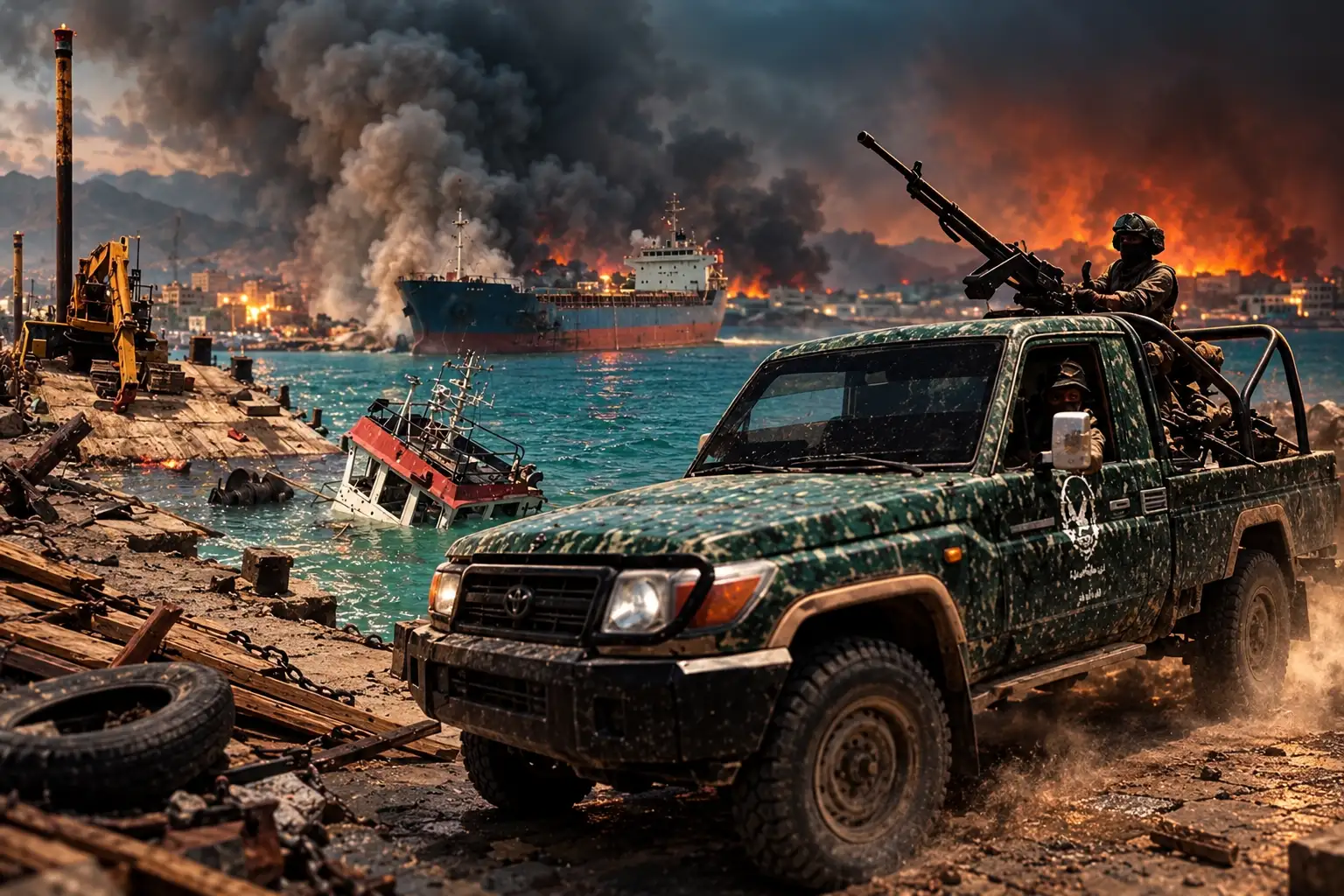
Mokha sits about 75 kilometers (46 miles) north of Bab el-Mandeb, the narrow gate between the Red Sea and the Gulf of Aden. It is the old coffee port that gave mocha its name. The Houthis seized it on September 10, during a run down the west coast that also took Dhubab and, within a day, Perim Island in the strait itself. The government is now asking the world to treat a 25-day Houthi hold as over. The pictures still argue.
The Island in the Middle of the Channel
Even a clean take of Mokha would not, by itself, reopen the waterway. Perim, also called Mayyun, is a 13-square-kilometer island that splits Bab el-Mandeb into two shipping channels. Government officials said in mid-September that their men had pulled off the island and that Houthi boats had landed. Nothing published on October 5 or October 6 showed Perim back in government hands.
Dhubab airport, about 45 kilometers south of Mokha, is the mainland piece the army was most eager to advertise. Taking an airstrip and cutting a coast road is a real tactical gain. It is not the same as holding the rock in the channel, or the mountains that look down on both. Houthi media, on October 6, also put out missile footage from Ras al-Ara, on the approach to the strait, and framed it as a stop on any march to Bab el-Mandeb.
CLAIMED POSITIONS ON OCTOBER 5
| Place | Government line | Houthi or other line |
|---|---|---|
| Mokha | Entered after outskirts fighting; city being cleared | Sinan video in the streets; later clips from the airport |
| Dhubab town and airport | District retaken; airport seized; road cut | Group still holds Dhubab |
| Bab el-Mandeb coast | Strait “secured” | Still holds the strait and Kahboub mountains |
| Perim (Mayyun) | No confirmed recapture | Taken after the September 11-12 landing, still the prize in the channel |
| Sanaa | A “strategic offensive” has started | Held since 2014 |
Fernando Carvajal, a former United Nations Security Council adviser on Yemen, said Mokha only matters in the next phase if the government can keep it. He noted that the city is surrounded by Houthis on three sides and has to be held before it can be used as a staging point. That is a supply problem, not a press-release problem.
Government military sources also said Houthi fighters were still moving around Taiz, Yemen’s third-largest city, and had taken stretches of a mountain road that leaves government units there more cut off. A coast win that coincides with a squeeze inland is not a collapse of the Houthi war. It is a trade of ground.
Riyadh Triggers the Mecca Pact for the First Time
The meeting that will outlast any one video from Mokha took place in Riyadh on October 5. Foreign ministers, defence ministers and chiefs of staff from Saudi Arabia, Pakistan and Turkey, sitting as the Strategic Political and Defence Committee of the Makkah Alliance, agreed to put their collective defence commitments into practice and to move agreed forces and kit into the kingdom at speed.
Prince Khalid bin Salman, the Saudi defence minister, said the committee had agreed to activate collective deterrence “in response to the attacks and all those responsible for them,” and that the three states stood together against attacks on the kingdom and the holy sites.
The Emergency Meeting of the Strategic Political and Defense Committee under the Makkah Alliance for Defense reaffirmed the solidarity and unity of our countries in confronting the heinous attacks against the Kingdom and the holy sites. The committee agreed to activate collective… pic.twitter.com/4hGjcJcw25
— Khalid bin Salman خالد بن سلمان (@kbsalsaud) October 5, 2026
The underlying treaty is the Makkah Agreement for Joint Defence, signed in Mecca on August 7. Pakistan’s foreign ministry, in the message that accompanied the signing, said an armed attack against any one of the three countries would be treated as an attack on all, under the right of self-defence in Article 51 of the United Nations Charter. It also called the accord defensive and said it was not aimed at any other state.
An earlier committee session in Istanbul on August 31 had already moved to lock the pact in, including a secretariat based in Saudi Arabia that Pakistan would head for the first three years. October 5 was the first time the three capitals used that machinery in a live war. The joint statement issued in Riyadh did not say how many troops would move, what they would fly or sail, or whether any of them would cross into Yemen.
Dania Thafer, executive director of the Gulf International Forum, said Saudi Arabia is trying to turn the pact from a political declaration into a deterrent, and that for now Riyadh mainly wants help defending Saudi ground and reinforcing air and missile defences. She also read Khalid’s phrase “all those responsible” as a warning aimed past the launch crews, at whoever arms and spots for them.
Pakistan Draws a Defensive Line in Riyadh
Pakistan’s defence minister, Khawaja Asif, speaking from Riyadh on the night of October 5, put his country’s role in a narrower box than the Saudi wording.
The forces of Turkiye and Pakistan are playing a supporting role. We are definitely involved in reconnaissance and such things, but the combat is practically being conducted by Saudi Arabia’s own forces, and they are the ones retaking those areas.
Khawaja Asif, Pakistan defence minister, Geo News, October 5, 2026
That line matters because Pakistan already has men and aircraft in the kingdom. A 1982 arrangement covers troops on deputation. A separate Saudi-Pakistan mutual defence deal was signed in September 2025. In April 2026, Riyadh confirmed that a Pakistani force, including fighter and support aircraft, had arrived at King Abdulaziz air base in the Eastern Province. Lieutenant General Ahmed Sharif Chaudhry, director general of Inter-Services Public Relations, said in September that Pakistani forces were already there “physically” to protect the kingdom and the holy sites.
Islamabad has not said how many. On October 6, Pakistan’s Ministry of Information said operational details of the deterrence were confidential. Deputy Prime Minister Ishaq Dar had already told a news conference on October 2 that the pact “is defensive in nature” and “has no offensive agenda.” In 2015, Pakistan’s parliament resolved to stay neutral in Yemen while still pledging to stand with Saudi Arabia if its territory or the holy sites were hit. Monday’s joint statement used that same holy-sites language.
LIMITS ON THE DEPLOYMENT
- No headcount: The Riyadh statement does not name a troop figure, a unit, or a base of arrival.
- Scouting, not assault: Asif described a supporting and reconnaissance role, with Saudi forces doing the fighting.
- Turkey’s parliament: Gokhan Ereli of Ibn Haldun University in Istanbul noted that Article 92 of Turkey’s constitution leaves foreign deployments to parliament, which has not yet ratified the Mecca pact, and that Ankara has not publicly confirmed any standing force in Saudi Arabia.
- Iran’s warning: Esmaeil Baghaei, the Iranian foreign ministry spokesman, said on October 4 that Tehran hoped reports of a Pakistani deployment into the Yemen war were untrue. Javad Heiran-Nia, an analyst with the Persian Gulf Studies Group in Tehran, said a purely defensive presence could be tolerated, and that joining offensive operations against the Houthis would be treated as a red line.
Tughral Yamin, a retired brigadier at Islamabad’s Institute of Policy Studies, expected air defence, drones, communications, cyber teams, engineers and some special forces, “nothing more than that.” Ereli expected Turkey’s part, if any, to be mostly off the ground: intelligence, air-defence resupply, drones, electronic warfare, perhaps naval or air-defence assets. Thafer’s caution sits on top of those guesses. Securing Saudi territory and Bab el-Mandeb could stay a bounded job. Trying to take Sanaa, she said, would be a much longer war.
Two Saudi Airports Were Hit the Same Night
While the committee met and the army talked of Mokha, the Houthis fired at Saudi Arabia. The General Authority of Civil Aviation said on October 6 that King Abdullah bin Abdulaziz Airport in Jazan and Najran International Airport, both near the Yemen border, were attacked on the evening of October 5. The authority said the strikes caused three minor injuries, with the wounded taken to hospital, and material damage to the facilities.
GACA said specialised teams responded at once and that it was working with other agencies to protect passengers, staff and the civil aviation system. The statement did not name the attacker. Saree had already said late on October 5 that Houthi forces had hit sites across the south, and he listed a wider set of targets: King Khalid International Airport in Riyadh, an Aramco refinery in Rabigh, Abha International Airport, the Khamis Mushait military base, and other sites in Najran and Jazan.
Jassim al-Budaiwi, secretary-general of the Gulf Cooperation Council, called attacks on airports and civilian facilities “a dangerous escalation.” Kuwait’s foreign ministry condemned what it called continued attacks on civilians and economic sites. The coalition, for its part, said Saudi naval forces had opened an operation in Hodeidah governorate, the Houthi-held Red Sea stretch north of the Mokha fight.
The pairing is the point of the night. A government that says it has just lifted a siege on a coffee port still has to explain drones and missiles on two of its own civilian airports. Deterrence, in the pact’s language, is being asked to cover both the strait and the runway.
Why Oil Is Still Trading Near $100
December Brent crude futures traded at $100.12 a barrel on the morning of October 6, down 0.3 percent. November West Texas Intermediate stood at $88.63, down nearly 0.9 percent. Those prints moved on Gulf loadings, a planned G7 release of 100 million barrels of diesel and crude, and a price cut by Saudi Aramco on Arab Light for Asia. They did not spike on the Mokha statement, and they did not collapse on the airport hits.
THE OIL TAPE ON OCTOBER 6
- Brent, December: $100.12 a barrel, down 0.3 percent in the Tuesday morning print.
- WTI, November: $88.63 a barrel, down nearly 0.9 percent.
- Emergency stocks: G7 countries agreed on October 3 to release 100 million barrels of diesel and crude and to avoid energy export curbs.
- The older choke: U.S. Energy Information Administration figures put Strait of Hormuz oil flows at 20.9 million barrels a day in 2023, about 20 percent of global petroleum liquids use.
The United States and Israel struck Iran in late February, and the Strait of Hormuz has been the damaged door on the Gulf ever since. Saudi Arabia has leaned on Red Sea loadings, including the East-West pipeline to Yanbu, to get crude out when Hormuz is ugly. That is why a Houthi hold on Bab el-Mandeb, after the September coastal run, landed on oil desks at all. It is also why a disputed take-back of Mokha does not, on its own, reset the tape.
The EIA’s last full pre-war baseline for the southern gate is still the one that frames the risk: oil through Bab el-Mandeb averaged 8.7 million barrels a day in 2023, then 4.0 million barrels a day in the first eight months of 2024, after Houthi attacks on Red Sea shipping sent tankers around the Cape of Good Hope. Energy strategists at ING, in a note issued October 6, said signs of a recovery in Persian Gulf oil flows were growing, and that the market was still nervous about further supply hits from the region.
“This nervousness is likely to persist until there are signs of progress in a deal between the US and Iran. In the meantime, the risk of further escalation remains very real,” they wrote. Mokha is a coastal argument inside that larger standoff. Hormuz still sets the floor under $100.
A Push Toward Sanaa Leaves Taiz Exposed
Al-Alimi has not described Dawn of Yemen as a raid on one port. Government statements said the offensive was meant to retake Houthi-held ground, restore the state and end what the council calls the coup, with Sanaa named as an aim. Al-Alimi also said forces would keep moving north and try for Khawkhah. Sanaa has been in Houthi hands since 2014, which is 12 years of urban control, air defences and a political administration, not a ridgeline that falls with an airstrip.
Yemen’s wider war paused in any large sense after a UN-brokered truce in 2022. The west-coast collapse in September, the Saudi air campaign, and the first use of the Mecca pact are the sharpest break in that pause. Iran is watching the Pakistani piece of it. Dar told Iranian President Masoud Pezeshkian and Foreign Minister Abbas Araghchi in New York in September that Pakistan would honour the defence pact. He said the Iranian officials wanted a political track with the Houthis. Monday’s Riyadh statement did not mention one.
FROM THE SEPTEMBER COLLAPSE TO OCTOBER 5
- August 7, 2026: Saudi Arabia, Pakistan and Turkey sign the Makkah Agreement for Joint Defence in Mecca.
- September 10, 2026: Houthis take Mokha after government-aligned National Resistance lines fold on the west coast.
- September 11-12, 2026: Government forces pull out of Dhubab and Perim; Houthi boats land on the island in Bab el-Mandeb.
- October 5, 2026: Operation Dawn of Yemen is announced, Mokha is claimed, the Mecca committee orders a rapid deployment, and Jazan and Najran airports are hit.
- October 6, 2026: GACA confirms three minor injuries; Saree says the group still holds its gains; competing clips from Dhubab and Mokha airport keep the recapture in dispute.
Carvajal’s test is the one that will still be there after the statements age. Government forces have to show they can keep a city the Houthis can fire on from three sides, and they have to do it while Taiz is under pressure and while Perim still sits in the shipping channel. Pakistan and Turkey have to show what “rapid deployment” means without walking into a Yemen ground war their own ministers say they are not joining. Brent, at $100.12, is waiting on Hormuz and on a US-Iran track, not on a coffee port whose streets were filmed by both armies on the same night.
Disclaimer: This article is news reporting and analysis of battlefield claims, alliance statements and energy-market prices, and it is for information only. It is not investment advice, a recommendation to buy or sell crude, fuels, equities or any other instrument, and it is not legal, shipping or security advice. Readers who make commercial or financial decisions on the back of oil prices, freight risk or regional conflict should consult a licensed financial adviser and, where relevant, a qualified maritime or security professional. Control claims, deployment details and the price prints named above reflect the official statements and market figures cited here and may change as the fighting and the oil market move.

Edinburgh Opens a 2027 Tour Built for Time Trials

Korda Maps Auður From Meðalland to Irvine Bay

Apple Music Films Its New Logo in Mineral Oil

Oppo Prices the Pad Mini Above India’s iPad Mini

Austen Soaks Scotland Before Boelo Brings Weekend Gales

Volkswagen Sells the Osnabruck Plant to Clear a Board Fight

Apple’s Foldable iPhone Hinges on Samsung Display Supply

Saksham Gaur Finds He Is His Own Company’s Client

Tata Motors’ Iveco Tender Opens as Holders Still Decide

Onimusha Way of the Sword Preload Hits a Windows 11 Wall
-
 AUTO2 months ago
Volkswagen Sells the Osnabruck Plant to Clear a Board Fight
-
 NEWS2 months ago
Apple’s Foldable iPhone Hinges on Samsung Display Supply
-
 AUTO2 months ago
Tata Motors’ Iveco Tender Opens as Holders Still Decide
-
 BUSINESS2 months ago
Saksham Gaur Finds He Is His Own Company’s Client
-
 GAMING2 months ago
Onimusha Way of the Sword Preload Hits a Windows 11 Wall
-

 ENTERTAINMENT3 years ago
What is SD on Amazon Prime? – All You Need to Know
-

 BUSINESS2 months ago
Hyderabad 22-Carat Gold Jumps After a False Bargain
-

 NEWS2 months ago
iQOO 16 Locks 8,400 mAh While 100W Charging Holds