
BUSINESS
Tether’s $550 Million Freeze Maps the Senate Iran Case
Senate Democrats found USDT in 84% of 846 Iran-linked wallets, while Tether cited about $550 million in 2026 freezes on the same rail.

Senate Democrats found USDT in 84% of 846 sanctioned Iran-linked wallets. Tether answered on September 28, 2026, saying it had helped freeze about $550 million in Iran-linked tokens this year.
Both figures describe the same rail. The tokens sat in Tether until U.S. authorities named the wallets, and the issuer then locked them.
Investigators Counted USDT in 84% of the Wallets
The 28-page staff paper, titled “Tethered to Terrorism: Crypto & Iran’s Shadow Banking Network,” comes from Ranking Member Richard Blumenthal of Connecticut and minority staff on the Senate Permanent Subcommittee on Investigations. Their forensic analysis of 846 wallets drew on lists from the Treasury’s Office of Foreign Assets Control and Israel’s National Bureau for Counter Terror Financing, covering orders from June 2021 to August 2026.
A wallet counted as USDT-heavy when more than 80% of its dollar volume ran in the token. On that rule, 87% of 757 wallets on Israel’s list, and 57% of 101 wallets on OFAC’s list, transacted predominantly in USDT. Bitcoin was a distant second, at 7% on the Israeli sample and 19% on OFAC’s.
WALLET SAMPLE BY LIST
| List | Wallets | Share mostly in USDT |
|---|---|---|
| Combined unique sample | 846 | 84% |
| Israel NBCTF | 757 | 87% |
| U.S. OFAC | 101 | 57% |
USDT’s main rival, Circle’s USDC, barely showed up, and then only in a few trades by the sanctioned exchange Shelbit. Native TRON and Ethereum tokens had some use, still far behind. The staff called the findings preliminary and said Iran’s preference is no puzzle: USDT is liquid, dollar-flat, and easy to buy on desks that skip know-your-customer checks, while the rial keeps losing value.
Tether is the largest dollar stablecoin issuer, about 60% of that market by cap as of September 2026 on DefiLlama figures cited in the paper. It started in 2014 in Santa Monica, California, and now says it is based in El Salvador. The panel argues that mix, plus U.S. Treasury holdings, gives the firm a real American nexus even as it sits offshore.
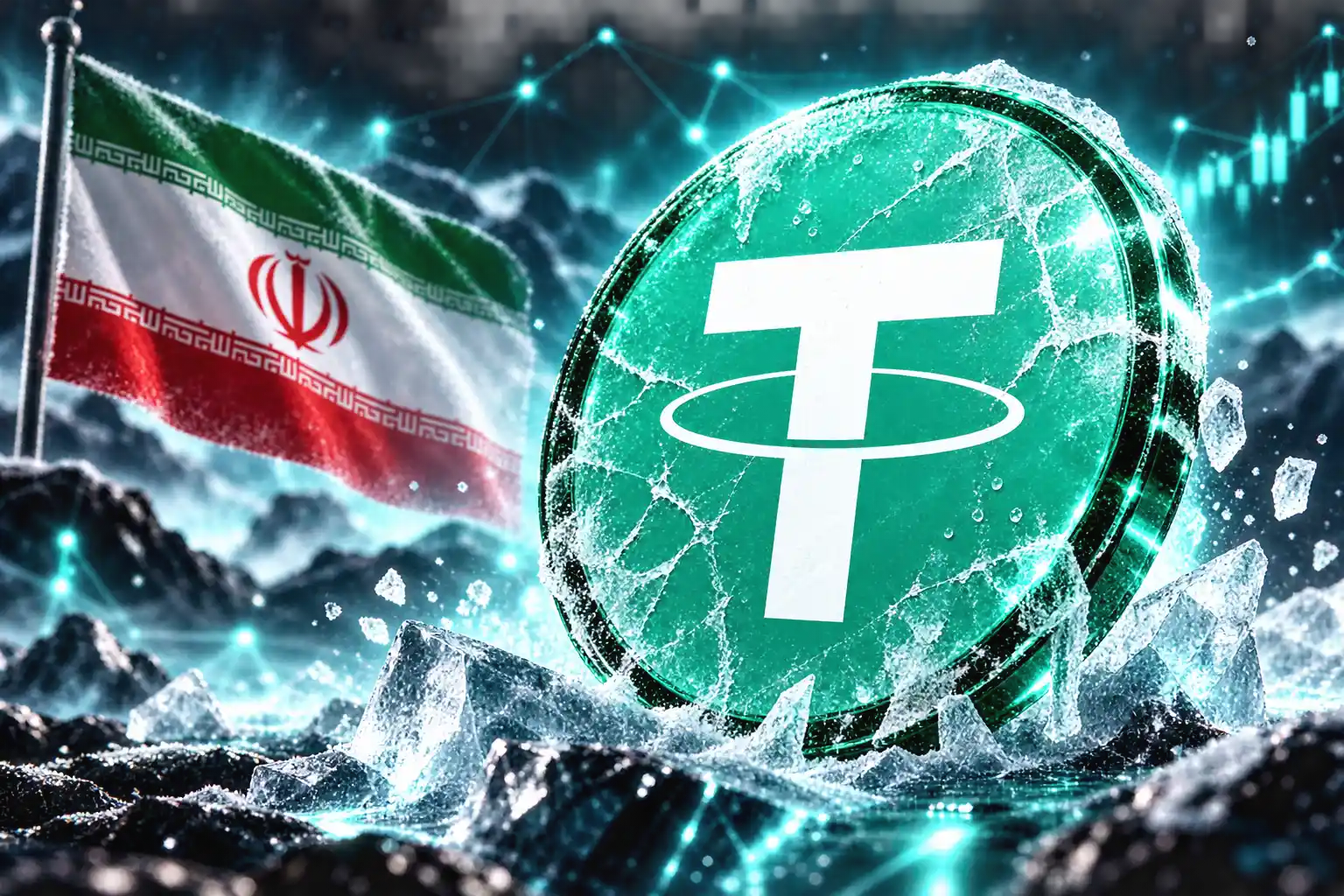
Tether’s $550 Million Freeze Counts the Same Dollars
Tether’s newsroom post the same Monday did not name the Senate paper. It tied the company’s work to Treasury’s Iran campaign and said actions in 2026 had frozen about $550 million in Iran-linked USDT in wallets U.S. authorities tied to the Central Bank of Iran and other sanctioned networks.
The release names two clusters. In April 2026, Tether said it froze more than $344 million across two addresses on information from OFAC and U.S. law enforcement, and OFAC added those addresses to the central bank’s entry the next day, with links to the IRGC-Qods Force and Hezbollah. In July 2026, it said more than $130 million was frozen across four TRON wallets after Treasury expanded that same listing. Those two named actions add to more than $474 million. Tether did not itemize the rest of the $550 million total.
WHAT TETHER SAYS IT FROZE
| Action | When | Amount Tether cites |
|---|---|---|
| Two addresses later tied to Iran’s central bank | April 2026 | More than $344 million |
| Four TRON wallets added to that listing | July 2026 | More than $130 million |
| Companywide Iran-linked total | 2026 | About $550 million |
| All freezes with authorities | Cumulative | More than $4.9 billion |
Paolo Ardoino, Tether’s chief executive, framed the lock as proof the token is a poor hiding place because the chain is public and the issuer can halt an address once police send a name.
Tether has consistently demonstrated that USD₮ is not a haven for sanctioned actors, terrorist organizations or criminal networks. Public blockchains provide authorities with a level of visibility into the movement of funds that simply does not exist with cash, and Tether can act when credible information is provided by law enforcement.
Paolo Ardoino, CEO of Tether, September 28, 2026 statement
The company said it works with more than 340 agencies in 67 countries, supporting more than 2,800 investigations, including more than 1,500 with U.S. agencies, and that more than $2.4 billion of the $4.9 billion total is tied to U.S. cases. With Israel’s counter-terror bureau it says it has frozen more than 22 million USDT across more than 640 addresses in over 40 cases. After the bureau published 187 IRGC-linked addresses in September 2025, Elliptic found Tether had blacklisted 39 of them, freezing about $1.5 million still sitting in those wallets.
How Tether Freezes Iran-Linked USDT Wallets
USDT is a claim on Tether, not a bearer coin like bitcoin. The issuer can blacklist an address so the balance remains visible and cannot move. Ardoino’s point is that this kill switch, plus an open ledger, beats cash. The staff paper’s third finding is that the switch is used too late, and sometimes not at all.
Tether says it has aligned wallet freezes with OFAC’s Specially Designated Nationals list, including secondary-market addresses on that list. The April cluster followed that script: freeze on government information, listing the next day. The July cluster followed an expanded central-bank designation onto TRON, a cheap network that carries a large share of USDT.
That sequence is the whole dispute. Tether waits for a name from police or a public listing, then locks what is still in the wallet. The panel wants a duty to hunt and block on open evidence, leaked addresses, and known exchange clusters before the money leaves. Personal liability for executives would close that gap faster than another press release, because the window after a public flag is where the $34.6 million problem lives.
$34.6 Million Still Moved After Designation
Finding 3 of the staff paper says that before 2024 Tether did not consistently freeze wallets named by counter-terror agencies, and that it still fails to block clearly illicit addresses on its own. In one case the analysis tracked $34.6 million moving through sanctioned wallets after they had already been designated. The staff say Hamas shifted toward USDT after earlier mixes of bitcoin and other coins, which they read as a sign that weak deterrence invited the switch.
OPEN CASES THE PANEL FLAGS
- Post-listing flow: $34.6 million kept moving through sanctioned wallets after designation.
- Gaza Now: OFAC listed the group in March 2024 over Hamas ties, and Blumenthal’s letter says it kept fundraising in Tether without those wallets frozen.
- Zanjani leak: In December 2025, Babak Zanjani posted Central Bank of Iran addresses on X, and the staff say Tether had still not blacklisted those and similar wallets when the report went out.
- June records request: The subcommittee wrote Tether on June 4, 2026, asking whether it had ever failed to freeze terrorist or Iranian government wallets; Tether confirmed receipt and had not answered by publication.
Blumenthal’s letter to Attorney General Todd Blanche used the Zanjani and Gaza Now files as proof of what he called an anemic response. The staff also note Iranian venues such as Nobitex have published guides on how a Tether freeze works and how users can try to avoid one, which is the opposite of a hidden back door. It is a known risk customers already plan around.
Two Oil Smugglers Sent $603 Million in USDT
The share-of-wallets number is a count of addresses, not a sum of every dollar Iran moved. The dollar examples in the paper are still large. Two sanctioned Iranian oil smugglers, Alireza Derakhshan and Arash Estaki Alivand, moved more than $603 million in USDT over a four-year period from 2021 to 2025 in a network the staff tie to Hezbollah, the Houthis, and Iranian financial institutions. The paper treats those rails as digital hawala: unregulated exchanges and brokers moving hundreds of millions between Iran and counterparties abroad.
Leaked central-bank letters from late 2025 described USDT buys meant to support the rial and oil sales. The subcommittee then pulled the two wallets named in those letters and found they received nearly $50 million, exclusively in USDT, in April and May 2025. Within days the funds went to Iranian exchanges such as Nobitex and Ramzinex, or to a mixer. That pattern is the staff’s picture of the central bank using domestic platforms as a holding pen.
The paper also points to drone and other military procurement on the same shadow network, and to designated Iranian exchanges including Nobitex, Wallex, Bitpin, and Ramzinex. FinCEN, in a May 11, 2026 alert issued during what the staff call the ongoing war with Iran, called cryptocurrencies one leg of Iran’s shadow banking network and warned about large-volume stablecoin issuers, of which Tether is the biggest.
Cantor Fitzgerald’s 5% Stake in Tether
Blumenthal did not send the paper into a vacuum. He referred it to Treasury Secretary Scott Bessent and Blanche and asked both departments to say, by October 9, 2026, whether they had narrowed, paused, or closed any earlier inquiry into Tether. He also asked Justice whether any Trump administration official, or a family member, had raised concerns about the handling of Tether matters.
The political charge is the firm’s Washington map. Blumenthal said Cantor Fitzgerald owns 5% of Tether and holds a substantial portion of the company’s more than $100 billion of assets in the United States. Cantor is the New York firm that, the staff paper says, is Tether’s main custodian for its Treasuries. Commerce Secretary Howard Lutnick ran Cantor until recently. His children control it now.
Yet, since President Trump’s return to the White House, investigations and enforcement actions into the cryptocurrency industry have been dropped, settled on meager terms, or even reversed. I fear this lenient self-dealing includes Tether, despite its role in propping up a country that the United States is currently at war with.
Richard Blumenthal, Ranking Member, Permanent Subcommittee on Investigations, September 28, 2026
My new PSI report exposes how Tether & its flagship token have become central to Iran’s shadow banking system, allowing the Iranian government to fund its regional proxies, commit human rights abuses, & pursue hostile drone & missile programs as they defy our sanctions regime.…
— Richard Blumenthal (@SenBlumenthal) September 28, 2026
The Blanche letter also notes that Bo Hines, former executive director of the President’s Council of Advisors on Digital Assets, became chief executive of Tether’s U.S. subsidiary in September 2025, weeks after leaving the White House. Blumenthal asked Justice for communications with Lutnick, his sons Brandon and Kyle, Cantor, and Hines. Those requests are unanswered in public. They are why a freeze ledger and a wallet study landed as a loyalty test, not only as a compliance memo.
Treasury Already Put Digital Assets on the Iran List
Tether’s post wrapped itself in a campaign Treasury had already named. On August 24, 2026, Bessent launched Operation Economic Outcast, which he described as a drive to cut every financial line that sustains Iran and the IRGC. The sector list put digital assets among five sectors facing expanded sanctions, alongside technology, gold, aviation, and shipping. He said any entity that facilitates money laundering for Iran will be removed from the U.S. dollar system.
THE YEAR THAT BUILT THIS FIGHT
- March 2024: OFAC designates Gaza Now over Hamas ties; Blumenthal later says Tether wallets tied to it were not frozen.
- December 2025: Zanjani posts Central Bank of Iran addresses on X; the staff say those wallets were still not blacklisted in September 2026.
- April 2026: Tether freezes more than $344 million across two addresses later added to the central bank’s OFAC entry.
- June 4, 2026: Blumenthal’s subcommittee asks Tether for records on Iran and Russian shadow banking; the company confirms receipt and does not reply by the report date.
- July 2026: Tether freezes more than $130 million across four TRON wallets as Treasury expands the central-bank listing.
- August 24, 2026: Bessent launches Operation Economic Outcast and names digital assets as a target sector.
- September 28, 2026: The staff report and Tether’s freeze post go out the same day.
Bessent’s clock and Blumenthal’s referral now sit on the same issuer. Tether’s record with the Justice Department, the FBI, the Secret Service, Homeland Security Investigations, and OFAC is real, and the company reprints those thank-yous for a reason. The staff paper still treats a freeze that starts after a designation as the thing that let Iranian networks treat USDT as a working dollar account. Blanche and Bessent have until October 9, 2026, to say whether anyone in government has been asking the same question, and whether they stopped.
Disclaimer: This article is news reporting and analysis of a Senate staff report, official letters, and Tether’s public statement. It is for information only and is not legal, sanctions-compliance, or investment advice. Readers who issue, hold, or transact in stablecoins, or who must follow OFAC rules, should consult a qualified sanctions attorney or licensed compliance adviser before acting. Wallet counts, freeze totals, and the status of any Justice or Treasury review reflect the cited documents as of September 28, 2026, and may change if departments answer the October 9, 2026 requests or if Tether updates its freeze figures.

Edinburgh Opens a 2027 Tour Built for Time Trials

Korda Maps Auður From Meðalland to Irvine Bay

Apple Music Films Its New Logo in Mineral Oil

Oppo Prices the Pad Mini Above India’s iPad Mini

Austen Soaks Scotland Before Boelo Brings Weekend Gales

Volkswagen Sells the Osnabruck Plant to Clear a Board Fight

Apple’s Foldable iPhone Hinges on Samsung Display Supply

Saksham Gaur Finds He Is His Own Company’s Client

Tata Motors’ Iveco Tender Opens as Holders Still Decide

Onimusha Way of the Sword Preload Hits a Windows 11 Wall
-
 AUTO2 months ago
Volkswagen Sells the Osnabruck Plant to Clear a Board Fight
-
 NEWS2 months ago
Apple’s Foldable iPhone Hinges on Samsung Display Supply
-
 AUTO2 months ago
Tata Motors’ Iveco Tender Opens as Holders Still Decide
-
 BUSINESS2 months ago
Saksham Gaur Finds He Is His Own Company’s Client
-
 GAMING2 months ago
Onimusha Way of the Sword Preload Hits a Windows 11 Wall
-

 ENTERTAINMENT3 years ago
What is SD on Amazon Prime? – All You Need to Know
-

 BUSINESS2 months ago
Hyderabad 22-Carat Gold Jumps After a False Bargain
-

 NEWS2 months ago
iQOO 16 Locks 8,400 mAh While 100W Charging Holds