
BUSINESS
Subsea Micropiles Funds a Montrose Plant for Wind Anchors
After a 2025 public-bank round, Subsea Micropiles is putting more than £5 million into Montrose anchors.

Subsea Micropiles is putting more than £5 million into a Montrose Port factory for floating-wind anchors, with around 80 jobs attached. First Minister John Swinney backed the plan on 28 September 2026 at the company’s existing harbour base.
The same visit confirmed SSE’s preferred operations base for Berwick Bank B and, the company later said, a work deal with Pentland Floating Offshore Wind Farm. The factory is the delayed hardware step on a port that already lives off turbine maintenance.
More jobs and investment are coming to Montrose.
Subsea Micropiles is investing in a new manufacturing facility, creating over 80 jobs – and SSE is planning to base its offshore wind operations at the Port, creating around 100 more.
Great news for Scotland’s industrial future. pic.twitter.com/ae3m4drnnq
— John Swinney (@JohnSwinney) September 28, 2026
Subsea Micropiles Commits a Montrose Factory for Floating-Wind Anchors
The Irish-established firm will expand manufacturing and offshore operations at the Port of Montrose over the next three years, with the new roles phased over the next three to five years. It already keeps an operations base on the quay and an office in Westhill, Aberdeenshire. The plant is meant to turn out anchoring parts for deep-water turbines in Scottish waters and for export.
Scottish Enterprise is adding a £1.45 million Regional Selective Assistance grant. Reuben Aitken, managing director of investment and international at the agency, said the grant was there to help unlock more than £5 million of private spend and to put an innovative foundations company deeper into Scotland’s supply chain.
Chief executive Derek Robertson said Scotland had become an important base for the firm’s growth, and that Montrose could support high-volume production of anchor and foundation systems as the market develops. Those parts, he said, can be made locally, with knock-on work in engineering, vessel services and the wider offshore supply chain.
THE MONEY BEHIND THE PLANT
- Company spend: More than £5 million, described by the firm as a three-year expansion of manufacturing and offshore operations at Montrose.
- Scottish Enterprise: £1.45 million Regional Selective Assistance grant tied to the Montrose expansion.
- Scottish National Investment Bank: £6.7 million commercial investment from February 2025, not a new cheque on 28 September.
- Marubeni-Itochu Steel: £2.5 million co-investment in that same 2025 round, from the Japanese steel trader.
Swinney said the expansion would help keep more of the energy transition’s economic benefit in Scotland, with jobs in Angus and the North East. The government notice also folds the plant into a wider £500 million, five-year push on offshore wind ports and supply chain, announced in October 2023.
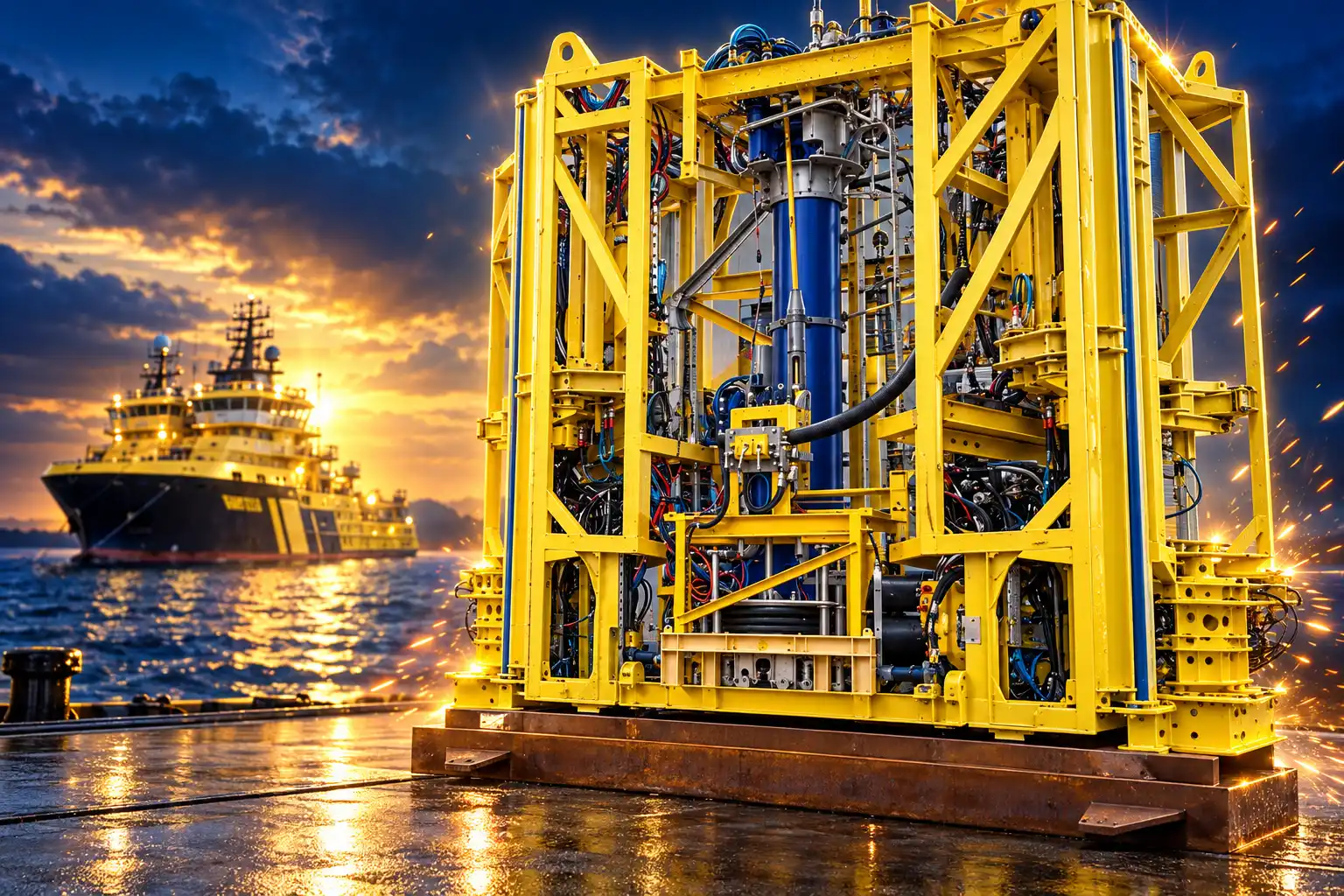
The Investment Bank Bought This Bet in 2025
The factory is new. The wager is not. In February 2025 the company closed a £9.2 million funding round led by the Scottish National Investment Bank, which put in £6.7 million, with Marubeni-Itochu Steel adding £2.5 million. The bank said that round was expected to support around 100 jobs over five years, a company-wide Scotland figure from 2025, not a second headcount on top of the around 80 now tied to Montrose.
The 2025 notice said the firm, then headquartered in Dublin with an Aberdeenshire office, would build a manufacturing facility “which will be announced soon.” Nineteen months later that site is Montrose. Robertson’s line at the time was the point of the cheque: make the anchors in Scotland and cut imports of a component floating wind cannot sail without.
Our plan to manufacture anchors in Scotland will help reduce import requirements for key offshore components and our technology will give further flexibility and reliability to developers by using smaller and more readily available vessels along with remote seabed drilling systems.
Derek Robertson, chief executive, Subsea Micropiles, February 2025
Laura Fidao, investment director at the bank, said easing bottlenecks in the renewable supply chain was part of delivering clean power and Scotland’s reputation in the sector. Then-Deputy First Minister Kate Forbes welcomed a commitment to build the plant in Scotland, arguing that as many of the parts for the country’s offshore wind build-out as possible should be made here.
FROM A BANK CHEQUE TO A FACTORY GATE
- October 2023: The Scottish Government says it will invest up to £500 million over five years in offshore wind ports and supply chain.
- February 2025: The Scottish National Investment Bank leads the £9.2 million round and says a Scottish manufacturing facility will be announced soon.
- March 2025: The company runs offshore anchor trials in Scapa Flow, Orkney, including Acoustic Zoom imaging during installation.
- 10 November 2025: It buys Acoustic Zoom’s imaging intellectual property to pair survey data with foundation design.
- 28 September 2026: Swinney visits Montrose, the factory spend is announced, SSE names the port for Berwick Bank B, and a Pentland work agreement is signed on site.
Marubeni-Itochu Steel’s presence in the cap table is easy to skip in a jobs story and harder to ignore in a hardware story. Makoto Ishitani, its president and chief executive, said the trader was investing in a firm it saw as a scalable industrial foundations name. Steel supply and factory throughput are the same problem seen from two desks.
What the Micropiles Do on the Seabed
Subsea Micropiles Ltd was set up in Ireland in 2017 to take a land method offshore. The company’s Lockheed Martin patent portfolio sits behind that shift: co-founders had led research there, co-funded by the U.S. Department of Energy, aimed at cheaper anchors for ocean energy. The firm later took that core intellectual property with it, worked with drilling partner Mincon International, and in 2022-23 logged a DNV Statement of Feasibility for a piled anchor.
Micropiles began onshore in 1950s Italy as “pale radice,” small piles that share load the way tree roots do. Offshore, the company installs groups of them through an anchor or foundation template using remote seabed drills rather than large driven piles. The sales pitch to developers is cost, noise and vessel size.
HOW THE ANCHOR SYSTEM IS BUILT TO RUN
- Shared load: Several small piles work together through a template, taking vertical and sideways loads in mixed soils.
- Remote drills: Subsea robots place the piles on the seabed so the job is less tied to a big surface spread.
- Smaller vessels: The bank and the company both say the method can use smaller, more available ships than driven piling.
- Lower noise: It is offered as a low-noise, low-vibration alternative to driven piles, with less acoustic disturbance for marine life.
- Site imaging: Acoustic Zoom is meant to sit between ordinary geophysical surveys and single-point geotechnical holes, mapping ground around the exact anchor location.
That last piece is not a brochure extra. Floating turbines live or die on the seabed they never touch, through mooring lines and anchors. Hard or mixed ground off Scotland is a known snag for standard drag-embedment or suction kit. A drill-in pile that can be made in volume, then installed from a modest vessel, is the industrial claim the Montrose floor is being asked to prove.
Seagreen, Inch Cape and Berwick Bank Already Share the Port
Montrose did not become a wind harbour on 28 September. SSE has used it as the operations base for Seagreen since vessel runs began in early 2022, after the base was finished in late 2021. The harbour authority lists Seagreen at 1,075 MW and 114 turbines, with about 80 full-time operational roles on the quay, including up to 60 Vestas staff, plus crew changes on the service vessel ESVAGT Brint every two to three weeks.
The Inch Cape operations and maintenance base is already in the ground on the South Quay. Construction started in September 2025 under Montrose contractor Pert Bruce Construction, with a 600 square metre warehouse, offices, dock cranes and a dedicated pontoon. Around 50 long-term jobs are planned, including technicians who will sit alongside Vestas under a 15-year contract. The 1.1 GW farm uses 72 Vestas 15 MW turbines. First power is due in late 2026, with commercial operation in 2027 and the base itself due early 2027.
Berwick Bank B is the new operations catch. SSE has named Montrose the preferred base for the 1.4 GW phase, with 100 full-time technician and engineer jobs over an expected life of more than 35 years, plus around 30 construction jobs while the port authority’s South Harbour offices are converted. The farm sits about 38 km off the east coast in the outer Firth of Forth and holds a 20-year Contract for Difference from the UK allocation round in January 2026. SSE is working toward a final investment decision in 2027.
MONTROSE PORT WIND WORKLOAD
| Project | Role at the port | Capacity | Jobs cited |
|---|---|---|---|
| Seagreen (SSE) | Operating O&M base since 2022 | 1,075 MW | About 80 full-time roles |
| Inch Cape (Red Rock / ESB) | O&M base under construction | 1.1 GW | Around 50 long-term jobs |
| Berwick Bank B (SSE) | Preferred O&M base, South Harbour | 1.4 GW | 100 full-time, 30 during conversion |
| Subsea Micropiles | Manufacturing and offshore expansion | Anchor and foundation parts | Around 80 jobs over three to five years |
If Berwick Bank’s A and C phases later win CfD support and reach final investment decisions, SSE has said Berwick-related full-time roles at Montrose could rise to almost 300. The full 4.1 GW scheme, the government says, could power more than six million UK homes. That is still a contingent pile of jobs, not a payroll.
Pentland Adds a Floating-Wind Customer Path
The factory announcement was the photocall. The customer path was signed in the same building. Subsea Micropiles said it strengthened its collaboration with Pentland Floating Offshore Wind Farm on 28 September at the Montrose facility, covering site investigations, anchor design and offshore installation, plus cyclic loading analysis. The deal also sets a framework to look at Copenhagen Offshore Partners’ wider international book.
Pentland is the test that matters for a drill-in anchor. The project, off Dounreay in Caithness, is being developed by Highland Wind Limited and is majority-owned by funds managed by Copenhagen Infrastructure Partners, with Copenhagen Offshore Partners running development. It won a Contract for Difference in January 2026, is heading for a 2027 final investment decision, and has operations expected to commence in 2030, with output put at enough electricity for up to 70,000 homes. Stiesdal’s TetraSub is the floating foundation. The Scottish National Investment Bank is also on that project, with up to £50 million alongside Great British Energy and the National Wealth Fund.
Robertson said floating offshore wind has to cut cost and manage risk, and that this means looking at the full picture, not a single widget. The Montrose floor is being asked to sit at the end of that picture: survey, design, steel, then installation. Pentland is a work agreement, not a published volume order for piles from the new hall.
The same bank that paid for the company’s Scottish expansion is now on both sides of a possible first floating job, as investor in the anchor firm and as a funder of the Caithness project. That is a tidy industrial-policy loop. It is also a concentration of public capital on one still-unproven production line.
The Factory Jobs Land on Top of Three Maintenance Bases
Add the two 28 September announcements and you get 180 roles on paper: around 80 at the factory over three to five years, and 100 at Berwick Bank B for more than 35 years. Seagreen’s about 80 and Inch Cape’s around 50 sit underneath that, already won. Stuart Hood, SSE Renewables’ director of offshore wind operations, said the Berwick choice reflected the port, its people and the local supply chain after years of working Seagreen from the same harbour.
The shape of the payroll is the second fact hiding under the ribbon. Most of those jobs are operations and maintenance. They last for decades, they follow CfD-backed farms, and they do not require Scotland to win the global fight to fabricate foundations. The around 80 factory jobs are the attempt to add a hardware layer, and they arrive slowly. A small firm is scaling a method that still has to be ordered in bulk.
The manufacturer is also not a Scottish corporate in the simple sense used on the visit. It was established in Ireland in 2017 and, at the 2025 round, was described by the bank as Dublin-headquartered. Westhill and Montrose are where it wants the work to sit. That split is not a smear; it is the structure the public money is underwriting. The 100 SSE jobs, meanwhile, exist because Berwick Bank B won a 20-year UK Contract for Difference paid through the GB power market. The skills pool is North Sea oil. The offtake is UK. The new claim is the steel.
High-Volume Output Still Waits on the Market
Robertson’s Montrose line was careful. He sees “significant potential” for high-volume production “as the market develops.” That is a factory funded ahead of a confirmed production rate. Floating wind in Scottish waters is still a handful of front-runner projects, not a conveyor of identical anchors. ScotWind’s leasing round created the political case for local manufacturing; the orders that fill a hall are a later event.
WHAT WE KNOW
- The spend: More than £5 million from the company over the next three years, plus the £1.45 million RSA grant, after the £6.7 million bank investment in 2025.
- The site: Expansion of an existing Montrose operations base, with engineering in Westhill, for anchor and foundation components and subsea kit used in survey and construction.
- The first floating path: A Pentland agreement on surveys, anchor design and installation, signed on 28 September 2026 at Montrose.
WHAT IS UNCONFIRMED
- Opening date: No public date has been set for when the new manufacturing floor starts turning out parts.
- Order book: No published volume contract ties Pentland, or any other farm, to a run-rate from Montrose.
- Job mix: The around 80 roles have no public breakdown by trade, wage or how many are already on site versus new hires.
Montrose now holds three maintenance franchises and a bet that piles can be made on the same water. The harbour already knows how to send technicians to Seagreen. The harder trick is to ship anchors out, at a price a floating farm will pay, before someone else’s yard industrialises the same small pile.

The BMW iX4 Undercuts Mercedes and Trails Its Twin

Scotland’s Ten Big Supermarkets Already Hold the Weekly Shop

Scotland EMS Faces a State Probe After a Wagram Death

Meritz Signs Ripple to Race Korea’s 2027 Token Rules

Pocognoli’s First Camp Leaves Scotland Third and Exposed

Volkswagen Sells the Osnabruck Plant to Clear a Board Fight

Tata Motors’ Iveco Tender Opens as Holders Still Decide

Saksham Gaur Finds He Is His Own Company’s Client

Onimusha Way of the Sword Preload Hits a Windows 11 Wall

Hyderabad 22-Carat Gold Jumps After a False Bargain
-
 AUTO1 month ago
Volkswagen Sells the Osnabruck Plant to Clear a Board Fight
-
 AUTO1 month ago
Tata Motors’ Iveco Tender Opens as Holders Still Decide
-
 BUSINESS1 month ago
Saksham Gaur Finds He Is His Own Company’s Client
-
 GAMING1 month ago
Onimusha Way of the Sword Preload Hits a Windows 11 Wall
-

 NEWS1 month ago
Apple’s Foldable iPhone Hinges on Samsung Display Supply
-

 NEWS1 month ago
The Frame Pro’s $1,200 Labor Day Cut Needs a Soundbar
-
 BUSINESS1 month ago
Hyderabad 22-Carat Gold Jumps After a False Bargain
-

 AUTO1 month ago
Simple Wave Chases Range as Ather Konarc Cuts Price